2004 CHEVROLET MALIBU wiring
[x] Cancel search: wiringPage 81 of 426
Lockout Protection
Lockout protection is intended to provide enhanced
security and convenience. This feature prevents
the driver’s door from being locked using the power
door locks. If the key is left in the ignition and a door is
open, pressing the power door lock switch will lock
all the doors and then unlock the driver’s door.
Pressing and holding down the power door lock switch
for more than three seconds or until the driver door
locks, will override this feature.
This feature cannot guarantee that you will never be
locked out of your vehicle. If you don’t leave the key in
the ignition, or if you use the manual door lock or
the remote keyless entry transmitter, you could still lock
your key inside your vehicle. Always remember to
take your key with you.
Leaving Your Vehicle
If you are leaving your vehicle, open your door and set
the locks from the inside, then get out and close the door.
Trunk
To unlock the trunk on the sedan manually from the
outside, insert the key and turn the trunk lock cylinder.
When closing the trunk, close from the center to
ensure it fully latches.
{CAUTION:
It can be dangerous to drive with the trunk lid
open because carbon monoxide (CO) gas can
come into your vehicle. You can not see or
smell CO. It can cause unconsciousness and
even death. If you must drive with the trunk lid
open or if electrical wiring or other cable
connections must pass through the seal
between the body and the trunk lid:
Make sure all other windows are shut.
Turn the fan on your heating or cooling
system to its highest speed and select the
control setting that will force outside air
into your vehicle. See Climate Control
System in the Index.
If you have air outlets on or under the
instrument panel, open them all the way.
SeeEngine Exhaust on page 2-33.
2-13
Page 83 of 426
Liftgate
To open the liftgate on the MAXX from the outside, use
the trunk button on the remote keyless entry transmitter
or the remote trunk release button, located on the
lower edge of the driver’s door.
Unlocking all doors using the power door unlock switch
or the remote keyless entry transmitter unlock button
will also unlock the liftgate. Locking all doors with
the power door lock switch or the remote keyless entry
transmitter lock button will also lock the liftgate.
You can also use the key in the driver’s door lock cylinder
to unlock and open the liftgate. Turn the driver’s door lock
cylinder toward the rear of the vehicle and back to the
center twice to unlock the liftgate. Turn the driver’s door
lock cylinder toward the rear of the vehicle and back to
the center three times to open the liftgate.
If the liftgate is unlocked, you can manually open it by
pushing on the touch pad switch located on the underside
of the liftgate trim panel, slightly to the right of center.
If none of these ways of opening the liftgate works, there
is a pull cable located under the body trim panel in
the liftgate area which will open it. This should be used
in case of emergency only, not for daily use.{CAUTION:
It can be dangerous to drive with the liftgate
open because carbon monoxide (CO) gas can
come into your vehicle. You can’t see or smell
CO. It can cause unconsciousness and even
death. If you must drive with the liftgate open
or if electrical wiring or other cable
connections must pass through the seal
between the body and the liftgate:
Make sure all other windows are shut.
Turn the fan on your heating or cooling
system to its highest speed and select the
control setting that will force outside air
into your vehicle. SeeClimate Control
System on page 3-21.
If you have air outlets on or under the
instrument panel, open them all the way.
SeeEngine Exhaust on page 2-33.
To close the liftgate, pull down on the openings, then
rmly shut the liftgate. Don’t drive with the liftgate open,
even slightly. SeeEngine Exhaust on page 2-33.
2-15
Page 150 of 426
Safety Belt Reminder Light
When the key is turned to ON, a chime will come
on for several seconds to remind people to fasten their
safety belts, unless the driver’s safety belt is already
buckled.
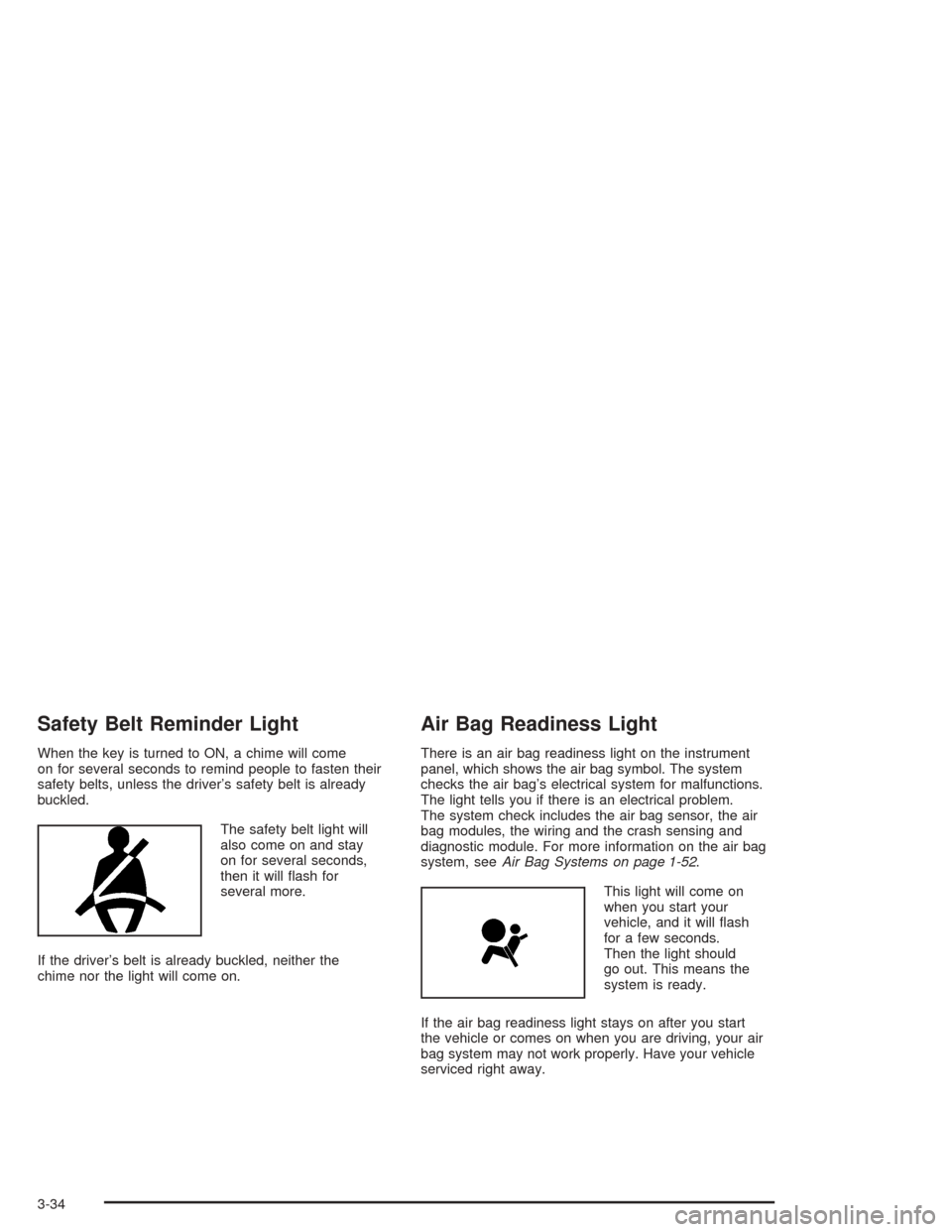
The safety belt light will
also come on and stay
on for several seconds,
then it will ash for
several more.
If the driver’s belt is already buckled, neither the
chime nor the light will come on.
Air Bag Readiness Light
There is an air bag readiness light on the instrument
panel, which shows the air bag symbol. The system
checks the air bag’s electrical system for malfunctions.
The light tells you if there is an electrical problem.
The system check includes the air bag sensor, the air
bag modules, the wiring and the crash sensing and
diagnostic module. For more information on the air bag
system, seeAir Bag Systems on page 1-52.
This light will come on
when you start your
vehicle, and it will ash
for a few seconds.
Then the light should
go out. This means the
system is ready.
If the air bag readiness light stays on after you start
the vehicle or comes on when you are driving, your air
bag system may not work properly. Have your vehicle
serviced right away.
3-34
Page 281 of 426
Making Turns
Notice:Making very sharp turns while trailering
could cause the trailer to come in contact with the
vehicle. Your vehicle could be damaged. Avoid
making very sharp turns while trailering.
When you’re turning with a trailer, make wider turns than
normal. Do this so your trailer won’t strike soft shoulders,
curbs, road signs, trees or other objects. Avoid jerky or
sudden maneuvers. Signal well in advance.
Turn Signals When Towing a Trailer
When you tow a trailer, your vehicle may need additional
wiring. Check with your dealer. The arrows on your
instrument panel will ash whenever you signal a turn or
lane change. Properly hooked up, the trailer lamps
will also ash, telling other drivers you’re about to turn,
change lanes or stop.
When towing a trailer, the arrows on your instrument
panel will ash for turns even if the bulbs on the trailer
are burned out. Thus, you may think drivers behind
you are seeing your signal when they are not. It’s
important to check occasionally to be sure the trailer
bulbs are still working.
Driving On Grades
Notice:Do not tow on steep continuous grades
exceeding 6 miles (9.6 km). Extended, higher
than normal engine and transaxle temperatures may
result and damage your vehicle. Frequent stops
are very important to allow the engine and transaxle
to cool.
Reduce speed and shift to a lower gearbeforeyou start
down a long or steep downgrade. If you don’t shift
down, you might have to use your brakes so much that
they would get hot and no longer work well.
Pay attention to the engine coolant gage. If the indicator
is in the red area, turn off the air conditioning to reduce
engine load. SeeEngine Overheating on page 5-27.
4-45
Page 284 of 426
Appearance Care............................................5-78
Cleaning the Inside of Your Vehicle.................5-78
Care of Safety Belts......................................5-81
Weatherstrips...............................................5-81
Cleaning the Outside of Your Vehicle..............5-81
Sheet Metal Damage.....................................5-83
Finish Damage.............................................5-83
Underbody Maintenance................................5-84
Chemical Paint Spotting.................................5-84
Vehicle Care/Appearance Materials..................5-84Vehicle Identication......................................5-86
Vehicle Identication Number (VIN).................5-86
Service Parts Identication Label.....................5-86
Electrical System............................................5-87
Add-On Electrical Equipment..........................5-87
Headlamp Wiring..........................................5-87
Windshield Wiper Fuses................................5-87
Power Windows and Other Power Options.......5-87
Fuses.........................................................5-88
Capacities and Specications..........................5-96
Section 5 Service and Appearance Care
5-2
Page 328 of 426
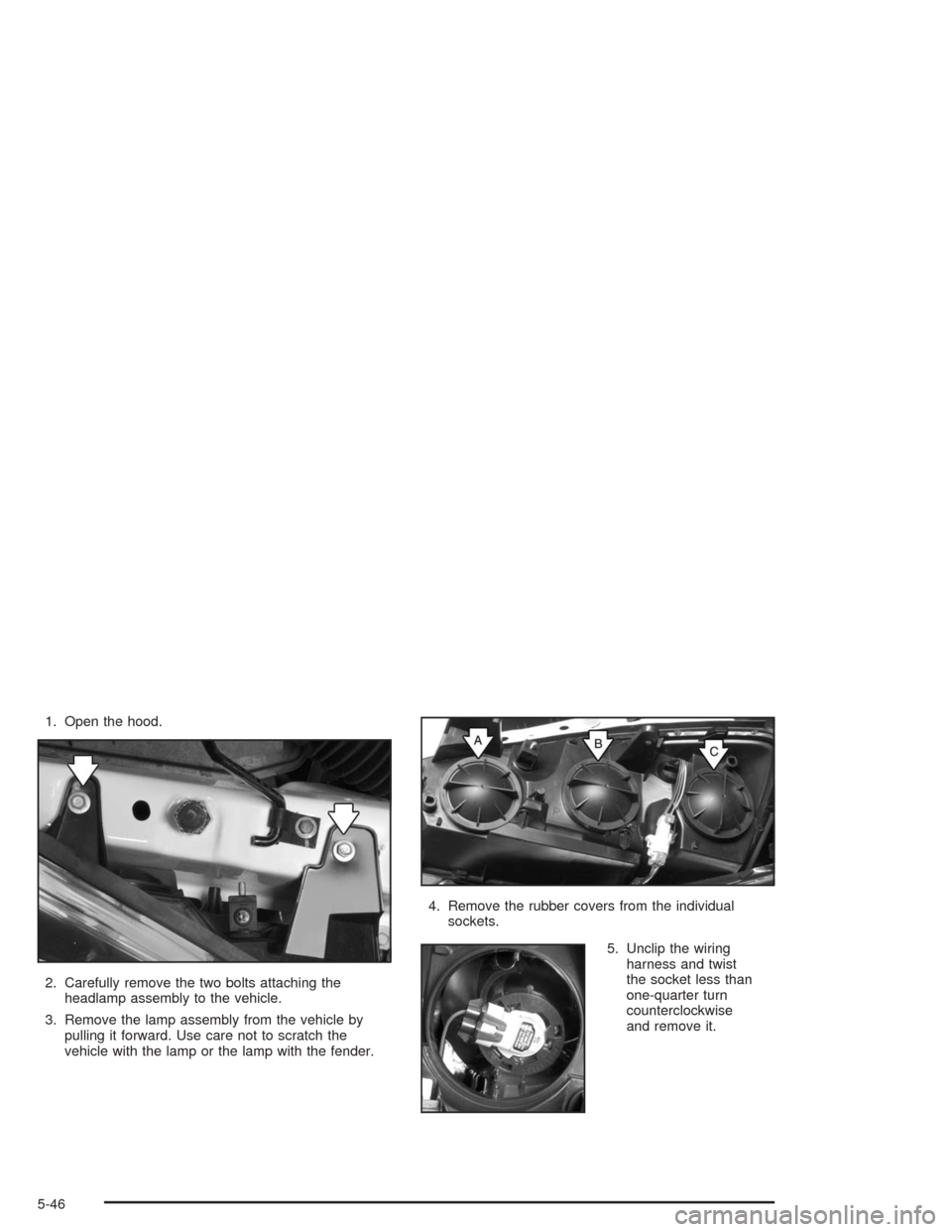
1. Open the hood.
2. Carefully remove the two bolts attaching the
headlamp assembly to the vehicle.
3. Remove the lamp assembly from the vehicle by
pulling it forward. Use care not to scratch the
vehicle with the lamp or the lamp with the fender.4. Remove the rubber covers from the individual
sockets.
5. Unclip the wiring
harness and twist
the socket less than
one-quarter turn
counterclockwise
and remove it.
5-46
Page 329 of 426
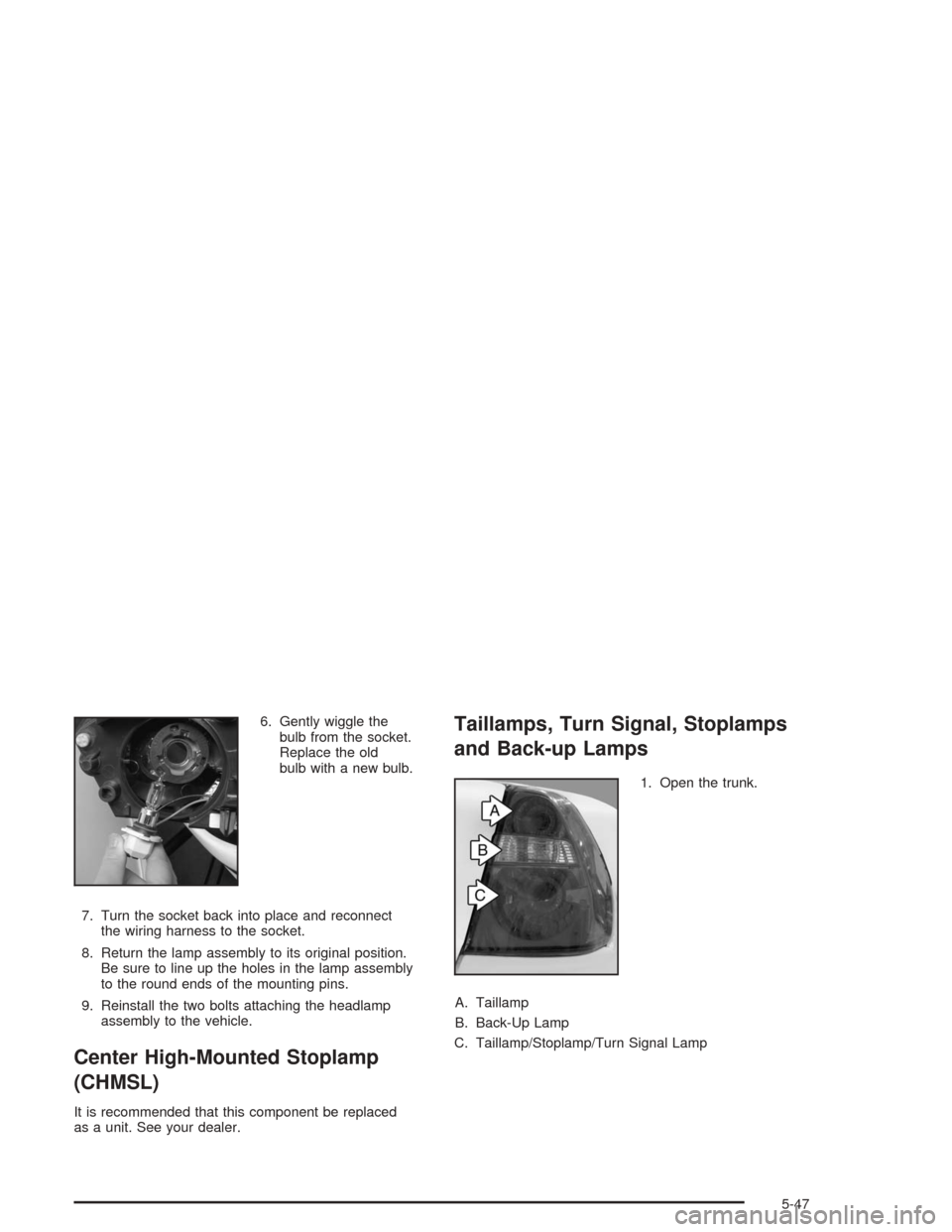
6. Gently wiggle the
bulb from the socket.
Replace the old
bulb with a new bulb.
7. Turn the socket back into place and reconnect
the wiring harness to the socket.
8. Return the lamp assembly to its original position.
Be sure to line up the holes in the lamp assembly
to the round ends of the mounting pins.
9. Reinstall the two bolts attaching the headlamp
assembly to the vehicle.
Center High-Mounted Stoplamp
(CHMSL)
It is recommended that this component be replaced
as a unit. See your dealer.
Taillamps, Turn Signal, Stoplamps
and Back-up Lamps
1. Open the trunk.
A. Taillamp
B. Back-Up Lamp
C. Taillamp/Stoplamp/Turn Signal Lamp
5-47
Page 369 of 426
Electrical System
Add-On Electrical Equipment
Notice:Don’t add anything electrical to your
vehicle unless you check with your dealer rst. Some
electrical equipment can damage your vehicle and
the damage wouldn’t be covered by your warranty.
Some add-on electrical equipment can keep other
components from working as they should.
Your vehicle has an air bag system. Before attempting
to add anything electrical to your vehicle, seeServicing
Your Air Bag-Equipped Vehicle on page 1-60.
Headlamp Wiring
The headlamp wiring is protected by fuses, one for
each headlamp, in the fuse block. An electrical overload
will cause the lamps to turn off. If this happens, have
your headlamp wiring checked right away.
Windshield Wiper Fuses
The windshield wiper motor is protected by an internal
circuit breaker and a fuse. If the motor overheats due
to heavy snow, etc., the wiper will stop until the
motor cools. If the overload is caused by some electrical
problem and not snow, etc., be sure to get it xed.
Power Windows and Other Power
Options
Fuses in the fuse block protect the power windows
and other power accessories. When the current load is
too heavy, the fuse opens protecting the circuit until
the problem is xed or goes away.
5-87