2004 CHEVROLET MALIBU radiator cap
[x] Cancel search: radiator capPage 307 of 426
If you have to add coolant more than four times a year,
have your dealer check your cooling system.
Notice:If you use the proper coolant, you do not
have to add extra inhibitors or additives which claim
to improve the system. These can be harmful.
Checking Coolant
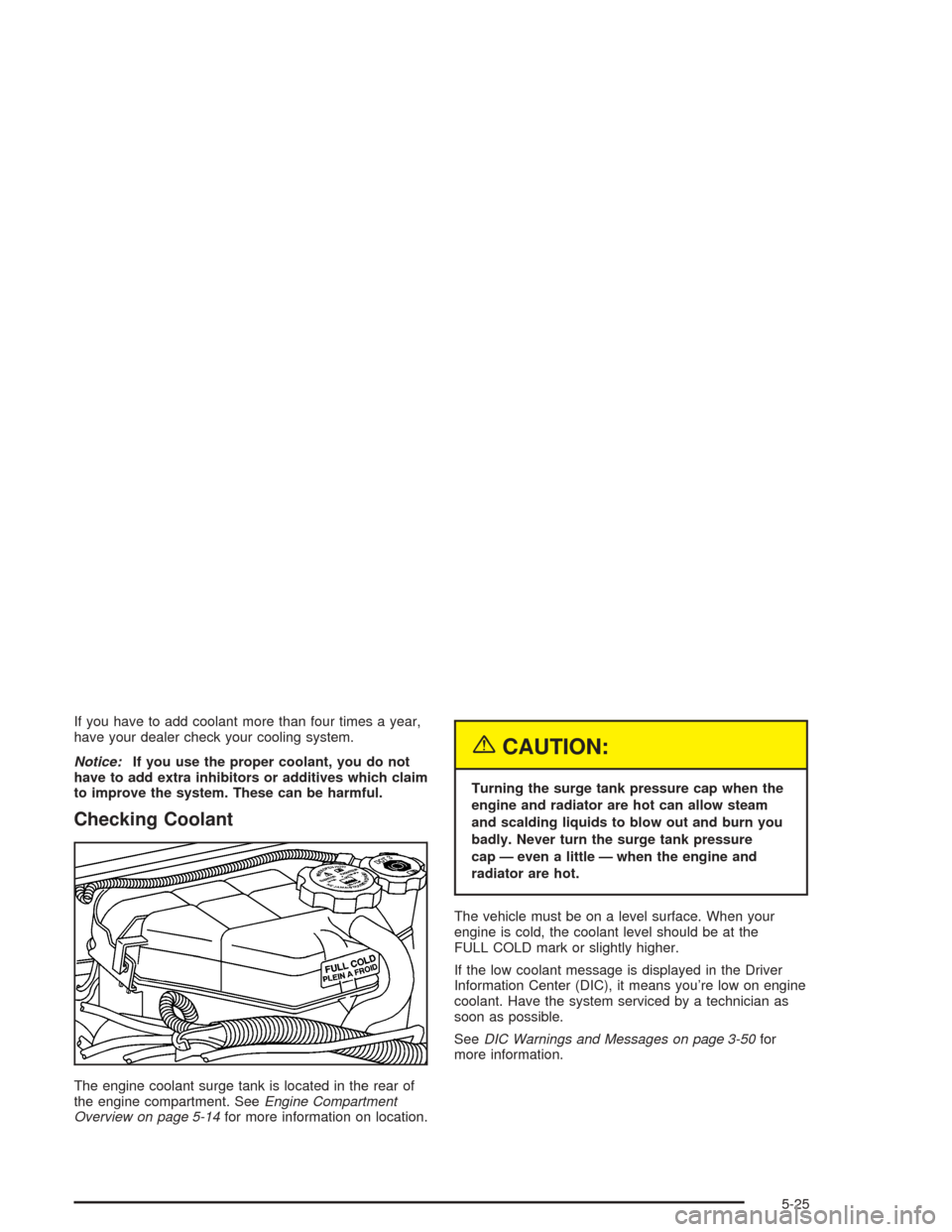
The engine coolant surge tank is located in the rear of
the engine compartment. SeeEngine Compartment
Overview on page 5-14for more information on location.
{CAUTION:
Turning the surge tank pressure cap when the
engine and radiator are hot can allow steam
and scalding liquids to blow out and burn you
badly. Never turn the surge tank pressure
cap — even a little — when the engine and
radiator are hot.
The vehicle must be on a level surface. When your
engine is cold, the coolant level should be at the
FULL COLD mark or slightly higher.
If the low coolant message is displayed in the Driver
Information Center (DIC), it means you’re low on engine
coolant. Have the system serviced by a technician as
soon as possible.
SeeDIC Warnings and Messages on page 3-50for
more information.
5-25
Page 312 of 426
The coolant level should be at or above the FULL COLD
mark. If it isn’t, you may have a leak at the pressure cap
or in the radiator hoses, heater hoses, radiator, water
pump or somewhere else in the cooling system.
{CAUTION:
Heater and radiator hoses, and other engine
parts, can be very hot. Do not touch them.
If you do, you can be burned.
Do not run the engine if there is a leak.
If you run the engine, it could lose all coolant.
That could cause an engine re, and you could
be burned. Get any leak xed before you drive
the vehicle.
If there seems to be no leak, with the engine on, check
to see if the electric engine cooling fans are running.
If the engine is overheating, both fans should be
running. If they aren’t, your vehicle needs service.
Notice:Engine damage from running your engine
without coolant is not covered by your warrany.Notice:Using coolant other than DEX-COOL
®may
cause premature engine, heater core or radiator
corrosion. In addition, the engine coolant may
require changing sooner, at 30,000 miles (50 000 km)
or 24 months, whichever occurs rst. Any repairs
would not be covered by your warranty. Always use
DEX-COOL
®(silicate-free) coolant in your vehicle.
How to Add Coolant to the Coolant
Surge Tank
Notice:This vehicle has a specic coolant ll
procedure. Failure to follow this procedure could
cause your engine to overheat and be severely
damaged.
If you haven’t found a problem yet, check to see if coolant
is visible in the surge tank. If coolant is visible but the
coolant level isn’t at or above the FULL COLD mark,
add a 50/50 mixture ofclean, drinkable waterand
DEX-COOL
®coolant at the coolant surge tank, but be
sure the cooling system, including the coolant surge tank
pressure cap, is cool before you do it. SeeEngine
Coolant on page 5-24for more information.
5-30
Page 314 of 426
{CAUTION:
Adding only plain water to your cooling system
can be dangerous. Plain water, or some other
liquid such as alcohol, can boil before the
proper coolant mixture will. Your vehicle’s
coolant warning system is set for the proper
coolant mixture. With plain water or the wrong
mixture, your engine could get too hot but
you would not get the overheat warning.
Your engine could catch re and you or others
could be burned. Use a 50/50 mixture of clean,
drinkable water and DEX-COOL
®coolant.
Notice:In cold weather, water can freeze and
crack the engine, radiator, heater core and other
parts. Use the recommended coolant and the
proper coolant mixture.
{CAUTION:
You can be burned if you spill coolant on
hot engine parts. Coolant contains ethylene
glycol and it will burn if the engine parts are
hot enough. Do not spill coolant on a hot
engine.
1. Park the vehicle on a level surface.
You can remove the coolant surge tank pressure
cap when the cooling system, including the coolant
surge tank pressure cap and upper radiator hose,
is no longer hot. Turn the pressure cap slowly
counterclockwise (left) about two or two and one-half
turns. If you hear a hiss, wait for that to stop. This will
allow any pressure still left to be vented out the
discharge hose.
5-32
Page 315 of 426
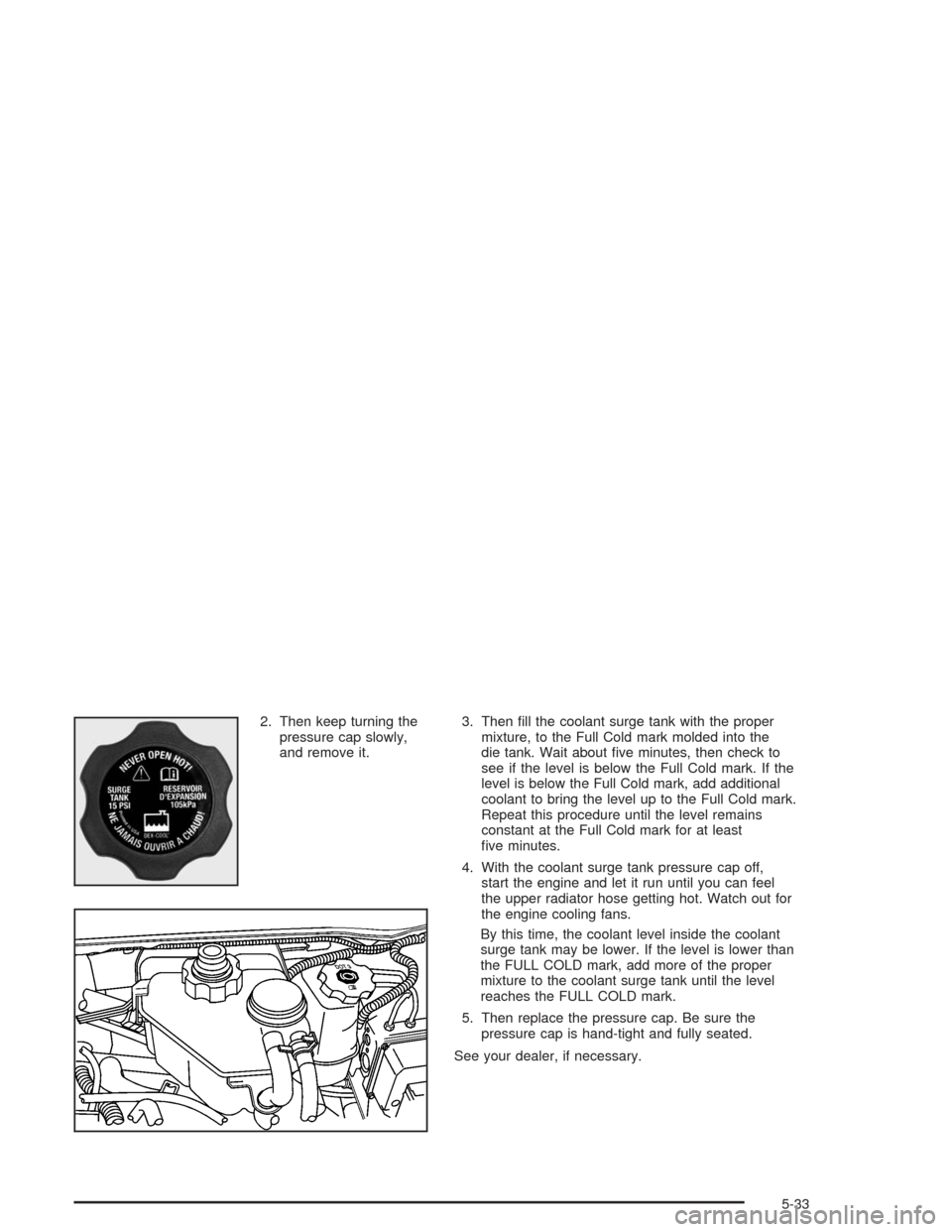
2. Then keep turning the
pressure cap slowly,
and remove it.3. Then ll the coolant surge tank with the proper
mixture, to the Full Cold mark molded into the
die tank. Wait about ve minutes, then check to
see if the level is below the Full Cold mark. If the
level is below the Full Cold mark, add additional
coolant to bring the level up to the Full Cold mark.
Repeat this procedure until the level remains
constant at the Full Cold mark for at least
ve minutes.
4. With the coolant surge tank pressure cap off,
start the engine and let it run until you can feel
the upper radiator hose getting hot. Watch out for
the engine cooling fans.
By this time, the coolant level inside the coolant
surge tank may be lower. If the level is lower than
the FULL COLD mark, add more of the proper
mixture to the coolant surge tank until the level
reaches the FULL COLD mark.
5. Then replace the pressure cap. Be sure the
pressure cap is hand-tight and fully seated.
See your dealer, if necessary.
5-33
Page 385 of 426
Maintenance Footnotes
†The U.S. Environmental Protection Agency or the
California Air Resources Board has determined that the
failure to perform this maintenance item will not nullify
the emission warranty or limit recall liability prior to
the completion of the vehicle’s useful life. We, however,
urge that all recommended maintenance services be
performed at the indicated intervals and the
maintenance be recorded.
(a)Visually inspect brake lines and hoses for proper
hook-up, binding, leaks, cracks, chang, etc. Inspect
disc brake pads for wear and rotors for surface
condition. Inspect other brake parts, including calipers,
parking brake, etc.
(b)Visually inspect front and rear suspension and
steering system for damaged, loose or missing parts or
signs of wear. Inspect power steering lines and
hoses for proper hook-up, binding, leaks, cracks,
chang, etc.(c)Visually inspect hoses and have them replaced if they
are cracked, swollen or deteriorated. Inspect all pipes,
ttings and clamps; replace with genuine GM parts as
needed. To help ensure proper operation, a pressure test
of the cooling system and pressure cap and cleaning the
outside of the radiator and air conditioning condenser is
recommended at least once a year.
(d)Visually inspect wiper blades for wear or cracking.
Replace blade inserts that appear worn or damaged
or that streak or miss areas of the windshield.
(e)Make sure the safety belt reminder light and all your
belts, buckles, latch plates, retractors and anchorages
are working properly. Look for any other loose or
damaged safety belt system parts. If you see anything
that might keep a safety belt system from doing its
job, have it repaired. Have any torn or frayed safety belts
replaced. Also look for any opened or broken air bag
coverings, and have them repaired or replaced. (The air
bag system does not need regular maintenance.)
6-7
Page 386 of 426
(f)Lubricate all key lock cylinders, door hinges and
latches, hood hinges and latches and trunk lid hinges
and latches. More frequent lubrication may be required
when exposed to a corrosive environment. Applying
silicone grease on weatherstrips with a clean cloth will
make them last longer, seal better and not stick or
squeak.
(g)Check system for interference or binding and for
damaged or missing parts. Replace parts as needed.
Replace any components that have high effort or
excessive wear. Do not lubricate accelerator or cruise
control cables.
(h)Change automatic transaxle uid and lter if the
vehicle is mainly driven under one or more of these
conditions:
In heavy city traffic where the outside temperature
regularly reaches 90°F (32°C) or higher.
In hilly or mountainous terrain.
When doing frequent trailer towing.
Uses such as found in taxi, police or delivery
service.If you do not use your vehicle under any of these
conditions, the uid and lter do not require changing.
(i)Drain, ush and rell cooling system. See Engine
Coolant on page 5-24for what to use. Inspect hoses.
Clean radiator, condenser, pressure cap and ller neck.
Pressure test the cooling system and pressure cap.
(j)A uid loss in any vehicle system could indicate a
problem. Have the system inspected and repaired and
the uid level checked. Add uid if needed.
6-8