2004 CHEVROLET MALIBU key
[x] Cancel search: keyPage 386 of 426
(f)Lubricate all key lock cylinders, door hinges and
latches, hood hinges and latches and trunk lid hinges
and latches. More frequent lubrication may be required
when exposed to a corrosive environment. Applying
silicone grease on weatherstrips with a clean cloth will
make them last longer, seal better and not stick or
squeak.
(g)Check system for interference or binding and for
damaged or missing parts. Replace parts as needed.
Replace any components that have high effort or
excessive wear. Do not lubricate accelerator or cruise
control cables.
(h)Change automatic transaxle uid and lter if the
vehicle is mainly driven under one or more of these
conditions:
In heavy city traffic where the outside temperature
regularly reaches 90°F (32°C) or higher.
In hilly or mountainous terrain.
When doing frequent trailer towing.
Uses such as found in taxi, police or delivery
service.If you do not use your vehicle under any of these
conditions, the uid and lter do not require changing.
(i)Drain, ush and rell cooling system. See Engine
Coolant on page 5-24for what to use. Inspect hoses.
Clean radiator, condenser, pressure cap and ller neck.
Pressure test the cooling system and pressure cap.
(j)A uid loss in any vehicle system could indicate a
problem. Have the system inspected and repaired and
the uid level checked. Add uid if needed.
6-8
Page 388 of 426
At Least Once a Year
Starter Switch Check
{CAUTION:
When you are doing this inspection, the
vehicle could move suddenly. If the vehicle
moves, you or others could be injured.
1. Before you start, be sure you have enough room
around the vehicle.
2. Firmly apply both the parking brake and the regular
brake. SeeParking Brake on page 2-29if necessary.
Do not use the accelerator pedal, and be ready to
turn off the engine immediately if it starts.
3. Try to start the engine in each gear. The starter
should work only in PARK (P) or NEUTRAL (N).
If the starter works in any other position, contact
your GM Goodwrench dealer for service.
Automatic Transaxle Shift Lock Control
System Check
{CAUTION:
When you are doing this inspection, the
vehicle could move suddenly. If the vehicle
moves, you or others could be injured.
1. Before you start, be sure you have enough room
around the vehicle. It should be parked on a level
surface.
2. Firmly apply the parking brake. SeeParking Brake
on page 2-29if necessary.
Be ready to apply the regular brake immediately if
the vehicle begins to move.
3. With the engine off, turn the key to the ON position,
but do not start the engine. Without applying the
regular brake, try to move the shift lever out
of PARK (P) with normal effort. If the shift lever
moves out of PARK (P), contact your GM
Goodwrench dealer for service.
6-10
Page 389 of 426
Ignition Transaxle Lock Check
While parked, and with the parking brake set, try to turn
the ignition key to OFF in each shift lever position.
The key should turn to OFF only when the shift lever
is in PARK (P).
The key should come out only in OFF.
Contact your GM Goodwrench dealer if service is
required.
Parking Brake and Automatic Transaxle
Park (P) Mechanism Check
{CAUTION:
When you are doing this check, your vehicle
could begin to move. You or others could be
injured and property could be damaged. Make
sure there is room in front of your vehicle in
case it begins to roll. Be ready to apply the
regular brake at once should the vehicle begin
to move.Park on a fairly steep hill, with the vehicle facing
downhill. Keeping your foot on the regular brake, set the
parking brake.
To check the parking brake’s holding ability: With
the engine running and transaxle in NEUTRAL (N),
slowly remove foot pressure from the regular
brake pedal. Do this until the vehicle is held by the
parking brake only.
To check the PARK (P) mechanism’s holding ability:
With the engine running, shift to PARK (P). Then
release the parking brake followed by the regular
brake.
Contact your GM Goodwrench dealer if service is
required.
Underbody Flushing Service
At least every spring, use plain water to ush any
corrosive materials from the underbody. Take care to
clean thoroughly any areas where mud and other debris
can collect.
6-11
Page 390 of 426
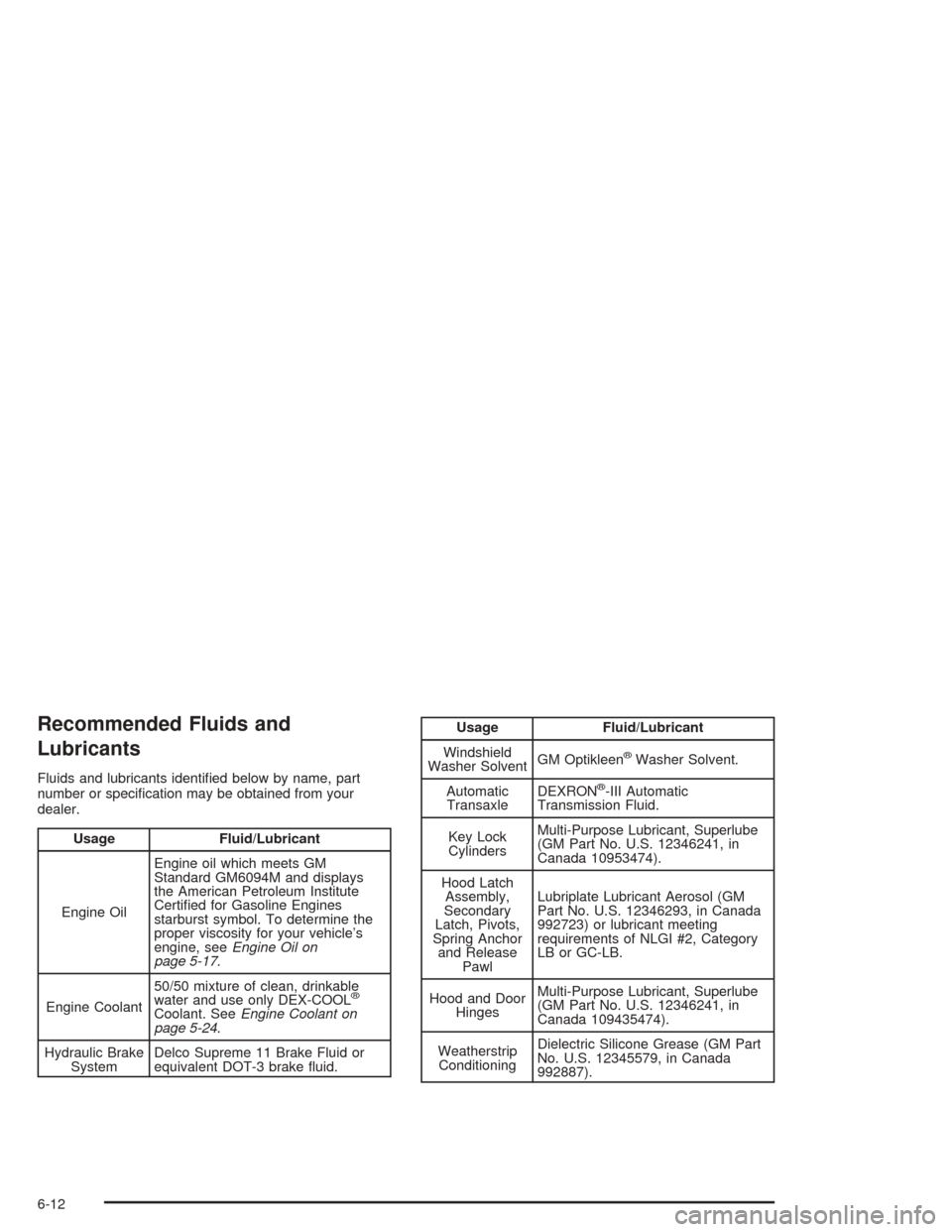
Recommended Fluids and
Lubricants
Fluids and lubricants identied below by name, part
number or specication may be obtained from your
dealer.
Usage Fluid/Lubricant
Engine OilEngine oil which meets GM
Standard GM6094M and displays
the American Petroleum Institute
Certied for Gasoline Engines
starburst symbol. To determine the
proper viscosity for your vehicle’s
engine, seeEngine Oil on
page 5-17.
Engine Coolant50/50 mixture of clean, drinkable
water and use only DEX-COOL
®
Coolant. SeeEngine Coolant on
page 5-24.
Hydraulic Brake
SystemDelco Supreme 11 Brake Fluid or
equivalent DOT-3 brake uid.
Usage Fluid/Lubricant
Windshield
Washer SolventGM Optikleen
®Washer Solvent.
Automatic
TransaxleDEXRON
®-III Automatic
Transmission Fluid.
Key Lock
CylindersMulti-Purpose Lubricant, Superlube
(GM Part No. U.S. 12346241, in
Canada 10953474).
Hood Latch
Assembly,
Secondary
Latch, Pivots,
Spring Anchor
and Release
PawlLubriplate Lubricant Aerosol (GM
Part No. U.S. 12346293, in Canada
992723) or lubricant meeting
requirements of NLGI #2, Category
LB or GC-LB.
Hood and Door
HingesMulti-Purpose Lubricant, Superlube
(GM Part No. U.S. 12346241, in
Canada 109435474).
Weatherstrip
ConditioningDielectric Silicone Grease (GM Part
No. U.S. 12345579, in Canada
992887).
6-12
Page 402 of 426
GM Mobility Program for Persons
with Disabilities
This program, available to
qualied applicants, can
reimburse you up to $1,000
toward eligible aftermarket
driver or passenger
adaptive equipment you
may require for your vehicle
(hand controls, wheelchair/
scooter lifts, etc.).
This program can also provide you with free resource
information, such as area driver assessment centers and
mobility equipment installers. The offer is available for
a limited period of time from the date of vehicle
purchase/lease. For more details, or to determine your
vehicle’s eligibility, see your GM dealer or call the
GM Mobility Assistance Center at 1-800-323-9935. Text
telephone (TTY) users, call 1-800-833-9935.
GM of Canada also has a Mobility Program. Call
1-800-GM-DRIVE (463-7483) for details. All TTY users
call 1-800-263-3830.
Roadside Assistance Program
Security While You Travel
1-800-CHEV-USA (243-8872)
As the proud owner of a new Chevrolet vehicle, you are
automatically enrolled in the Chevrolet Roadside
Assistance program. This value-added service is
intended to provide you with peace of mind as you drive
in the city or travel the open road. Chevrolet’s Roadside
Assistance toll-free number is staffed by courteous
and capable Roadside Assistance Representatives who
are available 24 hours a day, 365 days a year.
We will provide the following services during the
Bumper-to-Bumper warranty period, at no expense
to you:
Fuel Delivery:Delivery of enough fuel ($5
maximum) for the customer to get to the nearest
service station.
Lock-out Service (identication required):
Replacement keys or locksmith service will
be covered at no charge if you are unable to gain
entry into your vehicle. Delivery of the replacement
key will be covered within 10 miles.
7-6
Page 418 of 426
Instrument Panel
Cluster.......................................................3-32
Overview..................................................... 3-4
Instrument Panel Brightness.............................3-19
Instrument Panel Fuse Block............................5-89
Interior Lamps................................................3-19
J
Jump Starting.................................................5-39
K
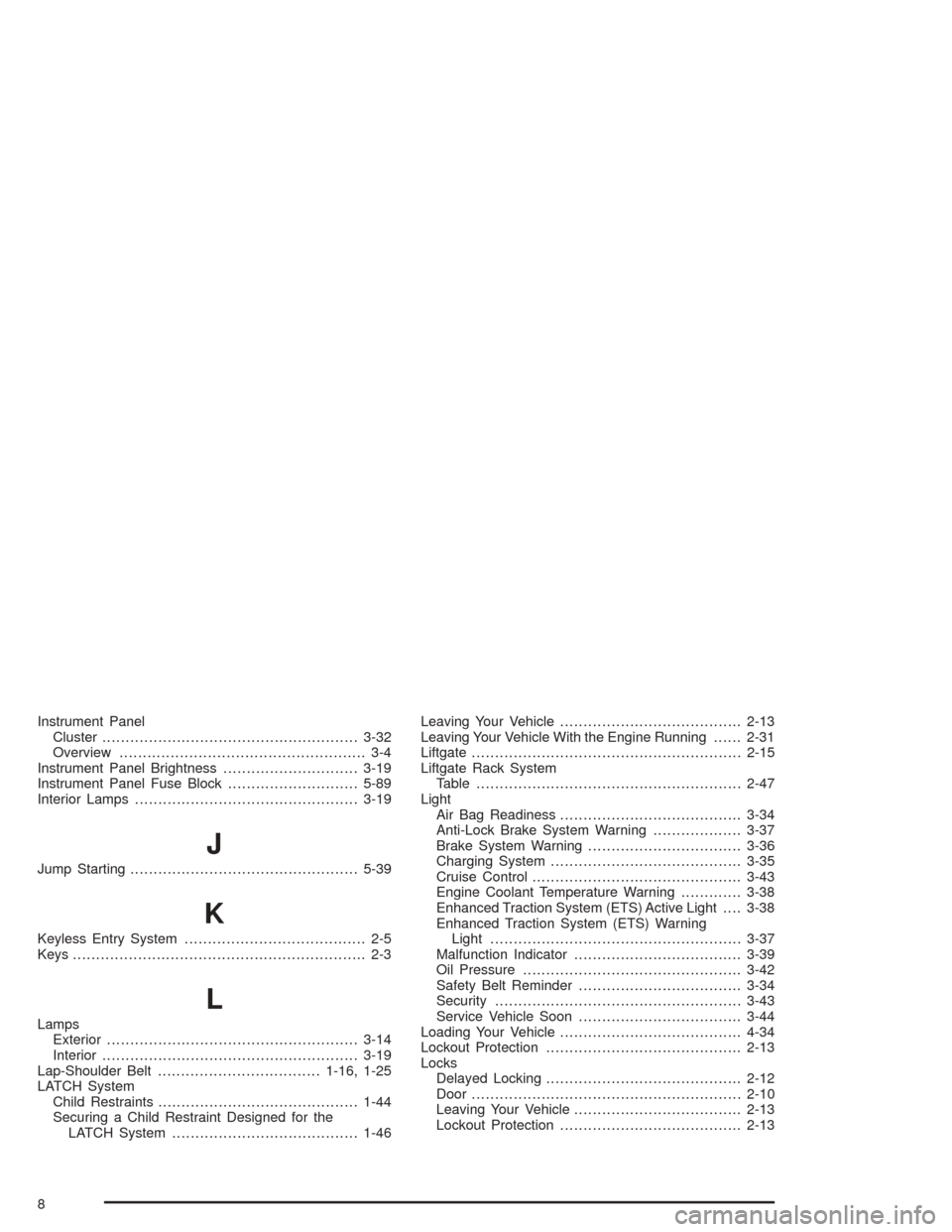
Keyless Entry System....................................... 2-5
Keys............................................................... 2-3
L
Lamps
Exterior......................................................3-14
Interior.......................................................3-19
Lap-Shoulder Belt...................................1-16, 1-25
LATCH System
Child Restraints...........................................1-44
Securing a Child Restraint Designed for the
LATCH System........................................1-46Leaving Your Vehicle.......................................2-13
Leaving Your Vehicle With the Engine Running......2-31
Liftgate..........................................................2-15
Liftgate Rack System
Table.........................................................2-47
Light
Air Bag Readiness.......................................3-34
Anti-Lock Brake System Warning...................3-37
Brake System Warning.................................3-36
Charging System.........................................3-35
Cruise Control.............................................3-43
Engine Coolant Temperature Warning.............3-38
Enhanced Traction System (ETS) Active Light....3-38
Enhanced Traction System (ETS) Warning
Light......................................................3-37
Malfunction Indicator....................................3-39
Oil Pressure...............................................3-42
Safety Belt Reminder...................................3-34
Security.....................................................3-43
Service Vehicle Soon...................................3-44
Loading Your Vehicle.......................................4-34
Lockout Protection..........................................2-13
Locks
Delayed Locking..........................................2-12
Door..........................................................2-10
Leaving Your Vehicle....................................2-13
Lockout Protection.......................................2-13
8
Page 420 of 426
O
Odometer......................................................3-33
Off-Road Recovery..........................................4-13
Oil
Engine.......................................................5-17
Pressure Light.............................................3-42
Older Children, Restraints................................1-31
Online Owner Center........................................ 7-4
OnStar
®Personal Calling.................................2-39
OnStar®Services............................................2-38
OnStar®System.............................................2-38
Operation......................................................3-21
Operation Tips................................................3-30
Other Warning Devices...................................... 3-7
Outlet Adjustment............................................3-30
Outside
Convex Mirror.............................................2-37
Power Heated Mirrors..................................2-37
Power Mirrors.............................................2-37
Overseas – Customer Assistance........................ 7-5
Owner Checks and Services.............................. 6-9
Owners, Canadian............................................... ii
Owner’s Information........................................7-13
P
Parental Control..............................................3-96
Park (P)
Shifting Into................................................2-30Park (P) (cont.)
Shifting Out of............................................2-32
Parking
Brake........................................................2-29
Over Things That Burn.................................2-32
Parking on Hills..............................................4-46
Passing.................................................4-13, 4-44
PASS-Key
®III+..............................................2-20
PASS-Key®III+ Operation................................2-20
Personalization...............................................3-47
Plan Ahead When Possible................................ 7-8
Playing a Cassette Tape..................................3-78
Playing a CD.........................3-56, 3-67, 3-80, 3-91
Playing a Specic Loaded CD..........................3-92
Playing the Radio...................3-53, 3-59, 3-70, 3-83
Power............................................................. 1-3
Accessory Outlets........................................3-20
Door Locks.................................................2-11
Electrical System.........................................5-87
Windows....................................................2-17
Power Lift Seat................................................ 1-2
Power Steering...............................................4-11
Pretensioners, Safety Belt................................1-30
Primary Radio Controls..................................3-111
Programmable Automatic Door Locks.................2-12
Programming the HomeLink
®Transmitter...........2-41
10
Page 421 of 426
Q
Questions and Answers About Safety Belts.........1-14
R
Radio Data System (RDS)...............3-58, 3-69, 3-82
Radio Messages.....................3-56, 3-64, 3-75, 3-88
Radios..........................................................3-52
Care of Your Cassette Tape Player...............3-117
Care of Your CD and DVD Player................3-118
Care of Your CDs and DVDs.......................3-118
Radio with Cassette and CD.........................3-69
Radio with CD....................................3-53, 3-58
Radio with Six-Disc CD................................3-82
Rear Seat Audio..............................3-111, 3-113
Setting the Time for Radios with Radio Data
Systems (RDS)........................................3-53
Setting the Time for Radios without Radio
Data Systems (RDS)................................3-52
Theft-Deterrent..........................................3-115
Understanding Reception............................3-116
RDS Messages..............................3-63, 3-74, 3-87
Rear Compartment Fuse Block.........................5-93
Rear Reading Lamps......................................3-19
Rear Safety Belt Comfort Guides......................1-28
Rear Seat Audio Controls...............................3-114Rear Seat Audio (RSA)........................3-111, 3-113
Rear Seat Entertainment System.......................3-96
Rear Seat Operation......................................... 1-7
Rear Seat Passengers, Safety Belts..................1-24
Rear Seat Radio Controls...............................3-112
Rear Sliding Seat (MAXX Only).......................... 1-9
Rear Window Defogger............................3-25, 3-29
Rearview Mirror, Automatic Dimming..................2-35
Rearview Mirror, Automatic Dimming with
OnStar
®.....................................................2-36
Rearview Mirror with OnStar®...........................2-35
Rearview Mirrors.............................................2-35
Reclining Seatbacks.......................................... 1-4
Recommended Fluids and Lubricants.................6-12
Recreational Vehicle Towing.............................4-31
Remote Control.............................................3-103
Remote Keyless Entry System............................ 2-5
Remote Keyless Entry System, Operation............ 2-6
Remote Trunk/Liftgate Release.........................2-14
Remote Vehicle Start........................................ 2-9
Removing the Flat Tire and Installing the
Spare Tire..................................................5-69
Removing the Spare Tire and Tools...................5-67
Replacement Bulbs.........................................5-49
Replacing Brake System Parts..........................5-38
Replacing Restraint System Parts After
a Crash.....................................................1-61
11