Page 224 of 406
Highway Hypnosis
Is there actually such a condition as “highway
hypnosis”? Or is it just plain falling asleep at the wheel?
Call it highway hypnosis, lack of awareness, or
whatever.
There is something about an easy stretch of road with
the same scenery, along with the hum of the tires on the
road, the drone of the engine, and the rush of the
wind against the vehicle that can make you sleepy.
Do not let it happen to you! If it does, your vehicle can
leave the road inless than a second,and you could
crash and be injured.What can you do about highway hypnosis? First, be
aware that it can happen.
Then here are some tips:
Make sure your vehicle is well ventilated, with a
comfortably cool interior.
Keep your eyes moving. Scan the road ahead and
to the sides. Check your mirrors and your
instruments frequently.
If you get sleepy, pull off the road into a rest,
service or parking area and take a nap, get some
exercise, or both. For safety, treat drowsiness
on the highway as an emergency.
4-24
Page 228 of 406
Driving on Snow or Ice
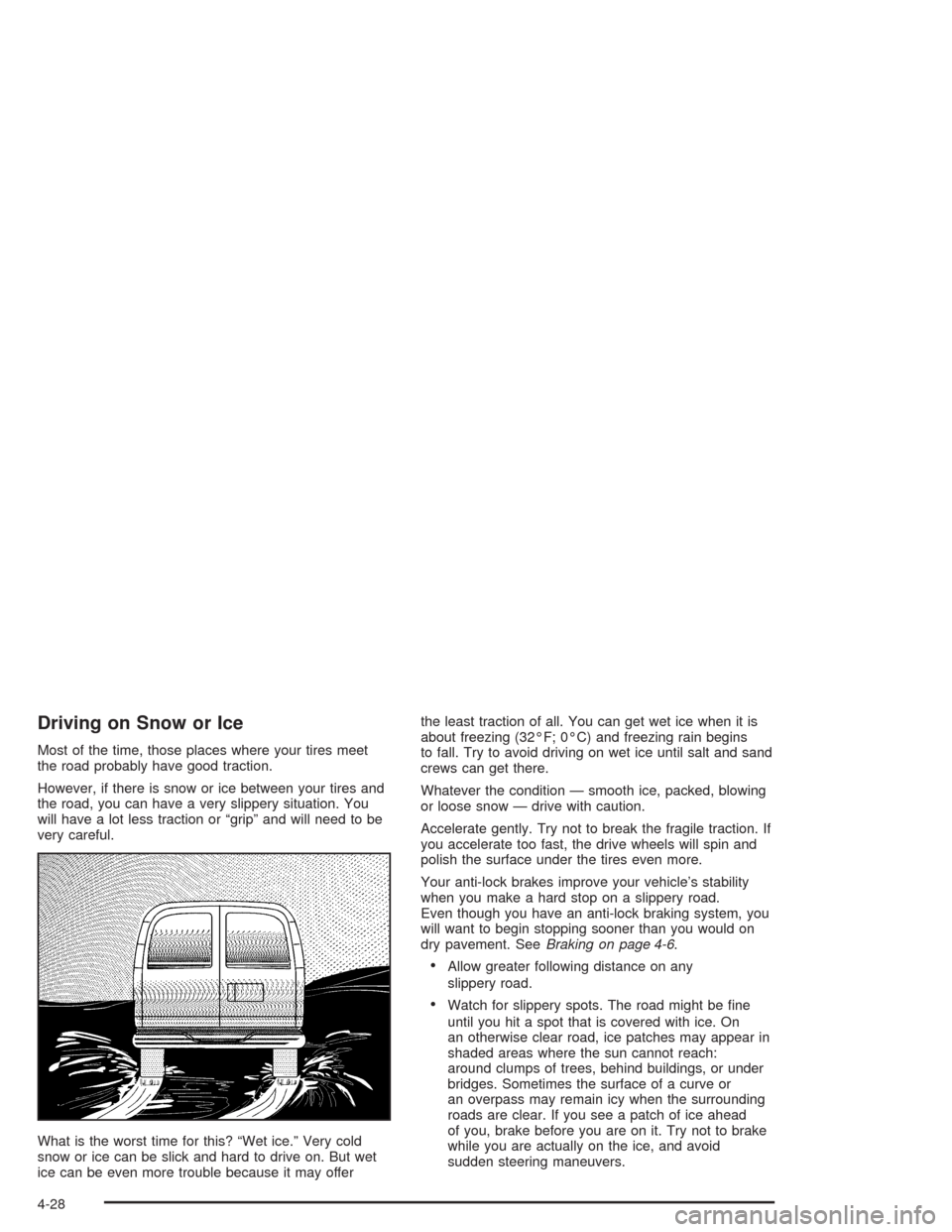
Most of the time, those places where your tires meet
the road probably have good traction.
However, if there is snow or ice between your tires and
the road, you can have a very slippery situation. You
will have a lot less traction or “grip” and will need to be
very careful.
What is the worst time for this? “Wet ice.” Very cold
snow or ice can be slick and hard to drive on. But wet
ice can be even more trouble because it may offerthe least traction of all. You can get wet ice when it is
about freezing (32°F; 0°C) and freezing rain begins
to fall. Try to avoid driving on wet ice until salt and sand
crews can get there.
Whatever the condition — smooth ice, packed, blowing
or loose snow — drive with caution.
Accelerate gently. Try not to break the fragile traction. If
you accelerate too fast, the drive wheels will spin and
polish the surface under the tires even more.
Your anti-lock brakes improve your vehicle’s stability
when you make a hard stop on a slippery road.
Even though you have an anti-lock braking system, you
will want to begin stopping sooner than you would on
dry pavement. SeeBraking on page 4-6.
Allow greater following distance on any
slippery road.
Watch for slippery spots. The road might be ne
until you hit a spot that is covered with ice. On
an otherwise clear road, ice patches may appear in
shaded areas where the sun cannot reach:
around clumps of trees, behind buildings, or under
bridges. Sometimes the surface of a curve or
an overpass may remain icy when the surrounding
roads are clear. If you see a patch of ice ahead
of you, brake before you are on it. Try not to brake
while you are actually on the ice, and avoid
sudden steering maneuvers.
4-28
Page 231 of 406
Then, shut the engine off and close the window almost
all the way to preserve the heat. Start the engine
again and repeat this only when you feel really
uncomfortable from the cold. But do it as little as
possible. Preserve the fuel as long as you can. To help
keep warm, you can get out of the vehicle and do
some fairly vigorous exercises every half hour or so until
help comes.
If You Are Stuck: In Sand, Mud, Ice
or Snow
In order to free your vehicle when it is stuck, you will
need to spin the wheels, but you do not want to
spin your wheels too fast. The method known as
“rocking” can help you get out when you are stuck, but
you must use caution.
{CAUTION:
If you let your tires spin at high speed, they
can explode, and you or others could be
injured. And, the transmission or other parts of
the vehicle can overheat. That could cause an
engine compartment re or other damage.
When you are stuck, spin the wheels as little
as possible. Do not spin the wheels above
35 mph (55 km/h) as shown on the
speedometer.
Notice:Spinning your wheels can destroy parts of
your vehicle as well as the tires. If you spin the
wheels too fast while shifting your transmission
back and forth, you can destroy your transmission.
For information about using tire chains on your
vehicle, seeTire Chains on page 5-74.
4-31
Page 232 of 406
Rocking Your Vehicle To Get It Out
First, turn your steering wheel left and right. That will
clear the area around your front wheels. Then shift back
and forth between REVERSE (R) and a forward gear,
spinning the wheels as little as possible. Release
the accelerator pedal while you shift, and press lightly
on the accelerator pedal when the transmission is
in gear. By slowly spinning your wheels in the forward
and reverse directions, you will cause a rocking
motion that may free your vehicle. If that does not get
you out after a few tries, you may need to be towed out.
If you do need to be towed out, seeTowing Your
Vehicle on page 4-32.
Towing
Towing Your Vehicle
Consult your dealer or a professional towing service if
you need to have your disabled vehicle towed. See
Roadside Assistance Program on page 7-6.
If you want to tow your vehicle behind another vehicle
for recreational purposes (such as behind a motorhome),
see “Recreational Vehicle Towing” following.
Recreational Vehicle Towing
Recreational vehicle towing means towing your vehicle
behind another vehicle — such as behind a motorhome.
The two most common types of recreational vehicle
towing are known as “dinghy towing” (towing your
vehicle with all four wheels on the ground) and “dolly
towing” (towing your vehicle with two wheels on
the ground and two wheels up on a device known
as a “dolly”).
Notice:Towing an all-wheel-drive vehicle with all
four wheels on the ground, or even with only two of
its wheels on the ground, will damage drivetrain
components. Do not tow an all-wheel-drive vehicle if
any of its wheels will be on the ground.
Your vehicle was not designed to be towed with any of
its wheels on the ground. If your vehicle must be
towed, it should be placed on a platform trailer.
4-32
Page 240 of 406
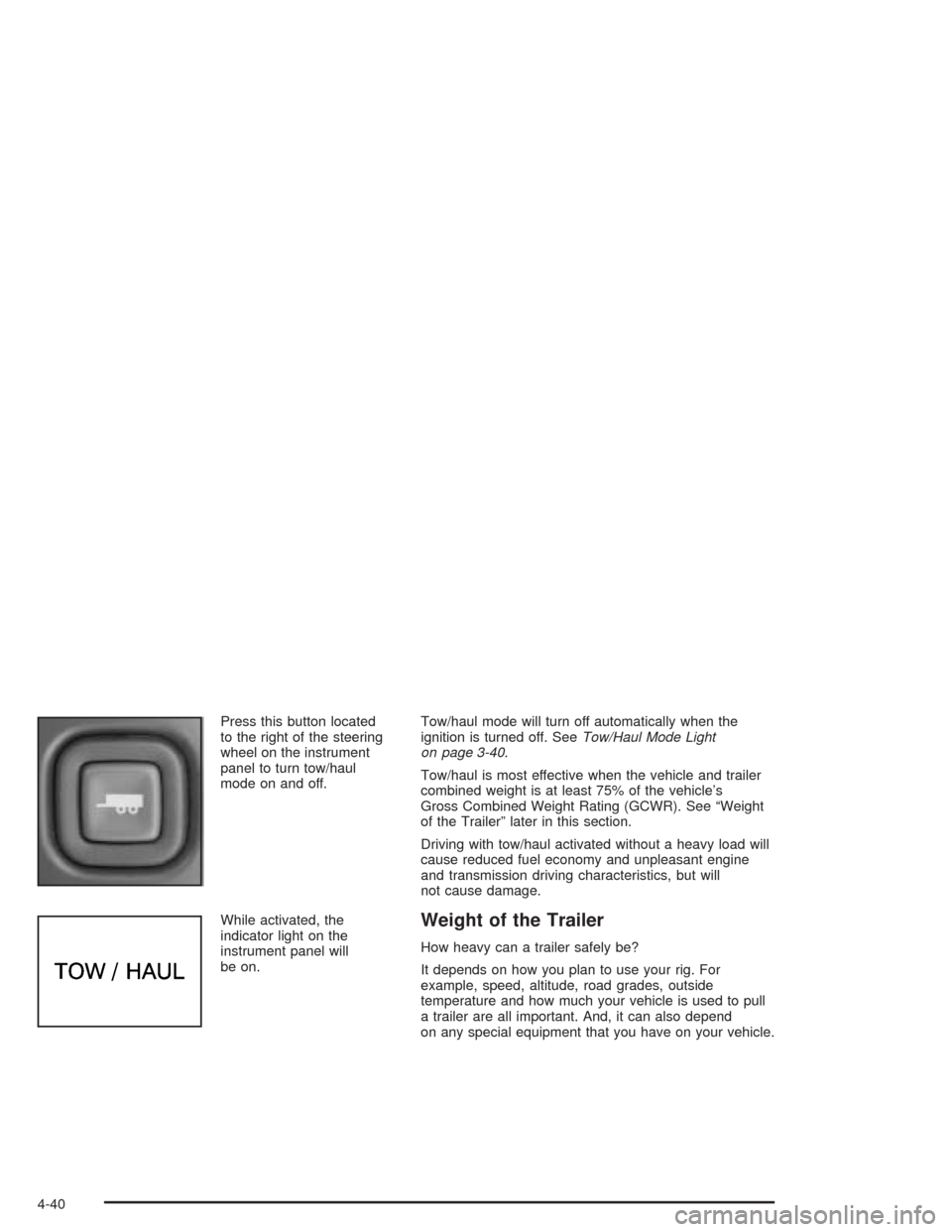
Press this button located
to the right of the steering
wheel on the instrument
panel to turn tow/haul
mode on and off.
While activated, the
indicator light on the
instrument panel will
be on.Tow/haul mode will turn off automatically when the
ignition is turned off. SeeTow/Haul Mode Light
on page 3-40.
Tow/haul is most effective when the vehicle and trailer
combined weight is at least 75% of the vehicle’s
Gross Combined Weight Rating (GCWR). See “Weight
of the Trailer” later in this section.
Driving with tow/haul activated without a heavy load will
cause reduced fuel economy and unpleasant engine
and transmission driving characteristics, but will
not cause damage.
Weight of the Trailer
How heavy can a trailer safely be?
It depends on how you plan to use your rig. For
example, speed, altitude, road grades, outside
temperature and how much your vehicle is used to pull
a trailer are all important. And, it can also depend
on any special equipment that you have on your vehicle.
4-40
Page 242 of 406
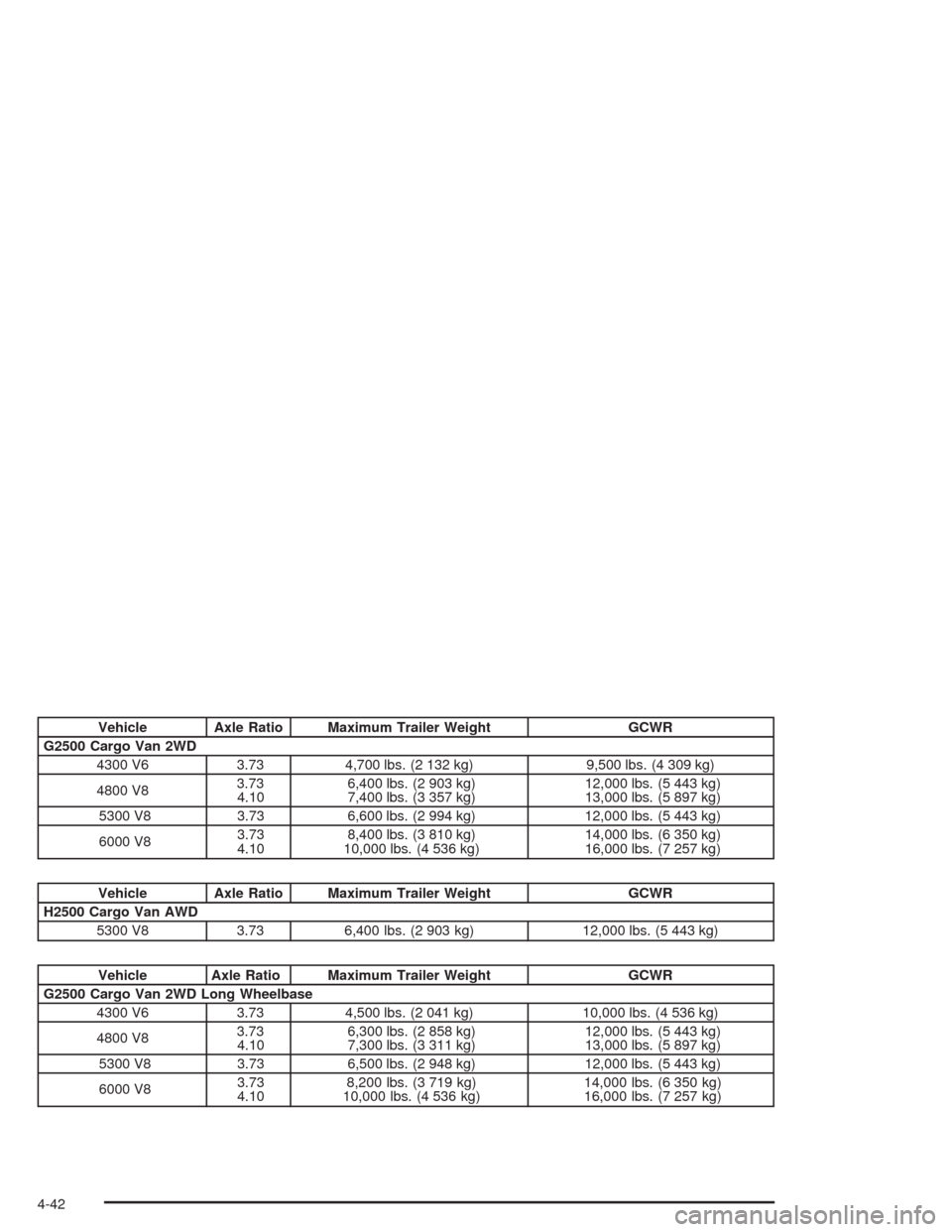
Vehicle Axle Ratio Maximum Trailer Weight GCWR
G2500 Cargo Van 2WD
4300 V6 3.73 4,700 lbs. (2 132 kg) 9,500 lbs. (4 309 kg)
4800 V83.73
4.106,400 lbs. (2 903 kg)
7,400 lbs. (3 357 kg)12,000 lbs. (5 443 kg)
13,000 lbs. (5 897 kg)
5300 V8 3.73 6,600 lbs. (2 994 kg) 12,000 lbs. (5 443 kg)
6000 V83.73
4.108,400 lbs. (3 810 kg)
10,000 lbs. (4 536 kg)14,000 lbs. (6 350 kg)
16,000 lbs. (7 257 kg)
Vehicle Axle Ratio Maximum Trailer Weight GCWR
H2500 Cargo Van AWD
5300 V8 3.73 6,400 lbs. (2 903 kg) 12,000 lbs. (5 443 kg)
Vehicle Axle Ratio Maximum Trailer Weight GCWR
G2500 Cargo Van 2WD Long Wheelbase
4300 V6 3.73 4,500 lbs. (2 041 kg) 10,000 lbs. (4 536 kg)
4800 V83.73
4.106,300 lbs. (2 858 kg)
7,300 lbs. (3 311 kg)12,000 lbs. (5 443 kg)
13,000 lbs. (5 897 kg)
5300 V8 3.73 6,500 lbs. (2 948 kg) 12,000 lbs. (5 443 kg)
6000 V83.73
4.108,200 lbs. (3 719 kg)
10,000 lbs. (4 536 kg)14,000 lbs. (6 350 kg)
16,000 lbs. (7 257 kg)
4-42
Page 243 of 406
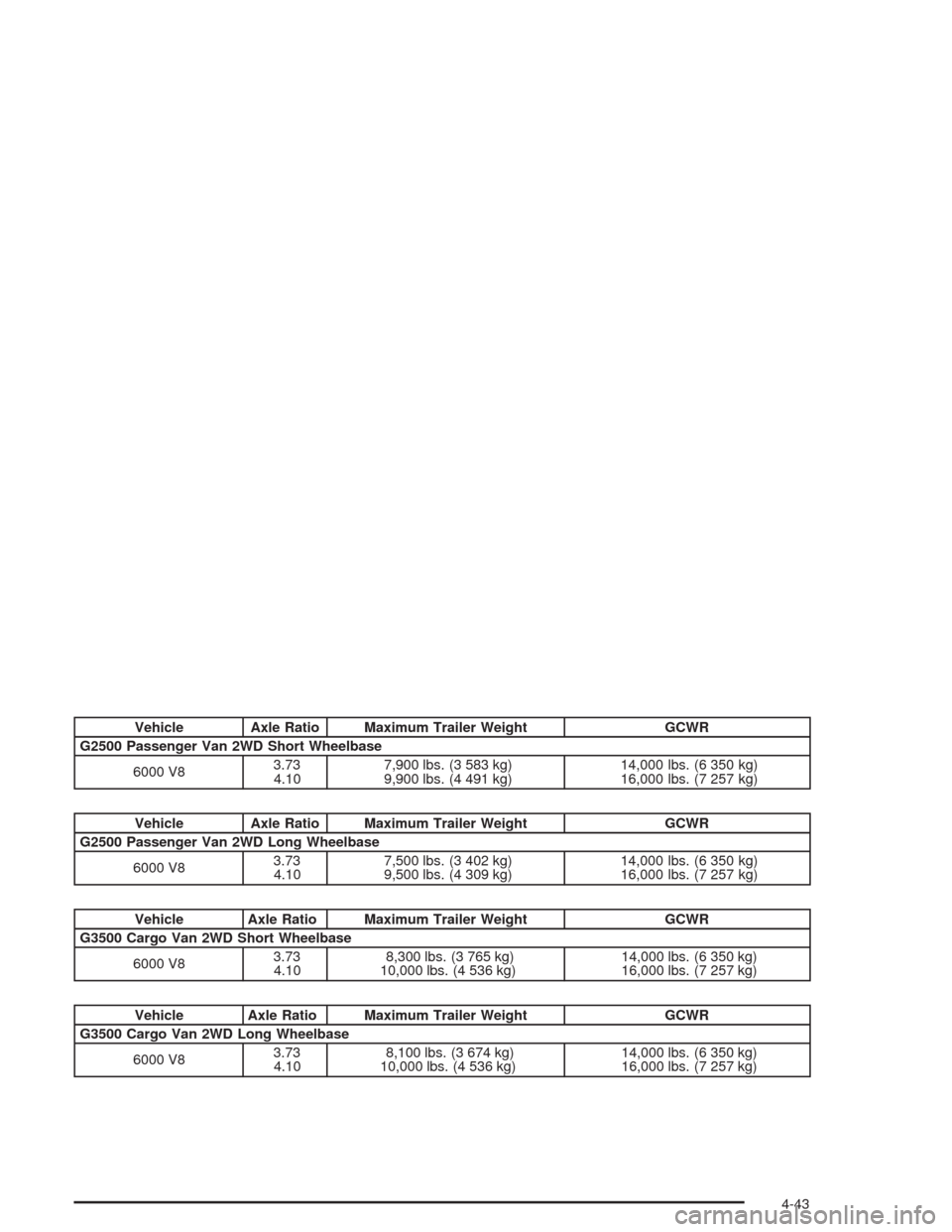
Vehicle Axle Ratio Maximum Trailer Weight GCWR
G2500 Passenger Van 2WD Short Wheelbase
6000 V83.73
4.107,900 lbs. (3 583 kg)
9,900 lbs. (4 491 kg)14,000 lbs. (6 350 kg)
16,000 lbs. (7 257 kg)
Vehicle Axle Ratio Maximum Trailer Weight GCWR
G2500 Passenger Van 2WD Long Wheelbase
6000 V83.73
4.107,500 lbs. (3 402 kg)
9,500 lbs. (4 309 kg)14,000 lbs. (6 350 kg)
16,000 lbs. (7 257 kg)
Vehicle Axle Ratio Maximum Trailer Weight GCWR
G3500 Cargo Van 2WD Short Wheelbase
6000 V83.73
4.108,300 lbs. (3 765 kg)
10,000 lbs. (4 536 kg)14,000 lbs. (6 350 kg)
16,000 lbs. (7 257 kg)
Vehicle Axle Ratio Maximum Trailer Weight GCWR
G3500 Cargo Van 2WD Long Wheelbase
6000 V83.73
4.108,100 lbs. (3 674 kg)
10,000 lbs. (4 536 kg)14,000 lbs. (6 350 kg)
16,000 lbs. (7 257 kg)
4-43
Page 244 of 406
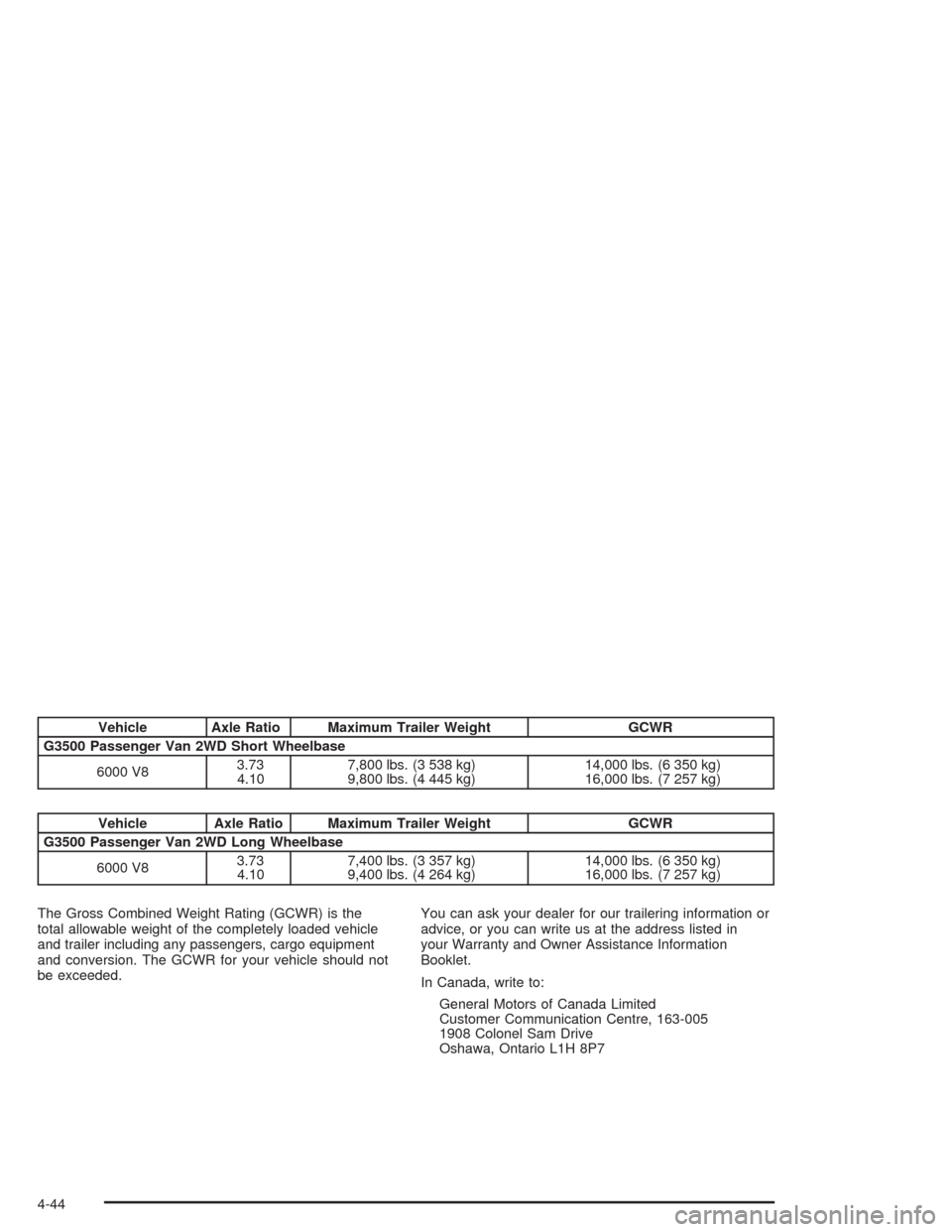
Vehicle Axle Ratio Maximum Trailer Weight GCWR
G3500 Passenger Van 2WD Short Wheelbase
6000 V83.73
4.107,800 lbs. (3 538 kg)
9,800 lbs. (4 445 kg)14,000 lbs. (6 350 kg)
16,000 lbs. (7 257 kg)
Vehicle Axle Ratio Maximum Trailer Weight GCWR
G3500 Passenger Van 2WD Long Wheelbase
6000 V83.73
4.107,400 lbs. (3 357 kg)
9,400 lbs. (4 264 kg)14,000 lbs. (6 350 kg)
16,000 lbs. (7 257 kg)
The Gross Combined Weight Rating (GCWR) is the
total allowable weight of the completely loaded vehicle
and trailer including any passengers, cargo equipment
and conversion. The GCWR for your vehicle should not
be exceeded.You can ask your dealer for our trailering information or
advice, or you can write us at the address listed in
your Warranty and Owner Assistance Information
Booklet.
In Canada, write to:
General Motors of Canada Limited
Customer Communication Centre, 163-005
1908 Colonel Sam Drive
Oshawa, Ontario L1H 8P7
4-44