2004 CHEVROLET EPICA light
[x] Cancel search: lightPage 62 of 338

If belts are cut or damaged, replace them. Collision
damage also may mean you will need to have LATCH
system, safety belt or seat parts repaired or replaced.
New parts and repairs may be necessary even if the belt
or LATCH system wasn’t being used at the time of
the collision.
If the frontal air bags inflate, you will also need to
replace the driver’s and right front passenger’s safety
belt pretentioners and safety belt. Be sure to do
so. Then the new pretensioner and safety belt will be
there to help protect you in a collision.
After a crash you may need to replace the driver and
right front passenger’s safety belt retractor assemblies,
even if the frontal air bags have not deployed. The
driver and right front passenger’s safety belt retractor
assemblies contain the safety belt pretensioners.Have your safety belt pretensioners checked if your
vehicle has been in a collision, or if your air bag
readiness light stays on after you start your vehicle or
while you are driving. SeeAir Bag Readiness Light
on page 3-33.
If your vehicle is equipped with side air bags, the front
seat assembly must be replaced after the side air
bag has been deployed.
If an air bag inflates, you will need to replace air bag
system parts. See the part on the air bag system earlier
in this section.
1-56
Page 71 of 338
Power Door Locks
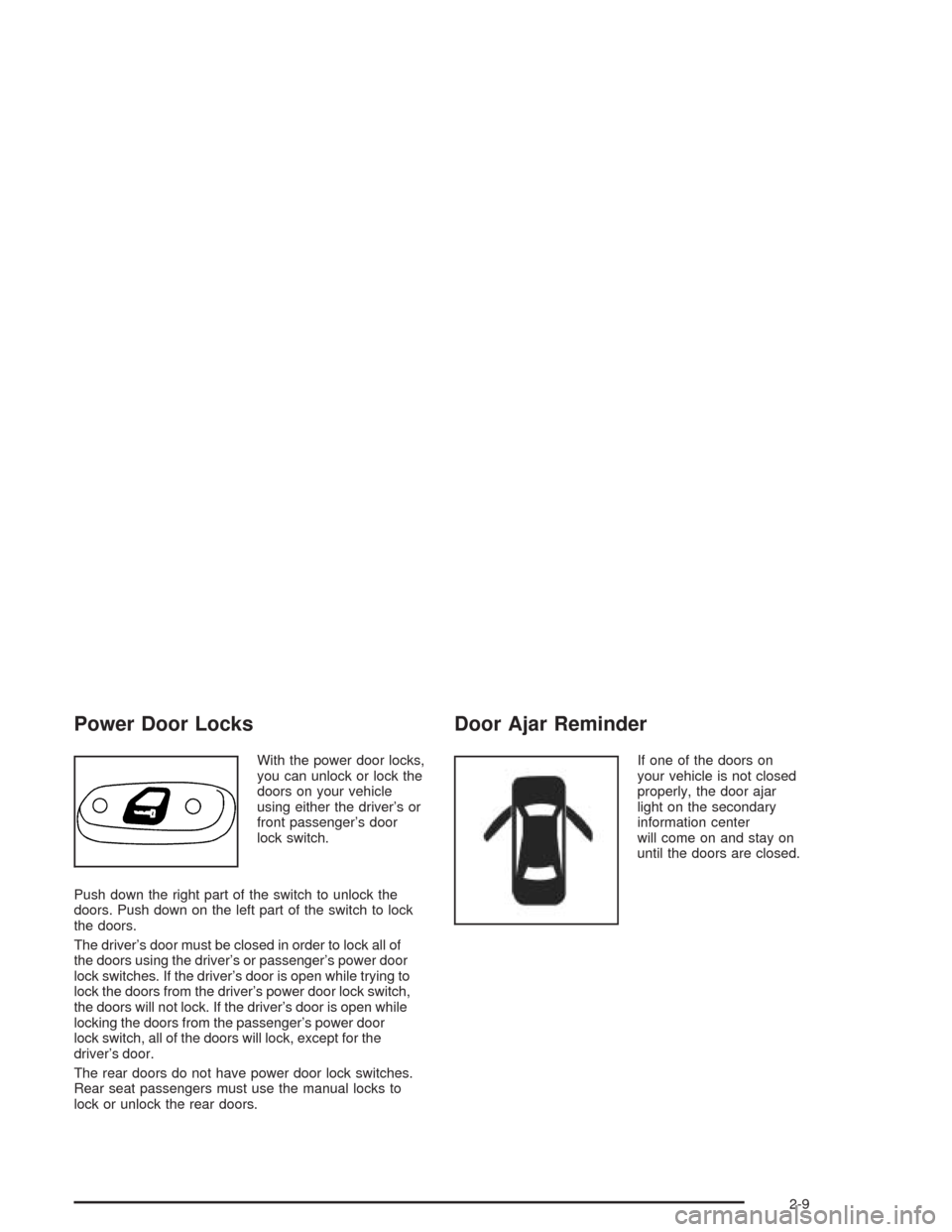
With the power door locks,
you can unlock or lock the
doors on your vehicle
using either the driver’s or
front passenger’s door
lock switch.
Push down the right part of the switch to unlock the
doors. Push down on the left part of the switch to lock
the doors.
The driver’s door must be closed in order to lock all of
the doors using the driver’s or passenger’s power door
lock switches. If the driver’s door is open while trying to
lock the doors from the driver’s power door lock switch,
the doors will not lock. If the driver’s door is open while
locking the doors from the passenger’s power door
lock switch, all of the doors will lock, except for the
driver’s door.
The rear doors do not have power door lock switches.
Rear seat passengers must use the manual locks to
lock or unlock the rear doors.
Door Ajar Reminder
If one of the doors on
your vehicle is not closed
properly, the door ajar
light on the secondary
information center
will come on and stay on
until the doors are closed.
2-9
Page 74 of 338
Remote Trunk Release
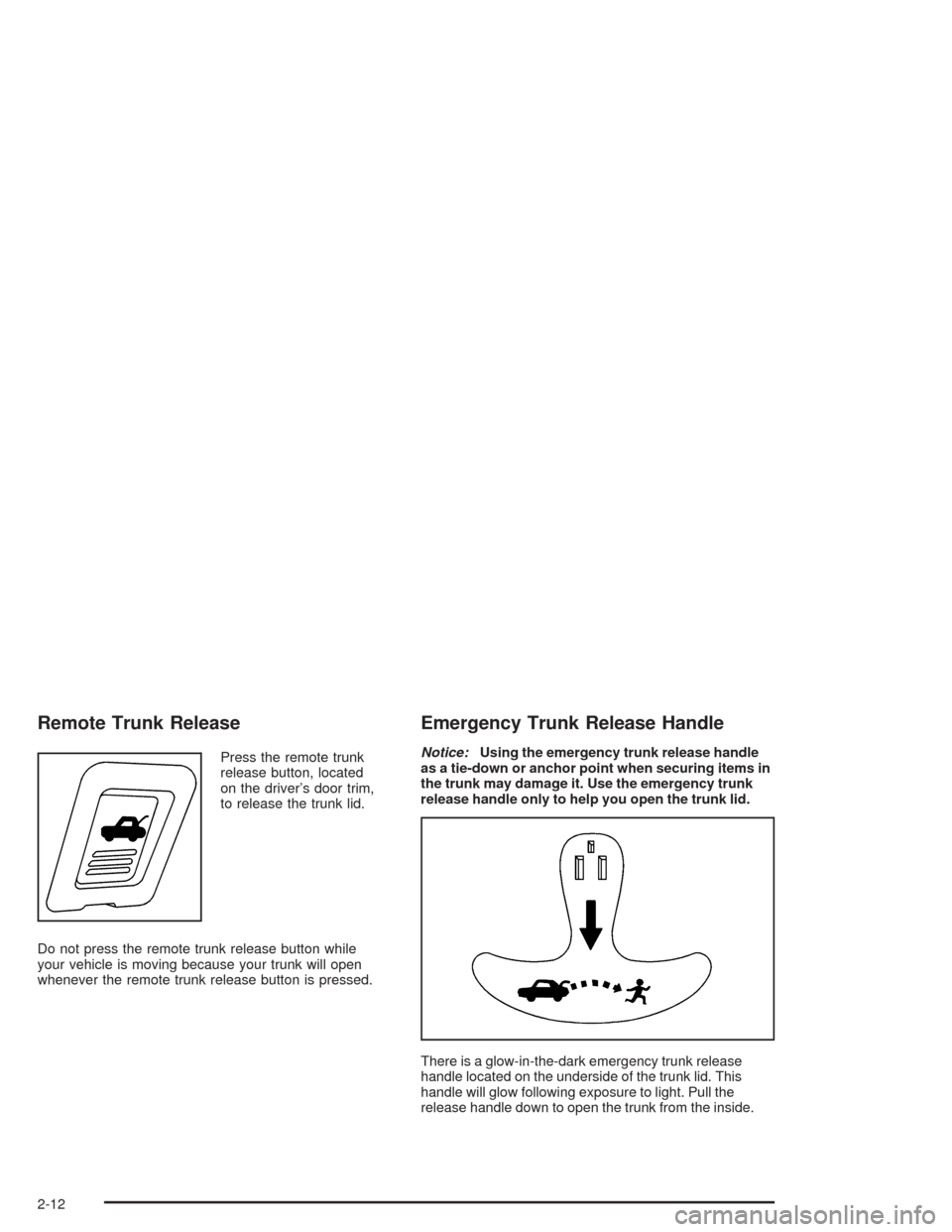
Press the remote trunk
release button, located
on the driver’s door trim,
to release the trunk lid.
Do not press the remote trunk release button while
your vehicle is moving because your trunk will open
whenever the remote trunk release button is pressed.
Emergency Trunk Release Handle
Notice:Using the emergency trunk release handle
as a tie-down or anchor point when securing items in
the trunk may damage it. Use the emergency trunk
release handle only to help you open the trunk lid.
There is a glow-in-the-dark emergency trunk release
handle located on the underside of the trunk lid. This
handle will glow following exposure to light. Pull the
release handle down to open the trunk from the inside.
2-12
Page 76 of 338
Power Windows
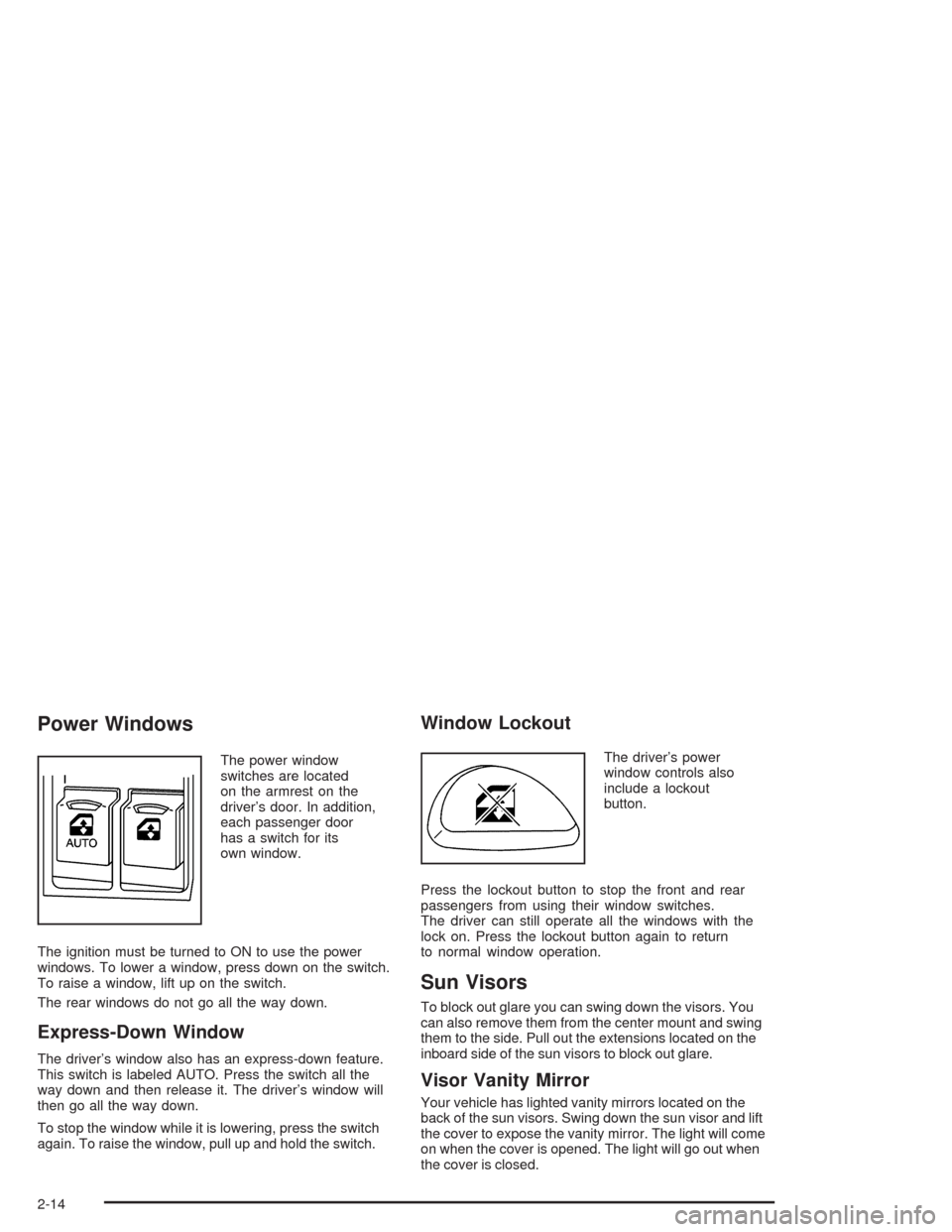
The power window
switches are located
on the armrest on the
driver’s door. In addition,
each passenger door
has a switch for its
own window.
The ignition must be turned to ON to use the power
windows. To lower a window, press down on the switch.
To raise a window, lift up on the switch.
The rear windows do not go all the way down.
Express-Down Window
The driver’s window also has an express-down feature.
This switch is labeled AUTO. Press the switch all the
way down and then release it. The driver’s window will
then go all the way down.
To stop the window while it is lowering, press the switch
again. To raise the window, pull up and hold the switch.
Window Lockout
The driver’s power
window controls also
include a lockout
button.
Press the lockout button to stop the front and rear
passengers from using their window switches.
The driver can still operate all the windows with the
lock on. Press the lockout button again to return
to normal window operation.
Sun Visors
To block out glare you can swing down the visors. You
can also remove them from the center mount and swing
them to the side. Pull out the extensions located on the
inboard side of the sun visors to block out glare.
Visor Vanity Mirror
Your vehicle has lighted vanity mirrors located on the
back of the sun visors. Swing down the sun visor and lift
the cover to expose the vanity mirror. The light will come
on when the cover is opened. The light will go out when
the cover is closed.
2-14
Page 77 of 338
Theft-Deterrent Systems
Vehicle theft is big business, especially in some cities.
Although your vehicle has a number of theft-deterrent
features, we know that nothing we put on it can make
it impossible to steal.
Theft-Deterrent System
Your vehicle has a theft-deterrent system.
The theft-deterrent system will not arm when you lock the
doors using the key or the manual door lock. It activates
only when you use the remote keyless entry transmitter.
Arming the System
To arm the system, do the following:
1. Turn the key to LOCK and remove the key from
the ignition.
If the key is inserted in the ignition, the transmitter
will not operate the theft-deterrent system.
2. Close the doors, the windows, the hood, and
the trunk.
Ensure that the windows are closed, as the system
can be activated even if the windows are open.3. Lock the door using the remote keyless entry
transmitter. The transmitter must be used to activate
the theft-deterrent system.
•The LED on the transmitter will flash.
•All of the doors will lock.
•The hazard warning lamps will flash once and
the horn will chirp.
•The theft-deterrent mode will arm.
•The security light will flash once every second to
indicate that the theft-deterrent system is armed.
The security light is located on the top center
of the instrument panel, near the windshield.
To avoid activating the alarm by accident, do one of
the following:
•Unlock the driver’s or passenger’s front door using
the key.
•Press the lock/unlock button on the remote keyless
entry transmitter.
Unlocking a door any other way will activate the alarm
when a door or the trunk is opened.
If you do not want to arm the theft-deterrent system,
lock the vehicle using the key or the manual door locks.
2-15
Page 79 of 338

Immobilizer
This device complies with Part 15 of the FCC Rules.
Operation is subject to the following two conditions:
1. this device may not cause interference, and
2. this device must accept any interference received,
including interference that may cause undesired
operation.
This device complies with RSS-210 of Industry Canada.
Operation is subject to the following two conditions:
1. this device may not cause interference, and
2. this device must accept any interference received,
including interference that may cause undesired
operation of the device.
Changes or modifications to this system by other than
an authorized service facility could void authorization to
use this equipment.
Immobilizer Operation
Your vehicle may have a passive theft-deterrent system.
The immobilizer system prevents your vehicle from
being started by unauthorized persons.
If your vehicle has an immobilizer system, your vehicle
has a special key that works with the theft-deterrent
system. There is a transponder in the key head that is
electronically coded. The correct key will start the
vehicle. An invalid key immobilizes the engine. The
immobilizer system isolates the power supply to
the ignition system, the fuel pump and the fuel injectors.
The engine immobilizer is activated after the key is turned
to LOCK and removed from the ignition. The security light
located on the top center of the instrument panel, near
the windshield, will flash when the immobilizer is active. If
the light does not flash after removing the key, have the
system checked by your dealer.
The immobilizer system works when you turn the key to
START. If the immobilizer system does not recognize the
electronic code, the engine will not start and the security
indicator will continue blinking. If your key is ever
damaged, you may not be able to start your vehicle.
2-17
Page 80 of 338
When trying to start the vehicle, if the engine does
not start and the security light continues flashing, the
key may have a damaged transponder. Turn the ignition
off and try again.
If the engine still does not start, and the key appears to
be undamaged, try another key. At this time, you may
also want to check the fuse. SeeFuses and Circuit
Breakers on page 5-79. If the engine still does not start
with the other key, your vehicle needs service. If your
vehicle does start, the first key may be faulty. See your
dealer who can service the theft-deterrent system to
have a new key made.
Up to four keys may be programmed for the vehicle.
If you lose or damage your keys, only a GM dealer
can service the theft-deterrent system to have new
keys made.
If you are ever driving and the security light comes on
and stays on, you will be able to restart your engine
if you turn it off. The theft-deterrent system, however,
is not working properly and must be serviced by
your dealer. Your vehicle is not protected by the
theft-deterrent system at this time.
In an emergency, contact Chevrolet Roadside
Assistance. SeeRoadside Assistance Program
on page 7-6.Starting and Operating Your
Vehicle
New Vehicle Break-In
Notice:Your vehicle does not need an elaborate
“break-in.” But it will perform better in the long run
if you follow these guidelines:
Do not drive at any one speed — fast or
slow — for the rst 500 miles (805 km).
Do not make full-throttle starts.
Avoid making hard stops for the rst
200 miles (322 km) or so. During this time
your new brake linings are not yet broken in.
Hard stops with new linings can mean
premature wear and earlier replacement.
Follow this breaking-in guideline every time
you get new brake linings.
Do not tow a trailer during break-in.
SeeTowing a Trailer on page 4-35for
more information.
2-18
Page 81 of 338
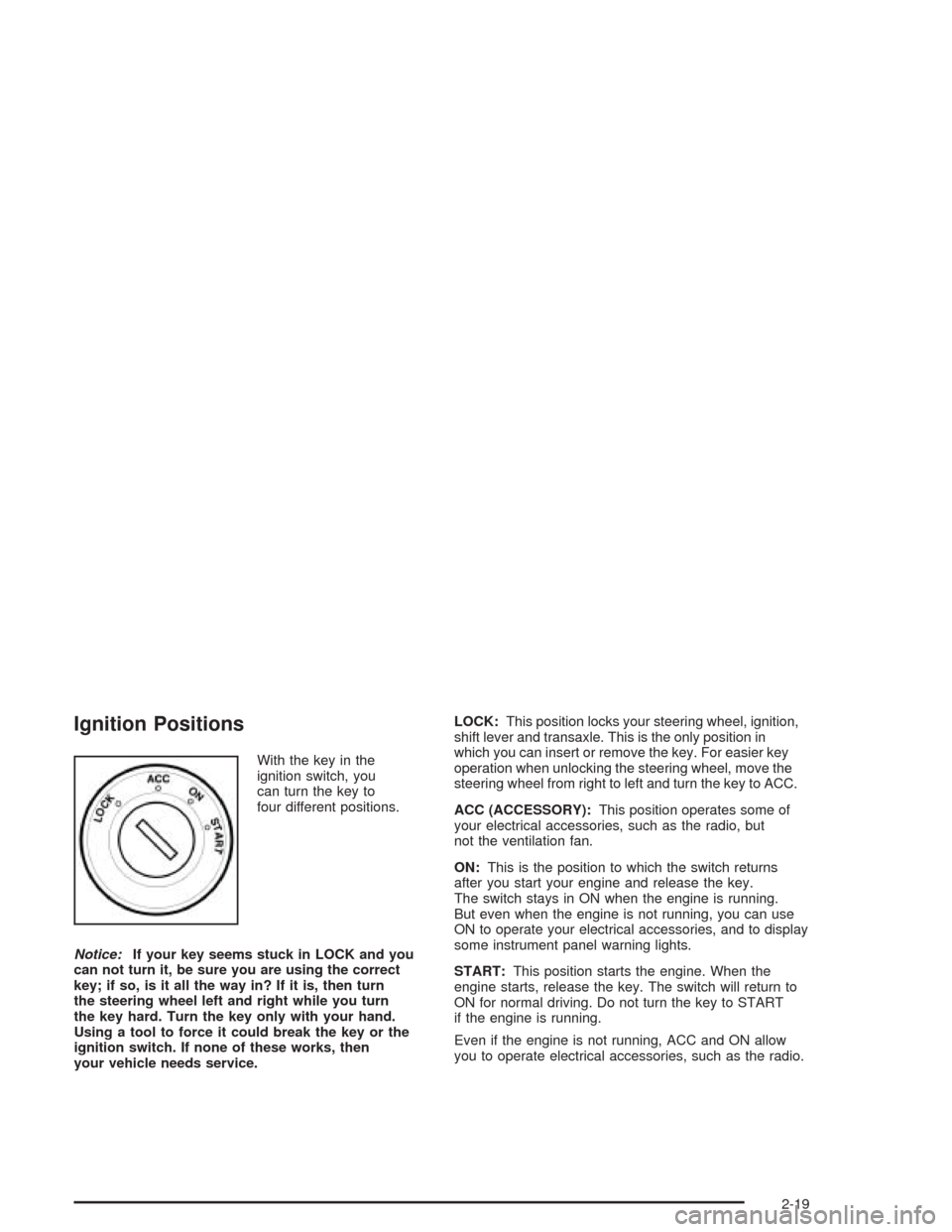
Ignition Positions
With the key in the
ignition switch, you
can turn the key to
four different positions.
Notice:If your key seems stuck in LOCK and you
can not turn it, be sure you are using the correct
key; if so, is it all the way in? If it is, then turn
the steering wheel left and right while you turn
the key hard. Turn the key only with your hand.
Using a tool to force it could break the key or the
ignition switch. If none of these works, then
your vehicle needs service.LOCK:This position locks your steering wheel, ignition,
shift lever and transaxle. This is the only position in
which you can insert or remove the key. For easier key
operation when unlocking the steering wheel, move the
steering wheel from right to left and turn the key to ACC.
ACC (ACCESSORY):This position operates some of
your electrical accessories, such as the radio, but
not the ventilation fan.
ON:This is the position to which the switch returns
after you start your engine and release the key.
The switch stays in ON when the engine is running.
But even when the engine is not running, you can use
ON to operate your electrical accessories, and to display
some instrument panel warning lights.
START:This position starts the engine. When the
engine starts, release the key. The switch will return to
ON for normal driving. Do not turn the key to START
if the engine is running.
Even if the engine is not running, ACC and ON allow
you to operate electrical accessories, such as the radio.
2-19