2004 CHEVROLET CORVETTE climate control
[x] Cancel search: climate controlPage 117 of 384
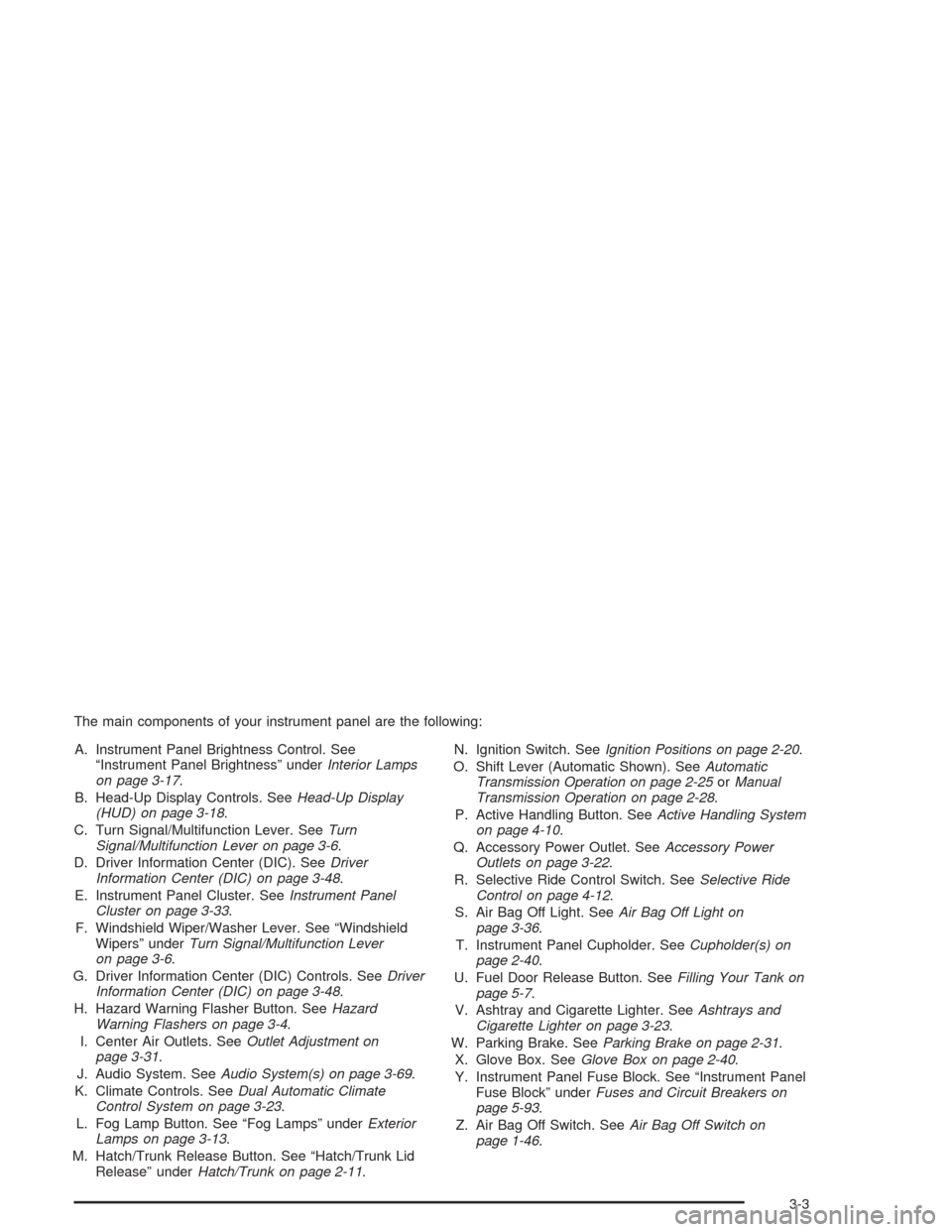
The main components of your instrument panel are the following:
A. Instrument Panel Brightness Control. See
“Instrument Panel Brightness” underInterior Lamps
on page 3-17.
B. Head-Up Display Controls. SeeHead-Up Display
(HUD) on page 3-18.
C. Turn Signal/Multifunction Lever. SeeTurn
Signal/Multifunction Lever on page 3-6.
D. Driver Information Center (DIC). SeeDriver
Information Center (DIC) on page 3-48.
E. Instrument Panel Cluster. SeeInstrument Panel
Cluster on page 3-33.
F. Windshield Wiper/Washer Lever. See “Windshield
Wipers” underTurn Signal/Multifunction Lever
on page 3-6.
G. Driver Information Center (DIC) Controls. SeeDriver
Information Center (DIC) on page 3-48.
H. Hazard Warning Flasher Button. SeeHazard
Warning Flashers on page 3-4.
I. Center Air Outlets. SeeOutlet Adjustment on
page 3-31.
J. Audio System. SeeAudio System(s) on page 3-69.
K. Climate Controls. SeeDual Automatic Climate
Control System on page 3-23.
L. Fog Lamp Button. See “Fog Lamps” underExterior
Lamps on page 3-13.
M. Hatch/Trunk Release Button. See “Hatch/Trunk Lid
Release” underHatch/Trunk on page 2-11.N. Ignition Switch. SeeIgnition Positions on page 2-20.
O. Shift Lever (Automatic Shown). SeeAutomatic
Transmission Operation on page 2-25orManual
Transmission Operation on page 2-28.
P. Active Handling Button. SeeActive Handling System
on page 4-10.
Q. Accessory Power Outlet. SeeAccessory Power
Outlets on page 3-22.
R. Selective Ride Control Switch. SeeSelective Ride
Control on page 4-12.
S. Air Bag Off Light. SeeAir Bag Off Light on
page 3-36.
T. Instrument Panel Cupholder. SeeCupholder(s) on
page 2-40.
U. Fuel Door Release Button. SeeFilling Your Tank on
page 5-7.
V. Ashtray and Cigarette Lighter. SeeAshtrays and
Cigarette Lighter on page 3-23.
W. Parking Brake. SeeParking Brake on page 2-31.
X. Glove Box. SeeGlove Box on page 2-40.
Y. Instrument Panel Fuse Block. See “Instrument Panel
Fuse Block” underFuses and Circuit Breakers on
page 5-93.
Z. Air Bag Off Switch. SeeAir Bag Off Switch on
page 1-46.
3-3
Page 137 of 384
Ashtrays and Cigarette Lighter
The ashtray and cigarette lighter are located on the
instrument panel, in front of the shift lever. To use the
ashtray, lift up on the bottom of the door.
Notice:If you put papers or other ammable items
in the ashtray, hot cigarettes or other smoking
materials could ignite them and possibly damage
your vehicle. Never put ammable items in the
ashtray.
Loose objects, such as paper clips, can lodge behind
and beneath the ashtray lid and prevent movement
of the lid. You should avoid putting small, loose objects
near the ashtray.
To use the cigarette lighter, push it in all the way and let
go. When it is ready, it will pop back out by itself.
Notice:Holding a cigarette lighter in while it is
heating will not allow the lighter to back away from
the heating element when it is hot. Damage from
overheating may occur to the lighter or heating
element, or a fuse could be blown. Do not hold a
cigarette lighter in while it is heating.
Climate Controls
Dual Automatic Climate
Control System
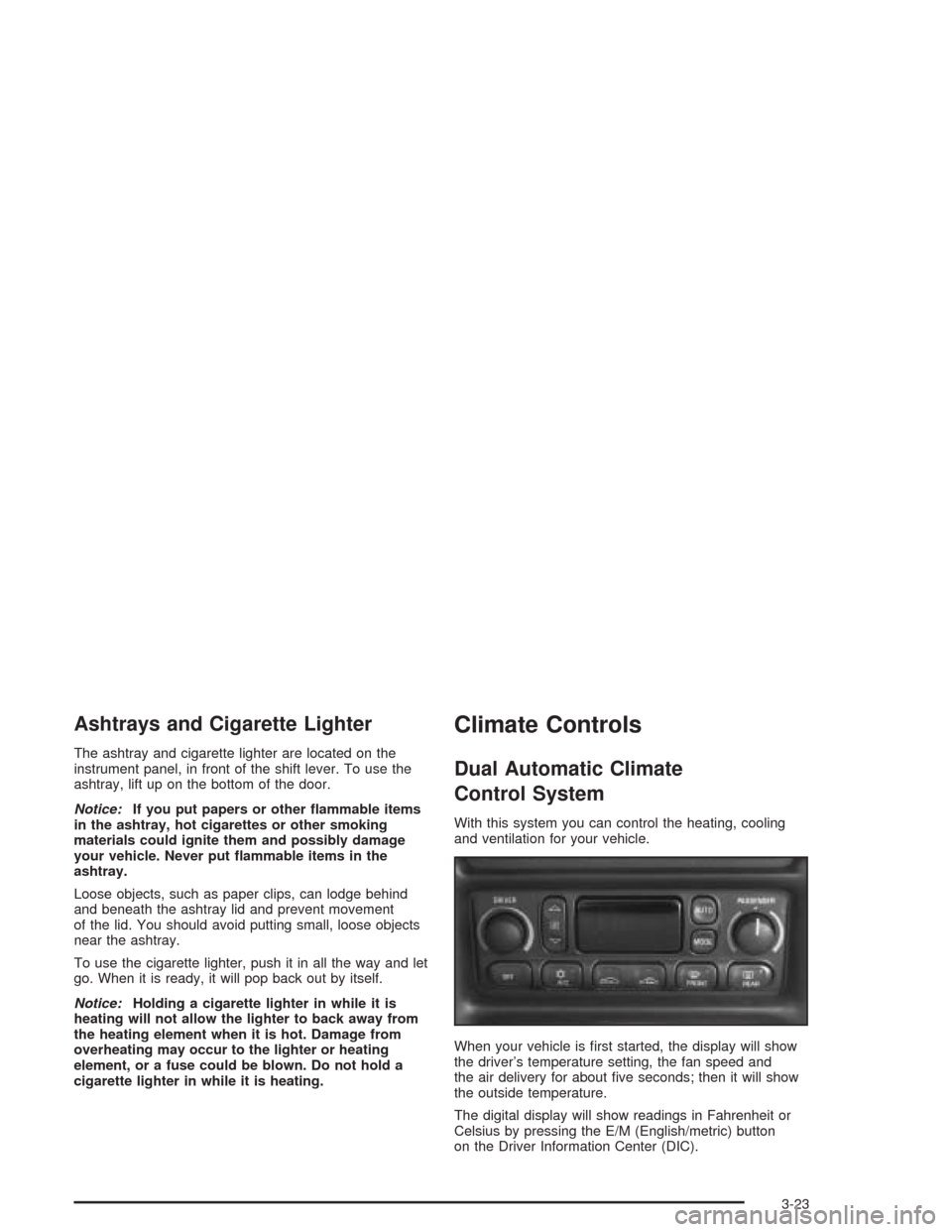
With this system you can control the heating, cooling
and ventilation for your vehicle.
When your vehicle is first started, the display will show
the driver’s temperature setting, the fan speed and
the air delivery for about five seconds; then it will show
the outside temperature.
The digital display will show readings in Fahrenheit or
Celsius by pressing the E/M (English/metric) button
on the Driver Information Center (DIC).
3-23
Page 139 of 384

Manual Operation
OFF:Press this button to turn off the climate control
system. This is the only setting that fully shuts off
the fan. The digital display will show only the outside
temperature. You can still adjust the driver’s set
temperature, the passenger temperature offset and the
air intake mode while in OFF.
MODE:Press this button to manually lock in the current
air delivery setting and to stop the automatic mode
control. Pressing the MODE button will delete AUTO
from the digital display and the mode graphics will
be shown. To change the setting, press the MODE
button again. The AUTO button must be pressed
to return to the automatic mode selection.To change the current mode, select one of the following:H(Vent):This mode directs most of the air to the
instrument panel outlets, with a very small amount of air
directed to the floor outlets.
%(Bi-Level):This mode directs about half of the air
to the instrument panel outlets, and then directs
most of the remaining air to the floor outlets. Some air
may be directed toward the windshield. Cooler air is
directed to the upper outlets and warmer air to the floor
outlets.
6(Floor):This mode directs most of the air to the
floor outlets with some air directed to the outboard
outlets (for the side windows) and some air directed to
the windshield.
The MODE button can also be used to select the defog
mode. Information on defogging and defrosting can
be found later in this section.
3-25
Page 143 of 384

Sensors
The solar sensor on your vehicle monitors the solar
radiation and uses the information to maintain the
selected temperature when operating in AUTO mode by
initiating needed adjustments to the temperature, the
fan speed and the air delivery system. The system may
also supply cooler air to the side of the vehicle facing
the sun. The recirculation mode will also be activated, as
necessary. Do not cover the solar sensor located on
the top right side of the instrument panel near the
windshield or the system will not work properly.
There is also a sensor located behind the front bumper.
This sensor reads the outside air temperature and
helps to maintain the temperature inside the vehicle.
Any cover on the front of the vehicle could give a false
reading in the temperature.If the outside temperature goes up, the displayed
temperature will not change until:•The vehicle’s speed is above 16 mph (26 km/h) for
one and a half minutes.
•The vehicle’s speed is above 45 mph (72 km/h) for
one minute.
These delays prevent false readings. If the temperature
goes down, the outside temperature will be shown
when you start the vehicle. If it has been turned off for
less than three hours, the temperature will be recalled
from the previous vehicle operation.
There is also an inside temperature sensor located to
the left of the ignition switch. The automatic climate
control system uses this sensor to receive information,
so if you block or cover it, the system will not function
properly.
3-29
Page 144 of 384

Defogging and Defrosting
Fog on the inside of windows is a result of high humidity
(moisture) condensing on the cool window glass. This
can be minimized if the climate control system is
used properly. There are two modes to clear fog or frost
from your windshield. Use the defog mode to clear
the windows of fog or moisture and warm the
passengers. Use FRONT to remove fog or frost from
the windshield more quickly.
Press the MODE button until the defog mode appears
on the display.
-(Defog):This mode directs the air equally between
the windshield and the floor outlets with a small
amount to the side window outlets. When you select this
mode, the system turns off recirculation and runs the
air-conditioning compressor unless the outside
temperature is at or below freezing. An indicator light in
the A/C button will come on to let you know that the
air-conditioning compressor is activated. The
recirculation mode cannot be selected while in the
defog mode.
1FRONT:Pressing this button directs most of the
air to the windshield, with a small amount directed to the
side window outlets. The light on the button will come
on and the digital display will show the defrost mode
symbol and fan speed when the front defrost mode is
being used. In this mode, the system will automatically
turn off the recirculation and run the air-conditioning
compressor, unless the outside temperature is at
or below freezing. An indicator light in the A/C button
will come on to let you know that the air-conditioning
compressor is activated. Recirculation cannot be
selected while in the defrost mode. Pressing this button
again will return the system to the last operating
mode and the air intake mode will be in outside air.
If the system is in FRONT defrost when you shut the
engine off, it will restart in FRONT defrost unless
the engine is off for longer than 40 minutes. If the engine
is off longer than 40 minutes, the system will restart in
the operating mode that was set prior to FRONT defrost
and the air intake mode will be in outside air. Do not
drive the vehicle until all the windows are clear.
3-30
Page 309 of 384

Uniform Tire Quality Grading
Quality grades can be found where applicable on the
tire sidewall between tread shoulder and maximum
section width. For example:
Treadwear 200 Traction AA Temperature A
The following information relates to the system
developed by the United States National Highway
Traffic Safety Administration, which grades tires by
treadwear, traction and temperature performance. (This
applies only to vehicles sold in the United States.)
The grades are molded on the sidewalls of most
passenger car tires. The Uniform Tire Quality Grading
system does not apply to deep tread, winter-type
snow tires, space-saver or temporary use spare tires,
tires with nominal rim diameters of 10 to 12 inches
(25 to 30 cm), or to some limited-production tires.
While the tires available on General Motors passenger
cars and light trucks may vary with respect to these
grades, they must also conform to federal safety
requirements and additional General Motors Tire
Performance Criteria (TPC) standards.
Treadwear
The treadwear grade is a comparative rating based on
the wear rate of the tire when tested under controlled
conditions on a specified government test course.
For example, a tire graded 150 would wear one and
a half (1.5) times as well on the government course as
a tire graded 100. The relative performance of tires
depends upon the actual conditions of their use,
however, and may depart significantly from the norm
due to variations in driving habits, service practices and
differences in road characteristics and climate.
Traction – AA, A, B, C
The traction grades, from highest to lowest, are AA, A,
B, and C. Those grades represent the tire’s ability
to stop on wet pavement as measured under controlled
conditions on specified government test surfaces of
asphalt and concrete. A tire marked C may have poor
traction performance. Warning: The traction grade
assigned to this tire is based on straight-ahead braking
traction tests, and does not include acceleration,
cornering, hydroplaning, or peak traction characteristics.
5-67
Page 321 of 384
Notice:The car engine must be running to avoid
draining the battery while running the air
compressor.
Follow the proper steps to be sure your vehicle will not
move. SeeParking Your Vehicle (Manual Transmission)
on page 2-35.
{CAUTION:
It can be dangerous to get out of your vehicle
with the engine running, if the shift lever is not
in NEUTRAL (N) with the parking brake rmly
set (manual transmission). Your vehicle can
roll or move suddenly even when on fairly
level ground. To be sure your vehicle won’t
move, always set your parking brake and move
the shift lever to NEUTRAL (N) when you start
or idle your engine.
{CAUTION:
Idling the engine in a closed-in place or with
the climate control system off can cause
deadly carbon monoxide (CO). See “Engine
Exhaust” in the Index.
{CAUTION:
Inating something too much can make it
explode, and you or others could be injured.
Be sure to read the inator instructions, and
inate the tire to its recommended pressure.
Do not exceed 36 psi (248 kPa).
5-79
Page 373 of 384

Checking Things Under the Hood......................5-10
Chemical Paint Spotting...................................5-90
Child Restraints
Child Restraint Systems...............................1-25
Infants and Young Children...........................1-22
Lower Anchorages and Top Tethers for
Children (LATCH System)..........................1-30
Older Children.............................................1-19
Securing a Child Restraint Designed for
the LATCH System...................................1-33
Securing a Child Restraint in the
Passenger Seat Position...........................1-36
Top Strap...................................................1-28
Top Strap Anchor Location............................1-30
Cigarette Lighter.............................................3-23
Cleaning
Fiberglass Springs.......................................5-90
Inside of Your Vehicle..................................5-83
Outside of Your Vehicle................................5-85
Titanium Exhaust System..............................5-89
Underbody Maintenance...............................5-89
Weatherstrips..............................................5-85
Cleaning Aluminum Wheels..............................5-88
Cleaning Coated Moldings................................5-83
Cleaning Exterior Lamps/Lenses.......................5-86
Cleaning Fabric/Carpet....................................5-83
Cleaning Glass Surfaces..................................5-84
Cleaning Interior Plastic Components.................5-84Cleaning Leather............................................5-84
Cleaning Removable Roof Panel.......................5-87
Cleaning the Convertible Top............................5-88
Cleaning the Security Shade and
Convenience Net.........................................5-84
Cleaning the Top of the Instrument Panel...........5-84
Cleaning Tires................................................5-88
Cleaning Windshield and Wiper Blades..............5-87
Climate Control System
Dual Automatic............................................3-23
Outlet Adjustment........................................3-31
Clutch, Hydraulic.............................................5-22
Competitive Driving Mode................................4-12
Control of a Vehicle.......................................... 4-6
Convenience Net............................................2-43
Convertible Top..............................................2-50
Lowering the Convertible Top........................2-51
Raising the Convertible Top..........................2-55
Coolant
Engine Temperature Gage............................3-41
Heater, Engine............................................2-23
Surge Tank Pressure Cap.............................5-26
Cooling System..............................................5-29
Courtesy Lamps.............................................3-17
Cruise Control................................................3-10
Cupholder(s)..................................................2-40
Current and Past Model Order Forms................7-12
Customer Assistance Information
Courtesy Transportation.................................. 7-7
3