Page 20 of 348
Driver Position
This part describes the driver’s restraint system.
Lap-Shoulder Belt
The driver has a lap-shoulder belt. Here is how to wear
it properly.
1. Close and lock the door.
2. Adjust the seat so you can sit up straight. To see
how, see “Seats” in the Index.
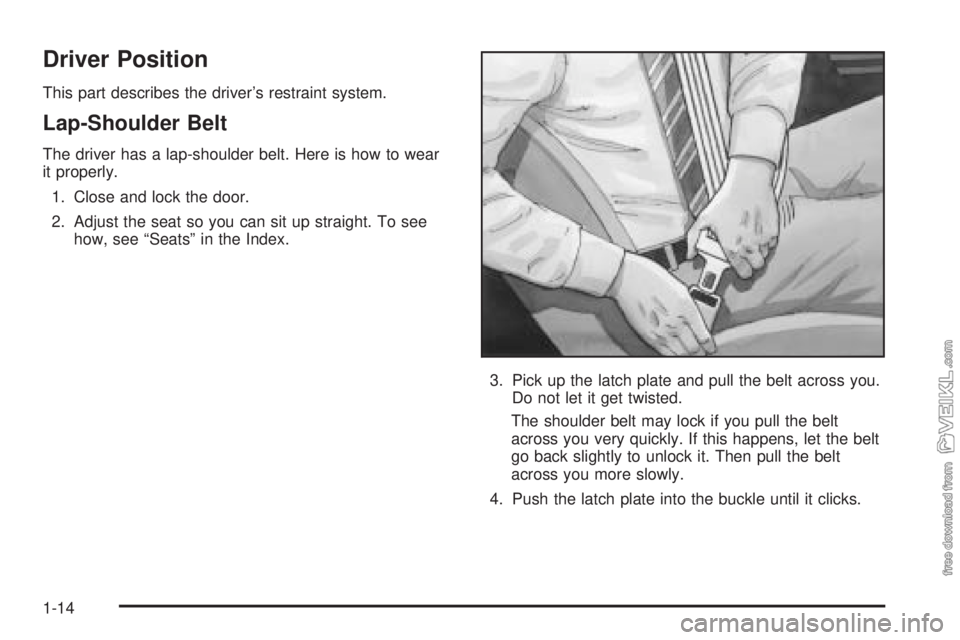
3. Pick up the latch plate and pull the belt across you.
Do not let it get twisted.
The shoulder belt may lock if you pull the belt
across you very quickly. If this happens, let the belt
go back slightly to unlock it. Then pull the belt
across you more slowly.
4. Push the latch plate into the buckle until it clicks.
1-14
Page 21 of 348
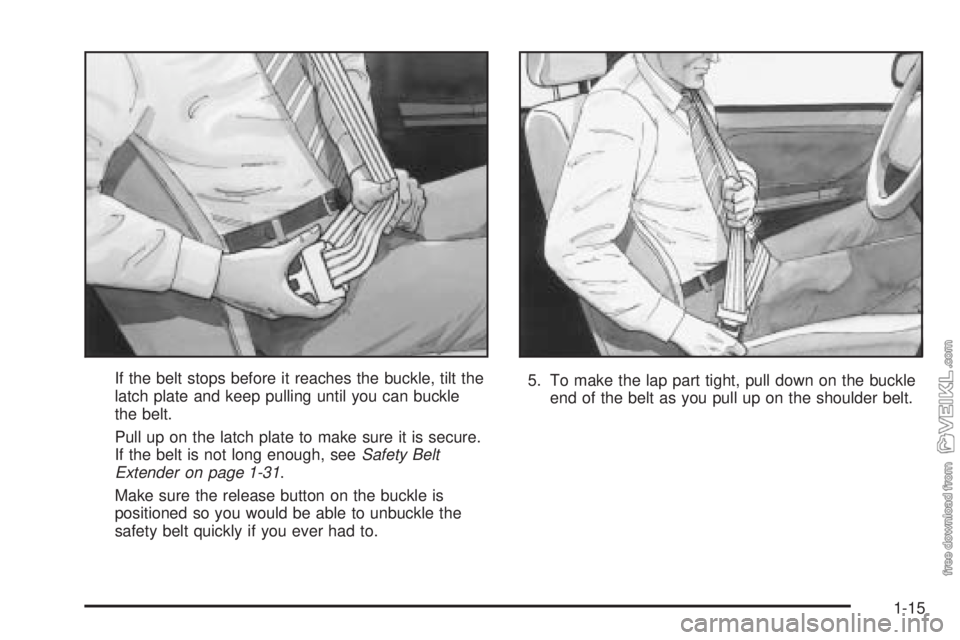
If the belt stops before it reaches the buckle, tilt the
latch plate and keep pulling until you can buckle
the belt.
Pull up on the latch plate to make sure it is secure.
If the belt is not long enough, seeSafety Belt
Extender on page 1-31.
Make sure the release button on the buckle is
positioned so you would be able to unbuckle the
safety belt quickly if you ever had to.5. To make the lap part tight, pull down on the buckle
end of the belt as you pull up on the shoulder belt.
1-15
Page 22 of 348
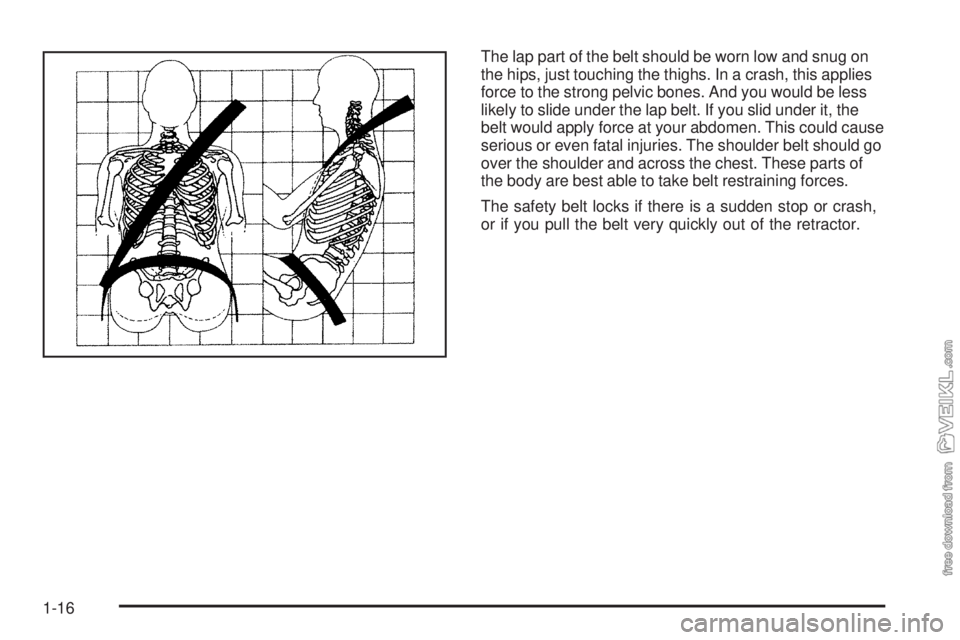
The lap part of the belt should be worn low and snug on
the hips, just touching the thighs. In a crash, this applies
force to the strong pelvic bones. And you would be less
likely to slide under the lap belt. If you slid under it, the
belt would apply force at your abdomen. This could cause
serious or even fatal injuries. The shoulder belt should go
over the shoulder and across the chest. These parts of
the body are best able to take belt restraining forces.
The safety belt locks if there is a sudden stop or crash,
or if you pull the belt very quickly out of the retractor.
1-16
Page 23 of 348
Shoulder Belt Height Adjuster
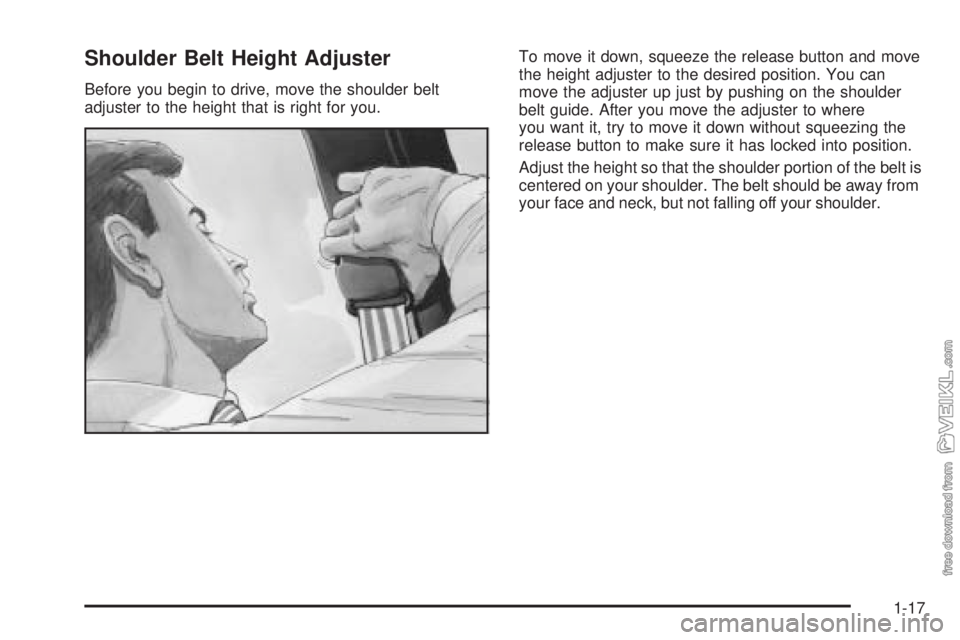
Before you begin to drive, move the shoulder belt
adjuster to the height that is right for you.To move it down, squeeze the release button and move
the height adjuster to the desired position. You can
move the adjuster up just by pushing on the shoulder
belt guide. After you move the adjuster to where
you want it, try to move it down without squeezing the
release button to make sure it has locked into position.
Adjust the height so that the shoulder portion of the belt is
centered on your shoulder. The belt should be away from
your face and neck, but not falling off your shoulder.
1-17
Page 24 of 348
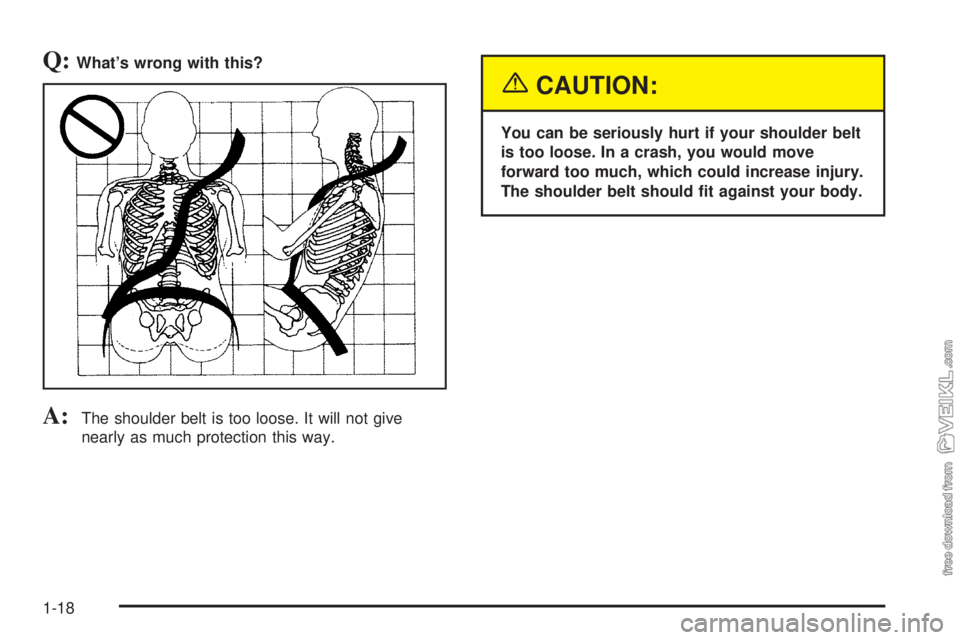
Q:What’s wrong with this?
A:The shoulder belt is too loose. It will not give
nearly as much protection this way.
{CAUTION:
You can be seriously hurt if your shoulder belt
is too loose. In a crash, you would move
forward too much, which could increase injury.
The shoulder belt should t against your body.
1-18
Page 25 of 348
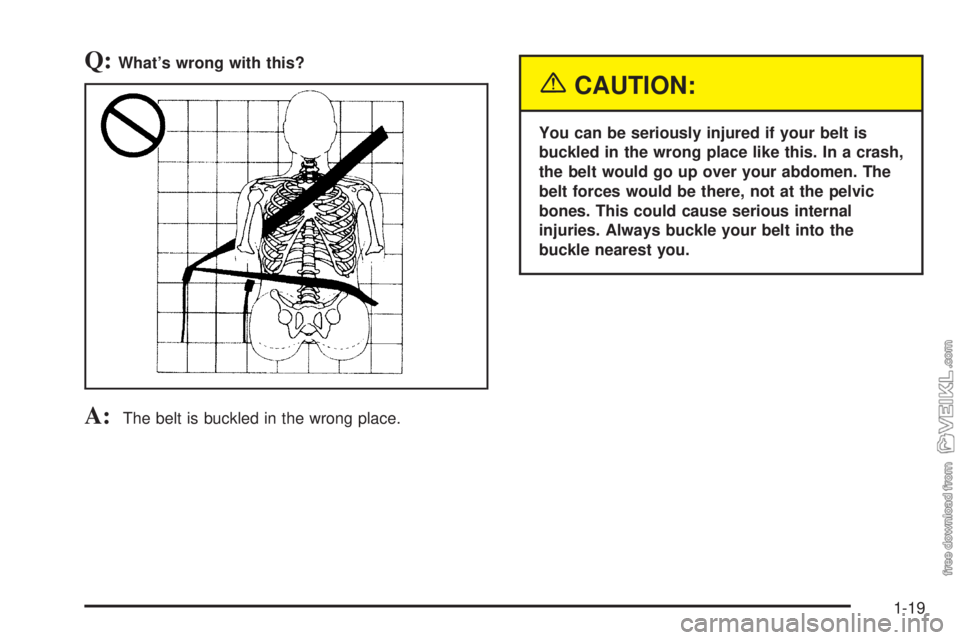
Q:What’s wrong with this?
A:The belt is buckled in the wrong place.
{CAUTION:
You can be seriously injured if your belt is
buckled in the wrong place like this. In a crash,
the belt would go up over your abdomen. The
belt forces would be there, not at the pelvic
bones. This could cause serious internal
injuries. Always buckle your belt into the
buckle nearest you.
1-19
Page 26 of 348
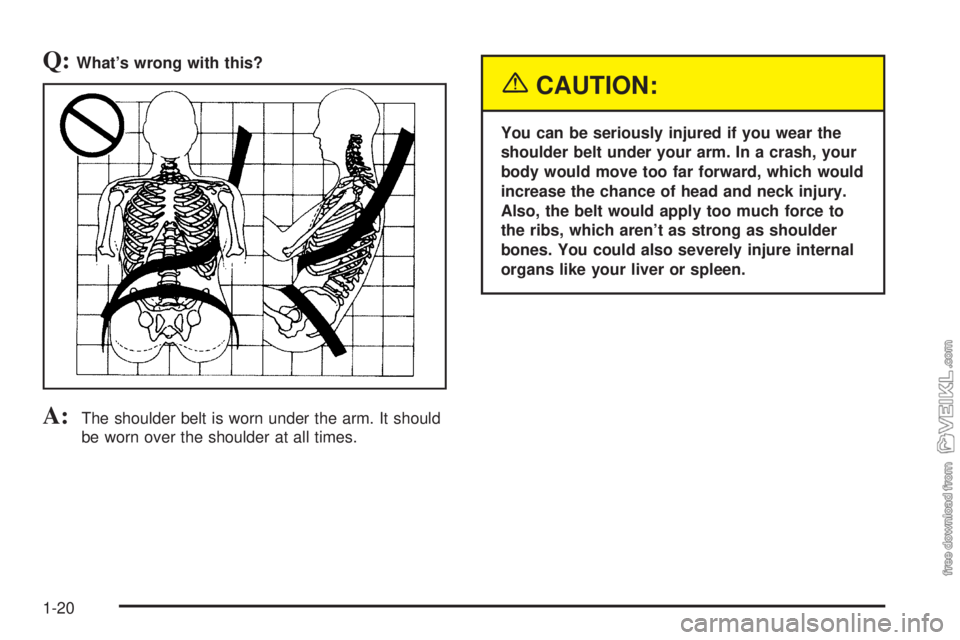
Q:What’s wrong with this?
A:The shoulder belt is worn under the arm. It should
be worn over the shoulder at all times.
{CAUTION:
You can be seriously injured if you wear the
shoulder belt under your arm. In a crash, your
body would move too far forward, which would
increase the chance of head and neck injury.
Also, the belt would apply too much force to
the ribs, which aren’t as strong as shoulder
bones. You could also severely injure internal
organs like your liver or spleen.
1-20
Page 27 of 348
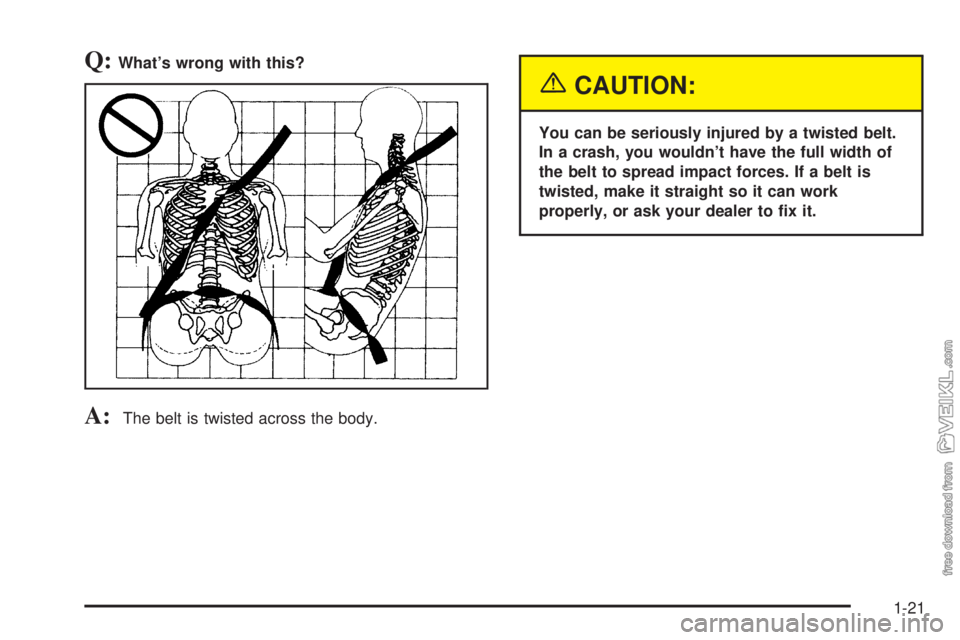
Q:What’s wrong with this?
A:The belt is twisted across the body.
{CAUTION:
You can be seriously injured by a twisted belt.
In a crash, you wouldn’t have the full width of
the belt to spread impact forces. If a belt is
twisted, make it straight so it can work
properly, or ask your dealer to x it.
1-21