2004 CHEVROLET BLAZER service indicator
[x] Cancel search: service indicatorPage 282 of 446
Additives
To provide cleaner air, all gasolines in the United States
are now required to contain additives that will help
prevent engine and fuel system deposits from forming,
allowing your emission control system to work properly.
You should not have to add anything to your fuel.
However, some gasolines contain only the minimum
amount of additive required to meet U.S. Environmental
Protection Agency regulations. General Motors
recommends that you buy gasolines that are advertised
to help keep fuel injectors and intake valves clean. If your
vehicle experiences problems due to dirty injectors or
valves, try a different brand of gasoline.
Gasolines containing oxygenates, such as ethers and
ethanol, and reformulated gasolines may be available in
your area to contribute to clean air. General Motors
recommends that you use these gasolines, particularly if
they comply with the specications described earlier.
Notice:Your vehicle was not designed for fuel that
contains methanol. Do not use fuel containing
methanol. It can corrode metal parts in your fuel
system and also damage the plastic and rubber
parts. That damage would not be covered under
your warranty.Some gasolines that are not reformulated for low
emissions may contain an octane-enhancing additive
called methylcyclopentadienyl manganese tricarbonyl
(MMT); ask the attendant where you buy gasoline
whether the fuel contains MMT. General Motors does
not recommend the use of such gasolines. Fuels
containing MMT can reduce the life of spark plugs and
the performance of the emission control system may
be affected. The malfunction indicator lamp may turn on.
If this occurs, return to your authorized GM dealer for
service.
Fuels in Foreign Countries
If you plan on driving in another country outside the
United States or Canada, the proper fuel may be hard
to nd. Never use leaded gasoline or any other fuel
not recommended in the previous text on fuel. Costly
repairs caused by use of improper fuel would not
be covered by your warranty.
To check the fuel availability, ask an auto club, or
contact a major oil company that does business in the
country where you will be driving.
5-6
Page 317 of 446

Brake Wear
If you have four-wheel drive, your vehicle has four-wheel
disc brakes. If not, your vehicle has front disc brakes
and rear drum brakes.
Disc brake pads have built-in wear indicators that make a
high-pitched warning sound when the brake pads are
worn and new pads are needed. The sound may come
and go or be heard all the time your vehicle is moving
(except when you are pushing on the brake pedal rmly).
{CAUTION:
The brake wear warning sound means that soon
your brakes will not work well. That could lead
to an accident. When you hear the brake wear
warning sound, have your vehicle serviced.
Notice:Continuing to drive with worn-out brake
pads could result in costly brake repair.
Some driving conditions or climates may cause a brake
squeal when the brakes are rst applied or lightly applied.
This does not mean something is wrong with your brakes.
Properly torqued wheel nuts are necessary to help
prevent brake pulsation. When tires are rotated, inspect
brake pads for wear and evenly tighten wheel nuts in
the proper sequence to GM torque specications.If you have rear drum brakes, they do not have wear
indicators, but if you ever hear a rear brake rubbing
noise, have the rear brake linings inspected immediately.
Also, the rear brake drums should be removed and
inspected each time the tires are removed for rotation
or changing. When you have the front brake pads
replaced, have the rear brakes inspected, too.
Brake linings should always be replaced as complete
axle sets.
SeeBrake System Inspection on page 6-32.
Brake Pedal Travel
See your dealer if the brake pedal does not return to
normal height, or if there is a rapid increase in
pedal travel. This could be a sign of brake trouble.
Brake Adjustment
Every time you make a brake stop, your disc brakes
adjust for wear.
If you do not have four-wheel drive and your brake
pedal goes down farther than normal, your rear drum
brakes may need adjustment. Adjust them by backing
up and rmly applying the brakes a few times.
5-41
Page 346 of 446
When It Is Time for New Tires
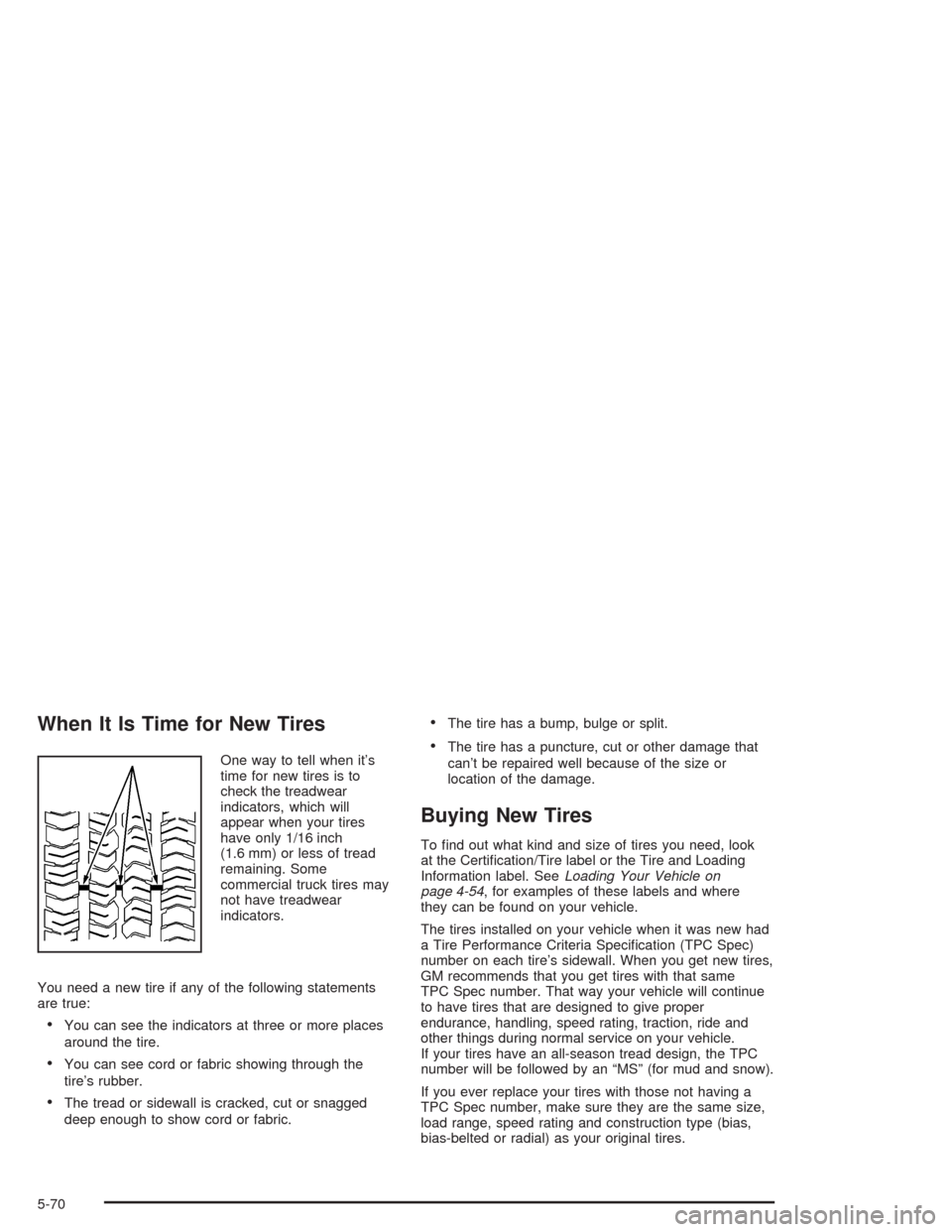
One way to tell when it’s
time for new tires is to
check the treadwear
indicators, which will
appear when your tires
have only 1/16 inch
(1.6 mm) or less of tread
remaining. Some
commercial truck tires may
not have treadwear
indicators.
You need a new tire if any of the following statements
are true:
You can see the indicators at three or more places
around the tire.
You can see cord or fabric showing through the
tire’s rubber.
The tread or sidewall is cracked, cut or snagged
deep enough to show cord or fabric.
The tire has a bump, bulge or split.
The tire has a puncture, cut or other damage that
can’t be repaired well because of the size or
location of the damage.
Buying New Tires
To nd out what kind and size of tires you need, look
at the Certication/Tire label or the Tire and Loading
Information label. SeeLoading Your Vehicle on
page 4-54, for examples of these labels and where
they can be found on your vehicle.
The tires installed on your vehicle when it was new had
a Tire Performance Criteria Specication (TPC Spec)
number on each tire’s sidewall. When you get new tires,
GM recommends that you get tires with that same
TPC Spec number. That way your vehicle will continue
to have tires that are designed to give proper
endurance, handling, speed rating, traction, ride and
other things during normal service on your vehicle.
If your tires have an all-season tread design, the TPC
number will be followed by an “MS” (for mud and snow).
If you ever replace your tires with those not having a
TPC Spec number, make sure they are the same size,
load range, speed rating and construction type (bias,
bias-belted or radial) as your original tires.
5-70
Page 438 of 446

Inspection (cont.)
Fuel System...............................................6-31
Part C - Periodic Maintenance.......................6-31
Steering, Suspension and Front Drive
Axle Boot and Seal..................................6-31
Throttle System...........................................6-32
Transfer Case and Front Axle
(Four-Wheel Drive)...................................6-32
Installing a Garage Door Opener.......................2-50
Instrument Panel
Cluster.......................................................3-22
Overview..................................................... 3-2
Instrument Panel Fuse Block............................5-99
Instrumental Panel Brightness...........................3-15
Interior Lamps................................................3-15
J
Jump Starting.................................................5-43
K
Key Lock Cylinders Service..............................6-28
Key Release Button........................................2-20
Keyless Entry System....................................... 2-4
Keys............................................................... 2-3
L
Lamps
Exterior......................................................3-12
Interior.......................................................3-15
Lamps On Reminder.......................................3-13
Lap Belt................................................1-21, 1-27
Lap-Shoulder Belt...........................................1-14
LATCH System
Child Restraints...........................................1-44
Securing a Child Restraint Designed for the
LATCH System........................................1-46
Leaving Your Vehicle.......................................2-10
Leaving Your Vehicle With the Engine Running......2-38
Light
Air Bag Readiness.......................................3-25
Anti-Lock Brake System Warning...................3-29
Brake System Warning.................................3-28
Charging System.........................................3-26
Check Gages Warning.................................3-35
Gate Ajar...................................................3-35
Low Fuel Warning.......................................3-36
Malfunction Indicator....................................3-30
Safety Belt Reminder...................................3-24
Security.....................................................3-34
Service Four-Wheel-Drive Warning Light.........3-34
Tow/Haul Mode...........................................3-35
Up-Shift.....................................................3-27
Loading Your Vehicle.......................................4-54
Loading Your Vehicle for Off-Road Driving..........4-16
8
Page 439 of 446

Locking Rear Axle...........................................4-10
Lockout Protection..........................................2-10
Locks
Door........................................................... 2-7
Leaving Your Vehicle....................................2-10
Lockout Protection.......................................2-10
Power Door.................................................. 2-8
Programmable Automatic Door Locks............... 2-8
Rear Door Security Locks.............................2-10
Long Trip/Highway Denition.............................. 6-6
Long Trip/Highway Intervals............................... 6-6
Long Trip/Highway Scheduled Maintenance........6-18
Loss of Control...............................................4-14
Low Fuel Warning Light...................................3-36
Luggage Carrier..............................................2-57
Lumbar
Power Controls............................................. 1-3
M
Maintenance Schedule
At Each Fuel Fill.........................................6-26
At Least Once a Month................................6-26
At Least Once a Year..................................6-28
At Least Twice a Year..................................6-27
Brake System Inspection..............................6-32
Engine Cooling System Inspection.................6-31
Exhaust System Inspection...........................6-31
Fuel System Inspection................................6-31Maintenance Schedule (cont.)
How This Section is Organized....................... 6-3
Introduction.................................................. 6-2
Long Trip/Highway Scheduled Maintenance.....6-18
Maintenance Requirements............................. 6-2
Normal Maintenance Replacement Parts.........6-35
Part A - Scheduled Maintenance Services......... 6-4
Part B - Owner Checks and Services.............6-26
Part C - Periodic Maintenance Inspections......6-31
Part D - Recommended Fluids
and Lubricants.........................................6-33
Part E - Maintenance Record........................6-37
Selecting the Right Schedule.......................... 6-5
Short Trip/City Scheduled Maintenance............. 6-6
Steering, Suspension and Front Drive Axle
Boot and Seal Inspection..........................6-31
Throttle System Inspection............................6-32
Transfer Case and Front Axle
(Four-Wheel Drive) Inspection....................6-32
Using Your................................................... 6-4
Your Vehicle and the Environment................... 6-2
Maintenance When Trailer Towing.....................4-71
Making Turns.................................................4-68
Malfunction Indicator Light................................3-30
Manual Seats................................................... 1-2
Manual Transmission.......................................2-21
Fluid..........................................................5-22
Operation...................................................2-26
Manual Transmission Check.............................6-27
Memory Seat.................................................2-64
9