Page 293 of 410
{CAUTION:
Adding only plain water to your cooling
system can be dangerous. Plain water, or
some other liquid such as alcohol, can boil
before the proper coolant mixture will. Your
vehicle’s coolant warning system is set for the
proper coolant mixture. With plain water or the
wrong mixture, your engine could get too hot
but you would not get the overheat warning.
Your engine could catch fire and you or others
could be burned. Use a 50/50 mixture of clean,
drinkable water and DEX-COOL
®coolant.Notice:In cold weather, water can freeze and crack
the engine, radiator, heater core and other parts.
Use the recommended coolant and the proper
coolant mixture.
{CAUTION:
You can be burned if you spill coolant on hot
engine parts. Coolant contains ethylene glycol
and it will burn if the engine parts are hot
enough. Do not spill coolant on a hot engine.
5-33
Page 294 of 410
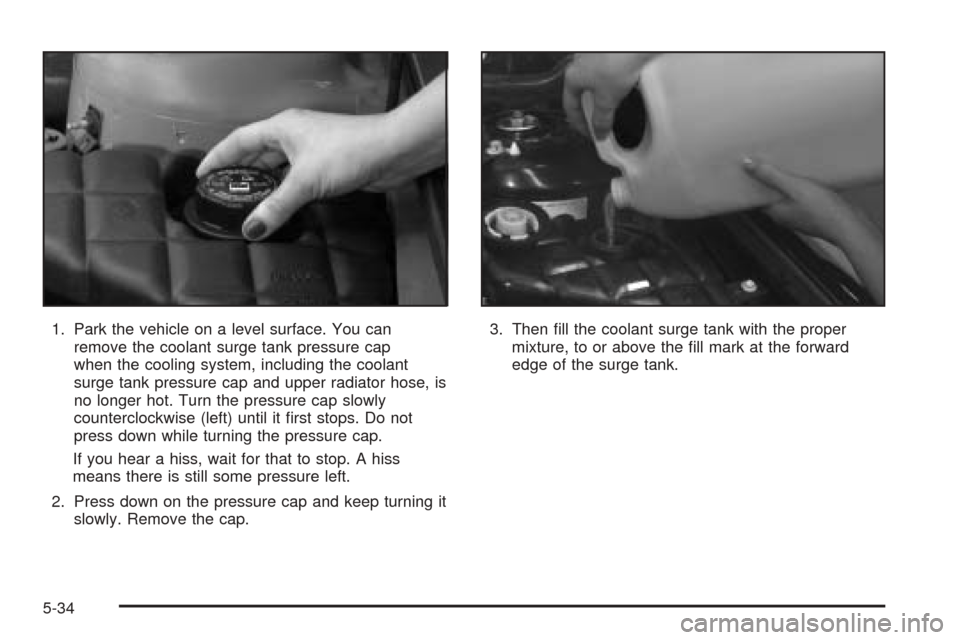
1. Park the vehicle on a level surface. You can
remove the coolant surge tank pressure cap
when the cooling system, including the coolant
surge tank pressure cap and upper radiator hose, is
no longer hot. Turn the pressure cap slowly
counterclockwise (left) until it first stops. Do not
press down while turning the pressure cap.
If you hear a hiss, wait for that to stop. A hiss
means there is still some pressure left.
2. Press down on the pressure cap and keep turning it
slowly. Remove the cap.3. Then fill the coolant surge tank with the proper
mixture, to or above the fill mark at the forward
edge of the surge tank.
5-34
Page 295 of 410
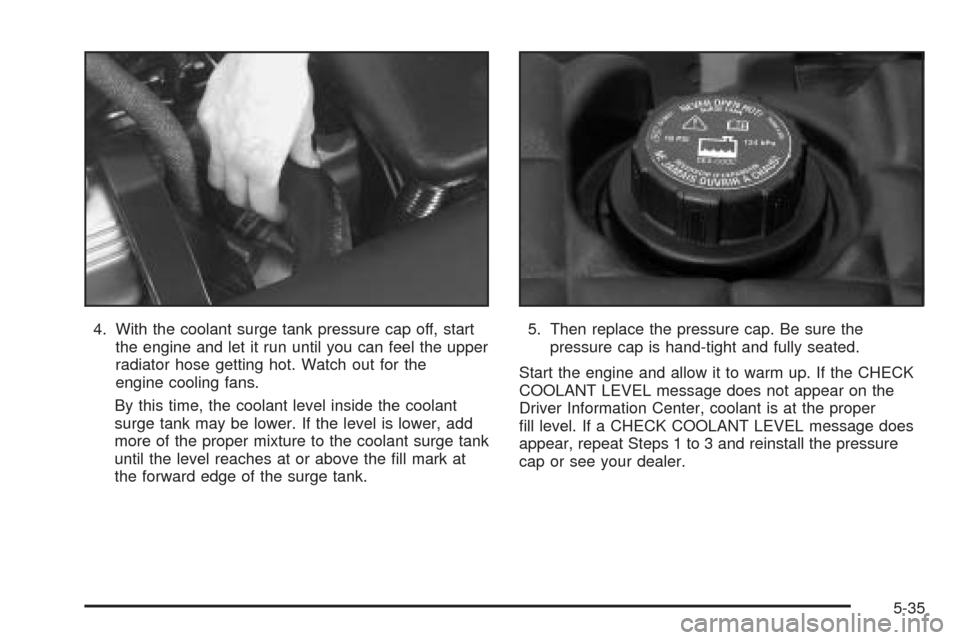
4. With the coolant surge tank pressure cap off, start
the engine and let it run until you can feel the upper
radiator hose getting hot. Watch out for the
engine cooling fans.
By this time, the coolant level inside the coolant
surge tank may be lower. If the level is lower, add
more of the proper mixture to the coolant surge tank
until the level reaches at or above the fill mark at
the forward edge of the surge tank.5. Then replace the pressure cap. Be sure the
pressure cap is hand-tight and fully seated.
Start the engine and allow it to warm up. If the CHECK
COOLANT LEVEL message does not appear on the
Driver Information Center, coolant is at the proper
fill level. If a CHECK COOLANT LEVEL message does
appear, repeat Steps 1 to 3 and reinstall the pressure
cap or see your dealer.
5-35
Page 336 of 410
If you need to replace any of your wheels, wheel bolts
or wheel nuts, replace them only with new GM
original equipment parts. This way, you will be sure to
have the right wheel, wheel bolts and wheel nuts
for your vehicle.
{CAUTION:
Using the wrong replacement wheels, wheel
bolts or wheel nuts on your vehicle can be
dangerous. It could affect the braking and
handling of your vehicle, make your tires lose
air and make you lose control. You could have
a collision in which you or others could be
injured. Always use the correct wheel, wheel
bolts and wheel nuts for replacement.
Notice:The wrong wheel can also cause problems
with bearing life, brake cooling, speedometer or
odometer calibration, headlamp aim, bumper height,
vehicle ground clearance and tire or tire chain
clearance to the body and chassis.
SeeChanging a Flat Tire on page 5-78for more
information.
Used Replacement Wheels
{CAUTION:
Putting a used wheel on your vehicle is
dangerous. You can’t know how it’s been used
or how far it’s been driven. It could fail
suddenly and cause a crash. If you have to
replace a wheel, use a new GM original
equipment wheel.
5-76
Page 359 of 410
Relays Usage
33 Not Used
34 Accessory
35 Not Used
36 Starter 1
37 Cooling Fan 1
38 Ignition 1
39 Cooling Fan Series/Parallel
40 Cooling Fan 2
Circuit
BreakersUsage
41 Starter
42 Export Use
Fuses Usage
43 Not Used
44 Antilock Brake System
45 Air Pump
46 Cooling Fan 1
47 Cooling Fan 2
The spare fuses are located in numbers 48 through 52.
The fuse puller is located in number 53.
Removing the Rear Seat Cushion
Notice:If you touch the exposed wires with
the metal on the seat cushion, you could cause a
short that could damage the battery and or
wires. Avoid contact between the rear seat and the
fuse center whenever you remove or reinstall
the rear seat. Do not remove covers from any of the
covered parts, and do not store anything under
the seats.
To remove the rear seat cushion, do the following:
1. Pull up on the front of the cushion to release the
front hooks.
2. Pull the cushion up and out toward the front of the
vehicle.
5-99
Page 364 of 410
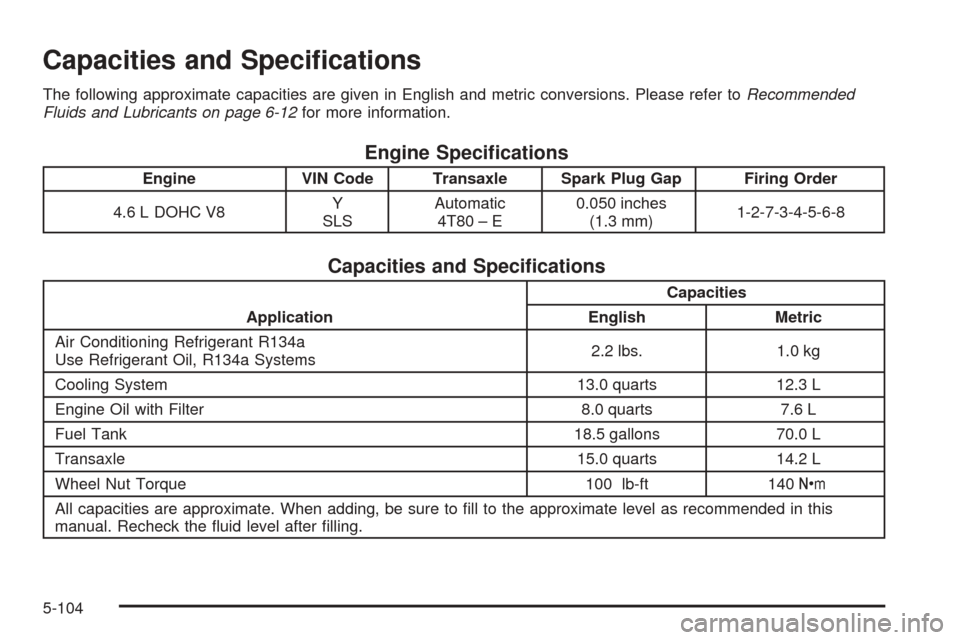
Capacities and Specifications
The following approximate capacities are given in English and metric conversions. Please refer toRecommended
Fluids and Lubricants on page 6-12for more information.
Engine Specifications
Engine VIN Code Transaxle Spark Plug Gap Firing Order
4.6 L DOHC V8Y
SLSAutomatic
4T80 – E0.050 inches
(1.3 mm)1-2-7-3-4-5-6-8
Capacities and Specifications
ApplicationCapacities
English Metric
Air Conditioning Refrigerant R134a
Use Refrigerant Oil, R134a Systems2.2 lbs. 1.0 kg
Cooling System 13.0 quarts 12.3 L
Engine Oil with Filter 8.0 quarts 7.6 L
Fuel Tank 18.5 gallons 70.0 L
Transaxle 15.0 quarts 14.2 L
Wheel Nut Torque 100 lb-ft 140Y
All capacities are approximate. When adding, be sure to fill to the approximate level as recommended in this
manual. Recheck the fluid level after filling.
5-104
Page 369 of 410
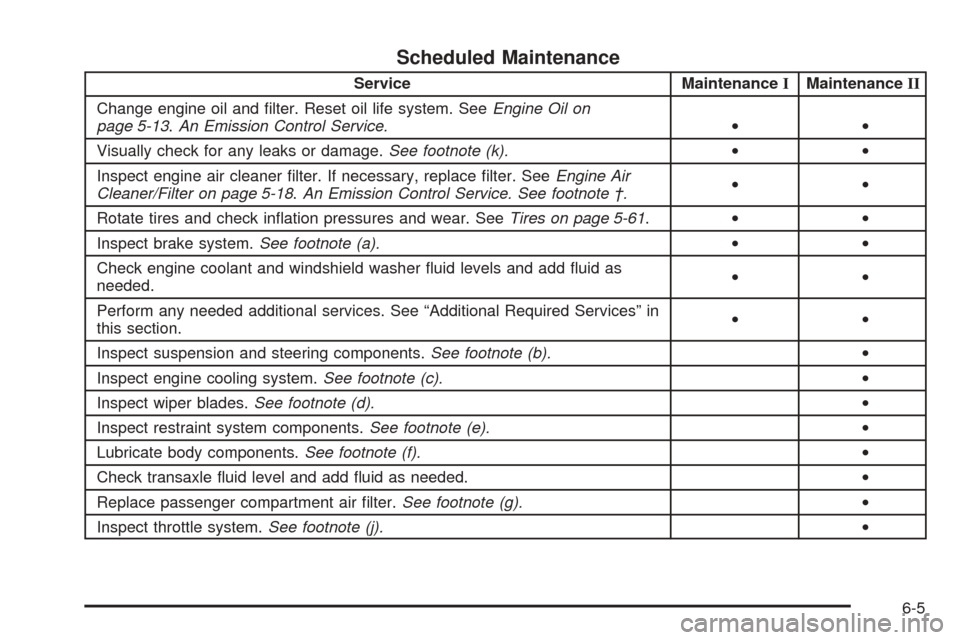
Scheduled Maintenance
Service MaintenanceIMaintenanceII
Change engine oil and filter. Reset oil life system. SeeEngine Oil on
page 5-13.An Emission Control Service.••
Visually check for any leaks or damage.See footnote (k).••
Inspect engine air cleaner filter. If necessary, replace filter. SeeEngine Air
Cleaner/Filter on page 5-18.An Emission Control Service. See footnote †.••
Rotate tires and check inflation pressures and wear. SeeTires on page 5-61.••
Inspect brake system.See footnote (a).••
Check engine coolant and windshield washer fluid levels and add fluid as
needed.••
Perform any needed additional services. See “Additional Required Services” in
this section.••
Inspect suspension and steering components.See footnote (b).•
Inspect engine cooling system.See footnote (c).•
Inspect wiper blades.See footnote (d).•
Inspect restraint system components.See footnote (e).•
Lubricate body components.See footnote (f).•
Check transaxle fluid level and add fluid as needed.•
Replace passenger compartment air filter.See footnote (g).•
Inspect throttle system.See footnote (j).•
6-5
Page 370 of 410
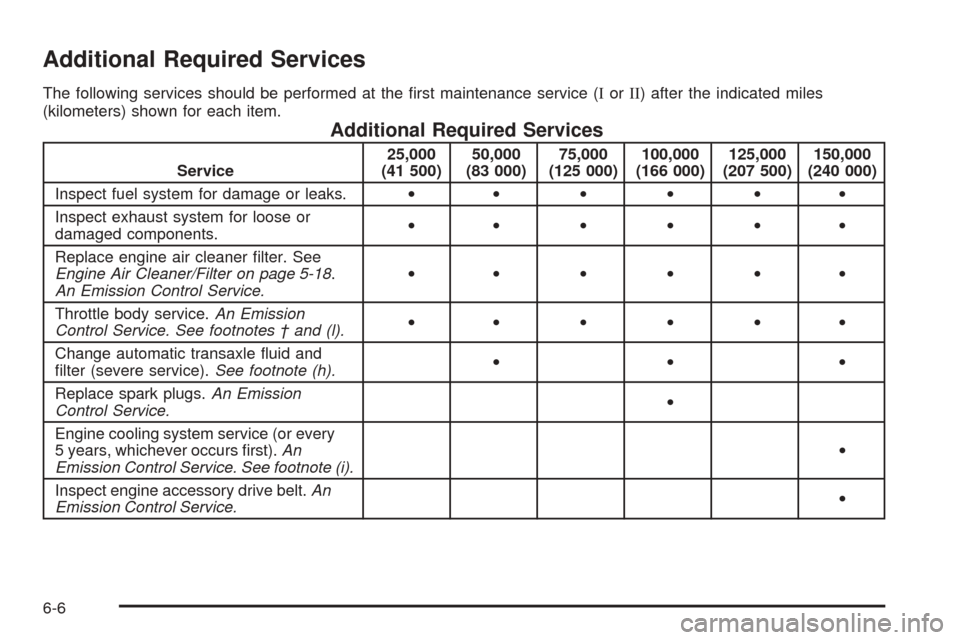
Additional Required Services
The following services should be performed at the first maintenance service (IorII) after the indicated miles
(kilometers) shown for each item.
Additional Required Services
Service25,000
(41 500)50,000
(83 000)75,000
(125 000)100,000
(166 000)125,000
(207 500)150,000
(240 000)
Inspect fuel system for damage or leaks.••••••
Inspect exhaust system for loose or
damaged components.••••••
Replace engine air cleaner filter. See
Engine Air Cleaner/Filter on page 5-18.
An Emission Control Service.••••••
Throttle body service.An Emission
Control Service. See footnotes † and (l).••••••
Change automatic transaxle fluid and
filter (severe service).See footnote (h).•••
Replace spark plugs.An Emission
Control Service.•
Engine cooling system service (or every
5 years, whichever occurs first).An
Emission Control Service. See footnote (i).•
Inspect engine accessory drive belt.An
Emission Control Service.•
6-6