2004 Acura RL airbag
[x] Cancel search: airbagPage 29 of 370

If a small child must ride in the
f ront, f ollow the instructions
provided in this section.
This page brief ly summarizes Acura’s
recommendations on where to place
rear-f acing and f orward-f acing child
seats in your car.
The passenger’s f ront airbag
inf lates with enough f orce to kill
or seriously injure an inf ant in a
rear-facing child seat. Never in the f ront seat, due
to the f ront airbag hazard.
Recommended positions.
Properlysecurearear-facingchild
seat (see page ).
Recommended
positions. Properly secure a
forward-facing child seat (see
page ).
A small child in a f orward-f acing
child seat is also at risk. If the
vehicle seat is too f ar f orward,
or the child’s head is thrown
f orward during a collision, an
inf lating f ront airbag can kill or
seriously injure the child. Not recommended,
due to the f ront airbag hazard. If a
small child must ride in f ront,
move the vehicle seat to the rear-
most position and secure a
forward-facing child seat with the
seat belt (see page ).
32 2832
Placing a Child Seat
Front Passenger’s Seat
Inf ant s:
Back Seat sInf ant s:
Small children:
Small children:
Airbags Pose Serious
Risks to Children
Protecting Children
Driver and Passenger Saf ety26
Page 31 of 370

Only a rear-f acing child seat provides
proper support f or a baby’s head,
neck, and back. Inf ants up to about
one year of age must be restrained in
a rear-f acing child seat.
Two types of seats may be used: a
seat designed exclusively f or inf ants,
or a convertible seat used in the rear-
f acing, reclining mode.If the passenger’s
f ront airbag inf lates, it can hit the
back of the child seat with enough
f orce to kill or seriously injure an
inf ant. If an inf ant must be closely
watched, we recommend that
another adult sit in the back seat
with the baby.
If placed
f acing f orward, an inf ant could be
very seriously injured during a
f rontal collision.
We recommend that an inf ant be
restrained in a rear-f acing child seat
until the inf ant is at least one year
old, reaches the seat maker’s weight
or height limit, and is able to sit up
without support. In this vehicle, a rear-f acing child
seatcanbeplacedinanyseating
position in the back, but not in the
front seat.
Protecting Inf ants
Child Seat T ype Rear-Facing Child Seat Placement
Never put a rear-f acing child seat inthe front seat.
Do not put a rear-f acing child seat ina f orward-f acing position.
Protecting Children
Driver and Passenger Saf ety28
Placing a rear-facing child seat
in the front seat can result in
serious injury or death if the
passenger’s front airbag inflates.
Always place a rear-facing child
seat in the back seat, not the
front.
Page 35 of 370

A child at least one year old who can
sit up without support, and who f its
within the child seat maker’s weight
and height limits, should be
restrained in a f orward-f acing,
upright child seat.
Of the different seats available, we
recommend those that have a f ive-
point harness system as shown.In this vehicle, the best place to
install a f orward-f acing child seat is
in one of the seating positions in the
back seat.
If the vehicle seat is
too far forward, or the child’s head is
thrown f orward during a collision, an
inflating front airbag can strike the
child with enough f orce to cause
very serious or f atal injuries. If a
small child must be closely watched,
we recommend that another adult sit
in the back seat with the child. If it is necessary to put a f orward-
f acing child seat in the f ront, move
the vehicle seat as far to the rear as
possible, be sure the child seat is
f irmly secured to the vehicle, and the
child is properly strapped in the seat.
Protecting Small Children
Child Seat T ype
Child Seat Placement
Placing a f orward-f acing child seat int he f ront seat of a vehicle equippedwit h a passenger’s f ront airbag canbe hazardous.
Protecting Children
Driver and Passenger Saf ety32
Improperly placing a forward-
facing child seat in the front
seat can result in serious injury
or death if the front airbags
inflate.
Ifyoumustplaceaforward-
facing child seat in front, move
the vehicle seat as far back as
possible and properly restrain
the child.
Page 38 of 370

If you are not wearing a seat
belt in a crash, you could be
thrown f orward into the
dashboard and crush the child.
During a crash, the
belt could press deep into the child
and cause very serious injuries. When a child reaches the
recommended weight or height limit
for a forward-facing child seat, the
child should sit in the back seat on a
booster and wear a lap/shoulder belt.
We recommend that the child use a
booster seat until the child is tall
enough to use the seat belt without a
booster.
The f ollowing pages give
instructions on how to check proper
seat belt f it, what kind of booster
seat to use if one is needed, and
important precautions f or a child
who must sit in the f ront seat.
If youarewearingaseatbelt,the
child can be torn f rom your arms
during a crash. For example, if
your car crashes into a parked
vehicleat30mph(48km/h),a
30-lb (14 kg) child will become a
900-lb (410 kg) f orce, and you will
not be able to hold on.
CONT INUED
Protecting L arger ChildrenA ddit ional Precaut ions f or Small
Children Never hold a small child on yourlap.
Never put a seat belt over yourselfand a child.
Protecting Children
Driver and Passenger Saf ety35
Allowing a larger child to sit
improperly in the front seat can
result in injury or death if the
passenger’s front airbag inflates.
If a larger child must sit in front,
make sure the child moves the
seat as far back as possible,
uses a booster seat if needed,
and wears the seat belt properly.
Page 40 of 370

The National Highway Traffic Safety
Administration and Transport
Canada recommend that all children
ages 12 and under be properly
restrained in a back seat.
The back seat is the safest place for
a child of any age or size.
In addition, the passenger’s f ront
airbag poses serious risks to children.
If the seat is too f ar f orward, or the
child’s head is thrown f orward
during a collision, or the child is
unrestrained or out of position, an
inf lating f ront airbag can kill or
seriously injure the child.
The side airbag also poses risks. If
any part of a larger child’s body is in
the path of a deploying airbag, the
child could receive possibly serious
injuries.
Whichever style you select, f ollow
the booster seat maker’s instructions. If a child needs a booster seat, we
recommend choosing a high or low-
back style that allows the child to be
directly secured with the lap/
shoulder belt. A child should continue using a
booster seat until the child exceeds
the booster seat manufacturer’s
requirements.
Even then, the child may still need to
use a booster seat. Note that some
states now require children to use
boosters until they reach a certain
ageand/orweight.Besuretocheck
current laws in the state or states
where you intend to drive.
CONT INUED
When Can a Larger Child Sit in Front
Using a Boost er Seat
Protecting Children
Driver and Passenger Saf ety37
Page 48 of 370
If the shoulder part of the belt is
pulled all the way out, the locking
mechanism will activate. The belt
will retract, but it will not allow the
passenger to move f reely.
To deactivate the locking
mechanism, unlatch the buckle and
let the seat belt f ully retract. To
ref asten the belt, pull it out only as
f ar as needed.
See page f or instructions on how
to wear the lap/shoulder belt
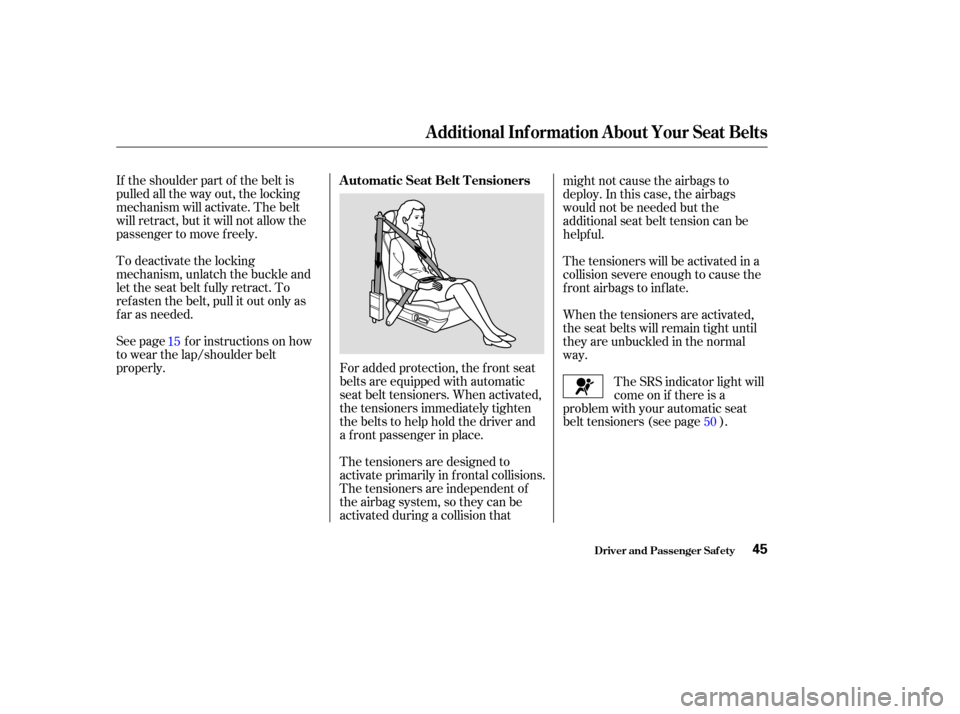
properly.For added protection, the f ront seat
belts are equipped with automatic
seat belt tensioners. When activated,
the tensioners immediately tighten
the belts to help hold the driver and
a f ront passenger in place.
The tensioners are designed to
activate primarily in f rontal collisions.
The tensioners are independent of
the airbag system, so they can be
activated during a collision that might not cause the airbags to
deploy. In this case, the airbags
would not be needed but the
additional seat belt tension can be
helpf ul.
The tensioners will be activated in a
collision severe enough to cause the
f ront airbags to inf late.
The SRS indicator light will
come on if there is a
problem with your automatic seat
belt tensioners (see page ). When the tensioners are activated,
the seat belts will remain tight until
they are unbuckled in the normal
way.
15
50
Driver and Passenger Saf ety
Additional Inf ormation About Your Seat Belts
A utomatic Seat Belt T ensioners
45
Page 50 of 370

Your Supplemental Restraint System
(SRS) includes:An indicator light on the
instrument panel that alerts you to
a possible problem with the
system (see page ).
Two f ront airbags. The driver’s
airbag is stored in the center of
the steering wheel; the f ront
passenger’sairbagisstoredinthe
dashboard. Both are marked ‘‘SRS
AIRBAG.’’
Sensors that can detect a
moderate to severe frontal
collision. Automatic seat belt tensioners
(see page ). Emergency backup power in case
your car’s electrical system is
disconnected in a crash.
A sophisticated electronic system
that continually monitors and
records inf ormation about the
sensors, the control unit, the
airbag activators, and driver and
passenger seat belt use when the
ignition is ON (II). If you ever have a moderate to
severe f rontal collision, the sensors
will detect the vehicle’s rapid
deceleration. If the rate of
deceleration is high enough, the
control unit will instantly inf late the
f ront airbags.
51
45
CONT INUED
SRS Components How Your Front A irbags Work
Driver and Passenger Saf ety
Additional Inf ormation About Your Airbags
47
Page 51 of 370

The total time for inflation and
def lation is approximately one-tenth
of a second, so f ast that most
occupants are not aware that the
airbags deployed until they see them
lying in their laps.
Since both airbags use the same
sensors, both airbags normally
inf late at the same time. However, it
is possible f or only one airbag to
inf late.
This can occur when the severity of
a collision is at the margin, or
threshold, that determines whether
or not the airbags will deploy. In
such cases, the seat belt will provide
suf f icient protection, and the
supplemental protection of f ered by
the airbag would be minimal.
Af ter inf lating, the f ront airbags
immediately def late, so they won’t
interf ere with the driver’s visibility,
or the ability to steer or operate
other controls.
During a f rontal crash, your seat
belts help restrain your lower body
and torso. Your airbag provides a
cushion to help restrain and protect
your head and chest.
After a crash, you may see what
looks like smoke. This is actually
powder f rom the airbag’s surf ace.
Although the powder is not harmf ul,
people with respiratory problems
mayexperiencesometemporary
discomf ort. If this occurs, get out of
the vehicle as soon as it is saf e to do
so.
Driver and Passenger Saf ety
Additional Inf ormation About Your Airbags
48