Page 58 of 134
3-1
E
EJU01041
Fuel and oil
This engine uses Yamaha’s oil injection
system, which provides superior lubrication
by ensuring the proper oil ratio for all operat-
ing conditions. No fuel premixing is neces-
sary except during the engine break-in
period. Simply pour gasoline into the fuel
tank and oil into the oil tank.
EJU01911
Gasoline
WARNING@ GASOLINE AND ITS VAPORS ARE
HIGHLY FLAMMABLE AND EXPLOSIVE!
�Do not smoke when refueling, and
keep away from sparks, flames, or
other sources of ignition.
�Stop engine before refueling.
�Refuel in a well-ventilated area with
the watercraft in a horizontal position.
�Do not stand or sit on the watercraft
while refueling in case of fire.
�Take care not to spill gasoline. If gaso-
line spills, wipe it up immediately with
dry rags. Always properly dispose of
gasoline-soaked rags.
�Avoid overfilling the fuel tank. Stop fill-
ing when the fuel level just reaches the
bottom of the filler tube. Do not fill up
the filler tube because fuel expands as
it warms up and could overflow. If tem-
porarily leaving the watercraft with a
full fuel tank, do not leave it in direct
sunlight. Leave it in a well-ventilated
area with the watercraft in a horizontal
position.
�Tighten the filler cap securely after
refueling.
�If you should swallow some gasoline,
inhale a lot of gasoline vapor, or get
gasoline in your eyes, get immediate
medical attention.
UGU572.book Page 1 Wednesday, August 28, 2002 1:31 PM
Page 62 of 134

3-5
E
EJU01346
Pre-operation checks
EJU01347
Pre-operation check list
Before operating this watercraft, perform the checks in the following check list. See the
accompanying text in this chapter for details on how to perform the checks.
WARNING@ If any item in the pre-operation check list is not working properly, have it inspected
and repaired before operating the watercraft, otherwise an accident could occur.
@
NOTE:@ Pre-operation checks should be made thoroughly each time the watercraft is used. This pro-
cedure can be completed in a short time. It is worth the time spent to assure safety and reli-
ability.
@
ITEM ROUTINE PAGE
Engine compartment Remove all seats to ventilate the engine com-
partment. Check for fuel vapors or loose electri-
cal connections3-6
Bilge Check for water and fuel residue and remove if
necessary3-7
Throttle Check that the throttle lever springs back 3-10
Steering system Check for proper steering system operation 3-10
Shift lever and reverse gate Check for proper operation 3-11
Fuel and oil Check fuel and oil level and add if necessary
Check hoses and tanks for leakage3-6
Water separator Check for water and drain if necessary 3-7
Battery Check electrolyte level and battery condition 3-8
Front and rear seats Check that the seats are properly secured 2-4–2-5
Hull/Deck Check the hull and deck for cracks or other dam-
age—
Jet unit Check for debris and remove if necessary 3-12
Fire extinguisher Check the condition and replace if necessary 3-9
Engine shut-off cord Check condition and replace is frayed or broken 3-12
Switches Check the start switch, engine stop switch and
engine shut-off switch for proper operation when
the watercraft is in the water3-13
Cooling water pilot outlet Check that water is discharged while the engine
is running and the watercraft is in the water3-13
Multifunction meter Check for warning indications and proper opera-
tion3-13
UGU572.book Page 5 Wednesday, August 28, 2002 1:31 PM
Page 64 of 134
3-7
E
EJU01961
Water separator
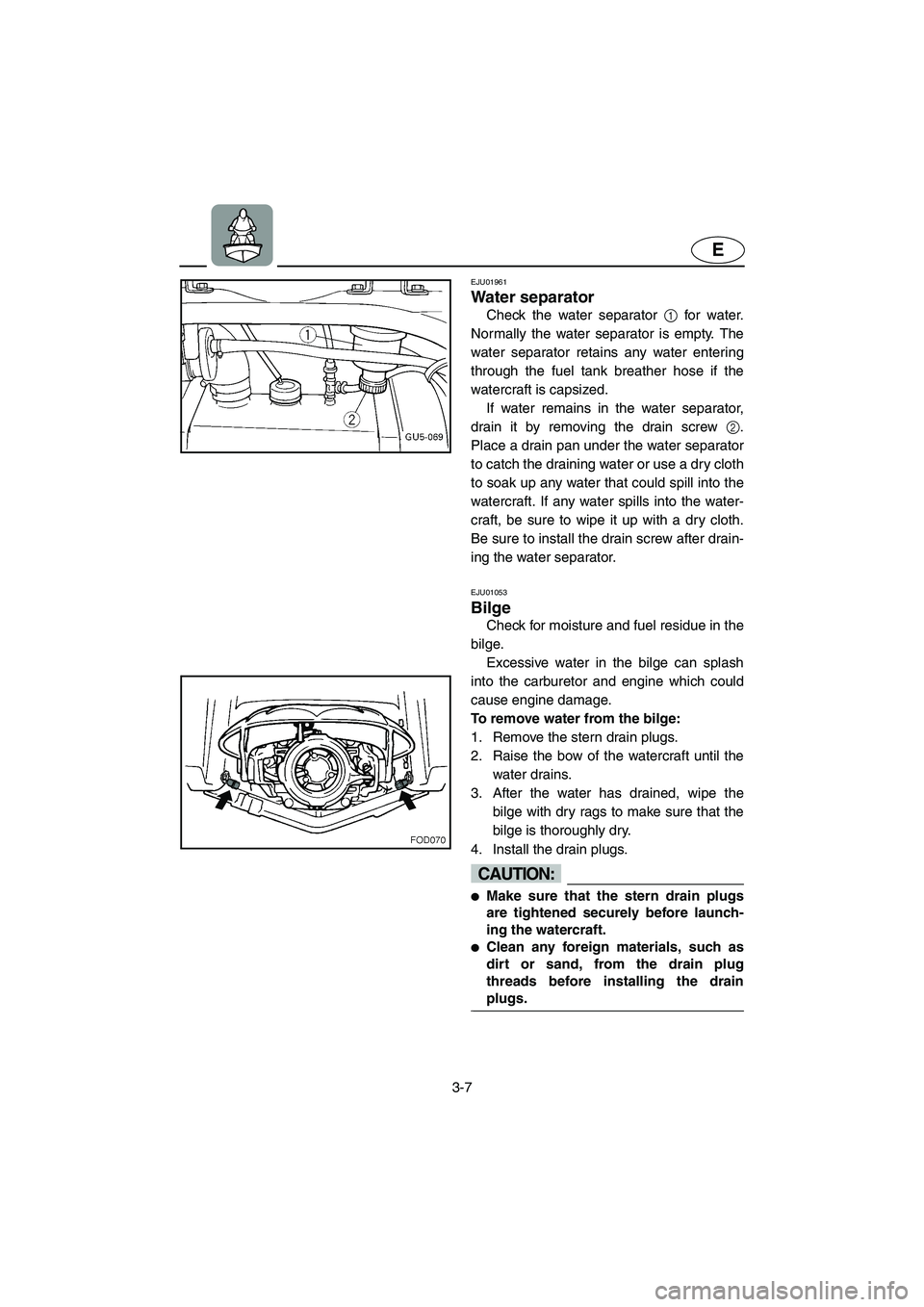
Check the water separator 1 for water.
Normally the water separator is empty. The
water separator retains any water entering
through the fuel tank breather hose if the
watercraft is capsized.
If water remains in the water separator,
drain it by removing the drain screw 2.
Place a drain pan under the water separator
to catch the draining water or use a dry cloth
to soak up any water that could spill into the
watercraft. If any water spills into the water-
craft, be sure to wipe it up with a dry cloth.
Be sure to install the drain screw after drain-
ing the water separator.
EJU01053
Bilge
Check for moisture and fuel residue in the
bilge.
Excessive water in the bilge can splash
into the carburetor and engine which could
cause engine damage.
To remove water from the bilge:
1. Remove the stern drain plugs.
2. Raise the bow of the watercraft until the
water drains.
3. After the water has drained, wipe the
bilge with dry rags to make sure that the
bilge is thoroughly dry.
4. Install the drain plugs.
CAUTION:@ �Make sure that the stern drain plugs
are tightened securely before launch-
ing the watercraft.
�Clean any foreign materials, such as
dirt or sand, from the drain plug
threads before installing the drain
plugs.
@
UGU572.book Page 7 Wednesday, August 28, 2002 1:31 PM
Page 65 of 134
3-8
E
EJU01969
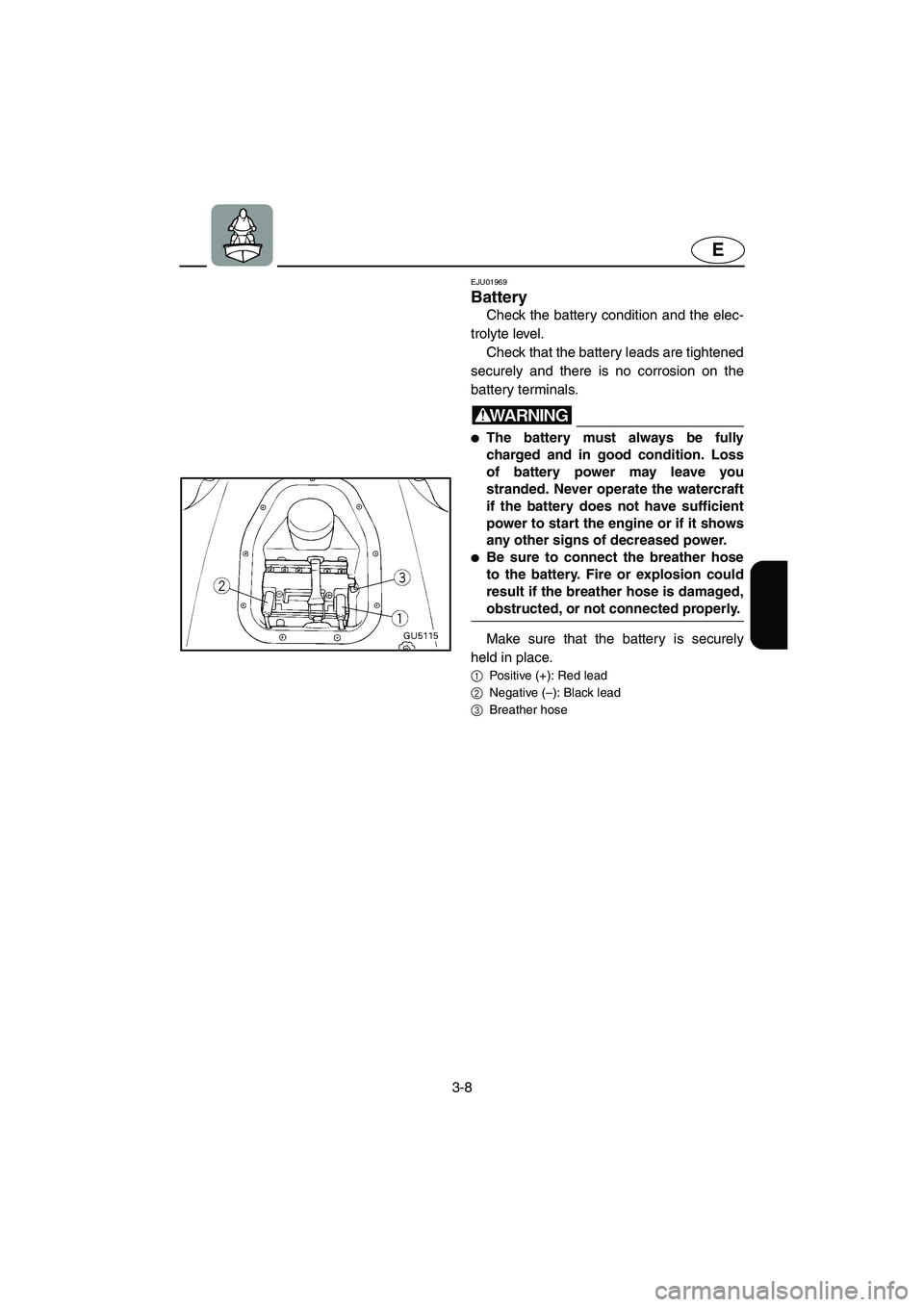
Battery
Check the battery condition and the elec-
trolyte level.
Check that the battery leads are tightened
securely and there is no corrosion on the
battery terminals.
WARNING@ �The battery must always be fully
charged and in good condition. Loss
of battery power may leave you
stranded. Never operate the watercraft
if the battery does not have sufficient
power to start the engine or if it shows
any other signs of decreased power.
�Be sure to connect the breather hose
to the battery. Fire or explosion could
result if the breather hose is damaged,
obstructed, or not connected properly.
@
Make sure that the battery is securely
held in place.
1
Positive (+): Red lead
2
Negative (–): Black lead
3
Breather hose
UGU572.book Page 8 Wednesday, August 28, 2002 1:31 PM
Page 66 of 134
3-9
E
F0P03010
EJU01319
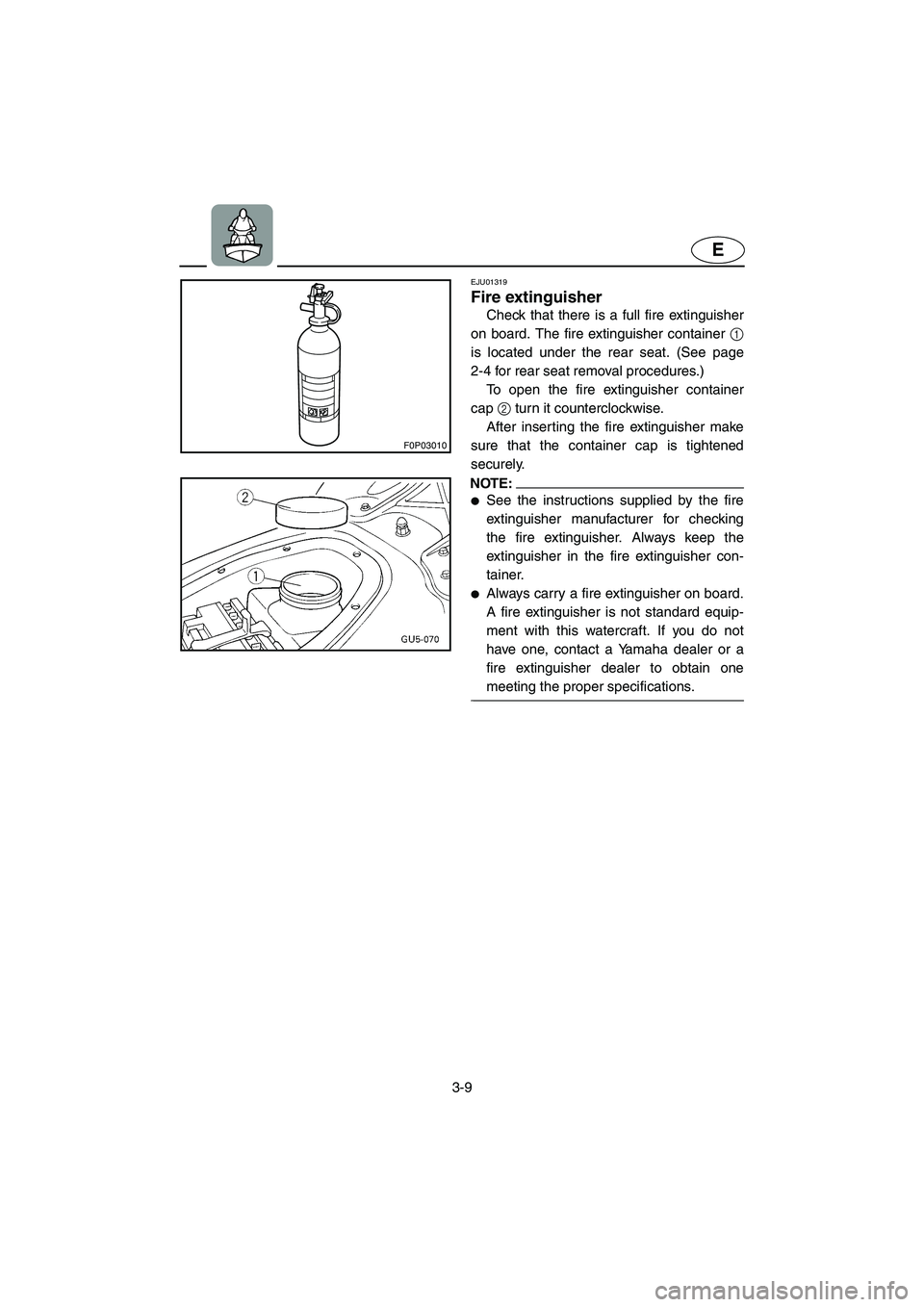
Fire extinguisher
Check that there is a full fire extinguisher
on board. The fire extinguisher container 1
is located under the rear seat. (See page
2-4 for rear seat removal procedures.)
To open the fire extinguisher container
cap 2 turn it counterclockwise.
After inserting the fire extinguisher make
sure that the container cap is tightened
securely.
NOTE:@ �See the instructions supplied by the fire
extinguisher manufacturer for checking
the fire extinguisher. Always keep the
extinguisher in the fire extinguisher con-
tainer.
�Always carry a fire extinguisher on board.
A fire extinguisher is not standard equip-
ment with this watercraft. If you do not
have one, contact a Yamaha dealer or a
fire extinguisher dealer to obtain one
meeting the proper specifications.
@
UGU572.book Page 9 Wednesday, August 28, 2002 1:31 PM
Page 71 of 134
3-14
E
EJU01836
Operation
WARNING@ Before operating your watercraft,
become familiar with all controls. Con-
sult your Yamaha dealer about any con-
trol or function you do not fully
understand. Failure to understand how
controls work could cause an accident or
prevent you from avoiding an accident.
@
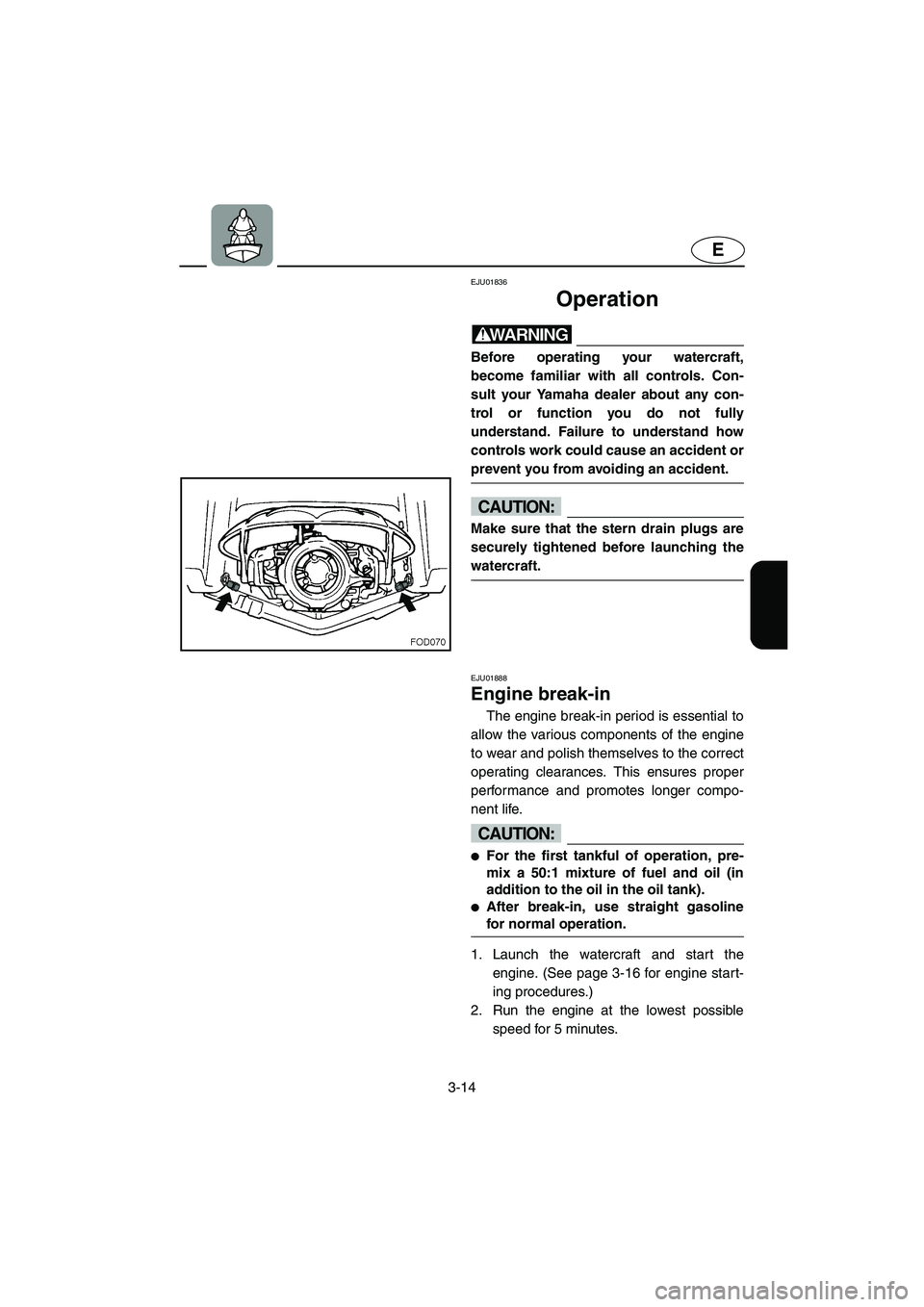
CAUTION:@ Make sure that the stern drain plugs are
securely tightened before launching the
watercraft.
@
EJU01888
Engine break-in
The engine break-in period is essential to
allow the various components of the engine
to wear and polish themselves to the correct
operating clearances. This ensures proper
performance and promotes longer compo-
nent life.
CAUTION:@ �For the first tankful of operation, pre-
mix a 50:1 mixture of fuel and oil (in
addition to the oil in the oil tank).
�After break-in, use straight gasoline
for normal operation.
@
1. Launch the watercraft and start the
engine. (See page 3-16 for engine start-
ing procedures.)
2. Run the engine at the lowest possible
speed for 5 minutes.
UGU572.book Page 14 Wednesday, August 28, 2002 1:31 PM
Page 82 of 134
3-25
E
EJU01323
Boarding with passengers
WARNING@ Severe internal injuries can occur if
water is forced into body cavities as a
result of being near the jet thrust nozzle.
Do not apply throttle until each passen-
ger is seated with his or her feet on the
floor of the footwell and is holding on to
the person in front of him or her or to the
side grips appropriately.
@
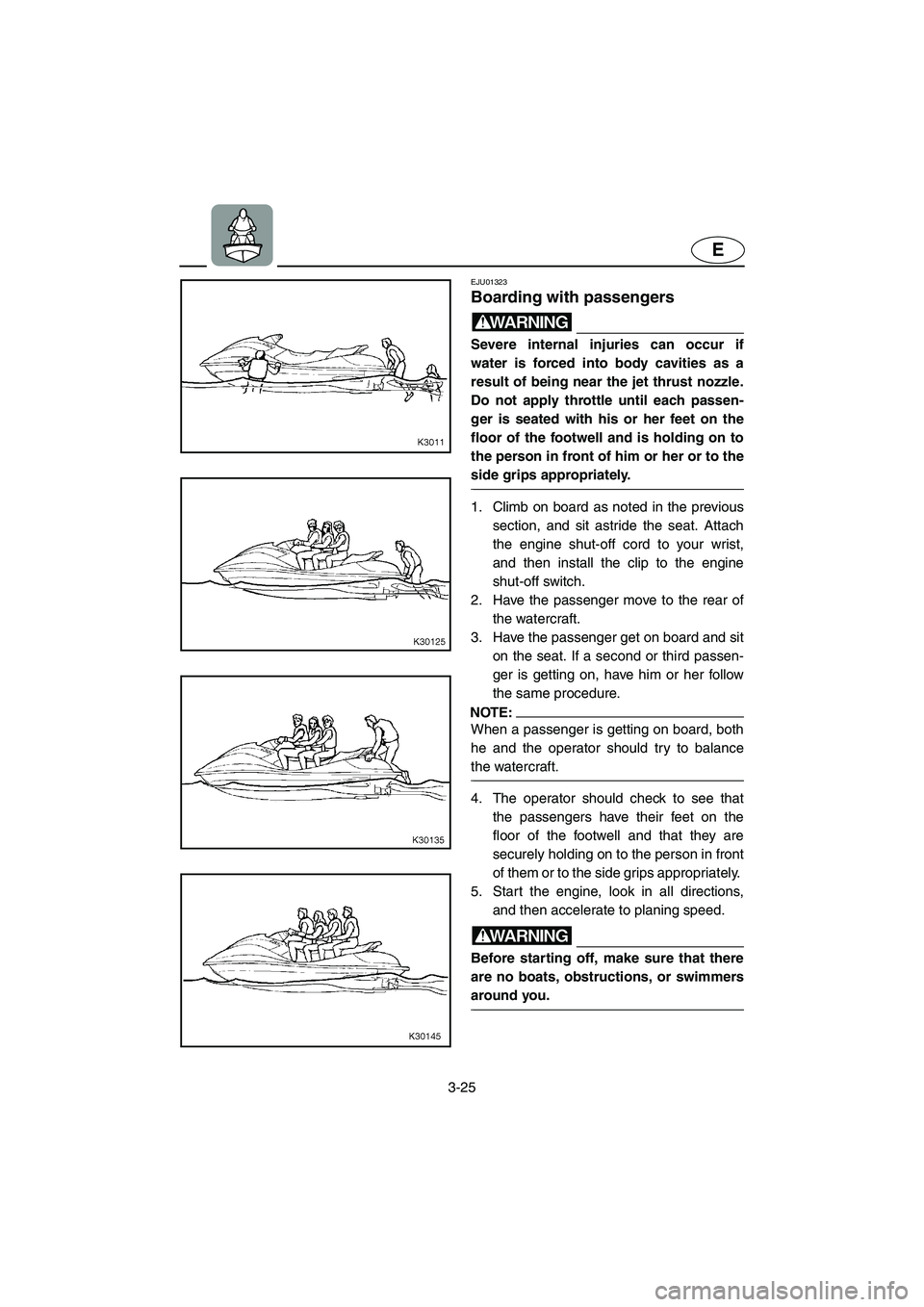
1. Climb on board as noted in the previous
section, and sit astride the seat. Attach
the engine shut-off cord to your wrist,
and then install the clip to the engine
shut-off switch.
2. Have the passenger move to the rear of
the watercraft.
3. Have the passenger get on board and sit
on the seat. If a second or third passen-
ger is getting on, have him or her follow
the same procedure.
NOTE:@ When a passenger is getting on board, both
he and the operator should try to balance
the watercraft.
@
4. The operator should check to see that
the passengers have their feet on the
floor of the footwell and that they are
securely holding on to the person in front
of them or to the side grips appropriately.
5. Start the engine, look in all directions,
and then accelerate to planing speed.
WARNING@ Before starting off, make sure that there
are no boats, obstructions, or swimmers
around you.
@
UGU572.book Page 25 Wednesday, August 28, 2002 1:31 PM
Page 92 of 134
3-35
E
EJU01256
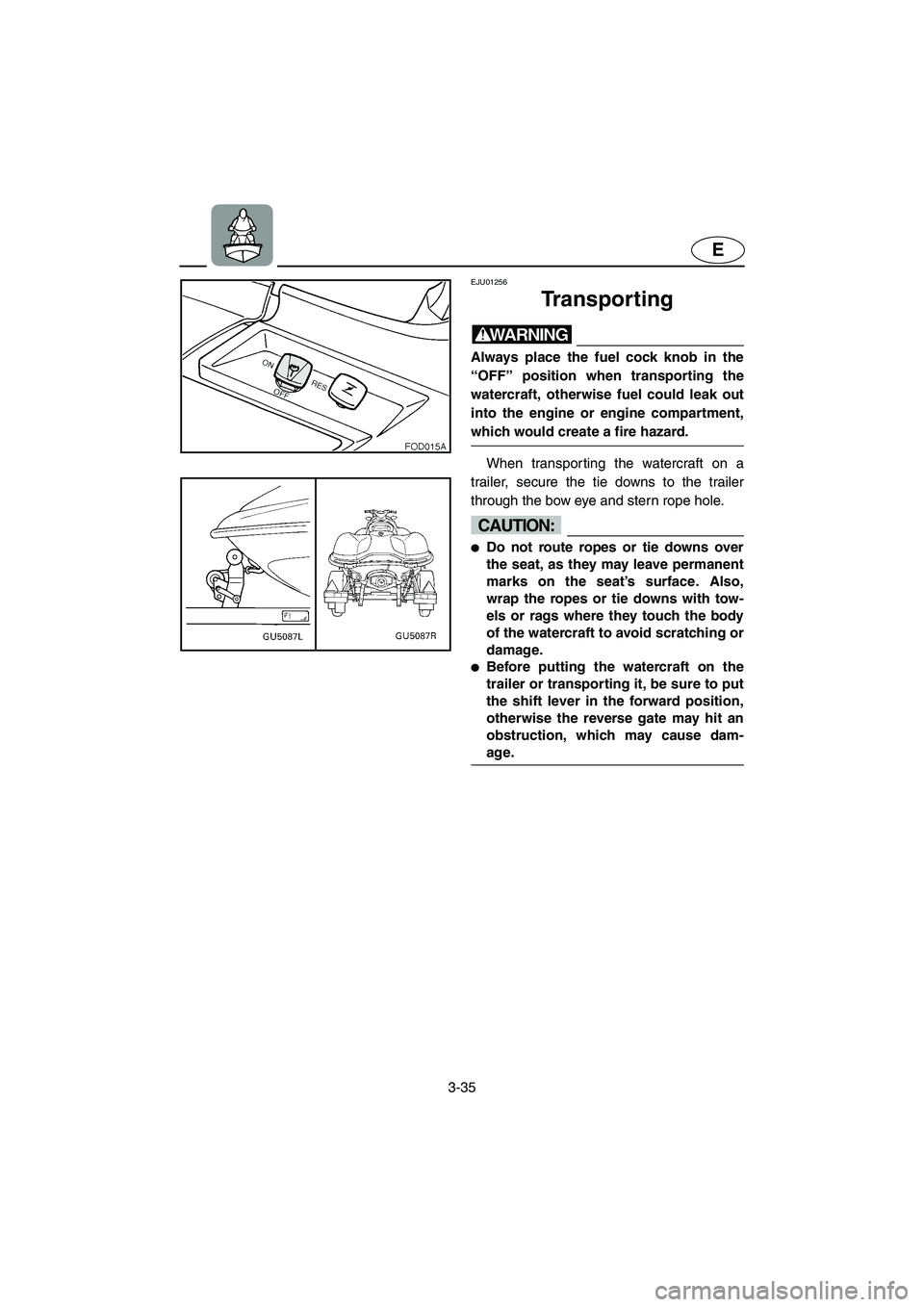
Transporting
WARNING@ Always place the fuel cock knob in the
“OFF” position when transporting the
watercraft, otherwise fuel could leak out
into the engine or engine compartment,
which would create a fire hazard.
@
When transporting the watercraft on a
trailer, secure the tie downs to the trailer
through the bow eye and stern rope hole.
CAUTION:@ �Do not route ropes or tie downs over
the seat, as they may leave permanent
marks on the seat’s surface. Also,
wrap the ropes or tie downs with tow-
els or rags where they touch the body
of the watercraft to avoid scratching or
damage.
�Before putting the watercraft on the
trailer or transporting it, be sure to put
the shift lever in the forward position,
otherwise the reverse gate may hit an
obstruction, which may cause dam-
age.
@
UGU572.book Page 35 Wednesday, August 28, 2002 1:31 PM