2003 VOLVO XC70 fuel
[x] Cancel search: fuelPage 172 of 257

2003 VOLVO XC70
Ordinary fuses
Location Amperage
1 Rear electrical module, cargo area lighting 10A
2 Rear fog light 10A
3 Brake lights 15A
4 Backup lights 10A
5 Rear window defroster, relay 15I -
accessories 5A
6 Unlocking tailgate 10A
7 Auxiliary 12 volt socket in cargo area
(option) 15A
8 Central locking rear doors/fuel filler door 20A
9 Trailer (30 feed) 15A
10 CD changer, VNS 10A
11 Accessory control module (AEM) 15A
12 Tailgate wiper 15A
13 Loudspeaker (subwoofer) cargo area -
option 15A
14 Brake lights 7.5A
15 Trailer (15I feed) 20A
16 -
17 All Wheel Drive control module 7.5A
18 -
pg. 120 Replacing bulbs
file:///K|/ownersdocs/2003/2003_XC70/03xc70_08a.htm (7 of 21)12/30/200\
6 4:18:03 PM
Page 187 of 257

2003 VOLVO XC70
pg. 130 Fuel/emissions systems
Fuel system
The fuel system continually compensates for variation in engine load, sp\
eed and temperature. A mass air
flow sensor continuously measures the inducted air and makes rapid adjus\
tments for changes in air
temperature and density, to balance fuel economy, emissions, and engine \
power requirements.
Heated oxygen sensor
This is an emission control system designed to reduce emissions and impr\
ove fuel economy. The heated
oxygen sensor monitors the composition of the exhaust gases leaving the \
engine. The exhaust gas
analysis is fed into an electronic module. This adjusts the air/fuel rat\
io to improve combustion and
reduce the three major pollutants (hydrocarbons, carbon monoxide, and o\
xides of nitrogen (NOx)) via a
three-way catalytic converter.
Crankcase ventilation
The engine is provided with positive crankcase ventilation which prevent\
s crankcase gases from being
released into the atmosphere. Instead, the crankcase gases are routed to\
the intake manifold and
cylinders.
PremAir®
On the surface of the radiator in the engine compartment, there is a spe\
cial coating called PremAir®.
PremAir® works as a catalytic converter, converting most of the ozone\
passing through the radiator into
oxygen, thereby reducing harmful ground-level ozone.
Evaporative control system
The car is equipped with an evaporative control system, which prevents g\
asoline vapor from being
released into the atmosphere.
The system consists of a fuel tank with filler pipe and cap, two rollove\
r valves, a Fill Limit Vent Valve
(FLVV), vapor vent lines, a charcoal canister, a purge line, and a pur\
ge control valve and engine
connections. In addition, there is a pressure sensor connected to the fu\
el tank and a filter-protected
Canister Close Valve (CCV) on the atmospheric side of the canister, fo\
r system diagnosis.
The gasoline vapor is channeled through the rollover valves and the FLVV\
via the vapor vent lines into
the charcoal canister, where it is stored. When the engine is started, t\
he gasoline vapor is drawn from the
file:///K|/ownersdocs/2003/2003_XC70/03xc70_08b.htm (1 of 16)12/30/200\
6 4:18:04 PM
Page 188 of 257

2003 VOLVO XC70
charcoal canister to the engine's air intake system and into the combust\
ion process.
NOTE:
l Overfilling the fuel tank can cause damage to the evaporative control sy\
stem.
l If the fuel filler cap is not closed tightly or if the engine is running\
when the car is refueled, the
Malfunction Indicator Lamp may indicate a fault.
l During a transitional period, a small number of service stations may sti\
ll have fuel nozzles that are not
compatible with the fuel filler neck on cars equipped with the evaporati\
ve emission control system
mandated by the U.S. Environmental Protection Agency and the California \
Air Resources Board. If you
experience difficulties in refueling your vehicle, please ask the gas st\
ation attendant for assistance.
CAUTION:
Fuel must not be siphoned from the fuel tank. This will damage the evapo\
rative control system.
pg. 131 Drive belt, Coolant
Belt check
Check the belt regularly to make sure it is in good condition and is cle\
an. A worn or dirty belt can cause
poor cooling and low alternator output as well as impair the operation o\
f the power steering and the air
conditioning unit.
NOTE: The drive belt is equipped with a self-tensioning mechanism and requires\
no adjustment
between changes.
WARNING!
The engine must not be running when this check is
performed.
Check coolant level
The cooling system must be filled with coolant and not leak to operate a\
t maximum efficiency. Check
the coolant level regularly. The level should be between the "MAX" and "\
MIN" marks on the expansion
tank. The check should be made with particular thoroughness when the eng\
ine is new or when the
cooling system has been drained. Do not remove the filler cap other than\
for topping up with coolant.
Frequent removal may prevent coolant circulation between the engine and \
the expansion tank during
file:///K|/ownersdocs/2003/2003_XC70/03xc70_08b.htm (2 of 16)12/30/200\
6 4:18:04 PM
Page 190 of 257

2003 VOLVO XC70
more often when the vehicle is driven under dirty and dusty conditions. \
The cartridge cannot be cleaned,
and should always be replaced with a new one.
Fuel filter
The fuel filter should be replaced at 105,000 miles (168,000 km) or at\
120,000 miles (193,000 km) for
the 2.5T engine on AWD models. The filter is replaced as a complete unit\
. Replace more frequently if
contaminated fuel is introduced into the tank, or if there is reason to \
suspect that this has occurred.
Fuel system, including filler cap, tank and lines and
connections
The ability of the fuel system to contain hydrocarbons depends upon a le\
ak-free system. Inspect fuel
lines every 30,000 miles (48,000 km).Check for proper sealing of the f\
uel filler cap which contains "O"
ring seals.
NOTE: If the fuel filler cap is not closed tightly or if the engine is running\
when the car is refueled, the
Check Engine light (Malfunction indicator) may indicate a fault. Howev\
er, your vehicle's performance
will not be affected. Use only Volvo original or approved fuel filler ca\
ps.
Timing belt
For proper functioning of the vehicle and its emission control systems, \
the timing belt and belt tensioner
must be replaced every 105,000 miles (168,000 km) or at 120,000 miles \
(193,000 km) for the 2.5T
engine on AWD models. Engine damage will occur if the belt fails.
PCV system
(on turbocharged models)
The nipple in the intake manifold and the filter at the end of the PCV h\
ose in the air cleaner should be
inspected and cleaned at 105,000 miles (168,000 km) and thereafter, ag\
ain at 150,000 mile (240,000 km)
intervals.
Spark plugs
The spark plugs should be replaced every 60,000 miles (96,000 km) unde\
r normal driving conditions.
City driving or fast highway driving may necessitate replacement sooner.\
Under normal driving conditions, spark plugs require no maintenance betw\
een replacement intervals.
file:///K|/ownersdocs/2003/2003_XC70/03xc70_08b.htm (4 of 16)12/30/200\
6 4:18:04 PM
Page 193 of 257
2003 VOLVO XC70
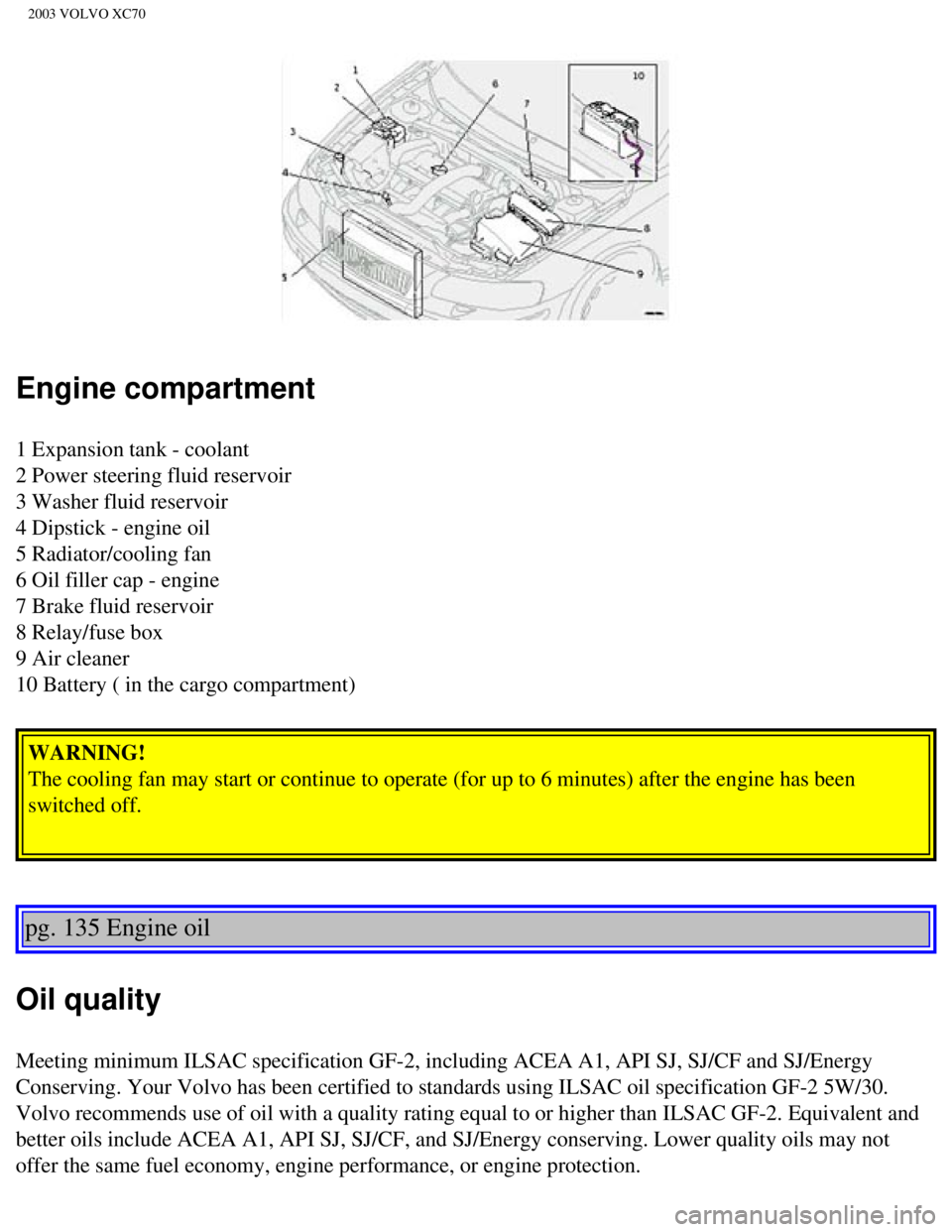
Engine compartment
1 Expansion tank - coolant
2 Power steering fluid reservoir
3 Washer fluid reservoir
4 Dipstick - engine oil
5 Radiator/cooling fan
6 Oil filler cap - engine
7 Brake fluid reservoir
8 Relay/fuse box
9 Air cleaner
10 Battery ( in the cargo compartment) WARNING!
The cooling fan may start or continue to operate (for up to 6 minutes)\
after the engine has been
switched off.
pg. 135 Engine oil
Oil quality
Meeting minimum ILSAC specification GF-2, including ACEA A1, API SJ, SJ/\
CF and SJ/Energy
Conserving. Your Volvo has been certified to standards using ILSAC oil s\
pecification GF-2 5W/30.
Volvo recommends use of oil with a quality rating equal to or higher tha\
n ILSAC GF-2. Equivalent and
better oils include ACEA A1, API SJ, SJ/CF, and SJ/Energy conserving. Lo\
wer quality oils may not
offer the same fuel economy, engine performance, or engine protection. \
file:///K|/ownersdocs/2003/2003_XC70/03xc70_08b.htm (7 of 16)12/30/200\
6 4:18:04 PM
Page 194 of 257

2003 VOLVO XC70
Volvo Cars recommends Castrol.
Depending on your driving habits, premium or synthetic oils may provide \
superior fuel economy and
engine protection. Consult your Volvo retailer for recommendations on pr\
emium or synthetic oils.
Oil additives must not be used.
NOTE: Synthetic oil is not used when the oil is changed at the normal maintena\
nce services. This oil is
only used at customer request, at additional charge. Please consult your\
Volvo retailer.
Oil viscosity (stable ambient temperatures)
Operation in temperate climates
Incorrect viscosity oil can shorten engine life. Under normal use when t\
emperatures do not exceed 86 °F
(30°C), SAE 5W/30 will provide good fuel economy and engine protect\
ion. See the viscosity chart
below.
Operation in hot climates
When temperatures exceed 86 °F (30°C) in your area, Volvo recomm\
ends, for the protection of your
engine, that you use a heavier weight oil, such as SAE 10W/30. See the v\
iscosity chart below.
Extreme engine operation
Synthetic oils meeting SAE 10W/30 and complying with oil quality require\
ments are recommended for
driving in areas of sustained temperature extremes (hot or cold), when\
towing a trailer over long
distances, and for prolonged driving in mountainous areas.
Changing oil and oil filter
Oil and oil filter changes should be made at 7,500 mile (12,000 km) in\
tervals.
The API Service Symbol
The API Service Symbol "donut" is divided into three parts:
file:///K|/ownersdocs/2003/2003_XC70/03xc70_08b.htm (8 of 16)12/30/200\
6 4:18:04 PM
Page 195 of 257

2003 VOLVO XC70
l The top half describes the oil's performance level.
l The center identifies the oil's viscosity.
l The bottom half tells whether the oil has demonstrated energy-conserving\
proper ties in a standard
test in comparison to a reference oil.
Viscosity (stable ambient temperatures)
Break-in Period
Although some oil consumption occurs during normal engine operation, mor\
e oil is consumed when the
engine is new as the internal parts generate higher friction while weari\
ng-in each other. From the time
the engine is new until the first service is performed, the oil consumpt\
ion could be higher than
normal. For this reason, it is especially important to check the oil eve\
ry time you refuel you car
during this period.
pg. 136 Engine oil
Checking the oil level
The oil level should be checked every time the car is refueled. This is \
especially important during
the period up to the first service.
CAUTION:
Not checking the oil level regularly can result in serious engine damage\
if the oil level becomes too low.
Park the car on a level surface and wait for at least 5 minutes after th\
e engine has been switched off. Be
sure the oil level is maintained between the upper and lower marks on th\
e dipstick. Low oil level can
damage the engine. Overfilling can result in high oil consumption and da\
mage the emissions system.
The distance between the dipstick marks represents approx. 1.6 US qt (1\
.5 liter). The oil should
preferably be checked when cold, before the engine has been started.
file:///K|/ownersdocs/2003/2003_XC70/03xc70_08b.htm (9 of 16)12/30/200\
6 4:18:04 PM
Page 203 of 257

2003 VOLVO XC70
2 0 0 3
VOLVO XC70
Chapter 9 - Specifications
pg. 141 Specifications
Label information 142
Dimensions and weights 143
Engine specifications 144
Transmission specifications 145
Oil/fluid specifications and volumes 146
Fuel system, Distributor ignition system,
Suspension 147
Electrical system 148
Volvo On Call 149
pg. 142 Label information
1 Vehicle Emission Control Information
Your Volvo is designed to meet all applicable emission standards, as evi\
denced by the certification label
on the underside of the hood. For further information regarding these re\
gulations, please consult your
Volvo retailer.
2 Vacuum hose routing
(underside of hood)
3 Loads and Tire Pressures
(on inside of fuel filler door)
file:///K|/ownersdocs/2003/2003_XC70/03xc70_09.htm (1 of 11)12/30/2006\
4:18:05 PM