2003 VOLVO XC70 fuel
[x] Cancel search: fuelPage 116 of 257
. The car can also be locked/unlocked with the key.
If one of the transmitters is misplaced, contact your nearest authorized\
Volvo retailer for assistance.
Button")
2003 VOLVO XC70
alarm system(s). The car can also be locked/unlocked with the key.
If one of the transmitters is misplaced, contact your nearest authorized\
Volvo retailer for assistance.
Buttons in remote control
1 - Lock, 2 - Unlock, 3 - Open tailgate
4 - "Panic" function *, 5 - Approach lighting
Using the remote control
l Press the LOCK button once to lock all doors, fuel filler door and tailgate.
l Press the UNLOCK button once to unlock the driver's door only. Press this button again (within 10
seconds) to unlock all doors, fuel filler door and tailgate.
l To open the tailgate (without unlocking the other doors), press the ta\
ilgate-unlock button twice.
NOTE:
l If the doors are unlocked with the remote, the locks will automatically \
reengage (re-lock) and the
alarm will reset after 2 minutes unless a door has been opened.
l The lock/unlock and alarm features can also be utilized by using the key\
s.
FCC ID:LQNP2T-APU
This device complies with part 15 of the FCC rules. Operation is subject\
to the following conditions: (1)
This device may not cause harmful interference, and (2) this device mu\
st accept any interference
received, including interference that may cause undesired operation.
Canadian 2306104388
Model 504 2927 by Donnelly Operation is subject to the following conditi\
ons: (1) this device may not
cause interference, and (2) this device must accept any interference, \
including interference that may
cause undesired operation of the device
Canadian 2306104388A
Model 509 977 by Connaught Electronics Operation is subject to the follo\
wing conditions: (1) this
device may not cause interference, and (2) this device must accept any\
interference, including
file:///K|/ownersdocs/2003/2003_XC70/03xc70_05.htm (4 of 11)12/30/2006\
4:17:58 PM
Page 124 of 257
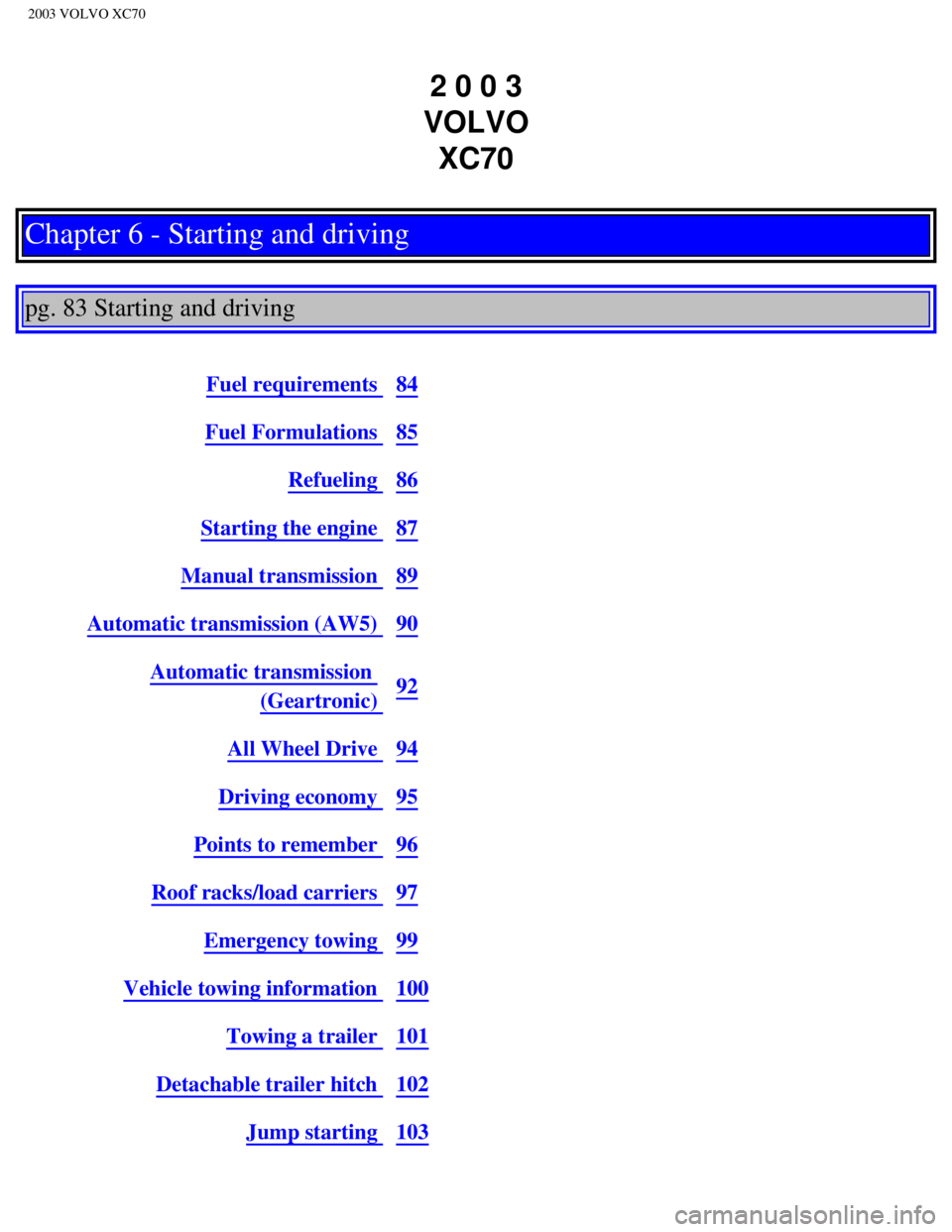
2003 VOLVO XC70
2 0 0 3
VOLVO XC70
Chapter 6 - Starting and driving
pg. 83 Starting and driving
Fuel requirements 84
Fuel Formulations 85
Refueling 86
Starting the engine 87
Manual transmission 89
Automatic transmission (AW5) 90
Automatic transmission
(Geartronic) 92
All Wheel Drive 94
Driving economy 95
Points to remember 96
Roof racks/load carriers 97
Emergency towing 99
Vehicle towing information 100
Towing a trailer 101
Detachable trailer hitch 102
Jump starting 103
file:///K|/ownersdocs/2003/2003_XC70/03xc70_06a.htm (1 of 22)12/30/200\
6 4:17:59 PM
Page 125 of 257

2003 VOLVO XC70
Winter driving 104
Long distance trips 105
Three-way catalytic converter 106
pg. 84 Fuel requirements
Fuel requirements
Octane rating: Volvo engines are designed for optimum performance on unleaded premium\
gasoline
with an octane rating AKI of 91, or above. AKI (ANTI KNOCK INDEX) is a\
n average of the Research
Octane Number, RON, and the Motor Octane Number, MON. (RON + MON/2). T\
he minimum octane
requirement is AKI 87 (RON 91).
Deposit control gasoline (detergent additives)
Volvo recommends the use of gasoline containing deposit control additive\
s. These additives have shown
to be effective in keeping injectors and intake valves clean. Consistent\
use of deposit control gasolines
will help ensure good driveability and fuel economy. If you are not sure\
whether the gasoline contains
deposit control additives, check with the service station operator.
Unleaded fuel
Each Volvo has a three-way catalytic converter and must use only unleade\
d gasoline. U.S. and Canadian
regulations require that pumps delivering unleaded gasoline be labelled \
"UNLEADED". Only these
pumps have nozzles which fit your car's filler inlet. It is unlawful to \
dispense leaded fuel into a vehicle
labelled "unleaded gasoline only". Leaded gasoline damages the three-way\
catalytic converter and the
heated oxygen sensor system. Repeated use of leaded gasoline will lessen\
the effectiveness of the
emission control system and could result in loss of emission warranty co\
verage. State and local vehicle
inspection programs will make detection of misfueling easier, possibly r\
esulting in emission test failure
for misfueled vehicles.
NOTE: Some U.S. and Canadian gasolines contain an octane enhancing additive ca\
lled methyl-
cyclopentadienyl manganese tricarbonyl (MMT). If such fuels are used, \
your Emission Control System
performance may be affected, and the Check Engine light (malfunction in\
dicator lamp) located on your
instrument panel may light. If this occurs, please return your vehicle t\
o an authorized Volvo retailer for
service.
Gasoline containing alcohol and ethers
"Oxygenated fuels"
file:///K|/ownersdocs/2003/2003_XC70/03xc70_06a.htm (2 of 22)12/30/200\
6 4:17:59 PM
Page 126 of 257

2003 VOLVO XC70
Some fuel suppliers sell gasoline containing "oxygenates" which are usua\
lly alcohols or ethers. In some
areas, state or local laws require that the service pump be marked indic\
ating use of alcohols or ethers.
However, there are areas in which the pumps are unmarked. If you are not\
sure whether there is alcohol
or ethers in the gasoline you buy, check with the service station operat\
or. To meet seasonal air quality
standards, some areas require the use of "oxygenated" fuel.
Volvo allows the use of the following "oxygenated fuels; however, the oc\
tane ratings listed on this page
must still be met.
Alcohol - Ethanol: Fuels containing up to 10% ethanol by volume may be used. Ethanol may al\
so be
referred to as Ethyl alcohol, or "Gasohol".
Ethers - MTBE: Fuels containing up to 15% MTBE may be used.
CAUTION! Do not use gasolines containing methanol (methyl alcohol, wood alcohol\
). This practice
can result in vehicle performance deterioration and can damage critical \
parts in the fuel system. Such
damage may not be covered under the New Vehicle Limited Warranty.
pg. 85 Fuel requirements
Carbon Monoxide - Important Warning
Carbon monoxide is a poisonous, colorless, and odorless gas. It is prese\
nt in all exhaust gases. If you
ever smell exhaust fumes inside the vehicle, make sure the passenger com\
partment is ventilated, and
immediately return the vehicle to your retailer for correction.
Fuel Formulations
Do not use gasoline that contains lead as a knock inhibitor, and do not \
use lead additives. Besides
damaging the exhaust emission control systems on your car, lead has been\
strongly linked to certain
forms of cancer.
Many fuels contain benzene as a solvent. Unburned benzene has been stron\
gly linked to certain forms of
cancer. If you live in an area where you must fill your own gas tank, ta\
ke precautions. These may
include:
l standing upwind away from the filler nozzle while refueling
l refueling only at gas stations with vapor recovery systems that fully se\
al the mouth of the filler neck
during refueling
l wear neoprene gloves while handling a fuel filler nozzle.
Use of Additives
file:///K|/ownersdocs/2003/2003_XC70/03xc70_06a.htm (3 of 22)12/30/200\
6 4:17:59 PM
Page 127 of 257

2003 VOLVO XC70
With the exception of gas line antifreeze during winter months, do not a\
dd solvents, thickeners, or other
store-bought additives to your car's fuel, cooling, or lubricating syste\
ms. Overuse may damage your
engine, and some of these additives contain organically volatile chemica\
ls. Do not needlessly expose
yourself to these chemicals.
pg. 86 Refueling
Refueling
The fuel tank holds approximately 18.5 US gals (70 liters) or 19 US ga\
ls (72 liters) on models equipped
with All Wheel Drive, with sufficient volume left over to accommodate po\
ssible expansion of the fuel in
hot weather. Be aware that the "usable" tank capacity will be somewhat l\
ess than the specified
maximum. When the fuel level is low, such factors as ambient temperature\
, the fuel's "Reid vapor
pressure" characteristics, and terrain can affect the fuel pump's abilit\
y to supply the engine with an
adequate supply of fuel. Therefore, it is advisable to refuel as soon as\
possible when the needle nears the
red zone, or when the fuel warning light comes on.
Fuel filler door
Press the button on the light switch panel (see illustration on page 34) when the car is at a standstill to
unlock the fuel filler door. Please note that the fuel filler door will \
remain unlocked until the car begins
to move forward. An audible click will be heard when the fuel filler doo\
r relocks.
If you intend to leave your car while it is being refueled, this feature\
s enables you to lock the door/
tailgate while leaving the fuel filler door unlocked.
You can also keep the car locked if you remain inside it during refuelin\
g. The central locking button
does not lock the fuel filler door.
Be sure the fuel filler door is not obstructed and is completely closed \
after refueling. Open the fuel
filler cap slowly during hot weather conditions.
file:///K|/ownersdocs/2003/2003_XC70/03xc70_06a.htm (4 of 22)12/30/200\
6 4:17:59 PM
Page 128 of 257

2003 VOLVO XC70
NOTE: During a transitional period, a small number of service stations may sti\
ll have fuel nozzles that
are not compatible with the fuel filler neck on cars equipped with the e\
vaporative control system. Please
refer to
page 130 for additional information.
CAUTION:
l Do not refuel with the engine running *. Turn the ignition off or to pos\
ition I. If the ignition is on, an
incorrect reading could occur in the fuel gauge.
l After refueling, close the fuel filler cap by turning it clockwise until\
it clicks into place *.
l Allow for fuel expansion by not overfilling the tank. Overfilling could \
also cause damage to the
emission control systems.
l Avoid spilling gasoline when refueling. In addition to causing damage to\
the environment, gasolines
containing alcohol can cause damage to painted surfaces, which may not b\
e covered under the New
Vehicle Limited Warranty.
l Do not use gasolines containing methanol (methyl alcohol, wood alcohol)\
. This practice can result in
vehicle performance deterioration and can damage critical parts in the f\
uel system. Such damage may
not be covered under the New Vehicle Limited Warranty.
* If the fuel filler cap is not closed tightly or if the engine is runni\
ng when the car is refueled, the Check
Engine light (malfunction indicator lamp) may indicate a fault. Howeve\
r, your vehicle's performance
will not be affected. Use only Volvo original or approved fuel filler ca\
ps.
pg. 87 Starting the engine
Starting the engine
1. Fasten the seat belt.
WARNING!
Before starting, check that the seat, steering wheel and mirrors adjuste\
d properly. Make sure the brake
pedal can be depressed completely. Adjust the seat if necessary. See
page 56.
2. Apply the parking brake, if not already set. The gear selector (automatic transmission) is locked in
the (P)ark position (SHIFT-LOCK). Manual transmission: the clutch must be fully depressed.
3. Without touching the accelerator pedal, turn the ignition key* to the starting position. Allow the
starter to operate for up to 10 seconds. Release the key as soon as the \
engine starts. If the engine fails to
start, repeat this step.
file:///K|/ownersdocs/2003/2003_XC70/03xc70_06a.htm (5 of 22)12/30/200\
6 4:17:59 PM
Page 130 of 257

2003 VOLVO XC70
WARNING!
l Always place the gear selector in Park and apply the parking brake befor\
e leaving the vehicle.
Never leave the car unattended with the engine running.
l Always open garage doors fully before starting the engine inside a garag\
e to ensure adequate
ventilation. The exhaust gases contain carbon monoxide, which is invisib\
le and odorless but very
poisonous.
l An extra mat on the driver's floor can cause the accelerator pedal and t\
he clutch to catch. Check
that the movement of the accelerator pedal and clutch is not impeded. No\
t more than one protective
floor covering may be used at one time.
pg. 89 Manual transmission
Shift positions
Depress the clutch pedal completely when changing gears*.
Remove your foot from the clutch pedal while driving. The shift pattern \
should be followed. Overdrive
(5th gear) should be used as often as possible to help improve fuel ec\
onomy. This gear should be
engaged at speeds above approx. 50 mph (80 km/h).
file:///K|/ownersdocs/2003/2003_XC70/03xc70_06a.htm (7 of 22)12/30/200\
6 4:17:59 PM
Page 133 of 257

2003 VOLVO XC70
D is the normal driving position and should be used as often as possible\
to help improve fuel economy.
The car should not be moving when shifting from R to the D position.
4 (Intermediate gear)
The transmission will shift automatically between gears 4, 3, 2 or 1 fro\
m this position. The
transmission cannot shift up to (D)rive from fourth gear.
3 (Intermediate gear)
The transmission will shift automatically between gears 3, 2 and 1 from \
this position. The transmission
cannot shift up to fourth gear or (D)rive from third gear.
L (Low gears)
The transmission is locked in gears 1 and 2 when the selector is in this\
position.
NOTE:
l Gears 4, 3, or L can be used if you are driving in a mountainous area, t\
owing a trailer or to increase
engine braking effect.
l The transmission has a built-in limiter designed to help prevent excessi\
ve engine speeds (high rpm)
when gears 4, 3 or L are selected.
Automatic transmission -adaptive system
The automatic transmission is controlled by an adaptive control system t\
hat constantly monitors the way
in which the transmission functions. It senses and adapts each gear shif\
t for optimal performance. The
system also monitors your particular driving style and adapts gear shift\
ing accordingly.
pg. 91 Automatic transmission AW5
file:///K|/ownersdocs/2003/2003_XC70/03xc70_06a.htm (10 of 22)12/30/20\
06 4:17:59 PM