2003 SKODA FABIA wheel bolts
[x] Cancel search: wheel boltsPage 192 of 233

Wheels and Tyres191
Using the systemSafetyDriving TipsGeneral MaintenanceBreakdown assist-
anceTechnical DataFabia Praktik
For the sake of the environment
Old tyres must be disposed of in conformity with the appropriate regula-
tions.
Note
It is not normally possible to fit wheels from other models of cars for tech-
nical reasons. This may also apply in certain circumstances to the wheels
of the same type of vehicle.
Wheel bolts
Wheels and wheel bolts are matched to each other in terms of design.
Each time you fit other wheels - e.g. light alloy wheels or wheels with
winter tyres - you must therefore also use the matching wheel bolts of the correct length and shape of spherical cap. This is essential to ensure that
the wheels are tightly fitted and that the brake system operates properly.
If you retrofit
wheel trims (or have this done), please also ensure that an
adequate flow of air remains assured for cooling the brake system.
Škoda dealers are instructed in the technical possibilities which exist
regarding converting or retrofitting wheels, tyres and wheel trim.
The wheel bolts must be clean and must turn easily.
Winter tyres
The handling of your vehicle will be significantly improved when driving on
wintry roads and at temperatures below 7 °C if you fit winter tyres.
Summer tyres do not offer the same grip on ice and snow because of their
construction (width, rubber blend, tread pattern). This particularly applies
to vehicles which are equipped with low-profile tyres or high-speed
tyres (code index V or W on wall of tyre).
Winter tyres must be mounted on all four wheels to obtain the best
handling characteristics.
Only use radial winter tyres.
You must only fit those types of winter tyre which are approved for your
vehicle. The permissible sizes of winter tyres are stated in your vehicle
documents. Approvals may differ because of national legislation.
Please remember that the tyres should be inflated to 0.2 bar more than is
the case for summer tyres ⇒page 187.
Winter tyres no longer offer the same winter performance once the tyre
tread has worn down to a depth of about 4 mm.
Ageing also causes winter tyres to lose most of their winter performance
properties - even in cases where the remaining tread depth is still clearly
more than 4 mm.
WARNING (continued)
•You must on no account drive at a higher speed than is permis-
sible for your tyres - risk of an accident resulting from tyre damage
and loss of control over your vehicle.
•Tyres which are 6 years old or more should only be fitted in
exceptional cases and when adopting an appropriately cautious
style of driving.
•Never fit tyres which have already been used without having
adequate knowledge of their previous history. Tyres age even if
they have not been used at all or only very little. A spare tyre must
only be used in exceptional cases and only then when adopting an
appropriately cautious style of driving.
•Do not, where possible, replace individual tyres but at least
replace them on both wheels of a given axle at the same time.
Always fit the tyres with the deeper tread depth to the front wheels.
Page 197 of 233
Breakdown assistance
196
Note
The fire extinguisher is only supplied in certain countries within the scope
of delivery.
Vehicle tool kit
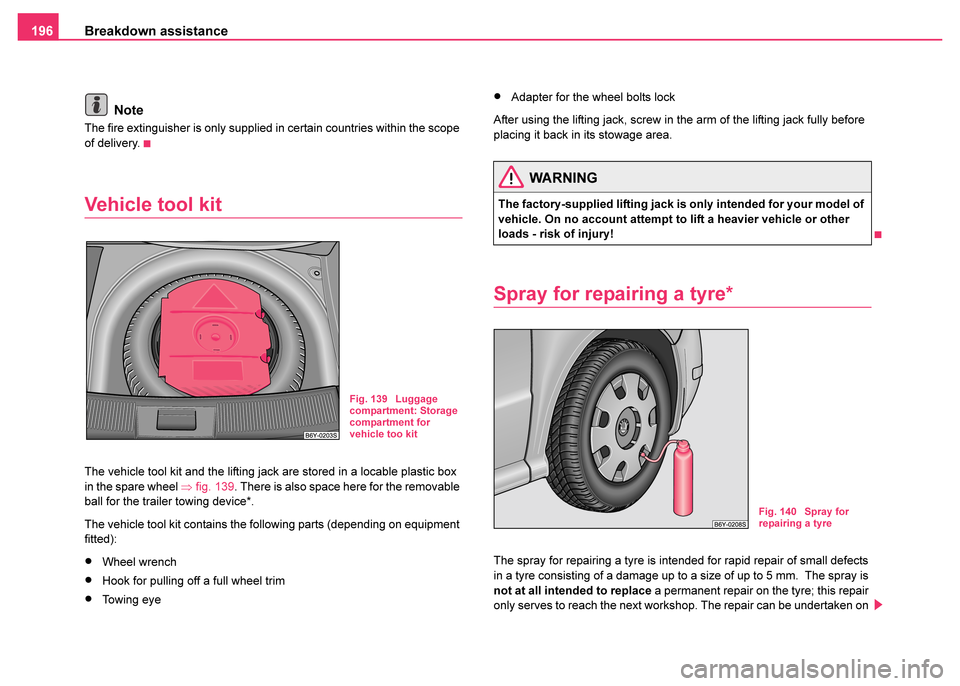
The vehicle tool kit and the lifting jack are stored in a locable plastic box
in the spare wheel ⇒ fig. 139. There is also space here for the removable
ball for the trailer towing device*.
The vehicle tool kit contains the following parts (depending on equipment
fitted):
•Wheel wrench
•Hook for pulling off a full wheel trim
•To w i n g e y e
•Adapter for the wheel bolts lock
After using the lifting jack, screw in the arm of the lifting jack fully before
placing it back in its stowage area.
Spray for repairing a tyre*
The spray for repairing a tyre is intended for rapid repair of small defects
in a tyre consisting of a damage up to a size of up to 5 mm. The spray is
not at all intended to replace a permanent repair on the tyre; this repair
only serves to reach the next workshop. The repair can be undertaken on
Fig. 139 Luggage
compartment: Storage
compartment for
vehicle too kit
WARNING
The factory-supplied lifting jack is only intended for your model of
vehicle. On no account attempt to lift a heavier vehicle or other
loads - risk of injury!
Fig. 140 Spray for
repairing a tyre
Page 200 of 233

Breakdown assistance199
Using the systemSafetyDriving TipsGeneral MaintenanceBreakdown assist-
anceTechnical DataFabia Praktik
Changing a wheel
Always change a wheel on a leve l surface as far as possible.
– Remove the full wheel trim* ⇒page 200.
– In the case of light alloy wheels remove the wheel trim cap ⇒page 200.
– Slacken the wheel bolts ⇒page 201.
– Jack up the vehicle until the wheel to be changed is clear of the ground ⇒page 201.
– Unscrew the wheel bolts and place them on a clean surface (cloth, paper etc.).
– Take off the wheel.
– Fit on the spare wheel and tighten the wheel bolts slightly.
– Lower the car.
– Tighten the wheel bolts firmly, alternately and diagonally using the wheel wrench ⇒page 201.
– Fit the full wheel trim/wheel trim cap.
Note
•All bolts must be clean and must turn easily.
•You must never grease or oil the wheel bolts!
Subsequent steps
After changing the wheel, you must perform the following steps.
– Stow and attach the replaced wheel in the spare wheel well.
– Stow the vehicle tool kit in the space provided.
–Check the tyre pressure on the spare wheel just mounted as
soon as possible.
– Have the tightening torque of the wheel bolts checked with
a torque wrench as soon as possible. Steel and light alloy
wheels must be tightened to a tightening torque of 120 Nm.
– Have the defective tyre repaired as soon as possible.
Note
•If you find, when changing the wheel, that the wheel bolts are corroded
and difficult to turn, the bolts must be replaced before checking the tight-
ening torque.
•Drive cautiously and only at a moderate speed to a workshop where
the tightening torque can be checked.
WARNING
It is necessary to observe the guidelines given on ⇒page 189,
“New tyres and wheels” if the vehicle is subsequently fitted with
tyres which are different to those it was fitted with at the works.
Page 202 of 233

Breakdown assistance201
Using the systemSafetyDriving TipsGeneral MaintenanceBreakdown assist-
anceTechnical DataFabia Praktik
Slackening and tightening wheel bolts
Slacken the wheel bolts before jacking up the vehicle.
Slackening wheel bolts
– Push the wheel wrench fully onto the wheel bolt
4).
– Grasp the end of the wrench and turn the bolt about one turn
to the left ⇒fig. 144 .
Tightening wheel bolts
– Push the wheel wrench fully onto the wheel bolt
4).
– Grasp the end of the wrench and turn the bolt to the right until it is tight. Note
Apply pressure carefully with your
foot to the end of the wheel wrench if
it proves difficult to slacken the wheel bolts. Hold tight on the vehicle when
doing this and ensure that you have a steady position.
Car jack
You have to raise the vehicle with a lifting jack in order to
be able to take off the wheel.
4)Use the appropriate adapter for slackening and tightening the safety wheel bolts
⇒ page 202.
Fig. 144 Changing a
wheel: Slackening
wheel bolts
WARNING
Slacken the wheel bolts only a little (about one turn) as long as the
vehicle has not yet been jacked up - risk of an accident!.
Fig. 145 Changing a
wheel: Points for posi-
tioning car jack
Page 203 of 233

Breakdown assistance
202
– Position the lifting jack by selecting the jacking point - lower sill - which is closest to the wheel to be removed ⇒page 201,
fig. 145 .
– Position the lifting jack below the jacking point and move it up until its claw is positioned directly below the vertical web of the
lower sill.
– Align the lifting jack so that its claw grasps the web of the lower sill and the moving base plate of the jack is resting flat
against firm ground.
– Turn the lifting jack up further until the wheel is just clear of the ground.
Ground below the lifting jack which is soft and slippery can cause the
vehicle to slip off the jack. It is therefore always necessary to place the
lifting jack on a solid surface or use a wide and stable base. Use a non-
slip base (e.g. a rubber foot mat) if the surface is smooth, such as
cobbled stones, a tiled floor,etc.
Securing wheels against being stolen*
You need a special adapter for slackening the safety
wheel bolts.
– Pull off the full wheel trim/cap from the wheel hub or cap from the safety wheel bolt.
– Push the adapter with its toothed side into the inner toothing of the safety wheel bolt right down in such a way
that only the outer hexagon is jutting out ⇒fig. 146 .
– Push the wheel wrench fully onto the adapter .
– Slacken the wheel bolt, or tighten it firmly ⇒page 201.
– Reinstall the full wheel trim/wheel cap after removing the adapter or place the cap onto the safety wheel bolt.
WARNING
•Take suitable measures to prevent the base of the lifting jack
from slipping off - risk of injury!
•Not positioning the lifting jack at the specified points can result
in damage to the vehicle. The jack can also slip off if it does not
have sufficient grip - risk of injury!.
•It is important to support the vehicle with suitable supporting
blocks if you wish to work under the lifted vehicle - risk of injury!
AAAB
Fig. 146 Safety wheel
bolt with adapter
AB
AA
AB
Page 204 of 233

Breakdown assistance203
Using the systemSafetyDriving TipsGeneral MaintenanceBreakdown assist-
anceTechnical DataFabia Praktik
– Have the tightening torque checked with a torque wrench as
soon as possible. Steel and light alloy wheels must be tight-
ened to a tightening torque of 120 Nm.
The safety wheel bolts on vehicles fitted with them (one safety wheel bolt
per wheel) can only be loosened or tighten up by using the adapter
provided.
It is meaningful to note the code number hammered into the rear side of
the adapter or the rear side of the safety wheel bolts. You can obtain a
replacement adapter from a Škoda Dealer, if necessary, by quoting this
number.
We recommend that you always carry the adapter for the wheel bolts with
you in the vehicle. It should be stowed in the vehicle tool kit.
Caution
Damage can occur to the adapter and safety wheel bolt if the safety wheel
bolt is tightened up too much.
Note
The set of safety wheel bolts can be obtained from your Skoda dealer as
an original accessory.
Jump-starting
Initial steps
You can use the battery of another vehicle for jump-starting yours if the
engine does not start because the battery on your vehicle is flat. You will
require jump-start cables for this purpose. Both batteries must have a rated voltage of 12 V. The
capacity (Ah) of the
battery supplying the power must not be significantly less than the
capacity of the discharged battery in your vehicle.
Jump-start cables
Only use jump-start cables which have an adequately large cross-section
and insulated terminal clamps. Please pay attention to the manufacturer's
instructions.
Positive cable - colour coding in the majority of cases red.
Negative cable - colour coding in the majority of cases black.
Note
•There must not be any contact between the two vehicles otherwise
current may flow as soon as the negative terminals are connected.
•The discharged battery must be properly connected to the system of
the vehicle.
•Switch off any installed telephone and also pay attention to the instruc-
tions for use of the telephone in such a situation.
•We recommend purchasing jump-start cables from a Skoda dealer as
an original accessory or from retailers who sell branded batteries.
WARNING
•A discharged battery may already freeze at temperatures just
below 0°C. It is essential to thaw out a frozen battery before you
connect the jump-start cables - risk of an explosion!
•Please pay attention to the warning instructions relating to
working in the engine compartment ⇒page 172.
Page 230 of 233

Index229
L
Lashing eyes . . . . . . . . . . . . . . . . . . . . . . . . . 70
Leather care . . . . . . . . . . . . . . . . . . . . . . . . 164
Lighting of the interior of the vehicle . . . . . . . 56
Lights
Converting/masking over headlights . . . 154
switching them on and off . . . . . . . . . . . . 52
Warning lights . . . . . . . . . . . . . . . . . . . . . 27
Lights and Visibility . . . . . . . . . . . . . . . . . . . . 53
Locking . . . . . . . . . . . . . . . . . . . . . . . . . . 39, 40
Low beam . . . . . . . . . . . . . . . . . . . . . . . . . . . 52 Warning light . . . . . . . . . . . . . . . . . . . . . . 29
Luggage compartment . . . . . . . . . . . . . . . . . 69
Luggage compartment door . . . . . . . . . . . . . 43 Lighting . . . . . . . . . . . . . . . . . . . . . . . . . . 57
Warning light . . . . . . . . . . . . . . . . . . . . . . 33
M
Main beam . . . . . . . . . . . . . . . . . . . . . . . . 52, 54Warning light . . . . . . . . . . . . . . . . . . . . . . 29
Manual shifting of gears . . . . . . . . . . . . . . . . 98
Memory for the on-board computer . . . . . . . . 17
Mobile phone . . . . . . . . . . . . . . . . . . . . 108, 109
Motoring abroad . . . . . . . . . . . . . . . . . . . . . 154
Multi-functional indicator . . . . . . . . . . . . . . . . 17
N
Navigation system . . . . . . . . . . . . . . . . . . . . . 26 Note holder . . . . . . . . . . . . . . . . . . . . . . . . . . 78
O
Oil . . . . . . . . . . . . . . . . . . . . . . . . . . . . . . . . 174
Warning light . . . . . . . . . . . . . . . . . . . . . . 32
Onboard computer . . . . . . . . . . . . . . . . . . . . . 17
Open door Warning light . . . . . . . . . . . . . . . . . . . . . . 33
Operation in winter Biodiesel . . . . . . . . . . . . . . . . . . . . . . . . . 168
De-icing windows . . . . . . . . . . . . . . . . . . 162
The battery . . . . . . . . . . . . . . . . . . . . . . . 183
Overview of the engine compartment . . . . . 173
P
Paint . . . . . . . . . . . . . . . . . . . . . . . . . . . . . . . 161
Paint damage . . . . . . . . . . . . . . . . . . . . . . . . 161
Parking aid . . . . . . . . . . . . . . . . . . . . . . . . . . 100
Parking light . . . . . . . . . . . . . . . . . . . . . . . . . . 55
Parking lights . . . . . . . . . . . . . . . . . . . . . . . . . 52
Pedals . . . . . . . . . . . . . . . . . . . . . . . . . . . . . . 69
Petrol . . . . . . . . . . . . . . . . . . . . . . . . . . . . . . 167
Power socket . . . . . . . . . . . . . . . . . . . . . . . . . 81
Power steering . . . . . . . . . . . . . . . . . . . . . . . 146 Warning light . . . . . . . . . . . . . . . . . . . . . . 30
Power windows . . . . . . . . . . . . . . . . . . . . . . . 47 Operational problems . . . . . . . . . . . . . . . . 48
R
Rear fog light . . . . . . . . . . . . . . . . . . . . . . . . . 53Warning light . . . . . . . . . . . . . . . . . . . . . . . 29
Rear seats . . . . . . . . . . . . . . . . . . . . . . . . . . . 67
Rear window heater . . . . . . . . . . . . . . . . . . . . 58
Rear-view mirror . . . . . . . . . . . . . . . . . . . . . . 62
Recirculated air mode Heating . . . . . . . . . . . . . . . . . . . . . . . . . . . 89
The air conditioning system . . . . . . . . . . . 93
Refuelling . . . . . . . . . . . . . . . . . . . . . . . . . . . 169
Remote control . . . . . . . . . . . . . . . . . . . . . . . . 44
Replacing fuses . . . . . . . . . . . . . . . . . . . . . . 209
Roof aerial . . . . . . . . . . . . . . . . . . . . . . . . . . 160
Running in the car . . . . . . . . . . . . . . . . . . . . 147
S
Safety wheel bolts . . . . . . . . . . . . . . . . . . . . 202
Saving energy . . . . . . . . . . . . . . . . . . . . . . . 149
Seat belt height adjuster . . . . . . . . . . . . . . . 116
Seat belt warning light . . . . . . . . . . . . . . . . . 115
Seat belts . . . . . . . . . . . . . . . . . . . . . . . . . . . 112 Cleaning . . . . . . . . . . . . . . . . . . . . . . . . . 165
Fasten . . . . . . . . . . . . . . . . . . . . . . . . . . . 115
Height adjustment . . . . . . . . . . . . . . . . . . 116
Safety instructions . . . . . . . . . . . . . . . . . 114
Seats . . . . . . . . . . . . . . . . . . . . . . . . . . . . . . . 63
Service Display . . . . . . . . . . . . . . . . . . . . . . . 15
Service Interval Display . . . . . . . . . . . . . . . . . 15
Page 231 of 233

Index
230
Setting temperature
Heating . . . . . . . . . . . . . . . . . . . . . . . . . . 87
The air conditioning system . . . . . . . . . . 91
Setting the clock . . . . . . . . . . . . . . . . . . . . . . 16
Shifting gears . . . . . . . . . . . . . . . . . . . . . . . . 98
Side airbags . . . . . . . . . . . . . . . . . . . . . . . . 124
Sliding/tilting roof . . . . . . . . . . . . . . . . . . . . . 49
Snow chains . . . . . . . . . . . . . . . . . . . . . . . . 192
Spare wheel . . . . . . . . . . . . . . . . . . . . . . . . 197
Speedometer . . . . . . . . . . . . . . . . . . . . . . . . 14
Starting engine . . . . . . . . . . . . . . . . . . . . . . . 96 after fuel tank has run empty . . . . . . . . . . 98
Storage compartment Lighting . . . . . . . . . . . . . . . . . . . . . . . . . . 56
Storage compartments . . . . . . . . . . . . . . . . . 81
Storage facilities . . . . . . . . . . . . . . . . . . . . . . 81
Sun visors . . . . . . . . . . . . . . . . . . . . . . . . . . . 58
Switch on the driver's door Power windows . . . . . . . . . . . . . . . . . . . . 47
Switching the engine off . . . . . . . . . . . . . . . . 98
T
Taking care of your vehicle . . . . . . . . . . . . . 159
TCS . . . . . . . . . . . . . . . . . . . . . . . . . . . . . . . 142 Warning light . . . . . . . . . . . . . . . . . . . . . . 33
Telephone . . . . . . . . . . . . . . . . . . . . . . . . . . 108
The air conditioning system . . . . . . . . . . . . . 90 The battery . . . . . . . . . . . . . . . . . . . . . . . . . 181
Charging . . . . . . . . . . . . . . . . . . . . . . . . 184
Inspecting the electrolyte level . . . . . . . 183
Operation in winter . . . . . . . . . . . . . . . . 183
The radiator fan . . . . . . . . . . . . . . . . . . . . . . 179
The roof luggage rack system . . . . . . . . . . . . 76
Thickness of brake pads Warning light . . . . . . . . . . . . . . . . . . . . . . 32
Tool . . . . . . . . . . . . . . . . . . . . . . . . . . . . . . . 196
Towing a trailer . . . . . . . . . . . . . . . . . . . . . . 155
Towing a vehicle . . . . . . . . . . . . . . . . . . . . . 205
Tow-starting a vehicle . . . . . . . . . . . . . . . . . 205
Traction Control System . . . . . . . . . . . . . . . 142
Trailer . . . . . . . . . . . . . . . . . . . . . . . . . . . . . 155
Transporting children . . . . . . . . . . . . . . . . . 130
Tread depth . . . . . . . . . . . . . . . . . . . . . . . . . 188
Turn signal system for vehicles towing a trailer Warning light . . . . . . . . . . . . . . . . . . . . . . 30
Turn signals Warning light . . . . . . . . . . . . . . . . . . . . . . 28
Two-way radio systems . . . . . . . . . . . . . . . 109
Type plate . . . . . . . . . . . . . . . . . . . . . . . . . . 223
Tyres . . . . . . . . . . . . . . . . . . . . . . . . . . . . . . 187 Winter . . . . . . . . . . . . . . . . . . . . . . . . . . 191
U
Underbody protection . . . . . . . . . . . . . . . . . 163
Unlocking . . . . . . . . . . . . . . . . . . . . . . . . . . . 40
V
Vanity mirror . . . . . . . . . . . . . . . . . . . . . . . . . 58
Vehicle data sticker . . . . . . . . . . . . . . . . . . . 223
Vehicle immobiliserWarning light . . . . . . . . . . . . . . . . . . . . . . 31
Vehicle tool kit . . . . . . . . . . . . . . . . . . . . . . . 196
W
Warning lights . . . . . . . . . . . . . . . . . . . . . . . . 27
Warning symbols . . . . . . . . . . . . . . . . . . . . . . 27
Warning triangle . . . . . . . . . . . . . . . . . . . . . 195
Washing . . . . . . . . . . . . . . . . . . . . . . . . . . . 160
Washing vehicle by hand . . . . . . . . . . . . . . 160
Wheel bolts . . . . . . . . . . . . . . . . . . . . . . . . . 191
Wheel rims . . . . . . . . . . . . . . . . . . . . . . . . . 187
Wheels . . . . . . . . . . . . . . . . . . . . . . . . . . . . 187
Windscreen Wiper and Washer System . . . 185
Windscreen wipers . . . . . . . . . . . . . . . . . . . . 59
Windshield washer fluid reservoir . . . . . . . . 185 Warning light . . . . . . . . . . . . . . . . . . . . . . 33
Winter tyres . . . . . . . . . . . . . . . . . . . . . . . . . 191
Wiper blades Replacing windscreen wiper blades . . . . . 60
X
Xenon headlights . . . . . . . . . . . . . . . . . . . . . 212