Page 228 of 265
spare tire. Tire chains will not fit
properly on the T-type spare tire and
may cause damage to the vehicle.
�When driving on roads covered with
snow or ice, the T-type spare tire
should be used on the rear wheel and
the original tire used on the front
wheels (drive wheels). Use tire chains
only on the front two original tires.
�Tire tread of the T-type spare tire will
wear at a faster rate than the original
tire. Replace the T-type spare tire as
soon as the tread wear indicators
appear.
�Because the T-type spare tire is
smaller than the original tire, ground
clearance is reduced. To avoid dam-
age to the vehicle do not drive over
obstacles. Also do not drive the ve-
hicle through an automatic car wash
since it may get caught.
�Do not use the T-type spare tire on
other vehicles.
�Do not use more than one T-typespare tire at the same time.
�Do not tow a trailer while the T-type
spare tire is installed.
Maintenance and do-it-yourself
8-33
�
03.1.28/Z50-D/V5.0
�
Page 235 of 265

unleaded gasoline with an octane rating of at
least 87 or 91 AKI (Anti-Knock Index) number.
However, you may use unleaded gasoline with
an octane rating as low as 85 AKI number in
these high altitude areas [over 4,000 ft (1,219
m)] such as: Colorado, Montana, New Mexico,
Utah, Wyoming, northeastern Nevada, southern
Idaho, western South Dakota, western Ne-
braska, and that part of Texas which is directly
south of New Mexico.
Using unleaded gasoline with an octane
rating lower than stated above can cause
persistent, heavy spark knock. (Spark
knock is a metallic rapping noise.) If se-
vere, this can lead to engine damage. If you
detect a persistent heavy spark knock even
when using gasoline of the stated octane
rating, or if you hear steady spark knock
while holding a steady speed on level
roads, have your dealer correct the condi-
tion. Failure to correct the condition is
misuse of the vehicle, for which NISSAN is
not responsible.
Incorrect ignition timing will result in knocking,
after-run or overheating. This in turn may cause
excessive fuel consumption or damage to the
engine. If any of the above symptoms are en-
countered, have your vehicle checked at a
NISSAN dealer or other competent service fa-
cility.However, now and then you may notice
light spark knock for a short time while
accelerating or driving up hills. This is no
cause for concern, because you get the
greatest fuel benefit when there is light
spark knock for a short time under heavy
engine load.9-4
Technical and consumer information
�
03.1.28/Z50-D/V5.0
�
Page 241 of 265

When planning to travel in another country,
you should first find out if the fuel available is
suitable for your vehicle’s engine.
Using fuel with too low an octane rating may
cause engine damage. All gasoline vehicles
must be operated with unleaded engine gaso-
line. Therefore, avoid taking your vehicle to areas
where appropriate fuel is not available.
When transferring the registration of your
vehicle to another country, state, province
or district,it may be necessary to modify the
vehicle to meet local laws and regulations.
The laws and regulations for motor vehicle emis-
sion control and safety standards vary according
to the country, state, province or district; there-
fore, vehicle specifications may differ.
When any vehicle is to be taken into an-
other country, state, province or district
and registered, its modifications, transpor-
tation, and registration are the responsibil-
ity of the user. NISSAN is not responsible
for any inconvenience that may result.
VEHICLE IDENTIFICATION NUMBER
(VIN) PLATEThe vehicle identification number plate is at-
tached as shown. This number is the identifica-
tion for your vehicle and is used in the vehicle
registration.
VEHICLE IDENTIFICATION NUMBER
(Chassis number)The number is stamped under the passenger’s
seat as shown.
STI0334
STI0335
WHENTRAVELING OR
REGISTERING YOUR VEHICLE IN
ANOTHER COUNTRYVEHICLE IDENTIFICATION9-10
Technical and consumer information
�
03.1.28/Z50-D/V5.0
�
Page 248 of 265
plus the total trailer load. Towing loads greater
than these or using improper towing equipment
could adversely affect vehicle handling, braking
and performance.
The ability of your vehicle to tow a trailer is not
only related to the maximum trailer loads, but
also the places you plan to tow. Tow weights
appropriate for level highway driving may have to
be reduced on very steep grades or in low
traction situations (for example, on slippery boat
ramps).
Temperature conditions also can affect towing.
For example, towing a heavy trailer in high
outside temperatures on graded roads can af-
fect engine performance and cause overheating.
The transmission high fluid temperature protec-
tion mode, which helps reduce the chance of
transmission damage, could activate and auto-
matically decrease engine power. Vehicle speed
may decrease to 40 to 50 MPH (65 to 80 km/h)
under high load. Plan your trip carefully to ac-
count for trailer and vehicle load, weather, and
road conditions.
WARNING
Overheating can result in reduced en-
gine power and lower vehicle speed.Also, when the high temperature mode
operates, vehicle speed may be gradu-
ally reduced. On highways, the reduced
speed may be lower than other traffic
which could increase the chance of a
collision. Be especially careful when
driving. If necessary, pull to the side of
the road at a safe place and allow the
engine to cool or the transmission to
return to normal operation.
Tongue loadKeep the tongue load between 9 to 11% of the
total trailer load within the maximum tongue load
limits shown in the following Towing
Load/Specifications Chart. If the tongue load
becomes excessive, rearrange cargo to allow for
proper tongue load.
Maximum gross vehicle weight/
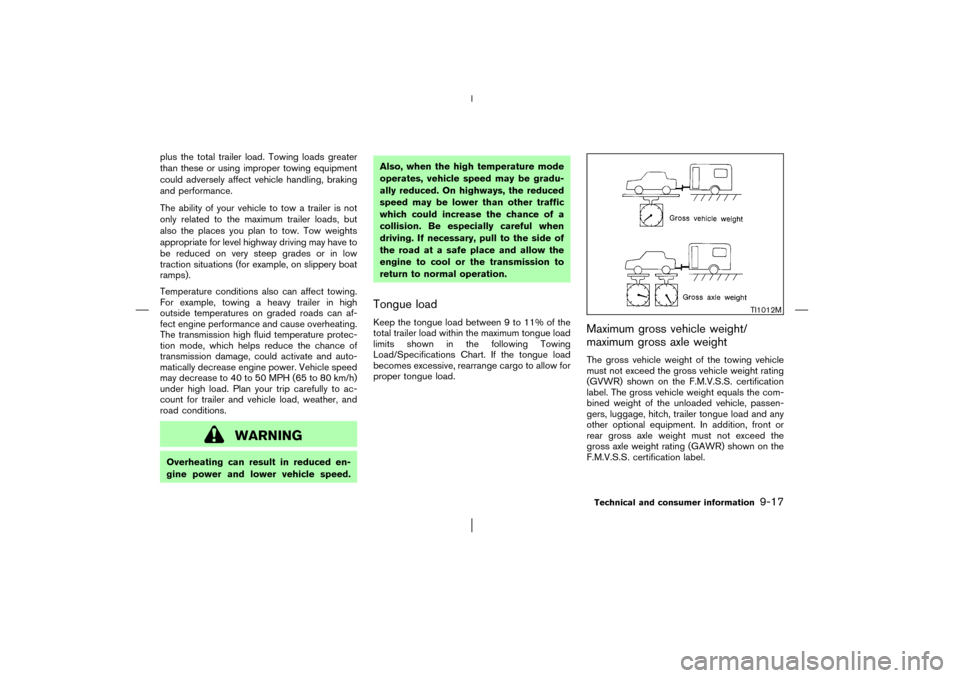
maximum gross axle weightThe gross vehicle weight of the towing vehicle
must not exceed the gross vehicle weight rating
(GVWR) shown on the F.M.V.S.S. certification
label. The gross vehicle weight equals the com-
bined weight of the unloaded vehicle, passen-
gers, luggage, hitch, trailer tongue load and any
other optional equipment. In addition, front or
rear gross axle weight must not exceed the
gross axle weight rating (GAWR) shown on the
F.M.V.S.S. certification label.
TI1012M
Technical and consumer information
9-17
�
03.1.28/Z50-D/V5.0
�