2003 NISSAN ALMERA N16 Engine Control
[x] Cancel search: Engine ControlPage 1484 of 3189
AT-28
OVERALL SYSTEM
TCM FUNCTION
The function of the TCM is to:
●Receive input signals sent from various switches and sensors.
●Determine required line pressure, shifting point, lock-up operation, and engine brake operation.
●Send required output signals to the respective solenoid valves.
INPUT/OUTPUT SIGNAL OF TCM
Control MechanismECS007NK
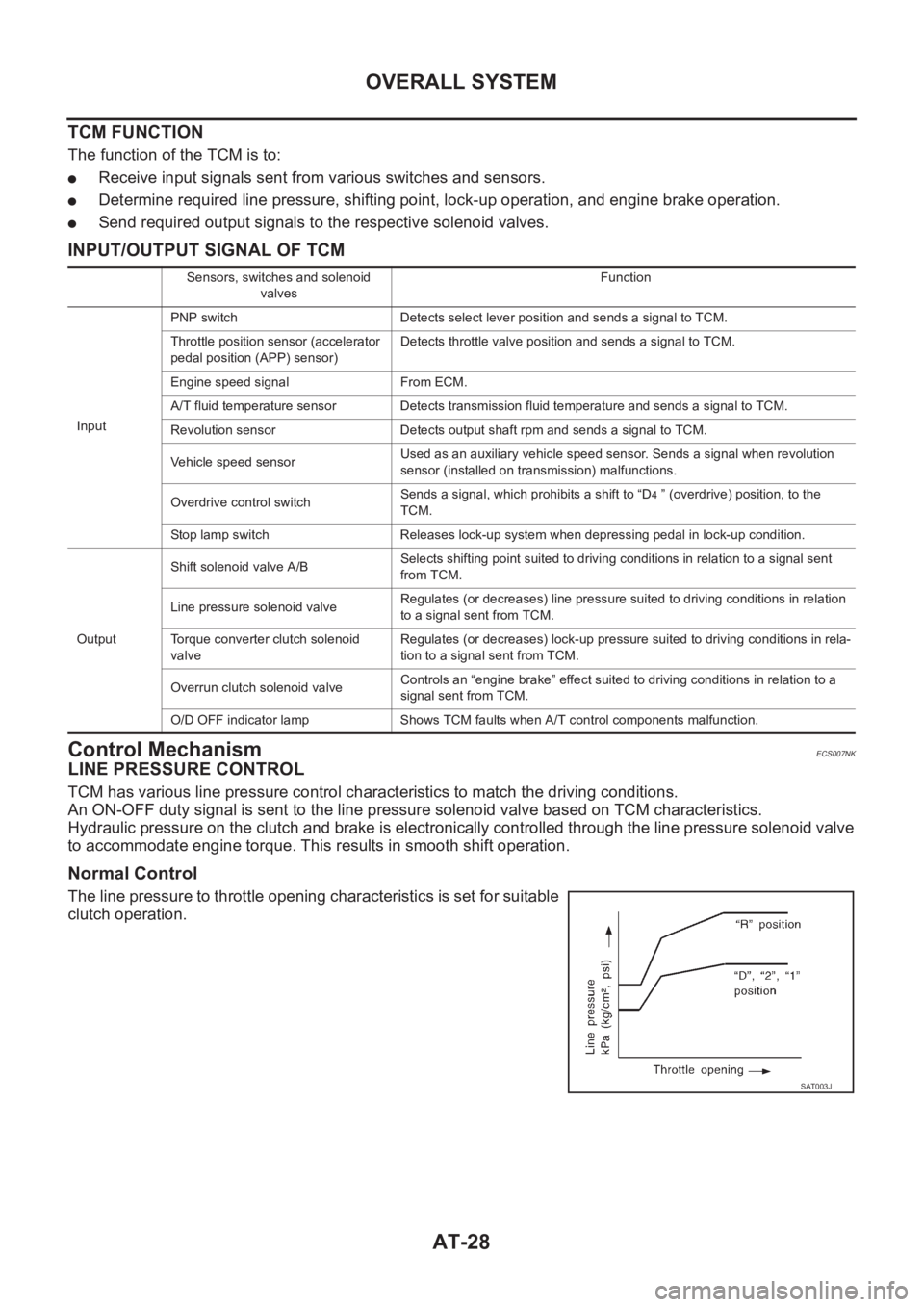
LINE PRESSURE CONTROL
TCM has various line pressure control characteristics to match the driving conditions.
An ON-OFF duty signal is sent to the line pressure solenoid valve based on TCM characteristics.
Hydraulic pressure on the clutch and brake is electronically controlled through the line pressure solenoid valve
to accommodate engine torque. This results in smooth shift operation.
Normal Control
The line pressure to throttle opening characteristics is set for suitable
clutch operation.
Sensors, switches and solenoid
valvesFunction
InputPNP switch Detects select lever position and sends a signal to TCM.
Throttle position sensor (accelerator
pedal position (APP) sensor)Detects throttle valve position and sends a signal to TCM.
Engine speed signal From ECM.
A/T fluid temperature sensor Detects transmission fluid temperature and sends a signal to TCM.
Revolution sensor Detects output shaft rpm and sends a signal to TCM.
Vehicle speed sensorUsed as an auxiliary vehicle speed sensor. Sends a signal when revolution
sensor (installed on transmission) malfunctions.
Overdrive control switchSends a signal, which prohibits a shift to “D
4 ” (overdrive) position, to the
TCM.
Stop lamp switch Releases lock-up system when depressing pedal in lock-up condition.
OutputShift solenoid valve A/BSelects shifting point suited to driving conditions in relation to a signal sent
from TCM.
Line pressure solenoid valveRegulates (or decreases) line pressure suited to driving conditions in relation
to a signal sent from TCM.
Torque converter clutch solenoid
valveRegulates (or decreases) lock-up pressure suited to driving conditions in rela-
tion to a signal sent from TCM.
Overrun clutch solenoid valveControls an “engine brake” effect suited to driving conditions in relation to a
signal sent from TCM.
O/D OFF indicator lamp Shows TCM faults when A/T control components malfunction.
SAT003J
Page 1485 of 3189
OVERALL SYSTEM
AT-29
D
E
F
G
H
I
J
K
L
MA
B
AT
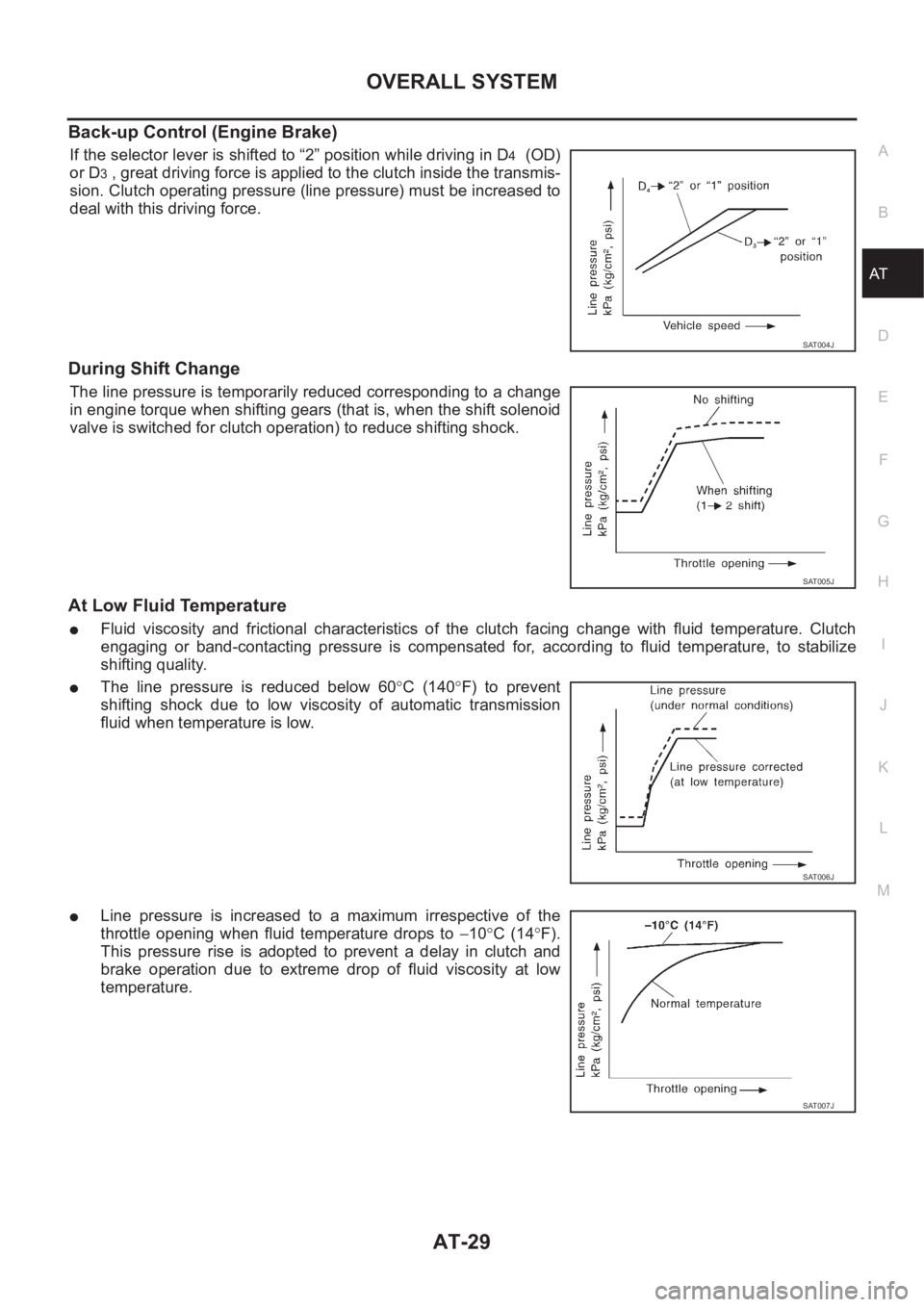
Back-up Control (Engine Brake)
If the selector lever is shifted to “2” position while driving in D4 (OD)
or D
3 , great driving force is applied to the clutch inside the transmis-
sion. Clutch operating pressure (line pressure) must be increased to
deal with this driving force.
During Shift Change
The line pressure is temporarily reduced corresponding to a change
in engine torque when shifting gears (that is, when the shift solenoid
valve is switched for clutch operation) to reduce shifting shock.
At Low Fluid Temperature
●Fluid viscosity and frictional characteristics of the clutch facing change with fluid temperature. Clutch
engaging or band-contacting pressure is compensated for, according to fluid temperature, to stabilize
shifting quality.
●The line pressure is reduced below 60°C (140°F) to prevent
shifting shock due to low viscosity of automatic transmission
fluid when temperature is low.
●Line pressure is increased to a maximum irrespective of the
throttle opening when fluid temperature drops to −10°C (14°F).
This pressure rise is adopted to prevent a delay in clutch and
brake operation due to extreme drop of fluid viscosity at low
temperature.
SAT004J
SAT005J
SAT006J
SAT007J
Page 1486 of 3189
AT-30
OVERALL SYSTEM
SHIFT CONTROL
The shift is regulated entirely by electronic control to accommodate vehicle speed and varying engine opera-
tions. This is accomplished by electrical signals transmitted by the revolution sensor and throttle position sen-
sor. This results in improved acceleration performance and fuel economy.
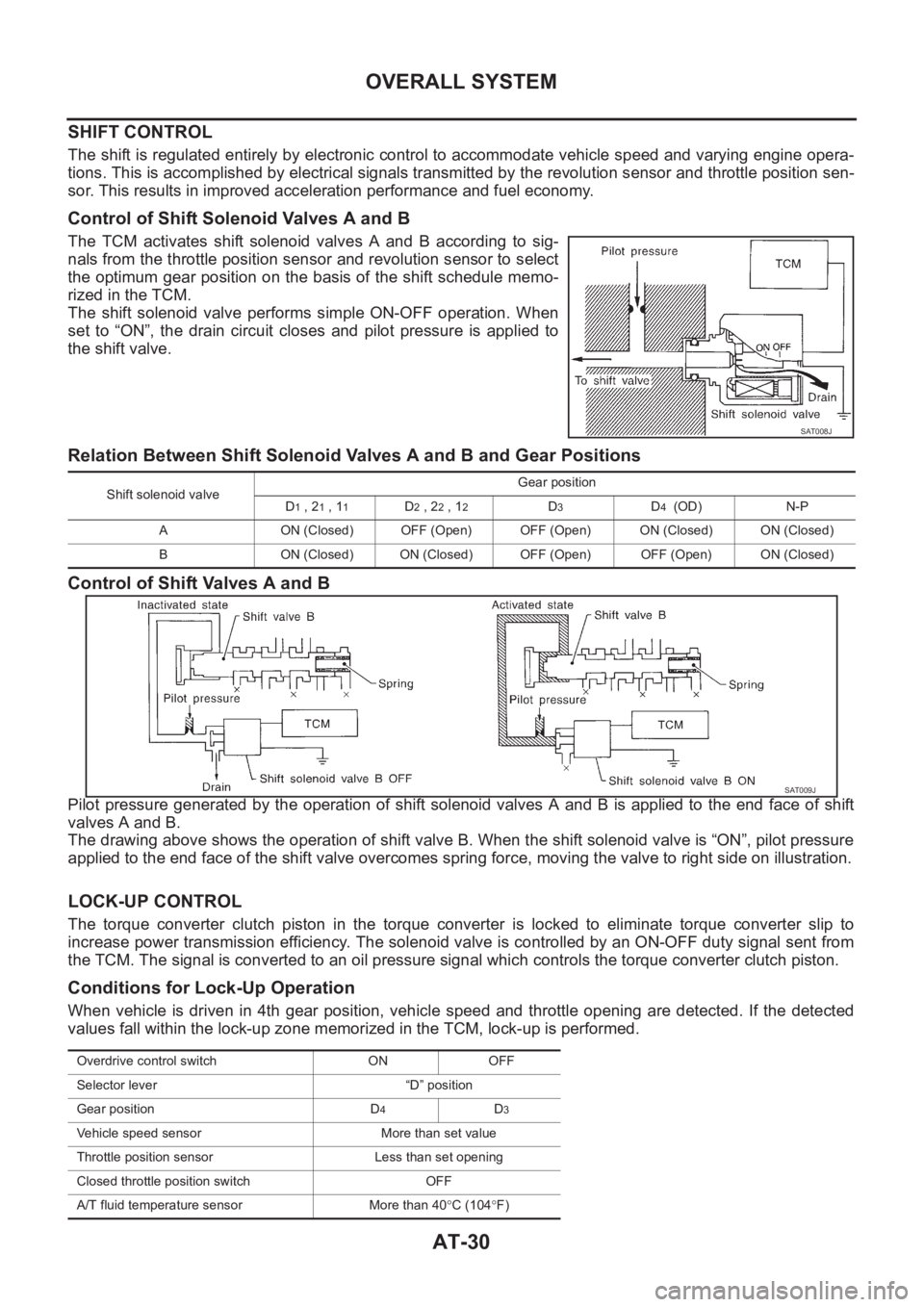
Control of Shift Solenoid Valves A and B
The TCM activates shift solenoid valves A and B according to sig-
nals from the throttle position sensor and revolution sensor to select
the optimum gear position on the basis of the shift schedule memo-
rized in the TCM.
The shift solenoid valve performs simple ON-OFF operation. When
set to “ON”, the drain circuit closes and pilot pressure is applied to
the shift valve.
Relation Between Shift Solenoid Valves A and B and Gear Positions
Control of Shift Valves A and B
Pilot pressure generated by the operation of shift solenoid valves A and B is applied to the end face of shift
valves A and B.
The drawing above shows the operation of shift valve B. When the shift solenoid valve is “ON”, pilot pressure
applied to the end face of the shift valve overcomes spring force, moving the valve to right side on illustration.
LOCK-UP CONTROL
The torque converter clutch piston in the torque converter is locked to eliminate torque converter slip to
increase power transmission efficiency. The solenoid valve is controlled by an ON-OFF duty signal sent from
the TCM. The signal is converted to an oil pressure signal which controls the torque converter clutch piston.
Conditions for Lock-Up Operation
When vehicle is driven in 4th gear position, vehicle speed and throttle opening are detected. If the detected
values fall within the lock-up zone memorized in the TCM, lock-up is performed.
SAT008J
Shift solenoid valveGear position
D1 , 21 , 11D2 , 22 , 12D3D4 (OD) N-P
A ON (Closed) OFF (Open) OFF (Open) ON (Closed) ON (Closed)
B ON (Closed) ON (Closed) OFF (Open) OFF (Open) ON (Closed)
SAT009J
Overdrive control switch ON OFF
Selector lever “D” position
Gear position D
4D3
Vehicle speed sensor More than set value
Throttle position sensor Less than set opening
Closed throttle position switch OFF
A/T fluid temperature sensor More than 40°C (104°F)
Page 1488 of 3189
AT-32
OVERALL SYSTEM
OVERRUN CLUTCH CONTROL (ENGINE BRAKE CONTROL)
Forward one-way clutch is used to reduce shifting shocks in downshifting operations. This clutch transmits
engine torque to the wheels. However, drive force from the wheels is not transmitted to the engine because
the one-way clutch rotates idle. This means the engine brake is not effective.
The overrun clutch operates when the engine brake is needed.
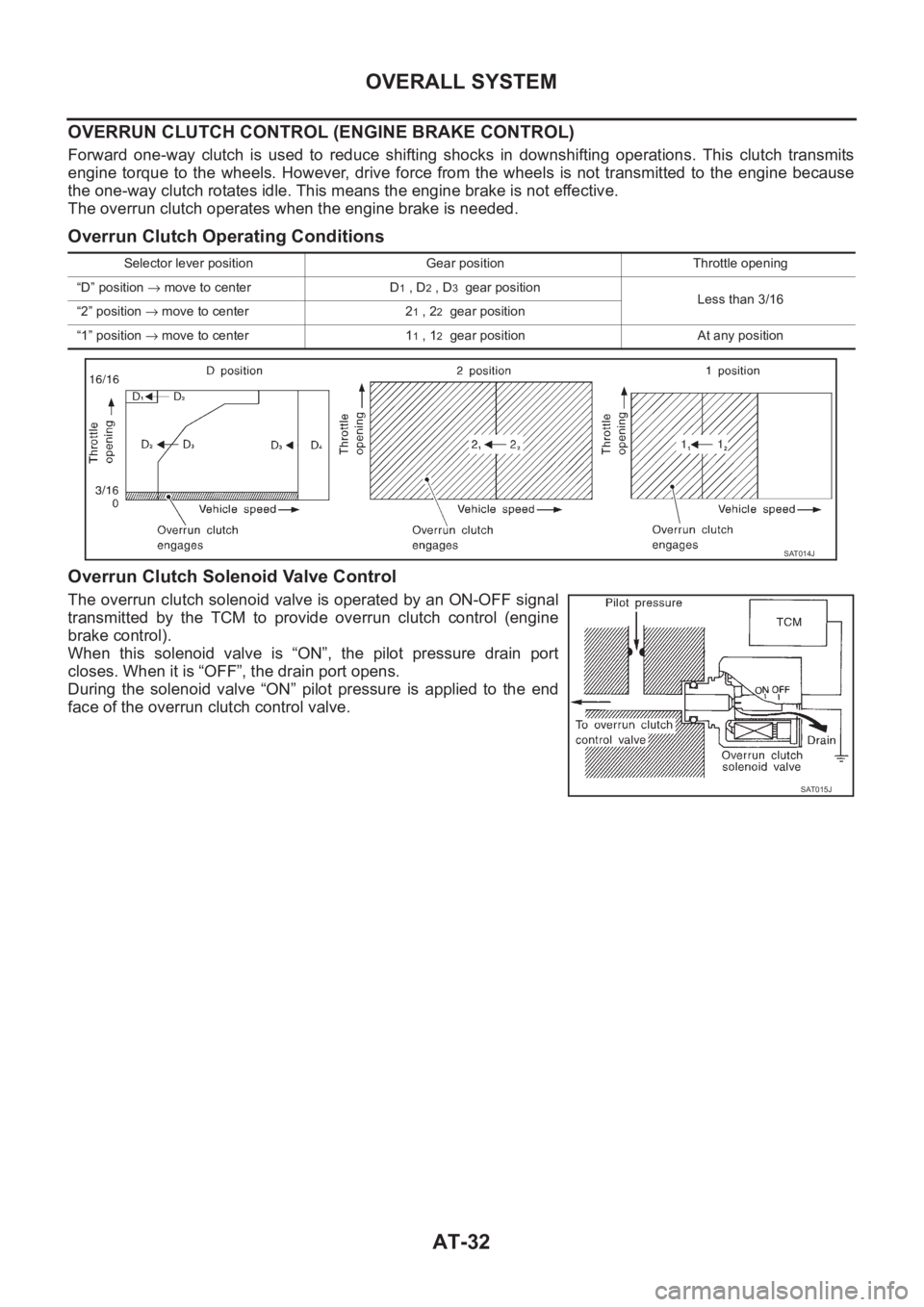
Overrun Clutch Operating Conditions
Overrun Clutch Solenoid Valve Control
The overrun clutch solenoid valve is operated by an ON-OFF signal
transmitted by the TCM to provide overrun clutch control (engine
brake control).
When this solenoid valve is “ON”, the pilot pressure drain port
closes. When it is “OFF”, the drain port opens.
During the solenoid valve “ON” pilot pressure is applied to the end
face of the overrun clutch control valve.
Selector lever position Gear position Throttle opening
“D” position → move to center D
1 , D2 , D3 gear position
Less than 3/16
“2” position → move to center 2
1 , 22 gear position
“1” position → move to center 1
1 , 12 gear position At any position
SAT014J
SAT015J
Page 1490 of 3189
AT-34
OVERALL SYSTEM
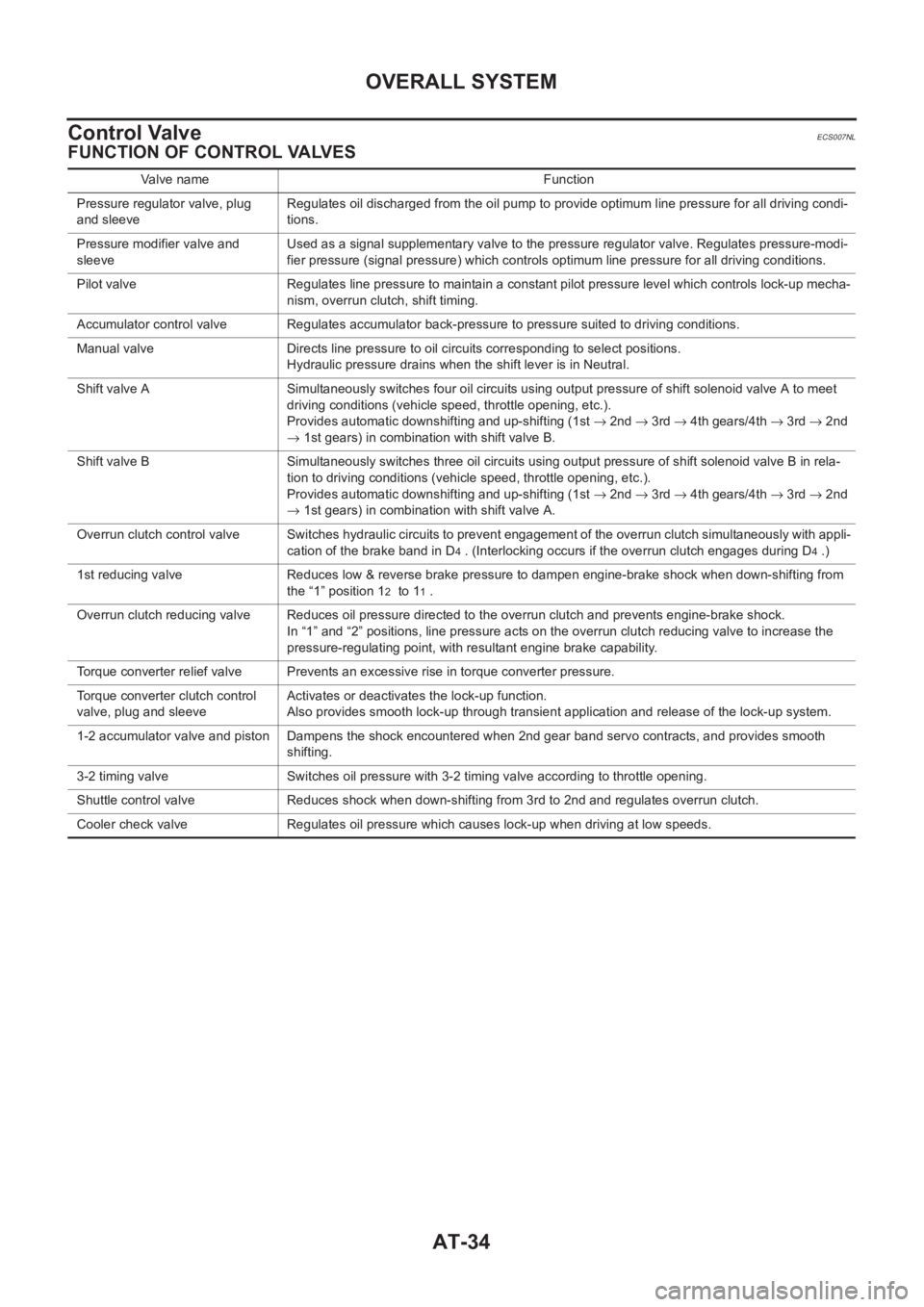
Control Valve
ECS007NL
FUNCTION OF CONTROL VALVES
Valve name Function
Pressure regulator valve, plug
and sleeveRegulates oil discharged from the oil pump to provide optimum line pressure for all driving condi-
tions.
Pressure modifier valve and
sleeveUsed as a signal supplementary valve to the pressure regulator valve. Regulates pressure-modi-
fier pressure (signal pressure) which controls optimum line pressure for all driving conditions.
Pilot valve Regulates line pressure to maintain a constant pilot pressure level which controls lock-up mecha-
nism, overrun clutch, shift timing.
Accumulator control valve Regulates accumulator back-pressure to pressure suited to driving conditions.
Manual valve Directs line pressure to oil circuits corresponding to select positions.
Hydraulic pressure drains when the shift lever is in Neutral.
Shift valve A Simultaneously switches four oil circuits using output pressure of shift solenoid valve A to meet
driving conditions (vehicle speed, throttle opening, etc.).
Provides automatic downshifting and up-shifting (1st → 2nd → 3rd → 4th gears/4th → 3rd → 2nd
→ 1st gears) in combination with shift valve B.
Shift valve B Simultaneously switches three oil circuits using output pressure of shift solenoid valve B in rela-
tion to driving conditions (vehicle speed, throttle opening, etc.).
Provides automatic downshifting and up-shifting (1st → 2nd → 3rd → 4th gears/4th → 3rd → 2nd
→ 1st gears) in combination with shift valve A.
Overrun clutch control valve Switches hydraulic circuits to prevent engagement of the overrun clutch simultaneously with appli-
cation of the brake band in D
4 . (Interlocking occurs if the overrun clutch engages during D4 .)
1st reducing valve Reduces low & reverse brake pressure to dampen engine-brake shock when down-shifting from
the “1” position 1
2 to 11 .
Overrun clutch reducing valve Reduces oil pressure directed to the overrun clutch and prevents engine-brake shock.
In “1” and “2” positions, line pressure acts on the overrun clutch reducing valve to increase the
pressure-regulating point, with resultant engine brake capability.
Torque converter relief valve Prevents an excessive rise in torque converter pressure.
Torque converter clutch control
valve, plug and sleeveActivates or deactivates the lock-up function.
Also provides smooth lock-up through transient application and release of the lock-up system.
1-2 accumulator valve and piston Dampens the shock encountered when 2nd gear band servo contracts, and provides smooth
shifting.
3-2 timing valve Switches oil pressure with 3-2 timing valve according to throttle opening.
Shuttle control valve Reduces shock when down-shifting from 3rd to 2nd and regulates overrun clutch.
Cooler check valve Regulates oil pressure which causes lock-up when driving at low speeds.
Page 1499 of 3189
![NISSAN ALMERA N16 2003 Electronic Repair Manual ON BOARD DIAGNOSTIC SYSTEM DESCRIPTION
AT-43
[EURO-OBD]
D
E
F
G
H
I
J
K
L
MA
B
AT
X: Applicable
—: Not applicable
*1: These malfunctions cannot be displayed by MI if another malfunction is assigned](/manual-img/5/57350/w960_57350-1498.png "NISSAN ALMERA N16 2003 Electronic Repair Manual ON BOARD DIAGNOSTIC SYSTEM DESCRIPTION
AT-43
[EURO-OBD]
D
E
F
G
H
I
J
K
L
MA
B
AT
X: Applicable
—: Not applicable
*1: These malfunctions cannot be displayed by MI if another malfunction is assigned")
ON BOARD DIAGNOSTIC SYSTEM DESCRIPTION
AT-43
[EURO-OBD]
D
E
F
G
H
I
J
K
L
MA
B
AT
X: Applicable
—: Not applicable
*1: These malfunctions cannot be displayed by MI if another malfunction is assigned to lamp MI.
*2: Refer to AT- 4 1 , "
Malfunction Indicator (MI)" .
*3: A/T COMM LINE means CAN COMM LINE in this model.
DATA MONITOR MODE (A/T)
A/T fluid temperature sensor●TCM receives an excessively low
or high voltage from the sensor.
X P0710
BATT/FLUID TEMP
SENATF TEMP SEN/
CIRC
Engine control
●The ECM-A/T communication line
is open or shorted.X U1000
A/T COMM LINE
*3—
TCM (RAM)
●TCM memory (RAM) is malfunc-
tioning.
——
CONTROL UNIT
(RAM)—
TCM (ROM)
●TCM memory (ROM) is malfunc-
tioning.
——
CONTROL UNIT
(ROM)—
TCM (EEP ROM)
●TCM memory (EEP ROM) is mal-
functioning.
——
CONT UNIT (EEP
ROM)—
Initial start
●This is not a malfunction message
(Whenever shutting off a power
supply to the TCM, this message
appears on the screen.)X— INITIAL START
—
No failure
(NO SELF DIAGNOSTIC FAILURE INDI-
CATED FURTHER TESTING MAY BE
REQUIRED**)
●No failure has been detected.
XX Detected items
(Screen terms for CONSULT-II, “SELF
DIAGNOSIS” test mode)
Malfunction is detected when...TCM self-diagnosis EURO-OBD (DTC)
Available by O/D OFF
indicator lamp or “A/T”
on CONSULT-IIAvailable by malfunc-
tion indicator*
2 ,
“ENGINE” on CON-
SULT-II or GST “A/T” “ENGINE”
Item DisplayMover to center Monitor items
Description Remarks TCM
Input
signalsCAN
comm
sig-
nalsMain
signalsSelection
from
menu
Vehicle speed
sensor 1 (A/T)
(Revolution sen-
sor)VHCL/S SE·A/T
[km/h] or [mph]
X——
●Vehicle speed com-
puted from signal of
revolution sensor is
displayed.When racing engine in N
or P with vehicle station-
ary, CONSULT-II data
may not indicate 0 km/h
(0 mph).
Vehicle speed
sensor 2
(Meter)VHCL/S
SE·MTR
[km/h] or [mph]
X——
●Vehicle speed com-
puted from signal of
vehicle speed sensor is
displayed.Vehicle speed display
may not be accurate
under approx. 10 km/h
(6 mph). It may not indi-
cate 0 km/h (0 mph)
when vehicle is station-
ary.
Page 1500 of 3189
![NISSAN ALMERA N16 2003 Electronic Repair Manual AT-44
[EURO-OBD]
ON BOARD DIAGNOSTIC SYSTEM DESCRIPTION
Throttle position
sensorTHRTL POS
SEN
[V]X——●Throttle position sensor
signal voltage is dis-
played.This sensor means
accelerator peda](/manual-img/5/57350/w960_57350-1499.png "NISSAN ALMERA N16 2003 Electronic Repair Manual AT-44
[EURO-OBD]
ON BOARD DIAGNOSTIC SYSTEM DESCRIPTION
Throttle position
sensorTHRTL POS
SEN
[V]X——●Throttle position sensor
signal voltage is dis-
played.This sensor means
accelerator peda")
AT-44
[EURO-OBD]
ON BOARD DIAGNOSTIC SYSTEM DESCRIPTION
Throttle position
sensorTHRTL POS
SEN
[V]X——●Throttle position sensor
signal voltage is dis-
played.This sensor means
accelerator pedal posi-
tion(APP)sensor.
A/T fluid tempera-
ture sensorFLUID TEMP SE
[V]
X——
●A/T fluid temperature
sensor signal voltage is
displayed.
●Signal voltage lowers
as fluid temperature
rises.
Battery voltage BATTERY VOLT
[V]X——
●Source voltage of TCM
is displayed.
Engine speed ENGINE SPEED
[rpm]
X—X
●Engine speed, com-
puted from engine
speed signal, is dis-
played.Engine speed display
may not be accurate
under approx. 800 rpm.
It may not indicate 0 rpm
even when engine is not
running.
Overdrive control
switchOVERDRIVE
SW
[ON/OFF]X——
●ON/OFF state com-
puted from signal of
overdrive control SW is
displayed.
PN position (PNP)
switchPN POSI SW
[ON/OFF]
X——
●ON/OFF state com-
puted from signal of PN
position SW is dis-
played.
R position switch R POSITION SW
[ON/OFF]
X——
●ON/OFF state com-
puted from signal of R
position SW is dis-
played.
D position switch D POSITION SW
[ON/OFF]
X——
●ON/OFF state com-
puted from signal of D
position SW is dis-
played.
2 position switch 2 POSITION SW
[ON/OFF]
X——
●ON/OFF status, com-
puted from signal of 2
position SW, is dis-
played.
1 position switch 1 POSITION SW
[ON/OFF]
X——
●ON/OFF status, com-
puted from signal of 1
position SW, is dis-
played.
Kickdown switch KICKDOWN SW
[ON/OFF]
X——
●ON/OFF status, com-
puted from signal of
kick down SW, is dis-
played.●This is displayed even
when no kick down
switch is equipped.
Gear position GEAR
—— X
●Gear position data
used for computation
by TCM, is displayed.
Selector lever
positionSLCT LVR POSI
—— X
●Selector lever position
data, used for compu-
tation by TCM, is dis-
played.●A specific value used
for control is displayed
if fail-safe is activated
due to error. Item DisplayMover to center Monitor items
Description Remarks TCM
Input
signalsCAN
comm
sig-
nalsMain
signalsSelection
from
menu
Page 1501 of 3189
![NISSAN ALMERA N16 2003 Electronic Repair Manual ON BOARD DIAGNOSTIC SYSTEM DESCRIPTION
AT-45
[EURO-OBD]
D
E
F
G
H
I
J
K
L
MA
B
AT
Vehicle speed VEHICLE
SPEED
[km/h] or [mph]—— X●Vehicle speed data,
used for computation
by TCM, is displayed](/manual-img/5/57350/w960_57350-1500.png "NISSAN ALMERA N16 2003 Electronic Repair Manual ON BOARD DIAGNOSTIC SYSTEM DESCRIPTION
AT-45
[EURO-OBD]
D
E
F
G
H
I
J
K
L
MA
B
AT
Vehicle speed VEHICLE
SPEED
[km/h] or [mph]—— X●Vehicle speed data,
used for computation
by TCM, is displayed")
ON BOARD DIAGNOSTIC SYSTEM DESCRIPTION
AT-45
[EURO-OBD]
D
E
F
G
H
I
J
K
L
MA
B
AT
Vehicle speed VEHICLE
SPEED
[km/h] or [mph]—— X●Vehicle speed data,
used for computation
by TCM, is displayed.
Torque converter
slip ratioTC SLIP
RATIO
[0.000]———
●Ratio of engine revolu-
tion to input shaft revo-
lution of torque
converter
Torque converter
slip speedTC SLIP
SPEED
[rpm]———Difference in revolution
between input shaft revo-
lution and input shaft rev-
olution of torque
converterDisplay doesn't indicate
o rpm even if engine is
stopped.
But this isn't malfunc-
tion.
can communica-
tionCAN COMM
[OK/UNKWN]—X—
CAN circuit 1CAN CIRC 1
[OK/UNKWN]—X—
CAN circuit 2CAN CIRC 2
[OK/UNKWN]—X—
CAN circuit 3CAN CIRC 3
[OK/UNKWN]—X—
CAN circuit 4CAN CIRC 4
[OK/UNKWN]—X—
CAN circuit 5CAN CIRC 5
[OK/UNKWN]—X—
Throttle position THROTTLE
POSI
[/8]—— X
●Throttle position data,
used for computation
by TCM, is displayed.●A specific value used
for control is displayed
if fail-safe is activated
due to error.
Stop lamp switch BRAKE SW
[ON/OFF]
X——
●ON/OFF status is dis-
played.
ON... Brake pedal is
depressed.
OFF... Brake pedal is
released.
Line pressure duty LINE PRES DTY
[%]
—— X
●Control value of line
pressure solenoid
valve, computed by
TCM from each input
signal, is displayed.
Torque converter
clutch solenoid
valve dutyTCC S/V DUTY
[%]
—— X
●Control value of torque
converter clutch sole-
noid valve, computed
by TCM from each
input signal, is dis-
played. Item DisplayMover to center Monitor items
Description Remarks TCM
Input
signalsCAN
comm
sig-
nalsMain
signalsSelection
from
menu