Page 342 of 399
342 Practical hintsFlat tireLowering the vehicle�
Lower vehicle by turning crank coun-
terclockwise until vehicle is resting ful-
ly on its own weight.
�
Remove the jack.
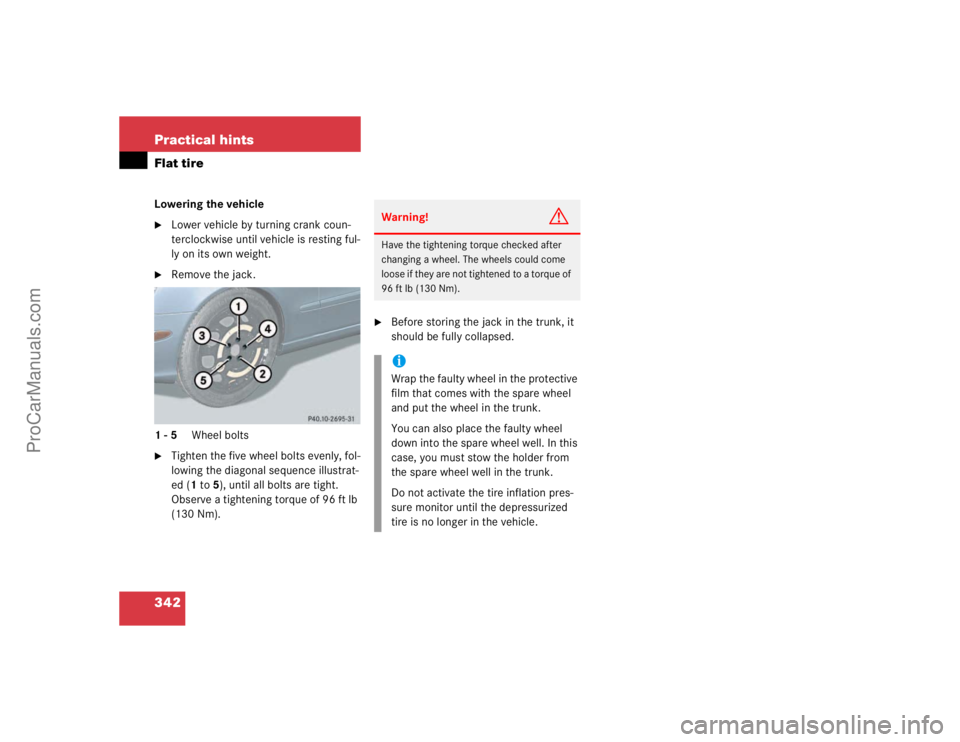
1-5 Wheel bolts
�
Tighten the five wheel bolts evenly, fol-
lowing the diagonal sequence illustrat-
ed (1 to 5), until all bolts are tight.
Observe a tightening torque of 96 ft lb
(130 Nm).
�
Before storing the jack in the trunk, it
should be fully collapsed.Warning!
G
Have the tightening torque checked after
changing a wheel. The wheels could come
loose if they are not tightened to a torque of
96 ft lb (130 Nm).iWrap the faulty wheel in the protective
film that comes with the spare wheel
and put the wheel in the trunk.
You can also place the faulty wheel
down into the spare wheel well. In this
case, you must stow the holder from
the spare wheel well in the trunk.
Do not activate the tire inflation pres-
sure monitor until the depressurized
tire is no longer in the vehicle.
ProCarManuals.com
Page 348 of 399
348 Practical hintsTowing the vehicle
Towing the vehicleTowing the vehicle
Mercedes-Benz recommends that the vehi-
cle be transported with all wheels off the
ground using flatbed or appropriate wheel
lift/dolly equipment.
When circumstances do not permit the
recommended towing methods, the vehi-
cle may be towed with all wheels on the
ground or front wheels raised only so far as to have the vehicle moved to a safe loca-
tion where the recommended towing
methods can be employed.
!Use flatbed or wheel lift/dolly equip-
ment with key in starter switch turned
to position0.
Do not tow with sling-type equipment.
Towing with sling-type equipment over
bumpy roads will damage radiator and
supports.
To prevent damage during transport,
do not tie down vehicle by its chassis or
suspension parts.
Switch off the tow-away alarm and the
automatic central locking
!If the vehicle is towed with the front
axle raised, the engine must be shut off
(key in starter switch position0 or1).
Otherwise, the ESP will immediately be
engaged and will apply the rear wheel
brakes.
When towing the vehicle with all wheels
on the ground, the selector lever must
be in positionN and the key must be in
starter switch position2. When towing
the vehicle with all wheels on the
ground, the vehicle may be towed only
for distances up to 30 miles (50 km)
and at a speed not to exceed 30 mph
(50 km/h).
!To be certain to avoid a possibility of
damage to the transmission, however,
we recommend the drive shaft be dis-
connected at the rear axle drive flange
for any towing beyond a short tow to a
nearby garage.
ProCarManuals.com
Page 349 of 399
349 Practical hints
Towing the vehicle
Warning!
G
If circumstances require towing the vehicle
with all wheels on the ground, always tow
with a tow bar if:�
the engine will not run
�
there is a malfunction in the SBC brake
system
�
there is a malfunction in the power sup-
ply or in the vehicle’s electrical system
as that will be necessary to adequately con-
trol the towed vehicle.
Prior to towing the vehicle with all wheels on
the ground, make certain that the key is in
starter switch position2.
If the key is left in the starter switch
position0 for an extended period of time, it
can no longer be turned in the switch. In this
case, the steering is locked. To unlock, re-
move key from starter switch and reinsert.
iTo signal turns while being towed with
the hazard warning flasher in use, turn
key in starter switch to position2 and
activate the combination switch for the
left or right turn signal in the usual
manner – only the selected turn signal
will operate.
Upon canceling the turn signal, the haz-
ard warning flasher will operate again.
Warning!
G
The brake system requires electrical power
to operate.
A malfunction in the vehicle’s power supply
or electrical system may impair brake sys-
tem operation and switch it into its
limp-home (emergency operation) mode. To
brake, the driver must then apply signifi-
cantly greater brake pedal pressure and de-
press the pedal much further to obtain the
expected braking effect. If necessary, apply
full pressure to the brake pedal. Brakes are
only applied to the front wheels. Stopping
distance is increased! Adapt your driving
style accordingly. SBC brake system
(�page 77).
With the engine not running, there is no
power assistance for the steering system. In
this case, it is important to keep in mind that
a considerably higher degree of effort is nec-
essary to steer the vehicle. Adapt your driv-
ing accordingly.
ProCarManuals.com
Page 350 of 399
350 Practical hintsTowing the vehicle
Installing towing eye bolt
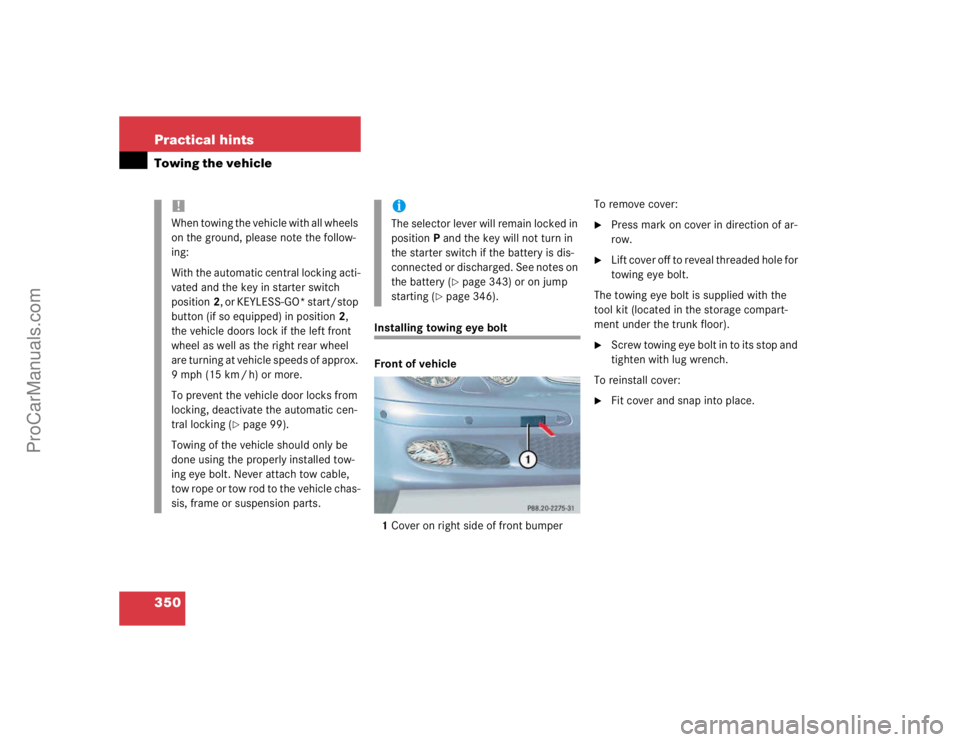
Front of vehicle
1Cover on right side of front bumperTo remove cover:
�
Press mark on cover in direction of ar-
row.
�
Lift cover off to reveal threaded hole for
towing eye bolt.
The towing eye bolt is supplied with the
tool kit (located in the storage compart-
ment under the trunk floor).
�
Screw towing eye bolt in to its stop and
tighten with lug wrench.
To reinstall cover:
�
Fit cover and snap into place.
!When towing the vehicle with all wheels
on the ground, please note the follow-
ing:
With the automatic central locking acti-
vated and the key in starter switch
position2, or KEYLESS-GO* start/stop
button (if so equipped) in position2,
the vehicle doors lock if the left front
wheel as well as the right rear wheel
are turning at vehicle speeds of approx.
9 mph (15 km / h) or more.
To prevent the vehicle door locks from
locking, deactivate the automatic cen-
tral locking (
�page 99).
Towing of the vehicle should only be
done using the properly installed tow-
ing eye bolt. Never attach tow cable,
tow rope or tow rod to the vehicle chas-
sis, frame or suspension parts.
iThe selector lever will remain locked in
positionP and the key will not turn in
the starter switch if the battery is dis-
connected or discharged. See notes on
the battery (
�page 343) or on jump
starting (
�page 346).
ProCarManuals.com
Page 361 of 399

361 Technical data
Rims and tires
Rims and tires
Use only tires and rims which have been
specifically developed for your vehicle and
tested and approved by Mercedes-Benz.
Other tires and rims can have detrimental
effects, such as:�
Poor handling characteristics
�
Increased noise
�
Increased fuel consumption
Same-sized tires
!Moreover, tires and rims not approved
by Mercedes-Benz may under load ex-
hibit dimensional variations and differ-
ent tire deformation characteristics
that could cause them to come into
contact with the vehicle body or axle
parts. Damage to the tires or the vehi-
cle can be the result.
iFurther information on tires and rims is
available at any authorized
Mercedes-Benz Center. A tire inflation
pressure table is located on the fuel fill-
er cap of the vehicle. The tire pressure
should only be adjusted on cold tires.
Follow the tire manufacturer’s mainte-
nance recommendation included with
the vehicle.
E320
E500
Rims (light alloy)
8J x 16 ET 39
8½J x 17 ET 38
Wheel offset
1.53 in (39 mm)
1.5 in (38 mm)
Summer tires (radial-ply tires)
225/55 R 16 95 H
245/45 R 17 95 H
1
Winter tires (radial-ply tires)
225/55 R 16 95 H M+S
245/45 R 17 95 H M+S
1
1Must not be used with snow chains.
ProCarManuals.com
Page 362 of 399
362 Technical dataRims and tiresMinispare wheel
Sport package
E320 / E500
Rim
4J x 17 ET 34
Wheel offset
1.34 (34 mm)
Tire
T 155/70 R 17
1
1Must not be used with snow chains.
E320*/ E500*
Same-sized
tiresRims
(light alloy)
8J x 17 ET 38
Wheel offset
1.5 in (38 mm)
Summer tires
(radial-ply tires)
245/45 R 17 95 H
1
Winter tires
(radial-ply tires)
245/45 R 17 95 M+S
1
1Must not be used with snow chains.
ProCarManuals.com
Page 364 of 399
364 Technical dataMain dimensions
Main dimensionsModel
E320
E500
Overall vehicle length
189.7 in (4818 mm)
189.7 in (4818 mm)
Overall vehicle width
78.3 in (1990 mm)
78.3 in (1990 mm)
Overall vehicle height
57.2 in (1452 mm)
Overall vehicle height (AIRMATIC DC*)
(optional on E320; standard on E500)
56.2 in (1428 mm)
56.3 in (1430 mm)
Wheelbase
112.4 in (2854 mm)
112.4 in (2854 mm)
Track, front
62.1 in (1577 mm)
62.1 in (1577 mm)
Track, rear
61.8 in (1570 mm)
61.8 in (1570 mm)
ProCarManuals.com
Page 366 of 399

366 Technical dataFuels, coolants, lubricants etc.
Fuels, coolants, lubricants etc.CapacitiesVehicle components and their respective
lubricants must match. Therefore use only
brands tested and recommended by us.Please refer to the Factory Approved Ser-
vice Products Pamphlet, or inquire at your
authorized Mercedes-Benz Center.
Model
Capacity
Fuels, coolants, lubricants etc.
Engine with oil filter
E320
E500
8.5 US qt (8.0 l)
8.0 US qt (7.5 l)
Recommended engine oils
Automatic transmission
8.0 US qt (7.5 l)
MB Automatic Transmission Oil
1
1MB part no. 001 989 21 03 10Rear axle
E320
E500
1.06 US qt (1 l)
1.37 US qt (1.3 l)
Hypoid gear oil SAE 85 W 90
Power steering
approx. 1.1 US qt (1.0 l)
MB Power Steering Fluid (Pentosin
CHF 11S)
Front wheel hubs
approx. 3.0 oz (85 g) each
High temperature roller bearing grease
Brake system
0.64 US qt (0.6 l)
MB Brake Fluid (DOT 4+)
Cooling system
E320
E500
approx. 10.7 US qt (10 l)
approx. 11.9 US qt (11.3 l)
MB 325.0 Anticorrosion / Antifreeze
Fuel tank including a reserve of
21.12 US gal (80.0 l)
2.38 US gal (9.0 l)
Premium unleaded gasoline:
Posted Octane 91 (Avg. of 96
RON / 86 MON)
Air conditioner system
R-134a refrigerant and special PAG lu-
bricant oil (never R-12)
ProCarManuals.com