Page 299 of 399
299 Practical hints
What to do if …
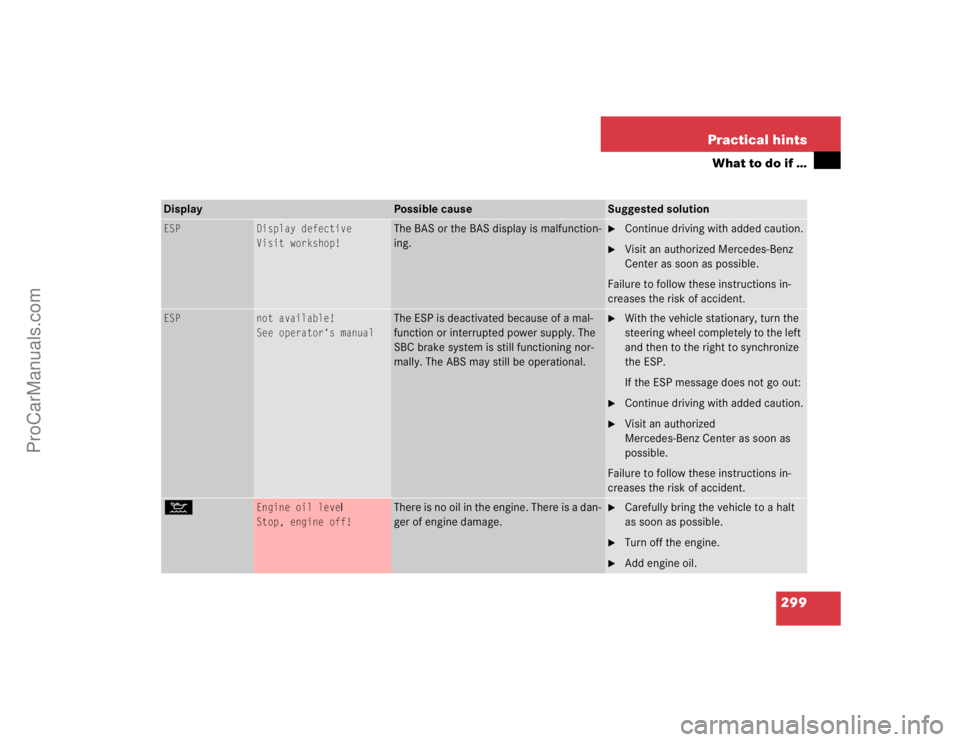
ESP
Display defective
Visit workshop!
The BAS or the BAS display is malfunction-
ing.
�
Continue driving with added caution.
�
Visit an authorized Mercedes-Benz
Center as soon as possible.
Failure to follow these instructions in-
creases the risk of accident.
ESP
not available!
See operator‘s manual
The ESP is deactivated because of a mal-
function or interrupted power supply. The
SBC brake system is still functioning nor-
mally. The ABS may still be operational.
�
With the vehicle stationary, turn the
steering wheel completely to the left
and then to the right to synchronize
the ESP.
If the ESP message does not go out:
�
Continue driving with added caution.
�
Visit an authorized
Mercedes-Benz Center as soon as
possible.
Failure to follow these instructions in-
creases the risk of accident.
:
Engine oil leve
l
Stop, engine off!
There is no oil in the engine. There is a dan-
ger of engine damage.
�
Carefully bring the vehicle to a halt
as soon as possible.
�
Turn off the engine.
�
Add engine oil.
Display
Possible cause
Suggested solution
ProCarManuals.com
Page 307 of 399
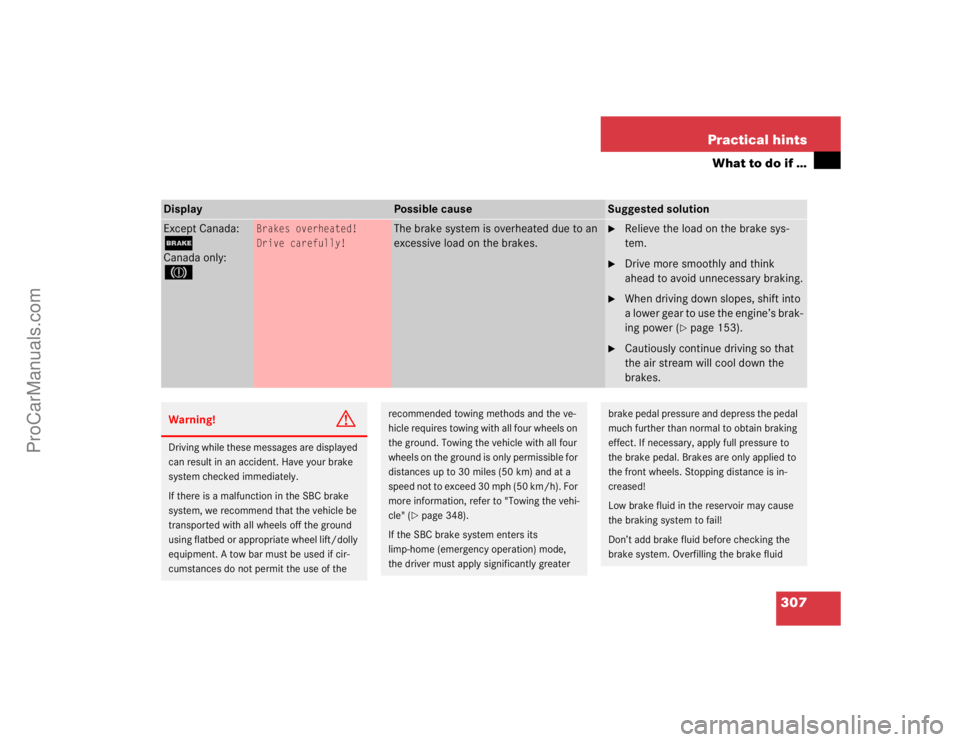
307 Practical hints
What to do if …
Except Canada:;Canada only:3
Brakes overheated!
Drive carefully!
The brake system is overheated due to an
excessive load on the brakes.
�
Relieve the load on the brake sys-
tem.
�
Drive more smoothly and think
ahead to avoid unnecessary braking.
�
When driving down slopes, shift into
a lower gear to use the engine’s brak-
ing power (
�page 153).
�
Cautiously continue driving so that
the air stream will cool down the
brakes.
Display
Possible cause
Suggested solution
Warning!
G
Driving while these messages are displayed
can result in an accident. Have your brake
system checked immediately.
If there is a malfunction in the SBC brake
system, we recommend that the vehicle be
transported with all wheels off the ground
using flatbed or appropriate wheel lift/dolly
equipment. A tow bar must be used if cir-
cumstances do not permit the use of the
recommended towing methods and the ve-
hicle requires towing with all four wheels on
the ground. Towing the vehicle with all four
wheels on the ground is only permissible for
distances up to 30 miles (50 km) and at a
speed not to exceed 30 mph (50 km/h). For
more information, refer to "Towing the vehi-
cle" (
�page 348).
If the SBC brake system enters its
limp-home (emergency operation) mode,
the driver must apply significantly greater
brake pedal pressure and depress the pedal
much further than normal to obtain braking
effect. If necessary, apply full pressure to
the brake pedal. Brakes are only applied to
the front wheels. Stopping distance is in-
creased!
Low brake fluid in the reservoir may cause
the braking system to fail!
Don’t add brake fluid before checking the
brake system. Overfilling the brake fluid
ProCarManuals.com
Page 309 of 399
309 Practical hints
What to do if …
Display
Possible cause
Suggested solution
F
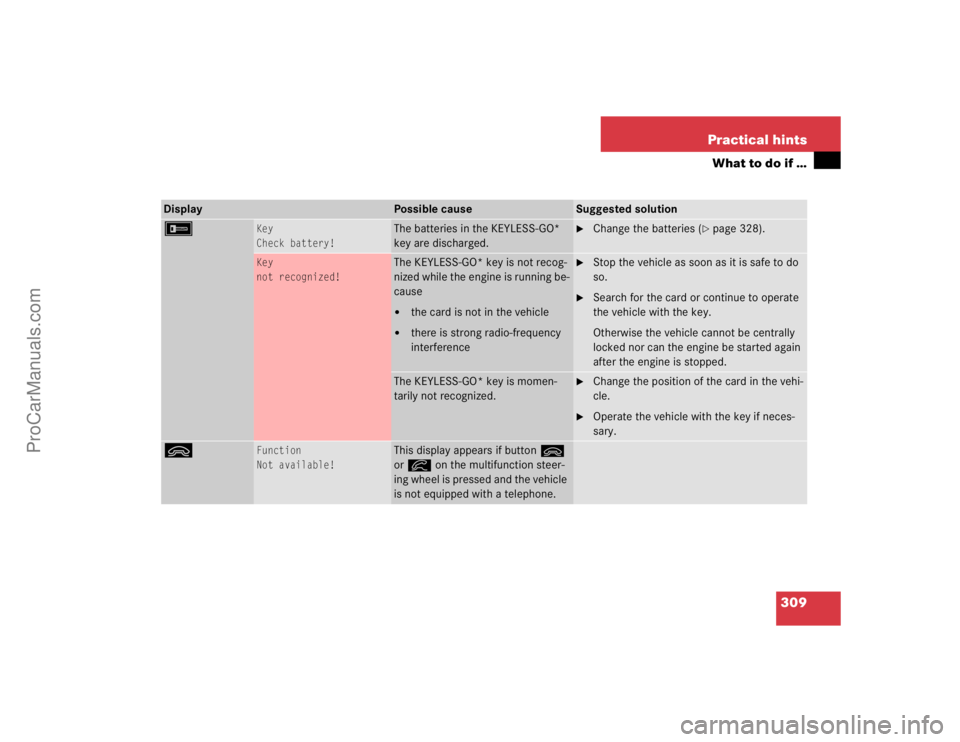
Key
Check battery!
The batteries in the KEYLESS-GO*
key are discharged.
�
Change the batteries (
�page 328).
Key
not recognized!
The KEYLESS-GO* key is not recog-
nized while the engine is running be-
cause�
the card is not in the vehicle
�
there is strong radio-frequency
interference
�
Stop the vehicle as soon as it is safe to do
so.
�
Search for the card or continue to operate
the vehicle with the key.
Otherwise the vehicle cannot be centrally
locked nor can the engine be started again
after the engine is stopped.
The KEYLESS-GO* key is momen-
tarily not recognized.
�
Change the position of the card in the vehi-
cle.
�
Operate the vehicle with the key if neces-
sary.
ì
Function
Not available!
This display appears if button ì
or í on the multifunction steer-
ing wheel is pressed and the vehicle
is not equipped with a telephone.
ProCarManuals.com
Page 310 of 399

310 Practical hintsWhat to do if …F
Key recognized
in vehicle!
A KEYLESS-GO* key left in the vehi-
cle was recognized while locking the
vehicle from the outside.
�
Take the key out of the vehicle.
Key
Visit workshop!
The KEYLESS-GO* system is mal-
functioning.
�
Visit an authorized Mercedes-Benz Center
as soon as possible.
Key
do not forget key
This display appears (for a maximum
of 60 seconds) if the driver’s door is
opened with the engine shut off and
no key in the starter switch.
This message is only a reminder.
�
Insert key in the starter switch.
_
Entry position
Do not drive!
Seat, mirrors and steering wheel
have not yet moved to their preset
driving positions.
�
Wait until the seat, mirrors and steering
wheel have moved to their driving positions.
The message disappears.
Except Canada:;Canada only:!
Release park. brake!
You are driving with the parking
brake set.
�
Release the parking brake (
�page 45).
<
Visit workshop!
The seat belt system is malfunction-
ing.
�
Visit an authorized Mercedes-Benz Center
as soon as possible.
Ê
Trunk open!
This message will appear whenever
the trunk lid is open.
�
Close the trunk lid.
Display
Possible cause
Suggested solution
ProCarManuals.com
Page 318 of 399
318 Practical hintsWhat to do if …Display
Possible cause
Suggested solution
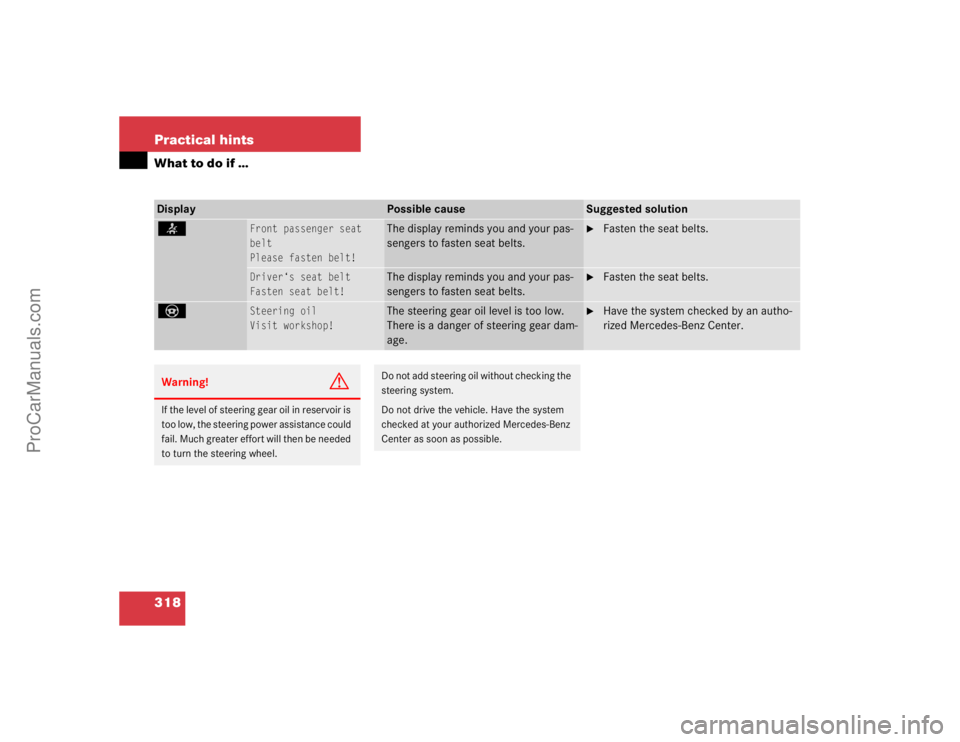
<
Front passenger seat
belt
Please fasten belt!
The display reminds you and your pas-
sengers to fasten seat belts.
�
Fasten the seat belts.
Driver‘s seat belt
Fasten seat belt!
The display reminds you and your pas-
sengers to fasten seat belts.
�
Fasten the seat belts.
_
Steering oil
Visit workshop!
The steering gear oil level is too low.
There is a danger of steering gear dam-
age.
�
Have the system checked by an autho-
rized Mercedes-Benz Center.
Warning!
G
If the level of steering gear oil in reservoir is
too low, the steering power assistance could
fail. Much greater effort will then be needed
to turn the steering wheel.
Do not add steering oil without checking the
steering system.
Do not drive the vehicle. Have the system
checked at your authorized Mercedes-Benz
Center as soon as possible.
ProCarManuals.com
Page 319 of 399
319 Practical hints
What to do if …
Display
Possible cause
Possible solution
H
Tire pressure monitor-
ing activated
The tire pressure is being checked.
Tire pressure monitor-
ing Reactivate
The tire inflation pressure monitor* is de-
activated.
�
Activate the tire inflation pressure moni-
tor* (
�page 271).
Tire pressure monitor-
ing currently inactive
The tire inflation pressure monitor* is un-
able to monitor the tire pressure due to�
the presence of several wheel sensors
in the vehicle.
�
excessive wheel sensor temperatures.
�
a nearby radio interference source.
�
unrecognized wheel sensors mounted.
�
Check the tire pressure at the next ser-
vice station.
Warning!
G
Do not drive with a flat tire. A flat tire affects
the ability to steer or brake the vehicle.
You may lose control of the vehicle. Contin-
ued driving with a flat tire will cause exces-
sive heat build-up and possibly a fire.
ProCarManuals.com
Page 320 of 399
320 Practical hintsWhat to do if …Display
Possible cause
Possible solution
H
Tire pressure monitor-
ing
Visit workshop!
The tire inflation pressure monitor is mal-
functioning.
A wheel without proper sensor was in-
stalled.
�
Have the tire inflation pressure monitor
checked by an authorized
Mercedes-Benz Center.
�
Change the wheel.
Tire pressure, rear left
Caution tire defect!
The left rear tire is rapidly deflating.
�
Carefully bring the vehicle to a halt,
avoiding abrupt steering and braking ma-
neuvers.
�
Change the wheel (
�page 338).
Tire pressure, rear left
Check tires!
The left rear tire pressure is low.
�
Carefully bring the vehicle to a halt.
�
Check the tire pressure.
�
Change the wheel (
�page 338).
Warning!
G
Do not drive with a flat tire. A flat tire affects
the ability to steer or brake the vehicle. You
may lose control of the vehicle.
Continued driving with a flat tire will cause
excessive heat build-up and possibly a fire.
ProCarManuals.com
Page 321 of 399
321 Practical hints
What to do if …
Display
Possible cause
Possible solution
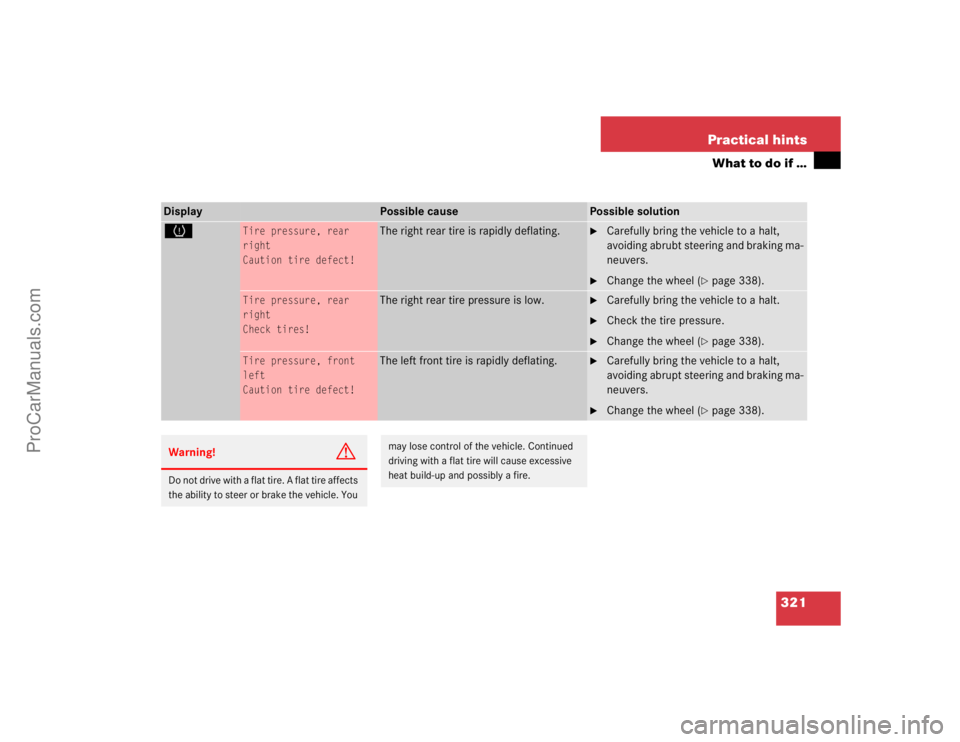
H
Tire pressure, rear
right
Caution tire defect!
The right rear tire is rapidly deflating.
�
Carefully bring the vehicle to a halt,
avoiding abrubt steering and braking ma-
neuvers.
�
Change the wheel (
�page 338).
Tire pressure, rear
right
Check tires!
The right rear tire pressure is low.
�
Carefully bring the vehicle to a halt.
�
Check the tire pressure.
�
Change the wheel (
�page 338).
Tire pressure, front
left
Caution tire defect!
The left front tire is rapidly deflating.
�
Carefully bring the vehicle to a halt,
avoiding abrupt steering and braking ma-
neuvers.
�
Change the wheel (
�page 338).
Warning!
G
Do not drive with a flat tire. A flat tire affects
the ability to steer or brake the vehicle. You
may lose control of the vehicle. Continued
driving with a flat tire will cause excessive
heat build-up and possibly a fire.
ProCarManuals.com