Page 246 of 288
BATTERY
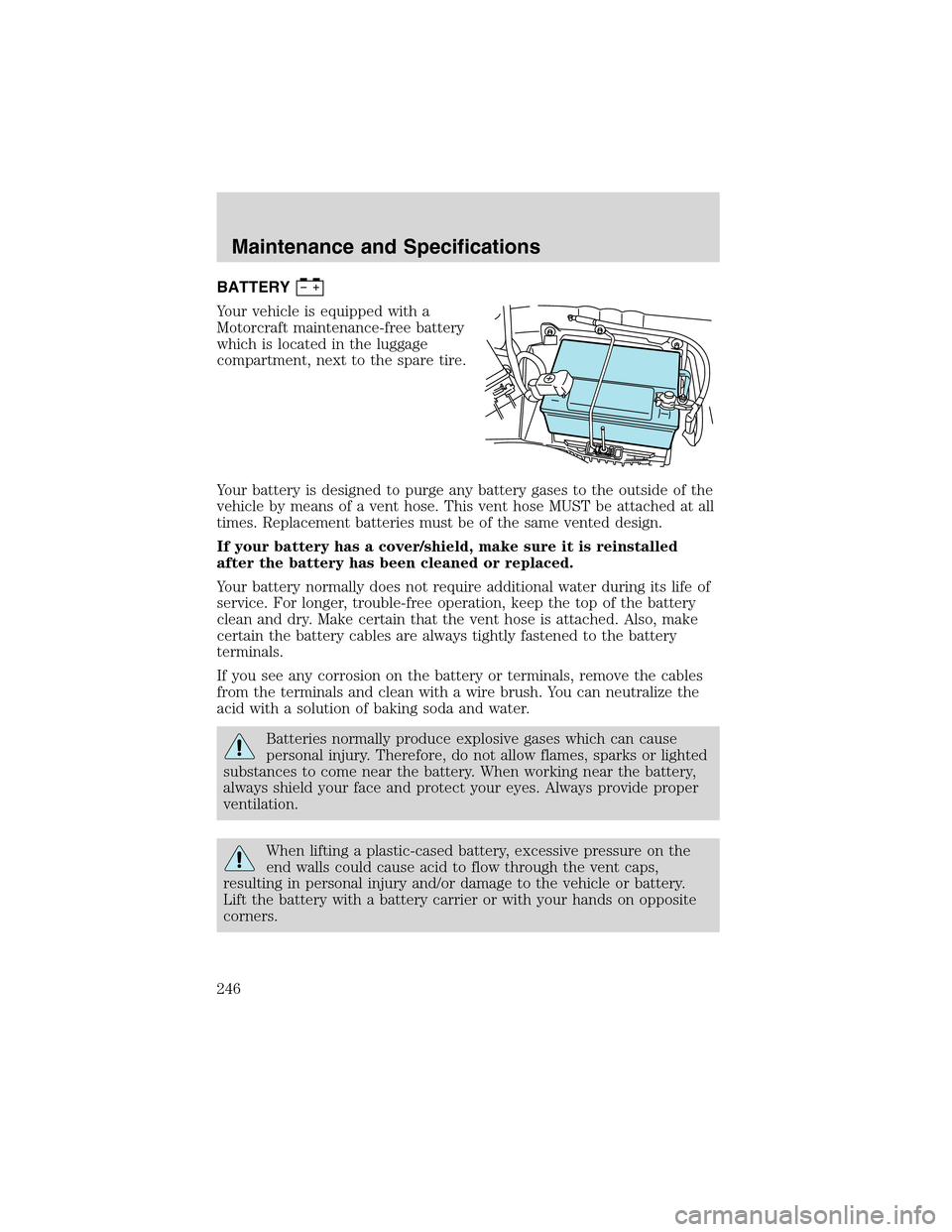
Your vehicle is equipped with a
Motorcraft maintenance-free battery
which is located in the luggage
compartment, next to the spare tire.
Your battery is designed to purge any battery gases to the outside of the
vehicle by means of a vent hose. This vent hose MUST be attached at all
times. Replacement batteries must be of the same vented design.
If your battery has a cover/shield, make sure it is reinstalled
after the battery has been cleaned or replaced.
Your battery normally does not require additional water during its life of
service. For longer, trouble-free operation, keep the top of the battery
clean and dry. Make certain that the vent hose is attached. Also, make
certain the battery cables are always tightly fastened to the battery
terminals.
If you see any corrosion on the battery or terminals, remove the cables
from the terminals and clean with a wire brush. You can neutralize the
acid with a solution of baking soda and water.
Batteries normally produce explosive gases which can cause
personal injury. Therefore, do not allow flames, sparks or lighted
substances to come near the battery. When working near the battery,
always shield your face and protect your eyes. Always provide proper
ventilation.
When lifting a plastic-cased battery, excessive pressure on the
end walls could cause acid to flow through the vent caps,
resulting in personal injury and/or damage to the vehicle or battery.
Lift the battery with a battery carrier or with your hands on opposite
corners.
Maintenance and Specifications
246
Page 267 of 288
•Treadwear 200 Traction AA Temperature A
These Tire Quality Grades are determined by standards that the United
States Department of Transportation has set.
Tire Quality Grades apply to new pneumatic tires for use on passenger
cars. They do not apply to deep tread, winter-type snow tires,
space-saver or temporary use spare tires, tires with nominal rim
diameters of 10 to 12 inches or limited production tires as defined in
Title 49 Code of Federal Regulations Part 575.104(c)(2).
U.S. Department of Transportation-Tire quality grades:The U.S.
Department of Transportation requires Ford to give you the following
information about tire grades exactly as the government has written it.
Treadwear
The treadwear grade is a comparative rating based on the wear rate of
the tire when tested under controlled conditions on a specified
government test course. For example, a tire graded 150 would wear one
and one-half (1 1/2) times as well on the government course as a tire
graded 100. The relative performance of tires depends upon the actual
conditions of their use, however, and may depart significantly from the
norm due to variations in driving habits, service practices, and
differences in road characteristics and climate.
Traction AA A B C
The traction grades, from highest to lowest are AA, A, B, and C. The
grades represent the tire’s ability to stop on wet pavement as measured
under controlled conditions on specified government test surfaces of
asphalt and concrete. A tire marked C may have poor traction
performance.
The traction grade assigned to this tire is based on
straight-ahead braking traction tests, and does not include
acceleration, cornering, hydroplaning or peak traction characteristics.
Temperature A B C
The temperature grades are A (the highest), B and C, representing the
tire’s resistance to the generation of heat and its ability to dissipate heat
when tested under controlled conditions on a specified indoor laboratory
test wheel. Sustained high temperature can cause the material of the tire
to degenerate and reduce tire life, and excessive temperature can lead to
sudden tire failure. The grade C corresponds to a level of performance
Maintenance and Specifications
267
Page 269 of 288
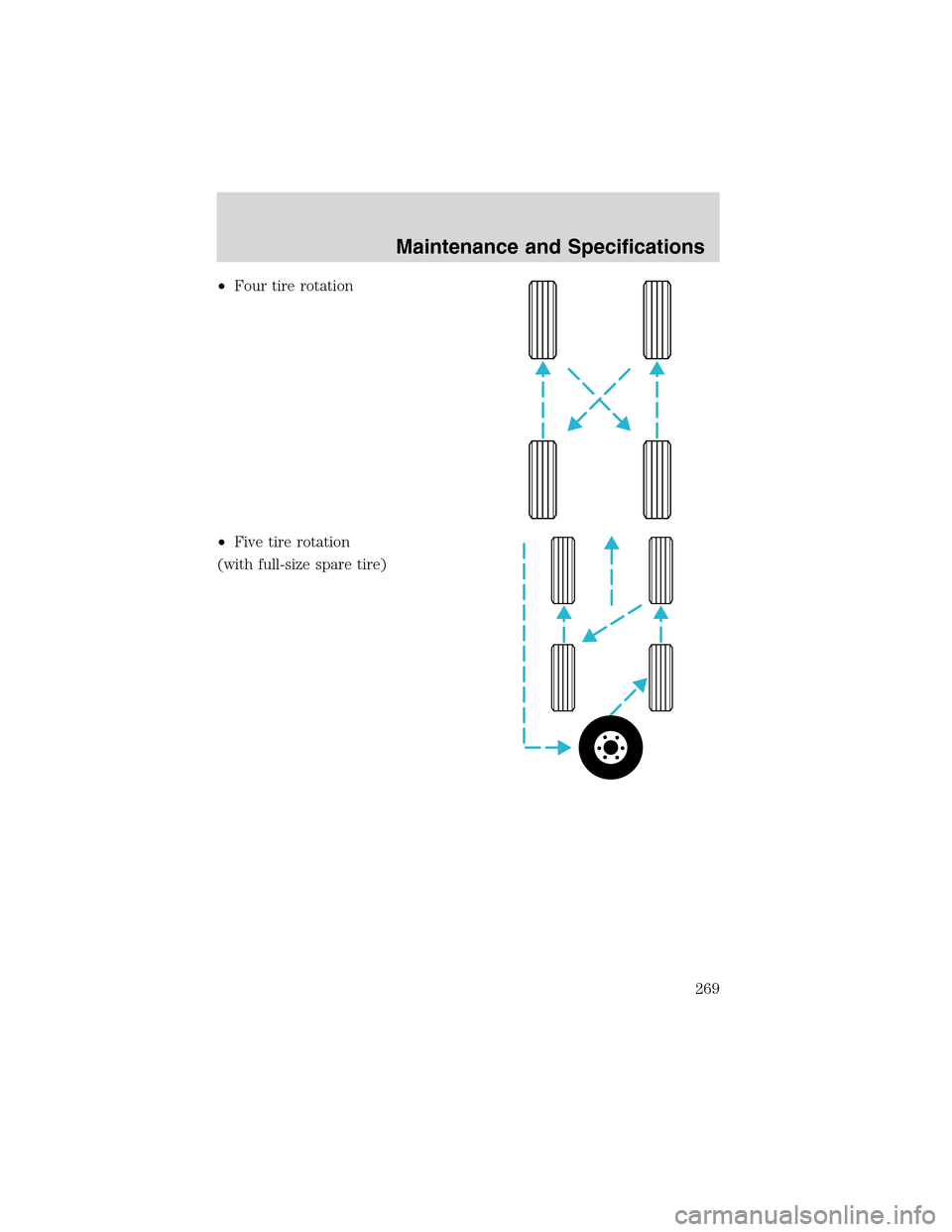
•Four tire rotation
•Five tire rotation
(with full-size spare tire)
Maintenance and Specifications
269
Page 270 of 288

•Unidirectional tire rotation
For vehicles equipped with original
equipment unidirectional tires and
full-size spare, your vehicle can be
driven with the unidirectional
full-size spare, rotating counter to
the directional arrow on the tire
sidewall.
Your unidirectional full-size spare
tire is rotated for wear balance. Best
performance may be achieved by
remounting the tire to the wheel, if
necessary, to permit tire rotation
with the directional arrow on the
tire sidewall.
Replacing the tires
Replace the tires when the wear
band is visible through the tire
treads.
When replacing full size tires, never mix radial bias-belted, or
bias-type tires. Use only the tire sizes that are listed on the
Certification or Tire Label. Make sure that all tires are the same size,
speed rating, and load-carrying capacity. Use only the tire combinations
recommended on the label. If you do not follow these precautions,
your vehicle may not drive properly and safely.
Make sure that all replacement tires are of the same size, type,
load-carrying capacity and tread design (e.g.,“All Terrain”,
“Touring”, etc.), as originally offered by Ford.
Failure to follow these precautions may adversely affect the
handling of the vehicle, and increase the risk of loss of vehicle
control, vehicle rollover and/or personal injury.
Maintenance and Specifications
270
Page 285 of 288

Passenger Occupant
Classification Sensor .................143
Pedals (see Power
adjustable foot pedals) ...............95
Power adjustable foot pedals .....95
Power distribution box
(see Fuses) .......................206, 209
Power door locks ......................120
Power steering ..........................186
fluid, checking and adding ....263
fluid, refill capacity ................272
fluid, specifications .........274–275
Power Windows ...........................90
R
Radio ......................................16, 20
Rear Park Assist .......................195
Rear window defroster ...............76
Relays ........................................202
Remote entry system ...............124
opening the trunk ...................125
Roadside assistance ..................200
Roof rack ...................................119
S
Safety Belt Maintenance ..........156
Safety belts (see Safety
restraints) ..........142, 145, 147–151
Safety defects, reporting ..........232
Safety restraints ...............142, 145,
147–151
belt minder .............................152
extension assembly ................156
for adults .........................147–150
for children .............................169Occupant Classification
Sensor ......................................143
safety belt maintenance .........156
warning light and
chime ...............................151–152
Safety seats for children ..........172
Seat belts (see
Safety restraints) ......................142
Seats ..........................................135
child safety seats ....................172
cleaning ...................................236
climate control ........................138
easy access/easyout
feature .....................................137
memory seat ...................128, 138
Select Shift Transmission
(SST) shifter .............................193
Servicing your vehicle ..............239
Spare tire (see
Changing the Tire) ...................212
Spark plugs,
specifications .............271, 275–276
Specification chart,
lubricants ...........................274–275
Speed control ..............................95
Starting your vehicle ........181–183
jump starting ..........................216
Steering
speed sensitive .......................186
Steering column lock ..................89
Steering wheel
controls ......................................98
tilting .........................................88
T
Tires ...........................211, 266–268
changing ..........................211–213
Index
285