2003 LINCOLN BLACKWOOD tire
[x] Cancel search: tirePage 162 of 280
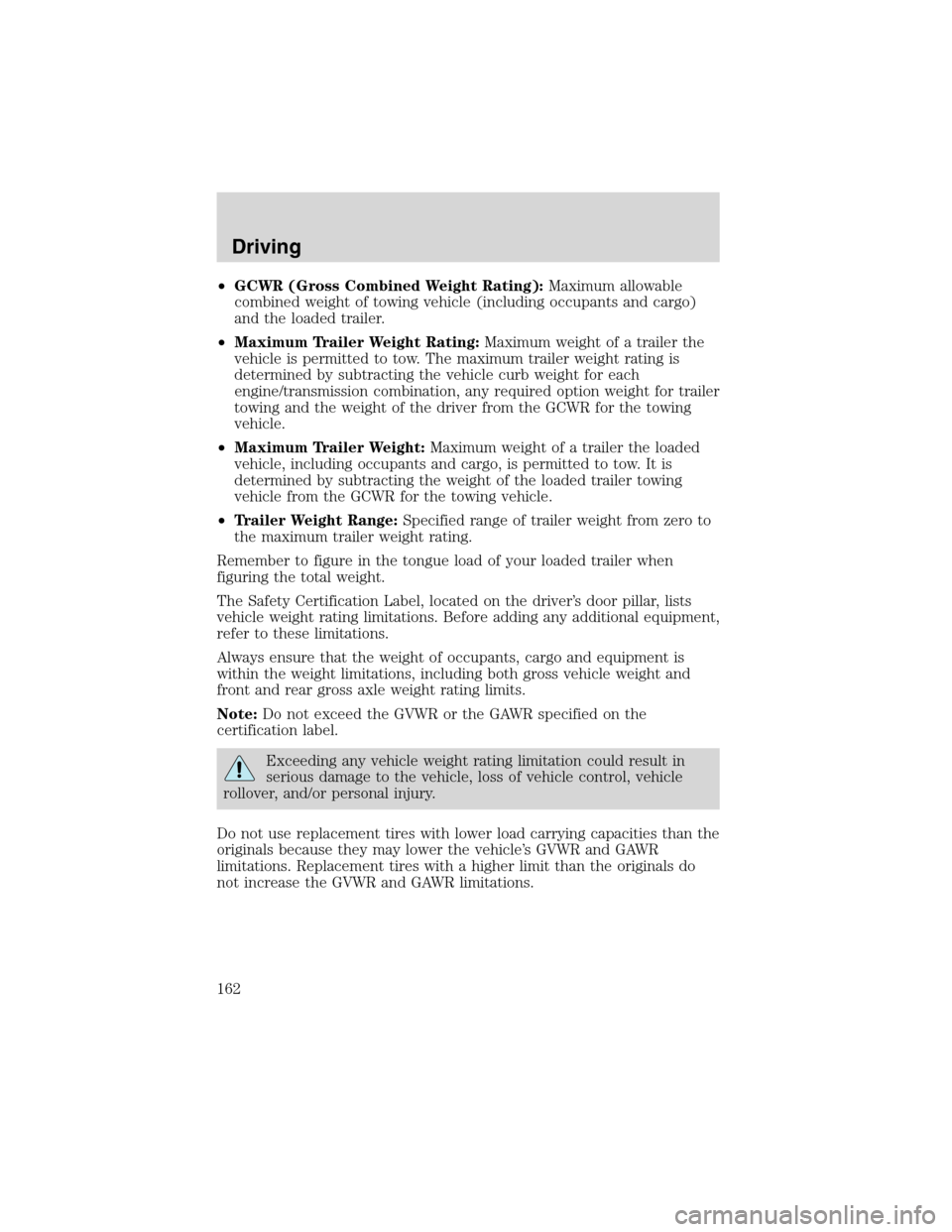
•GCWR (Gross Combined Weight Rating):Maximum allowable
combined weight of towing vehicle (including occupants and cargo)
and the loaded trailer.
•Maximum Trailer Weight Rating:Maximum weight of a trailer the
vehicle is permitted to tow. The maximum trailer weight rating is
determined by subtracting the vehicle curb weight for each
engine/transmission combination, any required option weight for trailer
towing and the weight of the driver from the GCWR for the towing
vehicle.
•Maximum Trailer Weight:Maximum weight of a trailer the loaded
vehicle, including occupants and cargo, is permitted to tow. It is
determined by subtracting the weight of the loaded trailer towing
vehicle from the GCWR for the towing vehicle.
•Trailer Weight Range:Specified range of trailer weight from zero to
the maximum trailer weight rating.
Remember to figure in the tongue load of your loaded trailer when
figuring the total weight.
The Safety Certification Label, located on the driver’s door pillar, lists
vehicle weight rating limitations. Before adding any additional equipment,
refer to these limitations.
Always ensure that the weight of occupants, cargo and equipment is
within the weight limitations, including both gross vehicle weight and
front and rear gross axle weight rating limits.
Note:Do not exceed the GVWR or the GAWR specified on the
certification label.
Exceeding any vehicle weight rating limitation could result in
serious damage to the vehicle, loss of vehicle control, vehicle
rollover, and/or personal injury.
Do not use replacement tires with lower load carrying capacities than the
originals because they may lower the vehicle’s GVWR and GAWR
limitations. Replacement tires with a higher limit than the originals do
not increase the GVWR and GAWR limitations.
Driving
162
Page 163 of 280
Special loading instructions for owners of pickup trucks and
utility-type vehicles
For important information regarding safe operation of this type
of vehicle, see thePreparing to drive your vehiclesection in
this chapter.
Loaded vehicles may handle differently than unloaded vehicles.
Extra precautions, such as slower speeds and increased stopping
distance, should be taken when driving a heavily loaded vehicle.
Your vehicle can haul more cargo and people than most passenger cars.
Depending upon the type and placement of the load, hauling cargo and
people may raise the center of gravity of the vehicle.
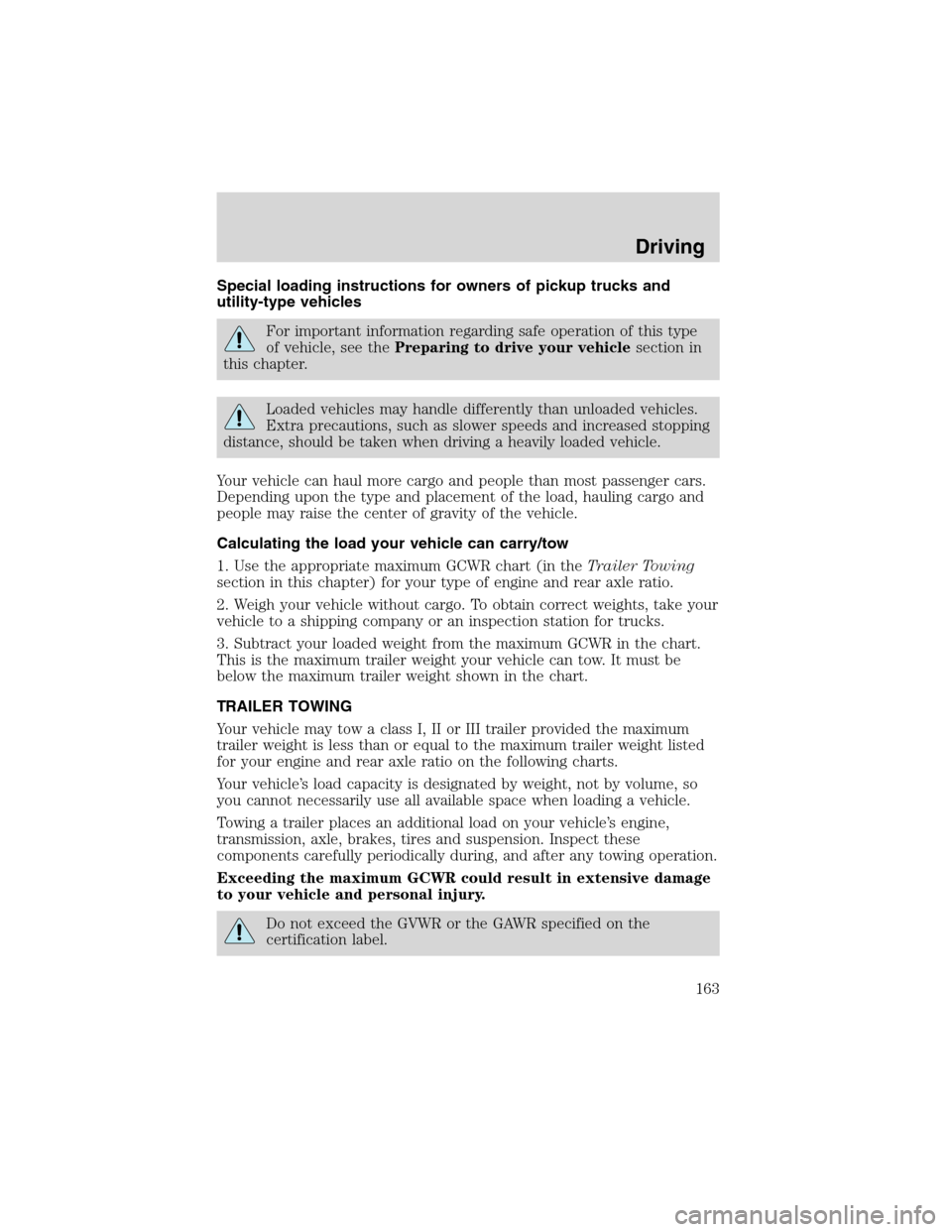
Calculating the load your vehicle can carry/tow
1. Use the appropriate maximum GCWR chart (in theTrailer Towing
section in this chapter) for your type of engine and rear axle ratio.
2. Weigh your vehicle without cargo. To obtain correct weights, take your
vehicle to a shipping company or an inspection station for trucks.
3. Subtract your loaded weight from the maximum GCWR in the chart.
This is the maximum trailer weight your vehicle can tow. It must be
below the maximum trailer weight shown in the chart.
TRAILER TOWING
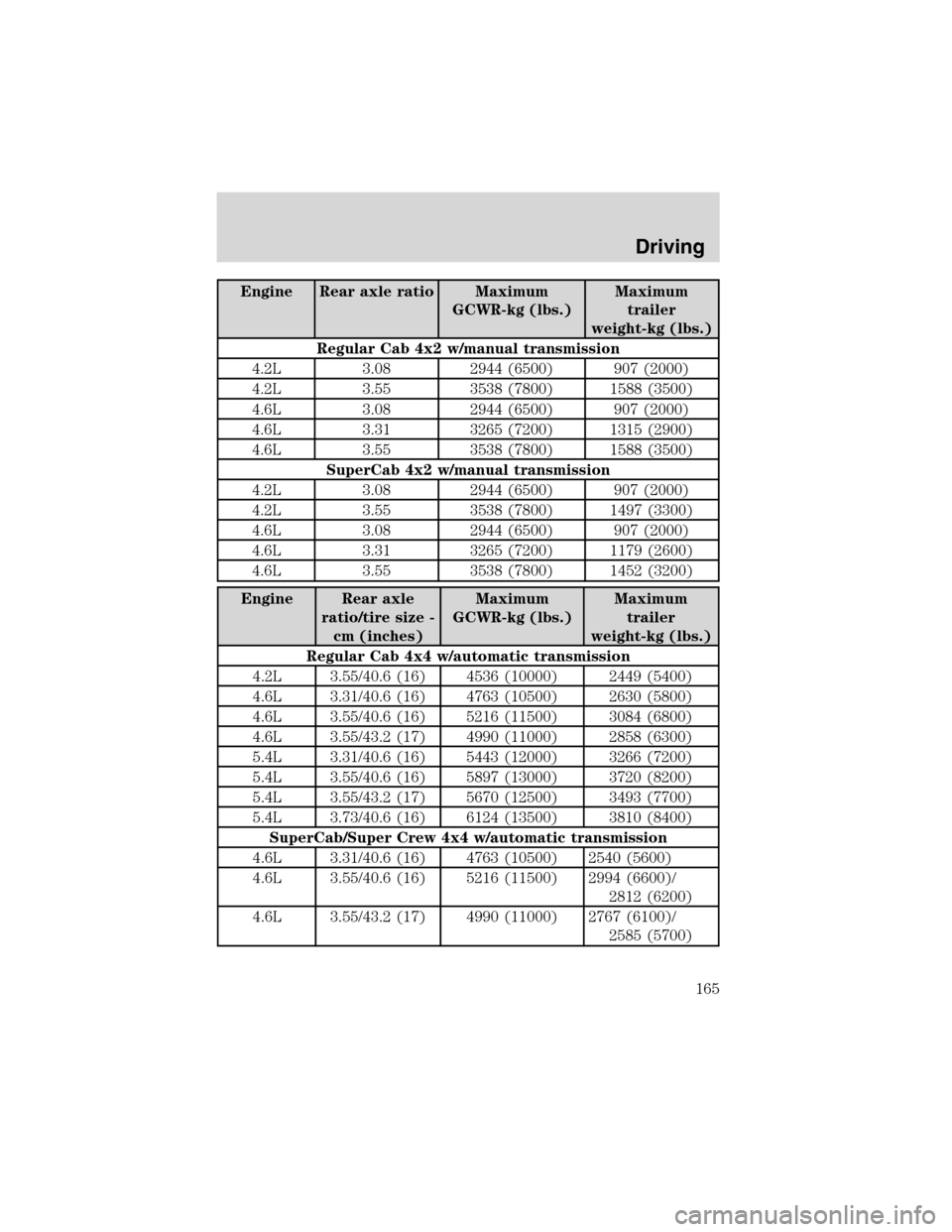
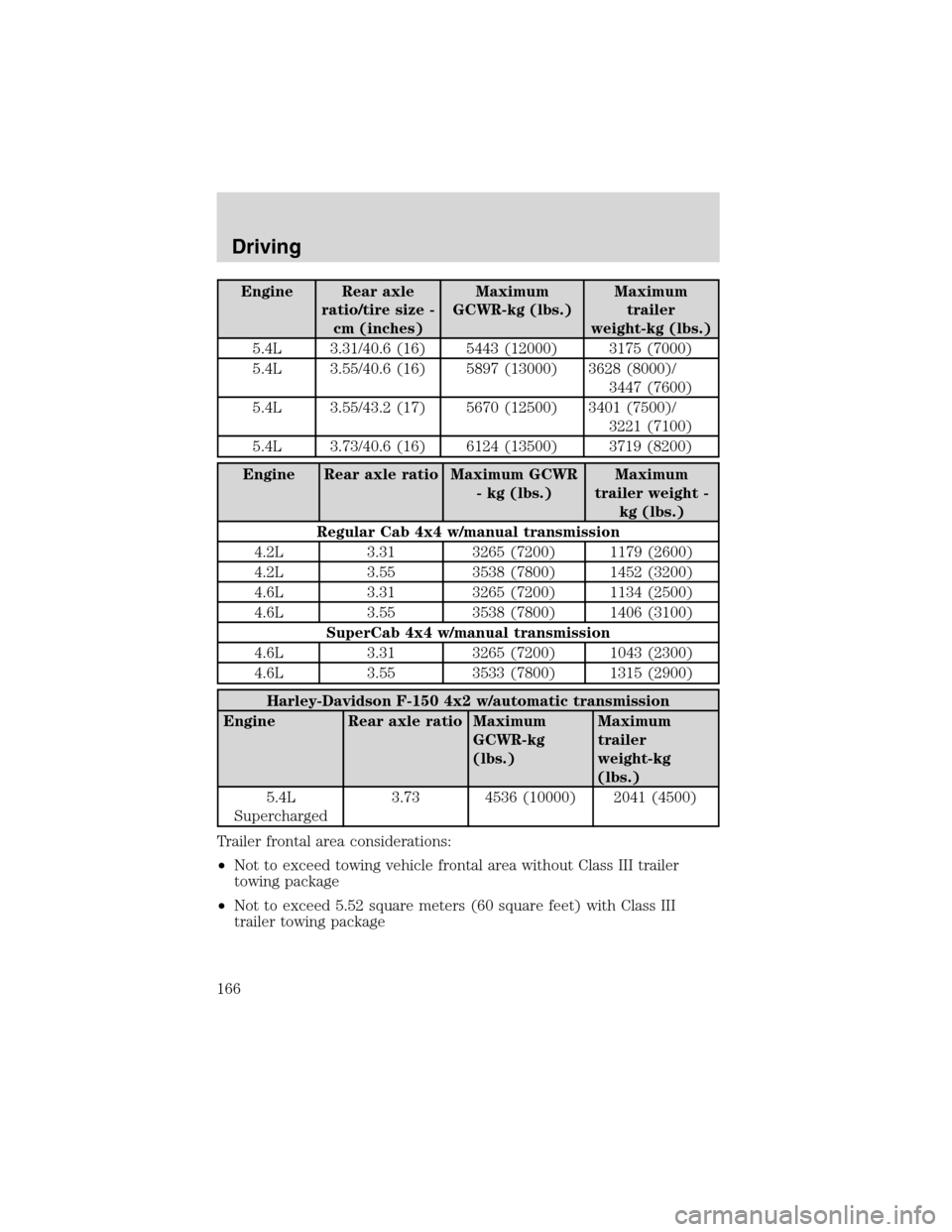
Your vehicle may tow a class I, II or III trailer provided the maximum
trailer weight is less than or equal to the maximum trailer weight listed
for your engine and rear axle ratio on the following charts.
Your vehicle’s load capacity is designated by weight, not by volume, so
you cannot necessarily use all available space when loading a vehicle.
Towing a trailer places an additional load on your vehicle’s engine,
transmission, axle, brakes, tires and suspension. Inspect these
components carefully periodically during, and after any towing operation.
Exceeding the maximum GCWR could result in extensive damage
to your vehicle and personal injury.
Do not exceed the GVWR or the GAWR specified on the
certification label.
Driving
163
Page 165 of 280
Engine Rear axle ratio Maximum
GCWR-kg (lbs.)Maximum
trailer
weight-kg (lbs.)
Regular Cab 4x2 w/manual transmission
4.2L 3.08 2944 (6500) 907 (2000)
4.2L 3.55 3538 (7800) 1588 (3500)
4.6L 3.08 2944 (6500) 907 (2000)
4.6L 3.31 3265 (7200) 1315 (2900)
4.6L 3.55 3538 (7800) 1588 (3500)
SuperCab 4x2 w/manual transmission
4.2L 3.08 2944 (6500) 907 (2000)
4.2L 3.55 3538 (7800) 1497 (3300)
4.6L 3.08 2944 (6500) 907 (2000)
4.6L 3.31 3265 (7200) 1179 (2600)
4.6L 3.55 3538 (7800) 1452 (3200)
Engine Rear axle
ratio/tire size -
cm (inches)Maximum
GCWR-kg (lbs.)Maximum
trailer
weight-kg (lbs.)
Regular Cab 4x4 w/automatic transmission
4.2L 3.55/40.6 (16) 4536 (10000) 2449 (5400)
4.6L 3.31/40.6 (16) 4763 (10500) 2630 (5800)
4.6L 3.55/40.6 (16) 5216 (11500) 3084 (6800)
4.6L 3.55/43.2 (17) 4990 (11000) 2858 (6300)
5.4L 3.31/40.6 (16) 5443 (12000) 3266 (7200)
5.4L 3.55/40.6 (16) 5897 (13000) 3720 (8200)
5.4L 3.55/43.2 (17) 5670 (12500) 3493 (7700)
5.4L 3.73/40.6 (16) 6124 (13500) 3810 (8400)
SuperCab/Super Crew 4x4 w/automatic transmission
4.6L 3.31/40.6 (16) 4763 (10500) 2540 (5600)
4.6L 3.55/40.6 (16) 5216 (11500) 2994 (6600)/
2812 (6200)
4.6L 3.55/43.2 (17) 4990 (11000) 2767 (6100)/
2585 (5700)
Driving
165
Page 166 of 280
Engine Rear axle
ratio/tire size -
cm (inches)Maximum
GCWR-kg (lbs.)Maximum
trailer
weight-kg (lbs.)
5.4L 3.31/40.6 (16) 5443 (12000) 3175 (7000)
5.4L 3.55/40.6 (16) 5897 (13000) 3628 (8000)/
3447 (7600)
5.4L 3.55/43.2 (17) 5670 (12500) 3401 (7500)/
3221 (7100)
5.4L 3.73/40.6 (16) 6124 (13500) 3719 (8200)
Engine Rear axle ratio Maximum GCWR
- kg (lbs.)Maximum
trailer weight -
kg (lbs.)
Regular Cab 4x4 w/manual transmission
4.2L 3.31 3265 (7200) 1179 (2600)
4.2L 3.55 3538 (7800) 1452 (3200)
4.6L 3.31 3265 (7200) 1134 (2500)
4.6L 3.55 3538 (7800) 1406 (3100)
SuperCab 4x4 w/manual transmission
4.6L 3.31 3265 (7200) 1043 (2300)
4.6L 3.55 3533 (7800) 1315 (2900)
Harley-Davidson F-150 4x2 w/automatic transmission
Engine Rear axle ratio Maximum
GCWR-kg
(lbs.)Maximum
trailer
weight-kg
(lbs.)
5.4L
Supercharged3.73 4536 (10000) 2041 (4500)
Trailer frontal area considerations:
•Not to exceed towing vehicle frontal area without Class III trailer
towing package
•Not to exceed 5.52 square meters (60 square feet) with Class III
trailer towing package
Driving
166
Page 170 of 280
2WD vehicles (with automatic transmissions):
•Place the transmission in N (Neutral)
•Maximum speed is 56 km (35 mph)
•Maximum distance is 80 km (50 miles)
If a distance of 80 km (50 miles) or a speed of 56 km (35 mph) must be
exceeded, the drive shaft will have to be removed before the vehicle is
towed.
Ford recommends the driveshaft be removed/installed only by a qualified
technician. See your local dealer for driveshaft removal/installation.
Improper removal/installation of the driveshaft can cause
transmission fluid loss, damage to the driveshaft and internal
transmission components.
4WD vehicles electronic shift transfer case (with automatic
transmissions):
4x4 vehicles with electronic shift on the fly cannot be towed with any
wheels on the ground.
SNOWPLOWING
Ford recommends the following specifications for low speed, personal
use snow removal:
•F-150 4x4 (except F-150 Supercrew, Lightning and Harley-Davidson
models)
•5.4L engine
•Heavy-duty service package
•Super engine cooling
•Heavy-duty front suspension package
•Automatic transmission with auxiliary automatic transmission fluid
cooling
•All-terrain tires
•Limited slip and optional axle ratio.
Do not install a snowplow and plow with your vehicle until it has been
driven at least 800 km (500 miles).
Driving
170
Page 171 of 280
Installing the snowplow
Read the following instructions before installing a snowplow:
•Front GAWR must not exceed 63% of the GVW. Add ballast weight to
the back of the vehicle, if necessary. Refer to the Safety Compliance
Certification Label to find your vehicle’s front GAWR.
•The Front Axle Accessory Reserve Capacity and the TARC listed on
the bottom right of the Safety Compliance Certification Label will
determine whether or not the addition of a snowplow will overload
your vehicle.
•The weight of the snowplow and supporting components distributed to
the front axle must not exceed the Front Axle Accessory Reserve
Capacity.
•The total weight of the snowplow and aftermarket equipment must
not exceed the TARC.
•The weight of the installed snowplow and aftermarket equipment must
not load the vehicle beyond the GAWR (front/rear) and GVWR listed
on the Safety Compliance Certification Label.
•The total weight of the snowplow and aftermarket equipment must be
considered part of the payload and must not exceed the GCWR for
towing.
•Federal and most local regulations require additional exterior lamps
for snowplow-equipped vehicles. Consult your dealer for additional
information.
•Tires have their maximum inflation pressure and associated load rating
imprinted on the tire sidewall. This pressure may or may not be the
same as that shown as recommended on the vehicle. The vehicle
operator may have to adjust the tire inflation pressure to
accommodate the snowplow and payload. Consult your dealer or
equipment installer for help with proper inflation pressures.
•Federal and some local regulations require additional exterior lamps
for snowplow-equipped vehicles. Consult your dealer for additional
information.
•After installing a snowplow to the vehicle, ensure the vehicle’s front
toe alignment and front ride height are within specification (reset if
required). These specifications are located in the vehicle’s Workshop
Manual.
Note:Do not exceed the GVWR or the GAWR specified on the
certification label.
Driving
171
Page 173 of 280
Transmission operation while plowing
•Shift transfer case to 4L (4WD Low) when plowing in small areas at
speeds below 8 km/h (5 mph).
•Shift transfer case to 4H (4WD High) when plowing larger areas or
light snow at higher speeds. Do not exceed 24 km/h (15 mph).
•Do not shift the transmission from a forward gear to R (Reverse) until
the engine is at idle and the wheels are stopped.
•If the vehicle is stuck, shift the transmission in a steady motion
between forward and reverse gears. Do not rock the vehicle for more
than a few minutes. The transmission and tires may be damaged or
the engine can overheat.
Do not rock the vehicle if the engine is not at operating
temperature. Do not rock the vehicle for more than a minute. The
transmission and tires may be damaged or the engine may
overheat.
Do not spin the wheels at over 35 mph (55 km/h). The tires may
fail and injure a passenger or bystander.
Driving
173
Page 174 of 280
GETTING ROADSIDE ASSISTANCE
To fully assist you should you have a vehicle concern, Ford Motor
Company offers a complimentary roadside assistance program. This
program is separate from the New Vehicle Limited Warranty. The service
is available:
•24–hours, seven days a week
•
for the New Vehicle Limited Warranty period of three years or 60,000 km
(36,000 miles), whichever occurs first on Ford and Mercury vehicles,
and four years or 80,000 km (50,000 miles) on Lincoln vehicles.
Roadside assistance will cover:
•changing a flat tire
•jump-starts
•lock-out assistance
•limited fuel delivery
•towing of your disabled vehicle to the nearest Ford Motor Company
dealership, or your selling dealer if within 56.3 km (35 miles) of the
nearest Ford Motor Company dealership (one tow per disablement).
Even non-warranty related tows, like accidents or getting stuck in the
mud or snow, are covered (some exclusions apply, such as impound
towing or repossession).
Canadian customers refer to your Owner Information Guide for
information on:
•coverage period
•exact fuel amounts
•towing of your disabled vehicle
•emergency travel expense reimbursement
•travel planning benefits
USING ROADSIDE ASSISTANCE
Complete the roadside assistance identification card and place it in your
wallet for quick reference. In the United States, this card is found in the
Owner Guide portfolio in the glove compartment in Ford vehicles and is
mailed to you if you own a Mercury or Lincoln. In Canada, the card is
found in the Owner Information Guide in the glove compartment.
U.S. Ford or Mercury vehicle customers who require roadside assistance,
call 1–800–241–3673; Lincoln vehicle customers call 1–800–521–4140.
Roadside Emergencies
174