Page 186 of 288
•If the vehicle goes from one type of surface to another (i.e., from
concrete to gravel) there will be a change in the way the vehicle
responds to a maneuver (steering, acceleration or braking). Again,
avoid these abrupt inputs.
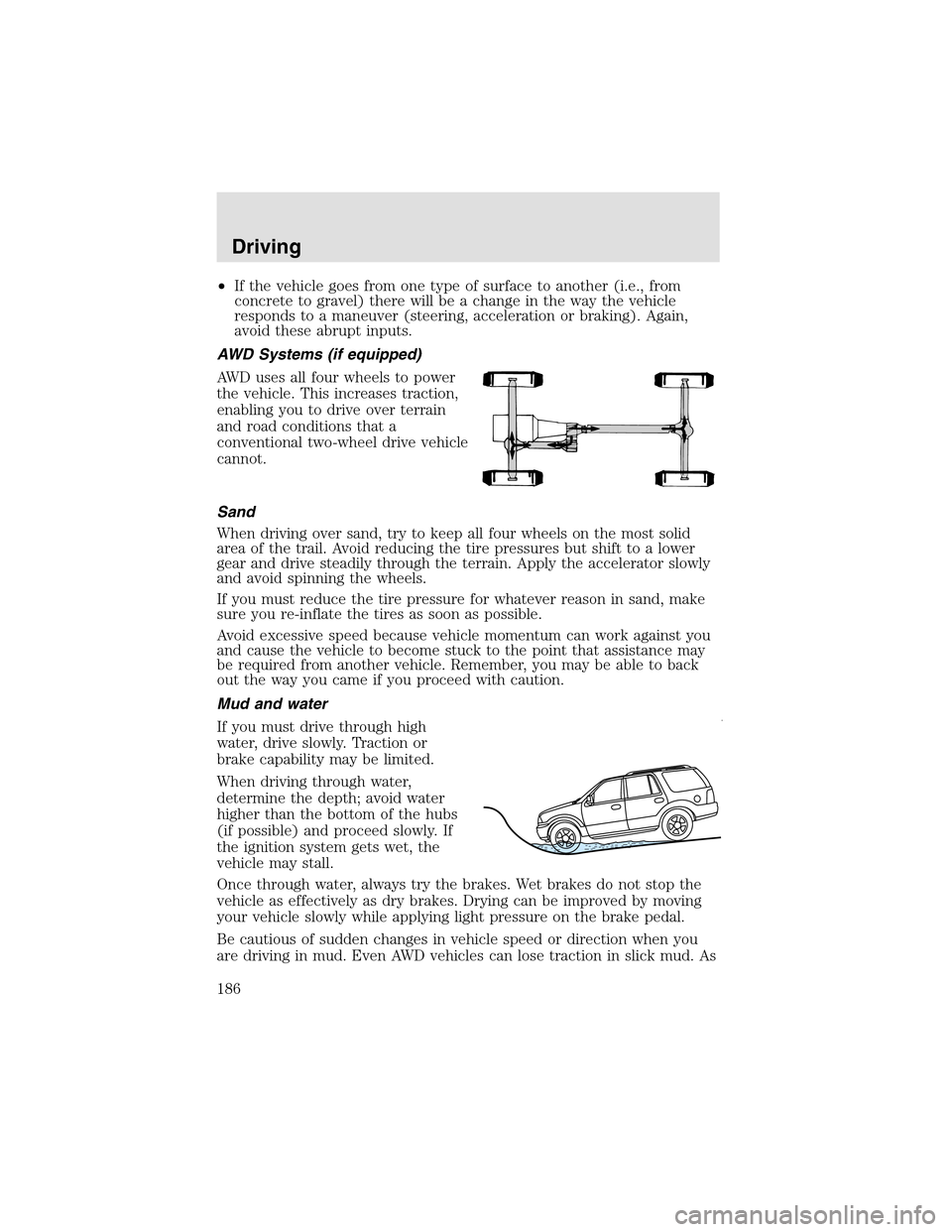
AWD Systems (if equipped)
AWD uses all four wheels to power
the vehicle. This increases traction,
enabling you to drive over terrain
and road conditions that a
conventional two-wheel drive vehicle
cannot.
Sand
When driving over sand, try to keepall four wheels on the most solid
area of the trail. Avoid reducing the tire pressures but shift to a lower
gear and drive steadily through the terrain. Apply the accelerator slowly
and avoid spinning the wheels.
If you must reduce the tire pressure for whatever reason in sand, make
sure you re-inflate the tires as soon as possible.
Avoid excessive speed because vehicle momentum can work against you
and cause the vehicle to become stuck to the point that assistance may
be required from another vehicle. Remember, you may be able to back
out the way you came if you proceed with caution.
Mud and water
If you must drive through high
water, drive slowly. Traction or
brake capability may be limited.
When driving through water,
determine the depth; avoid water
higher than the bottom of the hubs
(if possible) and proceed slowly. If
the ignition system gets wet, the
vehicle may stall.
Once through water, always try the brakes. Wet brakes do not stopthe
vehicle as effectively as dry brakes. Drying can be improved by moving
your vehicle slowly while applying light pressure on the brake pedal.
Be cautious of sudden changes in vehicle speed or direction when you
are driving in mud. Even AWD vehicles can lose traction in slick mud. As
Driving
186
Page 188 of 288
Apply just enough power to the wheels to climb the hill. Too much
power will cause the tires to slip, spin or lose traction, resulting in loss of
vehicle control.
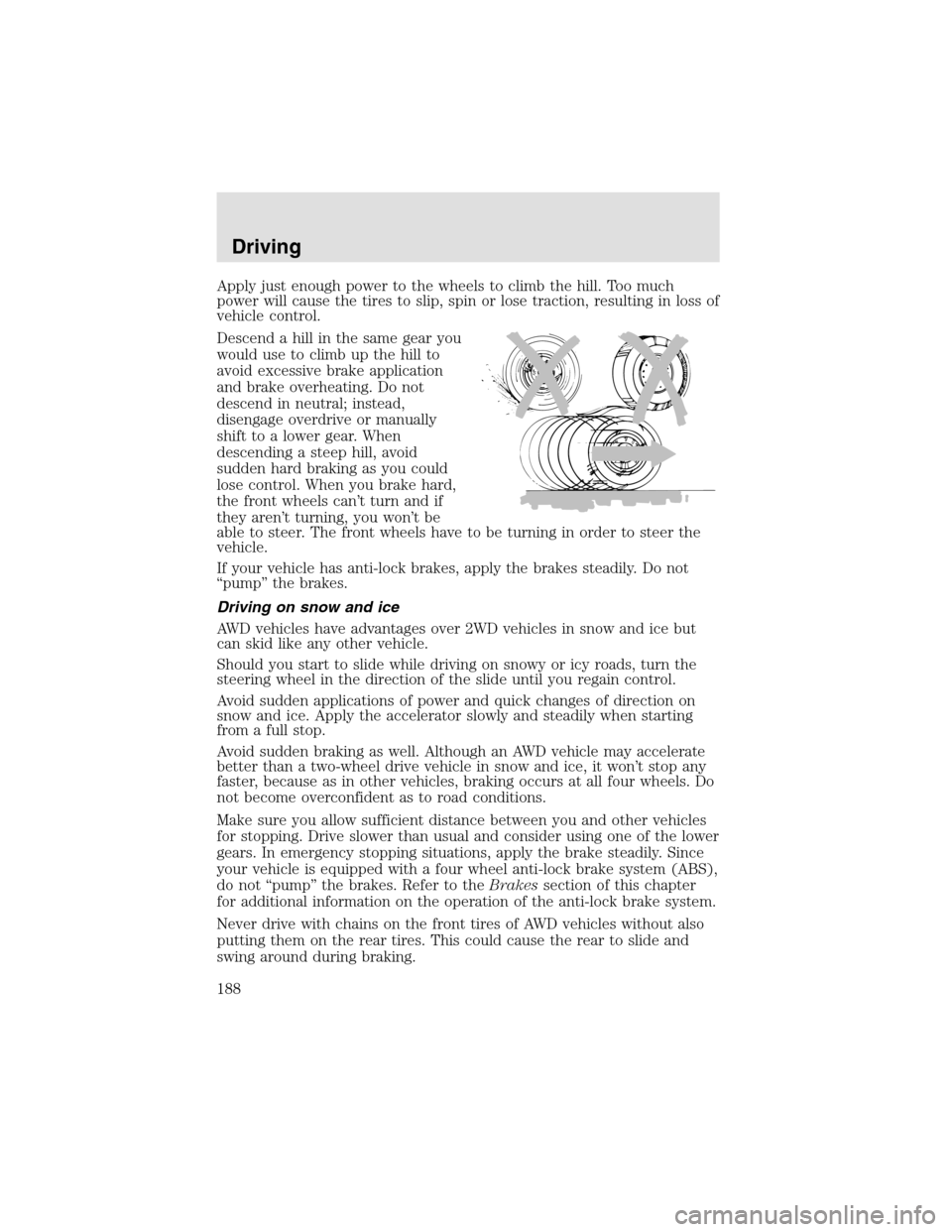
Descend a hill in the same gear you
would use to climb upthe hill to
avoid excessive brake application
and brake overheating. Do not
descend in neutral; instead,
disengage overdrive or manually
shift to a lower gear. When
descending a steephill, avoid
sudden hard braking as you could
lose control. When you brake hard,
the front wheels can’t turn and if
they aren’t turning, you won’t be
able to steer. The front wheels have to be turning in order to steer the
vehicle.
If your vehicle has anti-lock brakes, apply the brakes steadily. Do not
“pump” the brakes.
Driving on snow and ice
AWD vehicles have advantages over 2WD vehicles in snow and ice but
can skid like any other vehicle.
Should you start to slide while driving on snowy or icy roads, turn the
steering wheel in the direction of the slide until you regain control.
Avoid sudden applications of power and quick changes of direction on
snow and ice. Apply the accelerator slowly and steadily when starting
from a full stop.
Avoid sudden braking as well. Although an AWD vehicle may accelerate
better than a two-wheel drive vehicle in snow and ice, it won’t stopany
faster, because as in other vehicles, braking occurs at all four wheels. Do
not become overconfident as to road conditions.
Make sure you allow sufficient distance between you and other vehicles
for stopping. Drive slower than usual and consider using one of the lower
gears. In emergency stopping situations, apply the brake steadily. Since
your vehicle is equipped with a four wheel anti-lock brake system (ABS),
do not “pump” the brakes. Refer to theBrakessection of this chapter
for additional information on the operation of the anti-lock brake system.
Never drive with chains on the front tires of AWD vehicles without also
putting them on the rear tires. This could cause the rear to slide and
swing around during braking.
Driving
188
Page 199 of 288
Exceeding these limits may allow water to enter vehicle components:
•causing internal damage to the components.
•affecting driveability, emissions and reliability.
Replace the rear axle lubricant any time the axle has been submerged in
water. Rear axle lubricant quantities are not to be checked or changed
unless a leak is suspected or repair required.
RECREATIONAL TOWING (ALL WHEELS ON THE GROUND)
Follow these guidelines for your specific powertrain combination to tow
your vehicle with all four wheels on the ground (such as behind a
recreational vehicle).
These guidelines are designed to ensure that your transmission is not
damaged due to insufficient lubrication.
Rear Wheel Drive (RWD) 4x2 vehicles:
This applies to all 4x2 trucks/sport utilities with rear wheel drive
capability.
•Place the transmission in N (Neutral).
•Maximum speed is 56 km/h (35 mph).
•Maximum distance is 80 km (50 miles).
If a distance of 80 km (50 miles) or a speed of 56 km/h (35 mph) must
be exceeded, you must disconnect the driveshaft. Ford recommends the
driveshaft be removed/installed only by a qualified technician. See your
local dealer for driveshaft removal/installation.
Improper removal/installation of the driveshaft can cause
transmission fluid loss, damage to the driveshaft and internal
transmission components.
AWD vehicles:
Vehicles equipped with AWD cannot be towed with all wheels on the
ground as vehicle damage may occur.
Driving
199
Page 283 of 288

cleaning ...................................237
coolant .....................................251
fail-safe coolant ......................254
idle speed control ...................249
lubrication
specifications ..................273, 275
refill capacities ........................270
service points ..........................244
starting after a collision .........201
Engine block heater .................167
Engine oil ..................................245
change oil soon warning,
message center .......................245
checking and adding ..............245
dipstick ....................................245
filter, specifications ........248, 270
recommendations ...................248
refill capacities ........................270
specifications ..................273, 275
Exhaust fumes ..........................167
F
Fail safe cooling ........................254
Floor mats ...................................99
Fluid capacities .........................270
Foglamps .....................................50
Four-Wheel Drive vehicles
driving off road .......................183
indicator light ...........................14
preparing to drive your
vehicle .....................................173
Fuel ............................................255
calculating fuel
economy ............................88, 260
cap...........................................257
capacity ...................................270
choosing the right fuel ...........258
comparisons with EPA fuel
economy estimates .................262detergent in fuel .....................259
filling your vehicle
with fuel ..................255, 257, 260
filter, specifications ........259, 270
fuel pump shut-off switch .....201
gauge .........................................16
improving fuel economy ........260
octane rating ...................258, 275
quality ......................................258
running out of fuel .................259
safety information relating
to automotive fuels ................255
Fuses ..................................202–203
G
Garage door opener ....................82
Gas cap(see Fuel cap) ............257
Gas mileage
(see Fuel economy) .................260
Gauges .........................................15
engine coolant temperature
gauge .........................................15
fuel gauge ..................................16
odometer ...................................16
speedometer .............................16
tachometer ................................17
tripodometer ............................17
GAWR (Gross Axle
Weight Rating) ..........................191
calculating ...............................193
definition .................................191
driving with a heavy load ......191
location ....................................191
GVWR (Gross Vehicle
Weight Rating) ..........................191
calculating .......................191, 193
definition .................................191
driving with a heavy load ......191
location ....................................191
Index
283