2003 INFINITI G35 seat
[x] Cancel search: seatPage 95 of 256
3 Pre-driving checks and adjustments Keys .......................................................................... 3-2
Doors ......................................................................... 3-3
Locking with key (Driver's side) ........................... 3-3
Windows open/close with key .............................. 3-3
Locking with inside lock knob............................... 3-4
Locking with power door lock switch.................... 3-4
Child safety rear door lock ................................... 3-5
Remote keyless entry system ................................... 3-5
How to use remote keyless entry system ............ 3-5
Battery replacement ............................................. 3-8
Hood ........................................................................ 3-10
Trunk lid .................................................................. 3-10
Opener operation ............................................... 3-11
Interior trunk lid release ..................................... 3-12
Secondary trunk lid release ............................... 3-13 Fuel filler lid ............................................................. 3-14
Opening the filler lid ........................................... 3-14
Fuel filler cap ...................................................... 3-14
Steering wheel ........................................................ 3-16
Tilt operation....................................................... 3-16
Sun visors ............................................................... 3-16
Mirrors ..................................................................... 3-17
Automatic anti-glare inside mirror (if so
equipped)............................................................ 3-17
Outside mirrors ................................................... 3-18
Automatic seat positioner (if so equipped) ............. 3-19
Automatic seat positioner operation ................... 3-19
Procedure for storing memory............................ 3-19
Cancel switch ..................................................... 3-21
Z 02.7.29/V35-D/V5.0
X
Page 97 of 256
WARNINGO Always have the doors locked while
driving. Along with the use of seat
belts, this provides greater safety in
the event of an accident by helping to
prevent persons from being thrown
from the vehicle. This also helps keep
children and others from unintention-
ally opening the doors, and will help
keep out intruders.
O Before opening any door, always look
for and avoid oncoming traffic.
O Do not leave children unattended in-
side the vehicle. They could unknow-
ingly activate switches or controls.
Unattended children could become
involved in serious accidents.
LOCKING WITH KEY (Driver's side)
Power The power door lock system allows you to lock
or unlock all doors, trunk lid and fuel filler lid
simultaneously.
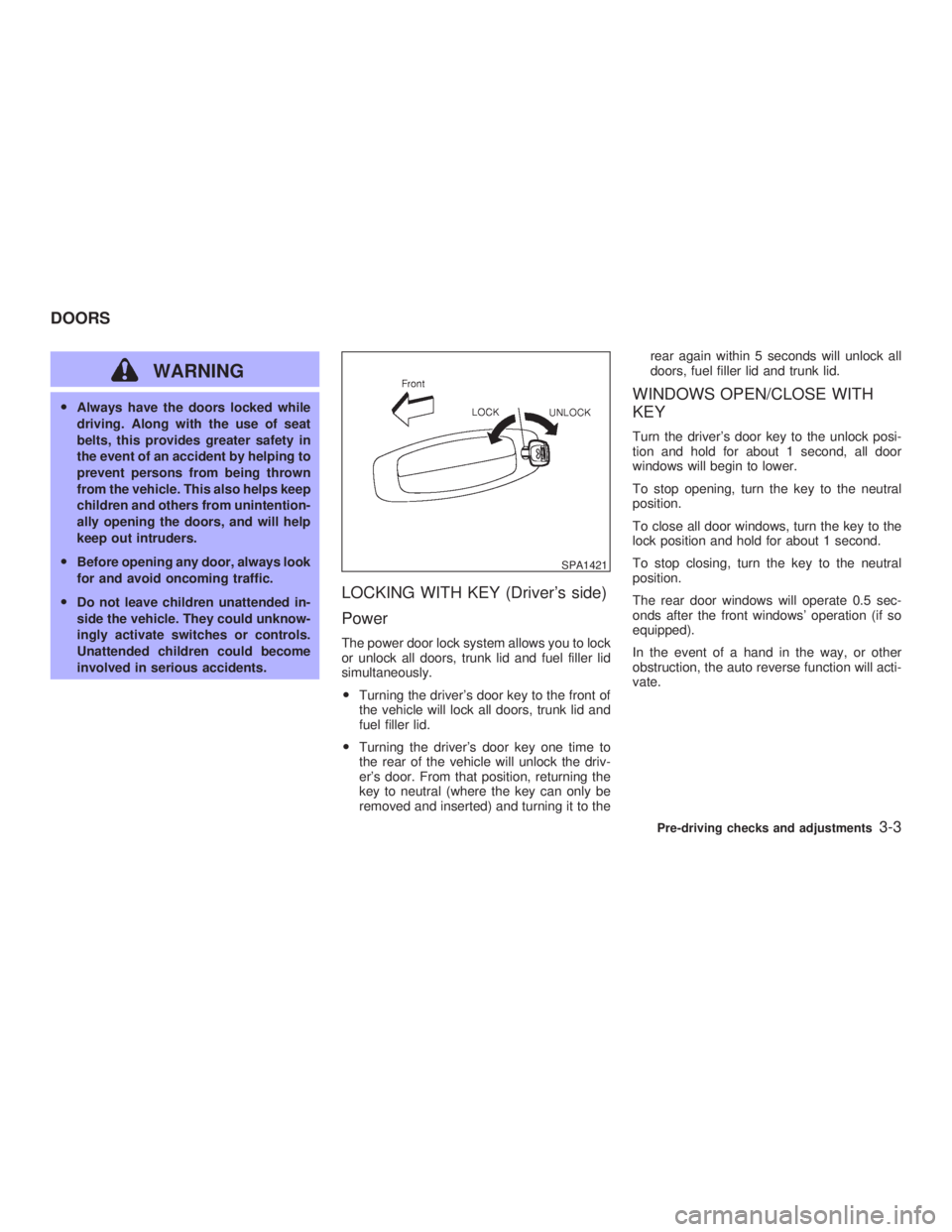
O Turning the driver's door key to the front of
the vehicle will lock all doors, trunk lid and
fuel filler lid.
O Turning the driver's door key one time to
the rear of the vehicle will unlock the driv-
er's door. From that position, returning the
key to neutral (where the key can only be
removed and inserted) and turning it to the rear again within 5 seconds will unlock all
doors, fuel filler lid and trunk lid.
WINDOWS OPEN/CLOSE WITH
KEY Turn the driver's door key to the unlock posi-
tion and hold for about 1 second, all door
windows will begin to lower.
To stop opening, turn the key to the neutral
position.
To close all door windows, turn the key to the
lock position and hold for about 1 second.
To stop closing, turn the key to the neutral
position.
The rear door windows will operate 0.5 sec-
onds after the front windows' operation (if so
equipped).
In the event of a hand in the way, or other
obstruction, the auto reverse function will acti-
vate. SPA1421
DOORS
Pre-driving checks and adjustments
3-3
Z 02.11.1/V35-D/V5.0
X
Page 107 of 256
SECONDARY TRUNK LID
RELEASE
Sedan The secondary trunk lid release mechanism
allows opening of the trunk lid in the event of a
discharged battery, etc.
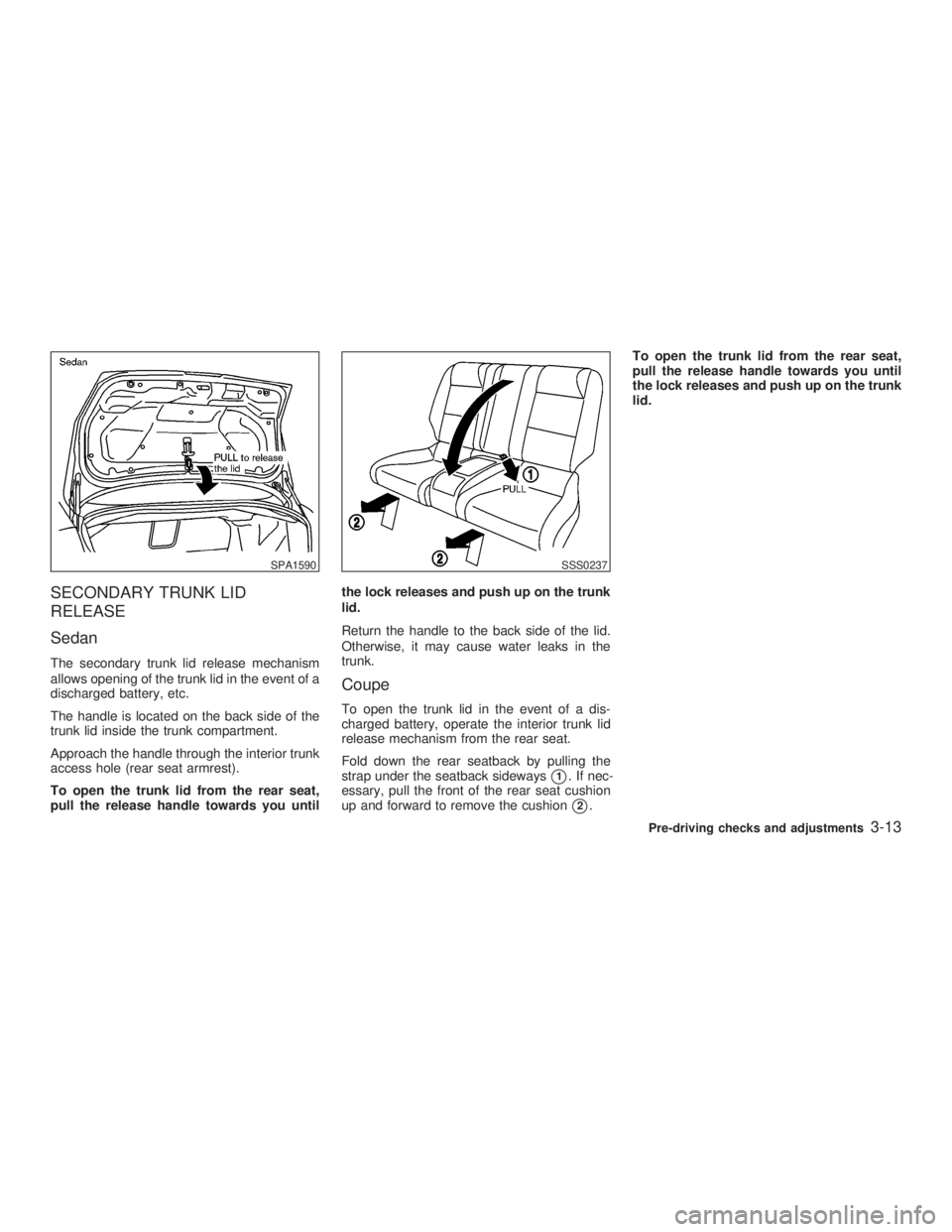
The handle is located on the back side of the
trunk lid inside the trunk compartment.
Approach the handle through the interior trunk
access hole (rear seat armrest).
To open the trunk lid from the rear seat,
pull the release handle towards you until the lock releases and push up on the trunk
lid.
Return the handle to the back side of the lid.
Otherwise, it may cause water leaks in the
trunk.
Coupe To open the trunk lid in the event of a dis-
charged battery, operate the interior trunk lid
release mechanism from the rear seat.
Fold down the rear seatback by pulling the
strap under the seatback sideways
j 1
. If nec-
essary, pull the front of the rear seat cushion
up and forward to remove the cushion
j 2
. To open the trunk lid from the rear seat,
pull the release handle towards you until
the lock releases and push up on the trunk
lid.
SPA1590 SSS0237
Pre-driving checks and adjustments
3-13
Z 02.7.29/V35-D/V5.0
X
Page 113 of 256
AUTOMATIC SEAT POSITIONER
OPERATION This system is designed so that the driver's
seat will automatically move when the auto-
matic transmission selector lever is in the P
(Park) position or when the parking brake is
applied (manual transmission model). This al-
lows the driver to get in and out of the driver's
seat more easily.
When one of the following conditions is met,
the driver's seat will slide backward. (AT mod-
els only)
O When the key is removed from the ignition
switch.
O When the driver's door is opened with the
key turned to ACC or LOCK.
O When the key is turned from ON to ACC
with the driver's door open.
When one of the following conditions is met,
the driver's seat will return to the positions
before being set. (AT models only)
O When the key is inserted into the ignition
switch.
O When the driver's door is closed with the
key turned to LOCK.
O When the key is turned from ACC to ON with the driver's door open.
PROCEDURE FOR STORING
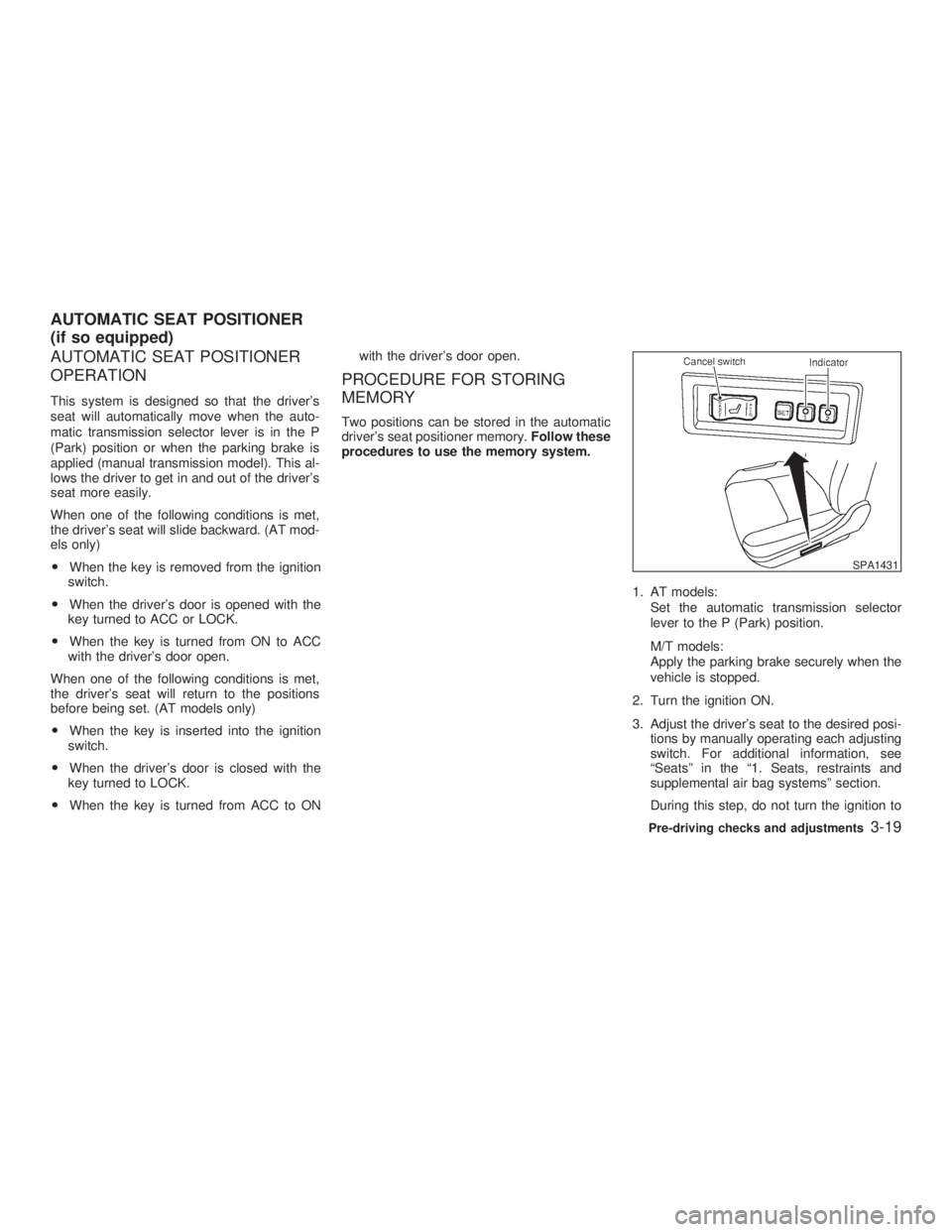
MEMORY Two positions can be stored in the automatic
driver's seat positioner memory. Follow these
procedures to use the memory system.
1. AT models:
Set the automatic transmission selector
lever to the P (Park) position.
M/T models:
Apply the parking brake securely when the
vehicle is stopped.
2. Turn the ignition ON.
3. Adjust the driver's seat to the desired posi-
tions by manually operating each adjusting
switch. For additional information, see
ªSeatsº in the ª1. Seats, restraints and
supplemental air bag systemsº section.
During this step, do not turn the ignition to SPA1431
AUTOMATIC SEAT POSITIONER
(if so equipped)
Pre-driving checks and adjustments
3-19
Z 02.7.29/V35-D/V5.0
X
Page 114 of 256

any positions other than ON.
4. Push the SET switch and, within 5 seconds,
push the memory switch 1 or 2 fully for at
least 1 second.
The indicator light for the pushed memory
switch will come on and stay on for approxi-
mately 5 seconds after pushing the switch.
After the indicator light goes off, the se-
lected positions are stored in the selected
memory (1 or 2).
If memory is stored in the same memory
switch, the previous memory will be de-
leted.
Confirming memory storage O Turn the ignition ON and push the SET
switch. If the main memory has not been
stored, the indicator light will come on for
approximately 0.5 seconds. When the
memory has stored the position, the indica-
tor light will stay on for approximately 5
seconds.
O If the battery cable is disconnected, or if the
fuse blows, the memory will be canceled. In
such a case, reset the desired positions
using the following procedures.
1. Open and close the driver's door more than two times with the ignition key in the LOCK
position.
2. Reset the desired position using the previ-
ous procedure.
Selecting the memorized position 1. A/T models:
Set the automatic transmission selector le-
ver to the P (Park) position.
M/T models:
Apply the parking brake securely when the
vehicle is stopped.
2. Turn the ignition ON.
3. Push the memory switch 1 or 2 fully for at
least 1 second.
The driver's seat will move to the memo-
rized position with the indicator light flash-
ing. Then the light will stay on for approxi-
mately 5 seconds.
When memory switch 1 or 2 is pushed with the
driver's door open and then the key inserted
into the ignition switch within approximately 1
minute, the driver's seat will move to the
memorized position. (AT models only) System operation The automatic drive positioner system will not
work or will stop operating under the following
conditions:
O when the vehicle speed is above 4 MPH (7
km/h).
O when any two or more of the memory
switches are simultaneously pressed while
the automatic drive positioner is operating.
O when the adjusting switch for the driver's
seat is turned on while the automatic drive
positioner is operating.
O when the cancel switch is pushed to cancel.
O when the memory switch 1 or 2 is not
pushed for at least 1 second.
O when the seat has already been moved to
the memorized position.
O when no seat position is stored in the
memory switch.
O when the parking brake is not applied. Ð
M/T models
O when the vehicle speed is above 4 MPH (7
km/h) while the parking brake is applied. Ð
M/T models
To restart the drive positioner system,
move the parking brake to off and on.
3-20 Pre-driving checks and adjustments
Z 02.7.29/V35-D/V5.0
X
Page 137 of 256

d. You have had an accident involv-
ing damage to the exhaust system,
underbody, or rear of the vehicle.
THREE WAY CATALYST The three way catalyst is an emission control
device installed in the exhaust system. Ex-
haust gases in the converter are burned at
high temperatures to help reduce pollutants.
WARNINGO The exhaust gas and the exhaust sys-
tem are very hot. Keep people, ani-
mals or flammable materials away
from the exhaust system compo-
nents.
O Do not stop or park the vehicle over
flammable materials such as dry
grass, waste paper or rags. They may
ignite and cause a fire. CAUTION O Do not use leaded gasoline. Deposits
from leaded gasoline seriously re-
duce the three way catalyst's ability
to help reduce exhaust pollutants.
O Keep your engine tuned up. Malfunc-
tions in the ignition, fuel injection, or
electrical systems can cause over-
rich fuel flow into the three way cata-
lyst, causing it to overheat. Do not
keep driving if the engine misfires, or
if noticeable loss of performance or
other unusual operating conditions
are detected. Have the vehicle in-
spected promptly by an authorized
INFINITI retailer.
O Avoid driving with an extremely low
fuel level. Running out of fuel could
cause the engine to misfire, damag-
ing the three way catalyst.
O Do not race the engine while warming
it up.
O Do not push or tow your vehicle to
start the engine. AVOIDING COLLISION AND
ROLLOVER
WARNING Failure to operate this vehicle in a safe
and prudent manner may result in loss
of control or an accident.
Be alert and drive defensively at all times.
Obey all traffic regulations. Avoid excessive
speed, high speed cornering, or sudden steer-
ing maneuvers, because these driving prac-
tices could cause you to lose control of your
vehicle. As with any vehicle, a loss of con-
trol could result in a collision with other
vehicles or objects, or cause the vehicle to
rollover, particularly if the loss of control
causes the vehicle to slide sideways. Be
attentive at all times, and avoid driving when
tired. Never drive when under the influence of
alcohol or drugs (including prescription or
over-the-counter drugs which may cause
drowsiness). Always wear your seat belt. See
ªSeat Beltsº in the ª1. Seats, restraints and
supplemental air bag systemsº section. Also
instruct your passengers to do so.
Starting and driving
5-3
Z 02.7.29/V35-D/V5.0
X
Page 141 of 256
O Make sure the area around the vehicle is
clear.
O Maintenance items should be checked pe-
riodically, e.g., each time you check engine
oil.
O Check that all windows and lights are clean.
O Visually inspect tires for their appearance
and condition. Also, check tires for proper
inflation.
O Lock all doors.
O Position seat and adjust head restraints.
O Adjust inside and outside mirrors.
O Fasten seat belts and ask all passengers to
do likewise.
O Check the operation of warning lights when
key is turned to the ON (3) position. 1. Apply the parking brake.
2. Automatic transmission:
Move the selector lever to P (Park) or N
(Neutral). (P preferred.)
The starter is designed not to operate if the
selector lever is in one of the driving posi-
tions.
Manual transmission:
Move the shift lever to N (Neutral) position,
and depress the clutch pedal to the floor
while cranking the engine.
The starter is designed not to operate un-
less the clutch pedal is fully depressed.
3. Crank the engine with your foot off the
accelerator pedal by turning the ignition
key to START. Release the key when the
engine starts. If the engine starts, but fails
to run, repeat the above procedure.
O If the engine is very hard to start in ex-
tremely cold weather or when restarting,
depress the accelerator pedal a little (ap-
proximately 1/5 to the floor) and hold it then
crank the engine. Release the key and the
accelerator pedal when the engine starts.
O If the engine is very hard to start because it
is flooded, depress the accelerator pedal all the way to the floor and hold it. Crank the
engine for 5 to 6 seconds. After cranking
the engine, release the accelerator pedal.
Crank the engine with your foot off the
accelerator pedal by turning the ignition
key to START. Release the key when the
engine starts. If the engine starts, but fails
to run, repeat the above procedure.
CAUTION Do not operate the starter for more than
15 seconds at a time. If the engine does
not start, turn the key off and wait 10
seconds before cranking again, other-
wise the starter could be damaged.
4. Warm-up
Allow the engine to idle for at least 30
seconds after starting. Drive at moderate
speed for a short distance first, especially in
cold weather.BEFORE STARTING THE ENGINE STARTING THE ENGINE
Starting and driving
5-7
Z 02.7.29/V35-D/V5.0
X
Page 173 of 256
7 Appearance and care Cleaning exterior ....................................................... 7-2
Washing................................................................ 7-2
Waxing.................................................................. 7-2
Removing spots.................................................... 7-3
Underbody ............................................................ 7-3
Glass .................................................................... 7-3
Aluminum alloy wheels ......................................... 7-3
Chrome parts........................................................ 7-3
Cleaning interior ........................................................ 7-3 Floor mats ............................................................ 7-4
Seat belts ............................................................. 7-4
Corrosion protection .................................................. 7-5
Most common factors contributing to vehicle
corrosion ............................................................... 7-5
Environmental factors influence the rate of
corrosion ............................................................... 7-5
To protect your vehicle from corrosion ................ 7-5
Z 02.7.29/V35-D/V5.0
X