2003 INFINITI G35 ECU
[x] Cancel search: ECUPage 8 of 256
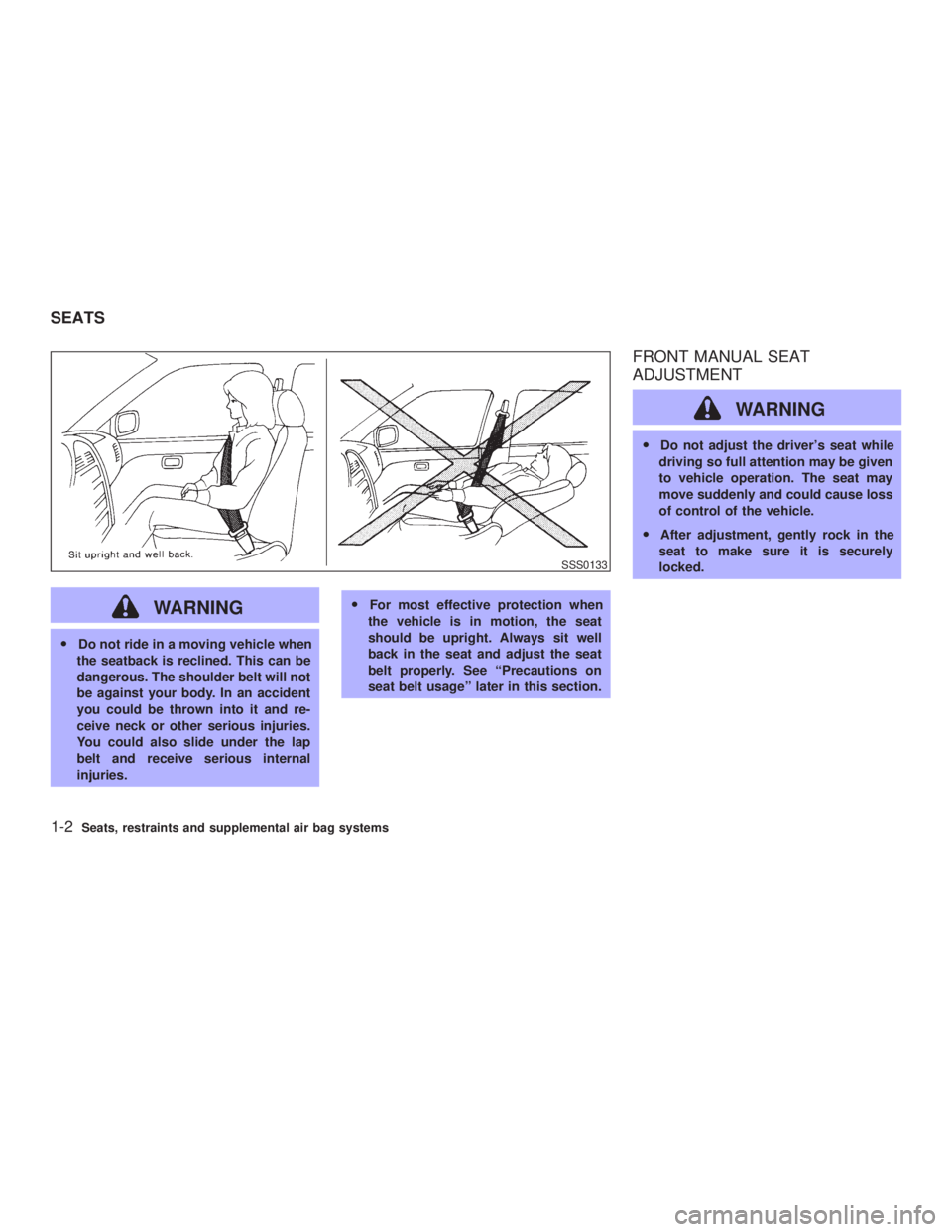
WARNINGO Do not ride in a moving vehicle when
the seatback is reclined. This can be
dangerous. The shoulder belt will not
be against your body. In an accident
you could be thrown into it and re-
ceive neck or other serious injuries.
You could also slide under the lap
belt and receive serious internal
injuries. O For most effective protection when
the vehicle is in motion, the seat
should be upright. Always sit well
back in the seat and adjust the seat
belt properly. See ªPrecautions on
seat belt usageº later in this section. FRONT MANUAL SEAT
ADJUSTMENT
WARNING O Do not adjust the driver's seat while
driving so full attention may be given
to vehicle operation. The seat may
move suddenly and could cause loss
of control of the vehicle.
O After adjustment, gently rock in the
seat to make sure it is securely
locked. SSS0133
SEATS
1-2 Seats, restraints and supplemental air bag systems
Z 02.7.29/V35-D/V5.0
X
Page 13 of 256
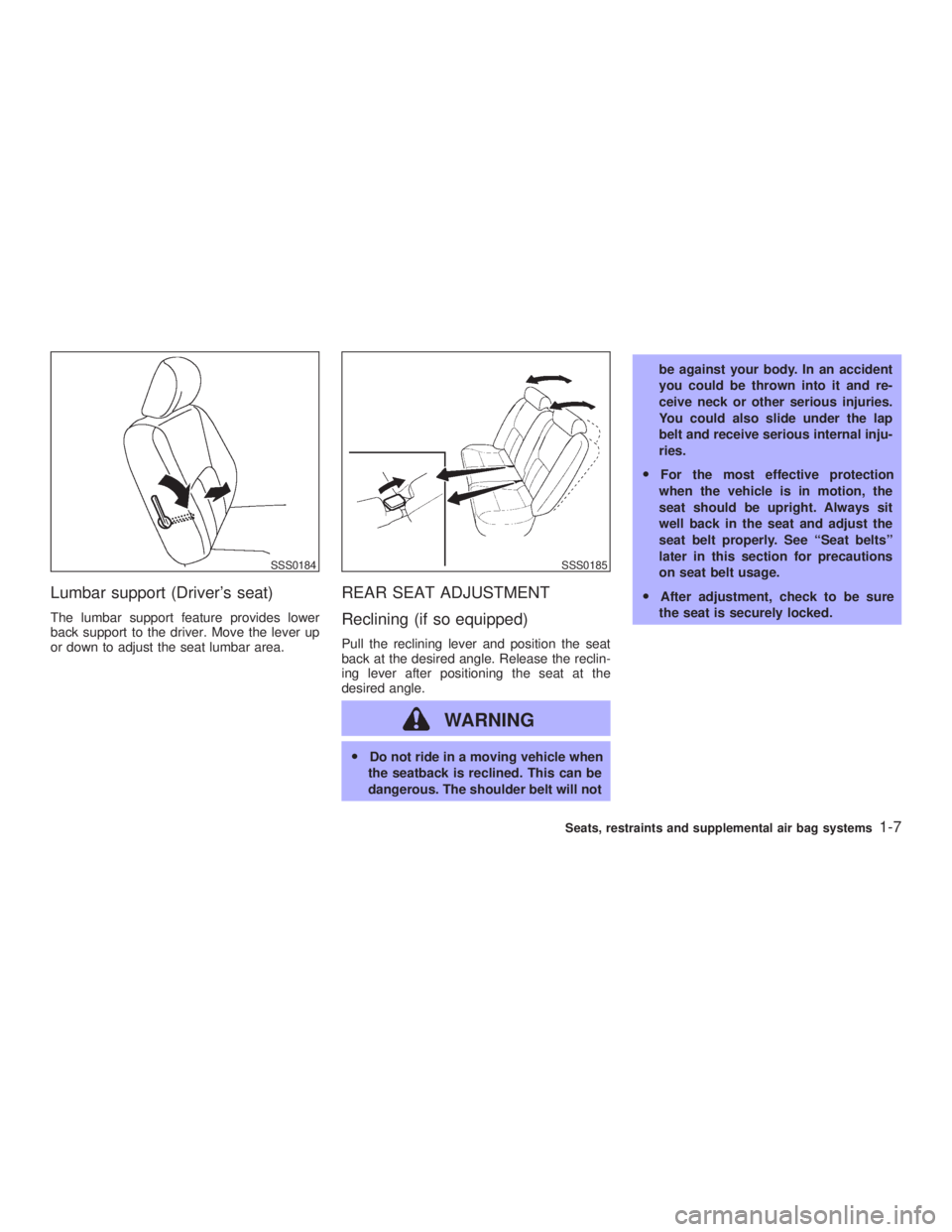
Lumbar support (Driver's seat) The lumbar support feature provides lower
back support to the driver. Move the lever up
or down to adjust the seat lumbar area.
REAR SEAT ADJUSTMENT
Reclining (if so equipped) Pull the reclining lever and position the seat
back at the desired angle. Release the reclin-
ing lever after positioning the seat at the
desired angle.
WARNING O Do not ride in a moving vehicle when
the seatback is reclined. This can be
dangerous. The shoulder belt will not be against your body. In an accident
you could be thrown into it and re-
ceive neck or other serious injuries.
You could also slide under the lap
belt and receive serious internal inju-
ries.
O For the most effective protection
when the vehicle is in motion, the
seat should be upright. Always sit
well back in the seat and adjust the
seat belt properly. See ªSeat beltsº
later in this section for precautions
on seat belt usage.
O After adjustment, check to be sure
the seat is securely locked.SSS0184 SSS0185
Seats, restraints and supplemental air bag systems
1-7
Z 02.7.29/V35-D/V5.0
X
Page 14 of 256
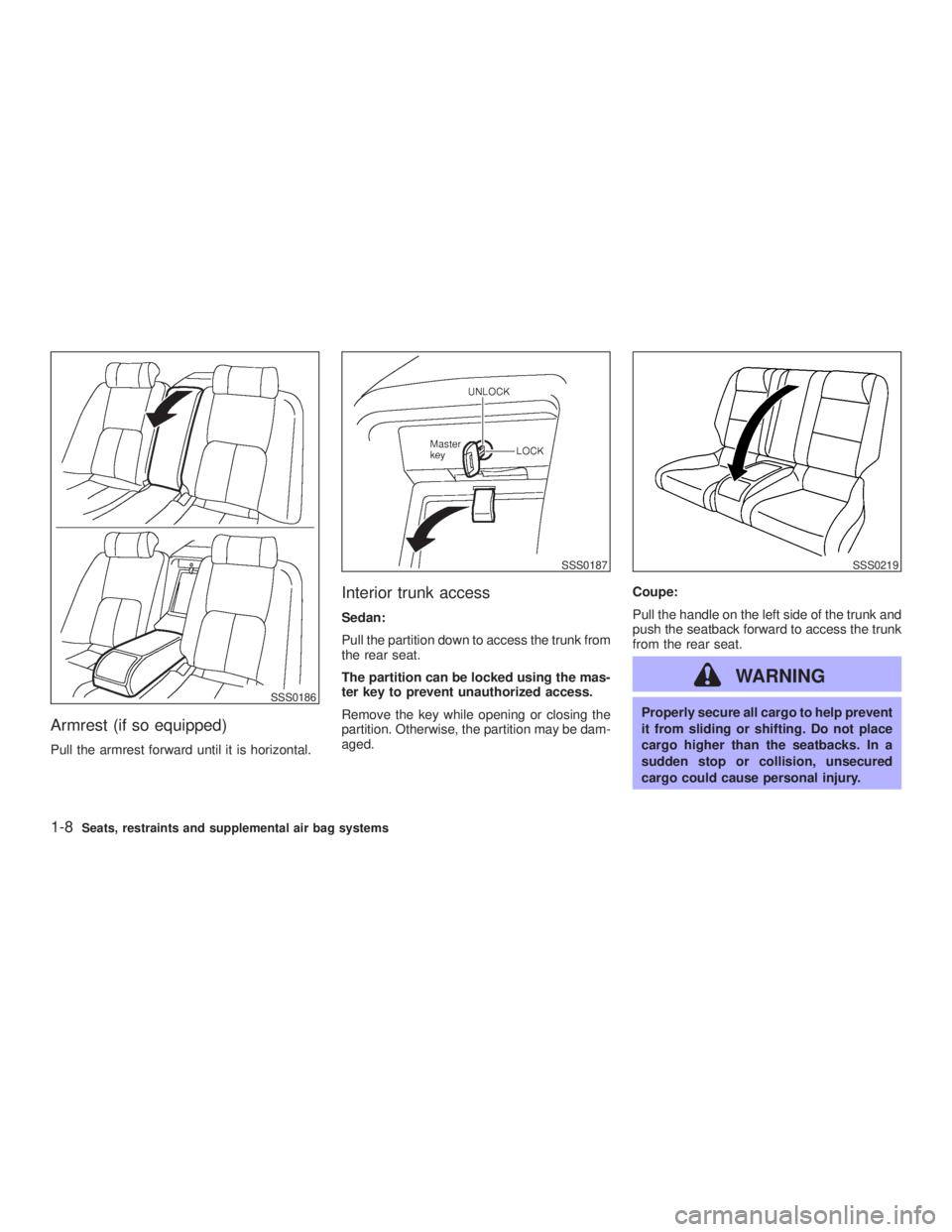
Armrest (if so equipped) Pull the armrest forward until it is horizontal. Interior trunk access Sedan:
Pull the partition down to access the trunk from
the rear seat.
The partition can be locked using the mas-
ter key to prevent unauthorized access.
Remove the key while opening or closing the
partition. Otherwise, the partition may be dam-
aged. Coupe:
Pull the handle on the left side of the trunk and
push the seatback forward to access the trunk
from the rear seat.
WARNING Properly secure all cargo to help prevent
it from sliding or shifting. Do not place
cargo higher than the seatbacks. In a
sudden stop or collision, unsecured
cargo could cause personal injury.SSS0186 SSS0187 SSS0219
1-8 Seats, restraints and supplemental air bag systems
Z 02.7.29/V35-D/V5.0
X
Page 36 of 256
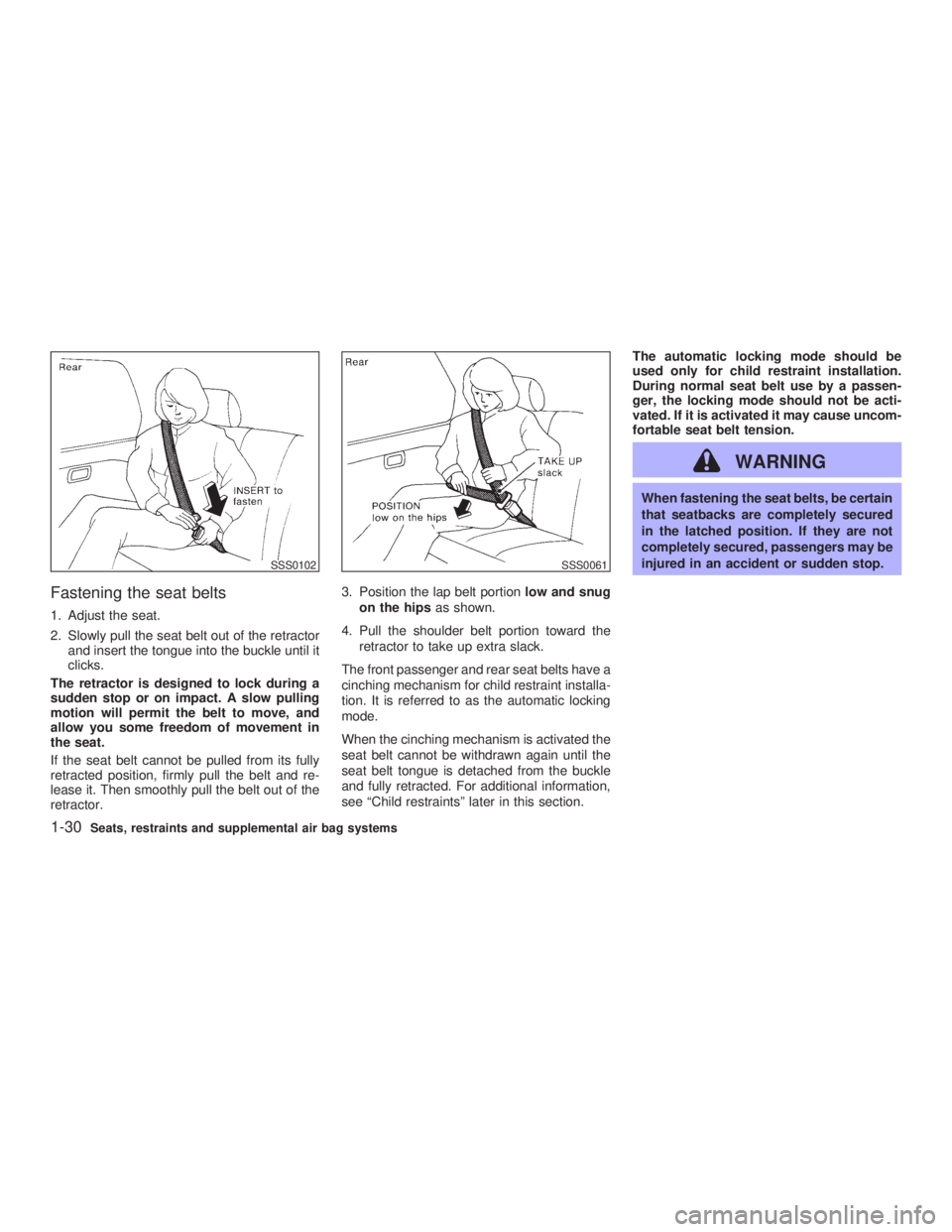
Fastening the seat belts 1. Adjust the seat.
2. Slowly pull the seat belt out of the retractor
and insert the tongue into the buckle until it
clicks.
The retractor is designed to lock during a
sudden stop or on impact. A slow pulling
motion will permit the belt to move, and
allow you some freedom of movement in
the seat.
If the seat belt cannot be pulled from its fully
retracted position, firmly pull the belt and re-
lease it. Then smoothly pull the belt out of the
retractor. 3. Position the lap belt portion low and snug
on the hips as shown.
4. Pull the shoulder belt portion toward the
retractor to take up extra slack.
The front passenger and rear seat belts have a
cinching mechanism for child restraint installa-
tion. It is referred to as the automatic locking
mode.
When the cinching mechanism is activated the
seat belt cannot be withdrawn again until the
seat belt tongue is detached from the buckle
and fully retracted. For additional information,
see ªChild restraintsº later in this section. The automatic locking mode should be
used only for child restraint installation.
During normal seat belt use by a passen-
ger, the locking mode should not be acti-
vated. If it is activated it may cause uncom-
fortable seat belt tension.
WARNING When fastening the seat belts, be certain
that seatbacks are completely secured
in the latched position. If they are not
completely secured, passengers may be
injured in an accident or sudden stop.SSS0102 SSS0061
1-30 Seats, restraints and supplemental air bag systems
Z 02.11.1/V35-D/V5.0
X
Page 38 of 256
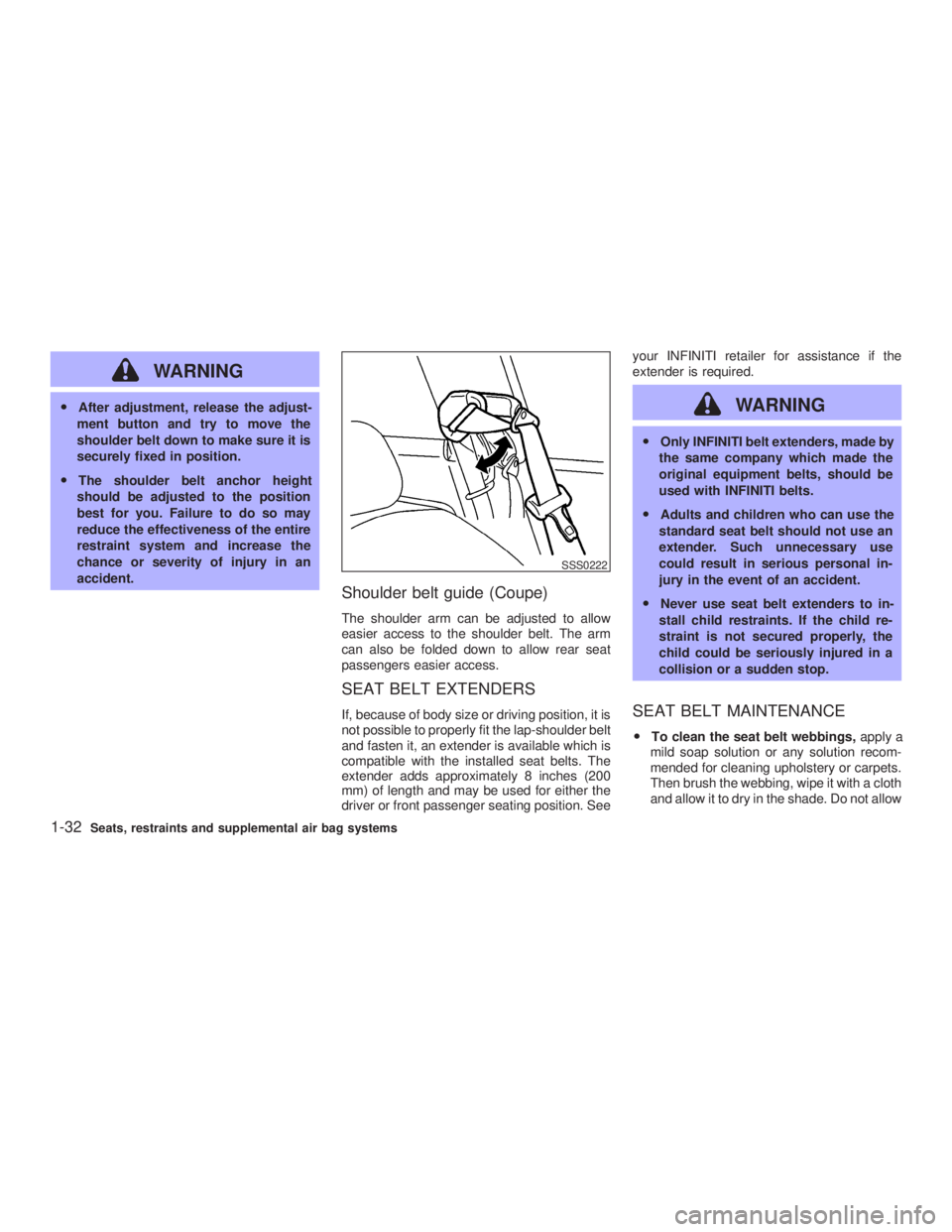
WARNINGO After adjustment, release the adjust-
ment button and try to move the
shoulder belt down to make sure it is
securely fixed in position.
O The shoulder belt anchor height
should be adjusted to the position
best for you. Failure to do so may
reduce the effectiveness of the entire
restraint system and increase the
chance or severity of injury in an
accident.
Shoulder belt guide (Coupe) The shoulder arm can be adjusted to allow
easier access to the shoulder belt. The arm
can also be folded down to allow rear seat
passengers easier access.
SEAT BELT EXTENDERS If, because of body size or driving position, it is
not possible to properly fit the lap-shoulder belt
and fasten it, an extender is available which is
compatible with the installed seat belts. The
extender adds approximately 8 inches (200
mm) of length and may be used for either the
driver or front passenger seating position. See your INFINITI retailer for assistance if the
extender is required.
WARNING O Only INFINITI belt extenders, made by
the same company which made the
original equipment belts, should be
used with INFINITI belts.
O Adults and children who can use the
standard seat belt should not use an
extender. Such unnecessary use
could result in serious personal in-
jury in the event of an accident.
O Never use seat belt extenders to in-
stall child restraints. If the child re-
straint is not secured properly, the
child could be seriously injured in a
collision or a sudden stop.
SEAT BELT MAINTENANCE O To clean the seat belt webbings, apply a
mild soap solution or any solution recom-
mended for cleaning upholstery or carpets.
Then brush the webbing, wipe it with a cloth
and allow it to dry in the shade. Do not allow SSS0222
1-32 Seats, restraints and supplemental air bag systems
Z 02.7.29/V35-D/V5.0
X
Page 40 of 256
Vehicle Safety Standard 213 or Canadian
Motor Vehicle Safety Standard 213.
O Check the child restraint in your vehicle to
be sure it is compatible with the vehicle's
seat and seat belt system.
O If the child restraint is compatible with your
vehicle, place your child in the child re-
straint and check the various adjustments
to be sure the child restraint is compatible
with your child. Always follow all recom-
mended procedures.
All US states and Canadian provinces re-
quire that infants and small children be
restrained in approved child restraints at
all times while the vehicle is being oper-
ated.
WARNINGO Improper use of a child restraint can
result in increased injuries for both
the infant or child and other occu-
pants in the vehicle.
O Follow all of the child restraint manu-
facturer's instructions for installation
and use. When purchasing a child restraint, be sure to select one which
will fit your child and vehicle. It may
not be possible to properly install
some types of child restraints in your
vehicle.
O If the child restraint is not anchored
properly, the risk of a child being
injured in a collision or a sudden stop
greatly increases.
O Adjustable seatbacks should be posi-
tioned to fit the child restraint, but as
upright as possible.
O After attaching the child restraint,
test it before you place the child in it.
Tilt it from side to side. Try to tug it
forward and check to see if the belt
holds the restraint in place. The child
restraint should not move more than
1 inch. If the restraint is not secure,
tighten the belt as necessary, or put
the restraint in another seat and test
it again.
O For a front facing child restraint,
check to make sure the shoulder belt
does not go in front of the child's face or neck. If it does, put the shoulder
belt behind the child restraint. If you-
must install a front facing child re-
straint in the front seat, see instruc-
tions later in this section.
O When your child restraint is not in
use, store it in the trunk or keep it
secured with a seat belt to prevent it
from being thrown around in case of
a sudden stop or accident.
CAUTION Remember that a child restraint left in a
closed vehicle can become very hot.
Check the seating surface and buckles
before placing your child in the child
restraint.
1-34 Seats, restraints and supplemental air bag systems
Z 02.11.1/V35-D/V5.0
X
Page 41 of 256
INSTALLATION ON REAR SEAT
OUTBOARD OR CENTER
POSITIONS
WARNINGO The three-point belt on your vehicle is
equipped with a locking mode retrac-
tor which must be used when install-
ing a child restraint.
O Failure to do so will result in the child
restraint not being properly secured.
It could tip over or otherwise be un-
secured and cause injury to the child
in a sudden stop or collision.
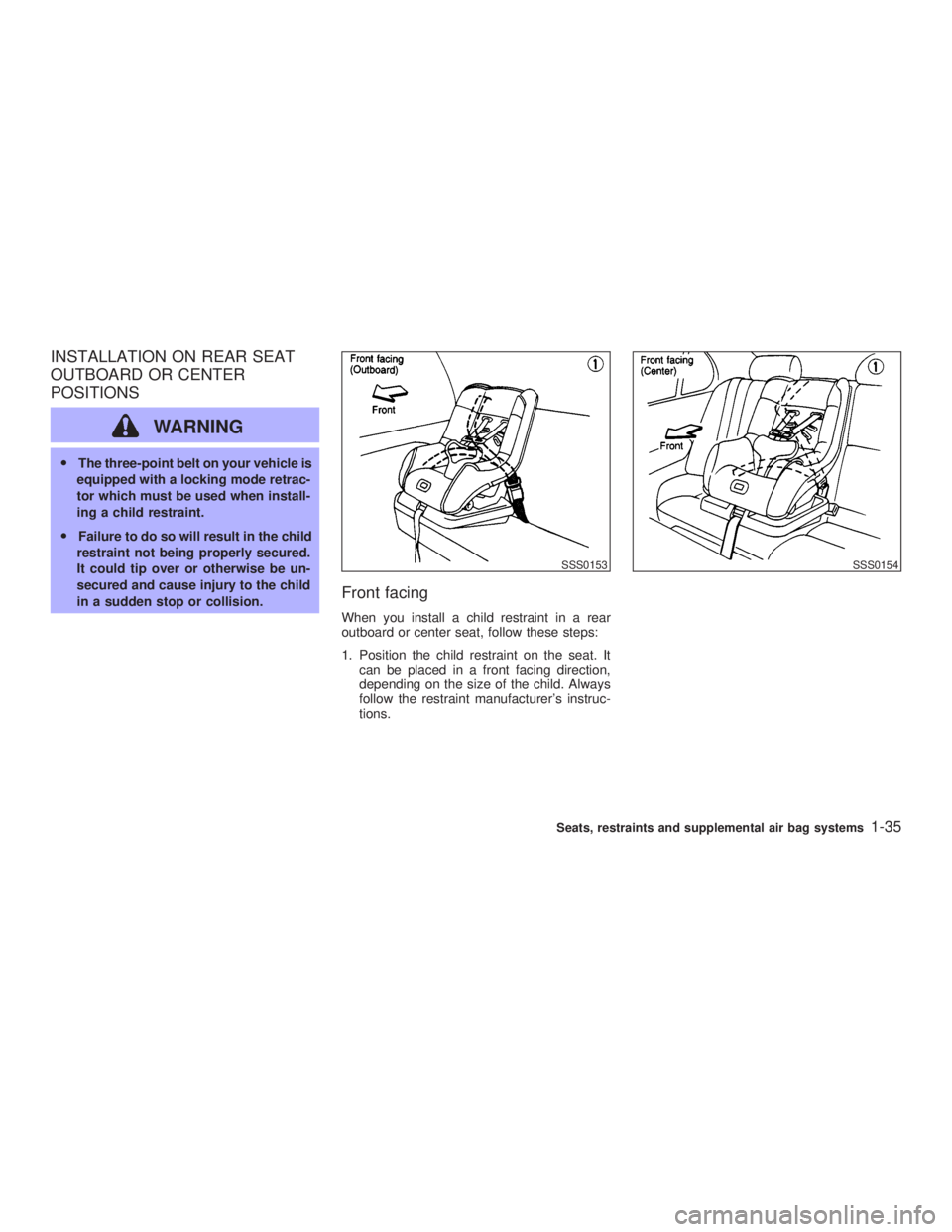
Front facing When you install a child restraint in a rear
outboard or center seat, follow these steps:
1. Position the child restraint on the seat. It
can be placed in a front facing direction,
depending on the size of the child. Always
follow the restraint manufacturer's instruc-
tions. SSS0153 SSS0154
Seats, restraints and supplemental air bag systems
1-35
Z 02.7.29/V35-D/V5.0
X
Page 43 of 256
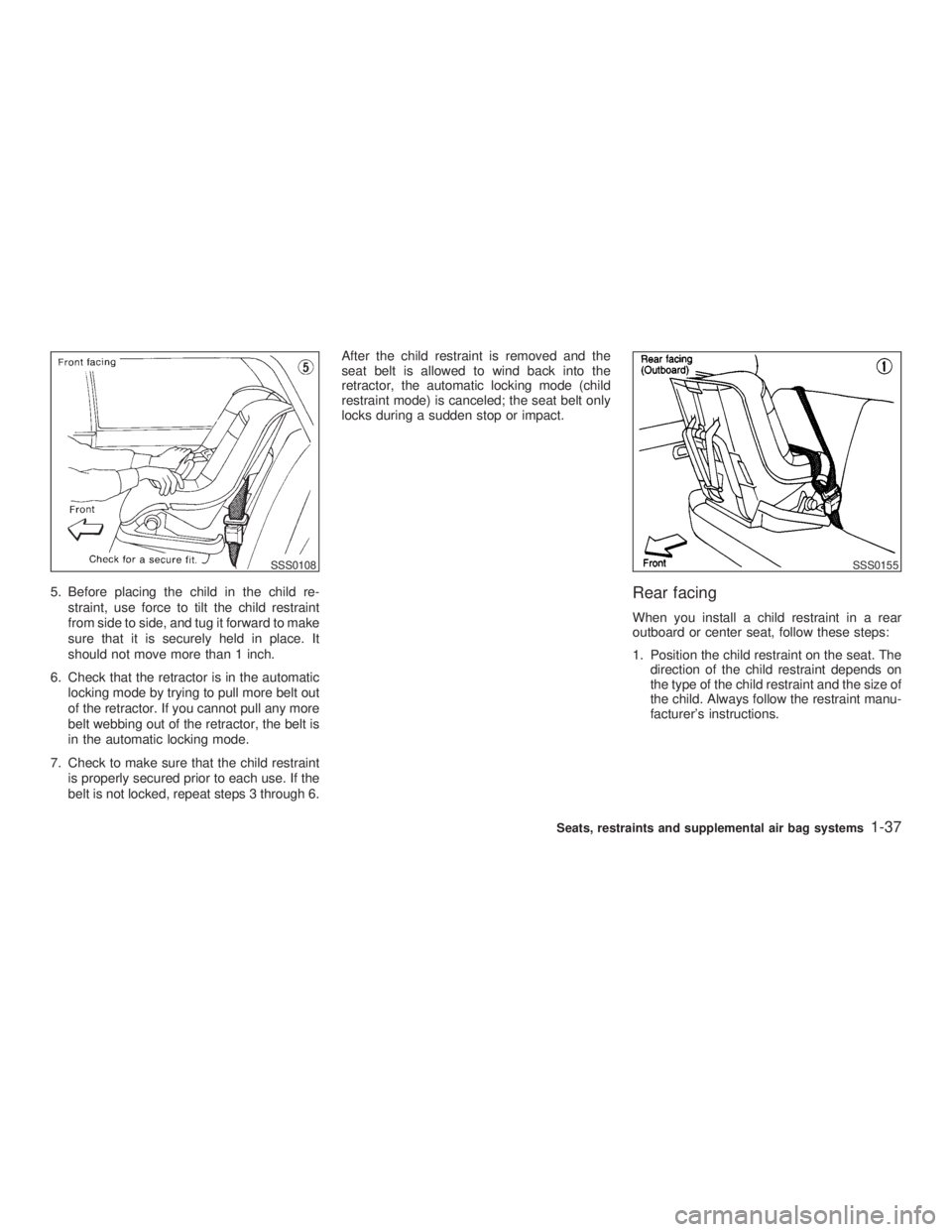
5. Before placing the child in the child re-
straint, use force to tilt the child restraint
from side to side, and tug it forward to make
sure that it is securely held in place. It
should not move more than 1 inch.
6. Check that the retractor is in the automatic
locking mode by trying to pull more belt out
of the retractor. If you cannot pull any more
belt webbing out of the retractor, the belt is
in the automatic locking mode.
7. Check to make sure that the child restraint
is properly secured prior to each use. If the
belt is not locked, repeat steps 3 through 6. After the child restraint is removed and the
seat belt is allowed to wind back into the
retractor, the automatic locking mode (child
restraint mode) is canceled; the seat belt only
locks during a sudden stop or impact.
Rear facing When you install a child restraint in a rear
outboard or center seat, follow these steps:
1. Position the child restraint on the seat. The
direction of the child restraint depends on
the type of the child restraint and the size of
the child. Always follow the restraint manu-
facturer's instructions.SSS0108 SSS0155
Seats, restraints and supplemental air bag systems
1-37
Z 02.11.1/V35-D/V5.0
X