2003 INFINITI G35 brake
[x] Cancel search: brakePage 166 of 256
O The booster battery must be rated at
12 volts. Use of an improperly rated
battery can damage your vehicle.
O Whenever working on or near a bat-
tery, always wear suitable eye protec-
tors (for example, goggles or indus-
trial safety spectacles) and remove
rings, metal bands, or any other jew-
elry. Do not lean over the battery
when jump starting.
O Do not attempt to jump start a frozen
battery. It could explode and cause
serious injury.
If needed Roadside Assistance is available.
Please see your Warranty Information Booklet
or Roadside Assistance I.D. Card for the toll-
free number to call (U.S.) or Warranty & Road-
side assistance information booklet (Canada).
WARNING Always follow the instructions below.
Failure to do so could result in damage
to the charging system and cause per-
sonal injury.
1. If the booster battery is in another vehicle,
position the two vehicles to bring their bat-
teries into close proximity to each other.
Do not allow the two vehicles to touch. 2. Apply parking brake. Move the shift lever to
the N (Neutral) position (On automatic
transmission models, move the selector
lever to the P (Park) position). Switch off all
unnecessary electrical systems (light,
heater, air conditioner, etc.).
3. Remove vent caps on the battery (if so
equipped). Cover the battery with an old
cloth to reduce explosion hazard.
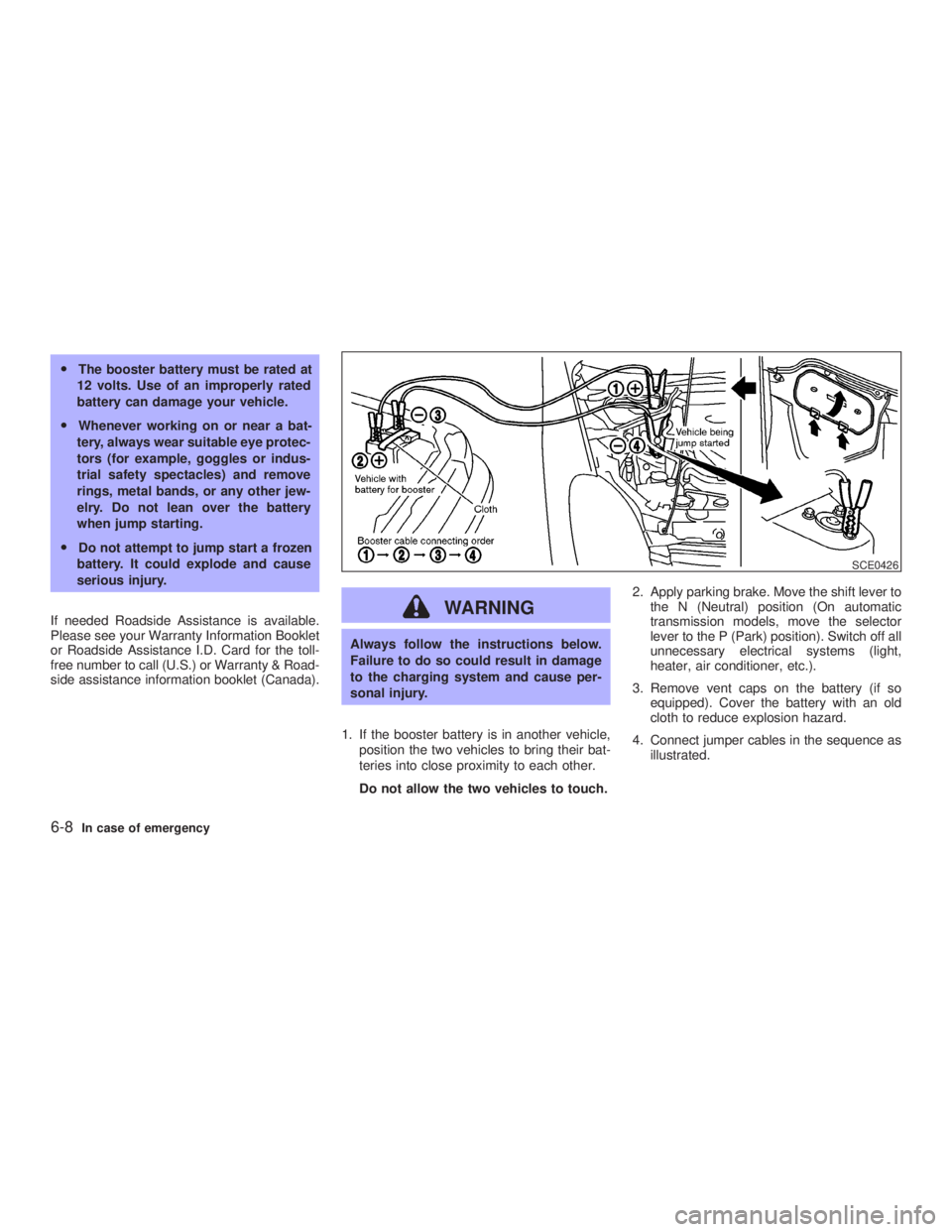
4. Connect jumper cables in the sequence as
illustrated. SCE0426
6-8 In case of emergency
Z 02.7.29/V35-D/V5.0
X
Page 168 of 256

WARNINGO Do not continue to drive if your ve-
hicle overheats. Doing so could
cause a vehicle fire.
O To avoid the danger of being scalded,
never remove the radiator cap while
the engine is still hot. When the radia-
tor cap is removed, pressurized hot
water will spurt out, possibly causing
serious injury.
O Do not open the hood if steam is
coming out.
If your vehicle is overheating (indicated by an
extremely high temperature gauge reading), or
if you feel a lack of engine power, detect
abnormal noise, etc., take the following steps:
1. Move the vehicle safely off the road, apply
the parking brake and move the shift lever
to the N (Neutral) position (automatic trans-
mission to the P (Park) position).
Do not stop the engine.
2. Turn off the air conditioner switch. Open all
the windows, move the heater or air condi- tioner temperature control to maximum hot
and fan control to high speed.
3. If engine overheating is caused by climbing
a long hill on a hot day, run the engine at a
fast idle (approximately 1,500 rpm) until the
temperature gauge indication returns to
normal.
4. Get out of the vehicle. Look and listen for
steam or coolant escaping from the radiator
before opening the hood. Wait until no
steam or coolant can be seen before pro-
ceeding.
5. Open the engine hood.
WARNING If steam or water is coming from the
engine, stand clear to prevent getting
burned.
6. Visually check if the cooling fan is running.
The radiator hoses and radiator should not
leak water.
If coolant is leaking or the cooling fan does
not run, stop the engine. WARNING O Be careful not to allow your hands,
hair, jewelry or clothing to come into
contact with, or to get caught in the
cooling fan, or drive belt.
O The engine cooling fan can start at
any time when the coolant tempera-
ture is high.
7. After the engine cools down, check the
coolant level in the reservoir tank with the
engine running. Add coolant to the reservoir
tank if necessary. Have your vehicle re-
paired at the nearest INFINITI retailer.
If needed, Roadside Assistance is available.
Please see your Warranty Information Booklet
or Roadside Assistance I.D. Card for the toll-
free number to call (U.S.) or Warranty & Road-
side assistance information booklet (Canada).IF YOUR VEHICLE OVERHEATS
6-10 In case of emergency
Z 02.7.29/V35-D/V5.0
X
Page 170 of 256
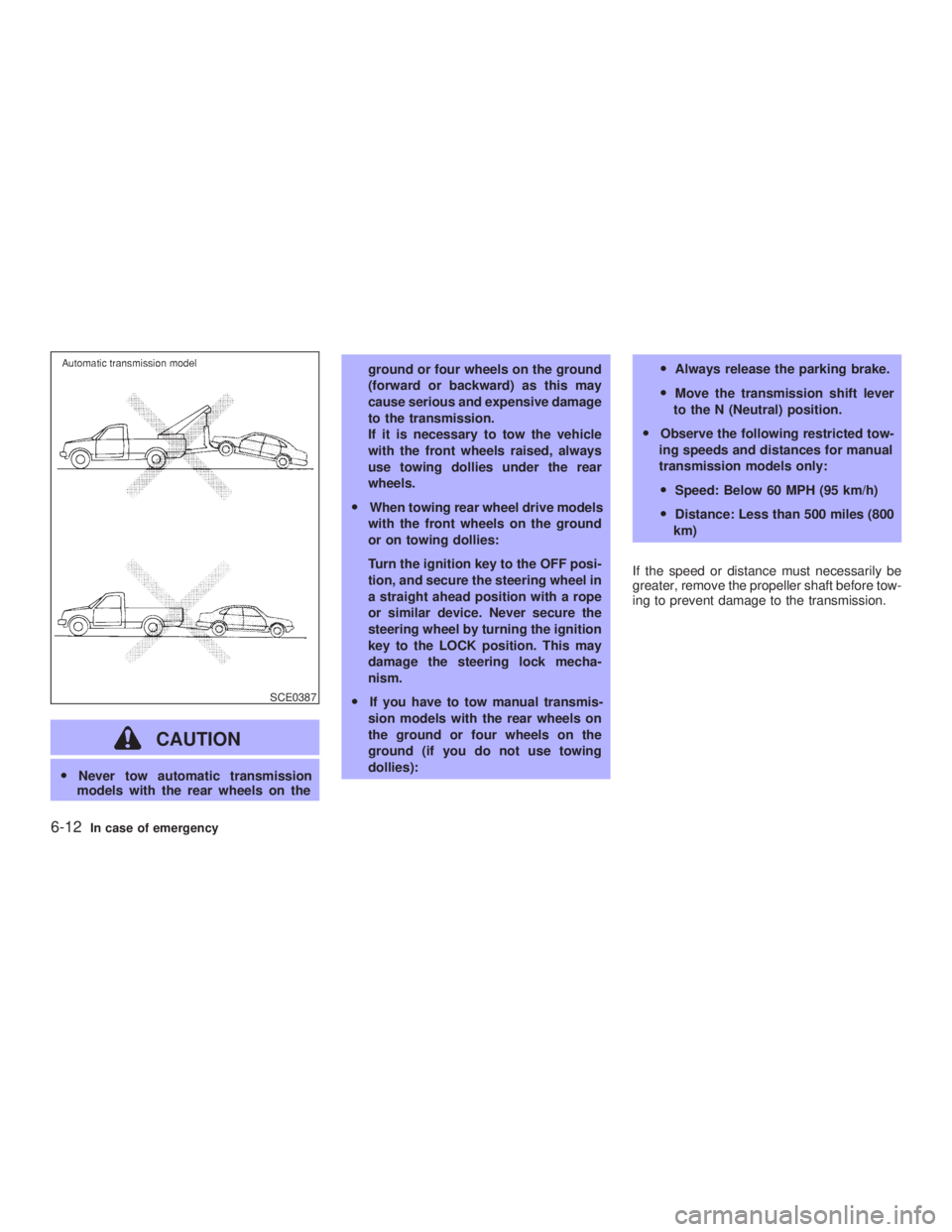
CAUTIONO Never tow automatic transmission
models with the rear wheels on the ground or four wheels on the ground
(forward or backward) as this may
cause serious and expensive damage
to the transmission.
If it is necessary to tow the vehicle
with the front wheels raised, always
use towing dollies under the rear
wheels.
O When towing rear wheel drive models
with the front wheels on the ground
or on towing dollies:
Turn the ignition key to the OFF posi-
tion, and secure the steering wheel in
a straight ahead position with a rope
or similar device. Never secure the
steering wheel by turning the ignition
key to the LOCK position. This may
damage the steering lock mecha-
nism.
O If you have to tow manual transmis-
sion models with the rear wheels on
the ground or four wheels on the
ground (if you do not use towing
dollies): O Always release the parking brake.
O Move the transmission shift lever
to the N (Neutral) position.
O Observe the following restricted tow-
ing speeds and distances for manual
transmission models only:
O Speed: Below 60 MPH (95 km/h)
O Distance: Less than 500 miles (800
km)
If the speed or distance must necessarily be
greater, remove the propeller shaft before tow-
ing to prevent damage to the transmission.SCE0387
6-12 In case of emergency
Z 02.7.29/V35-D/V5.0
X
Page 171 of 256
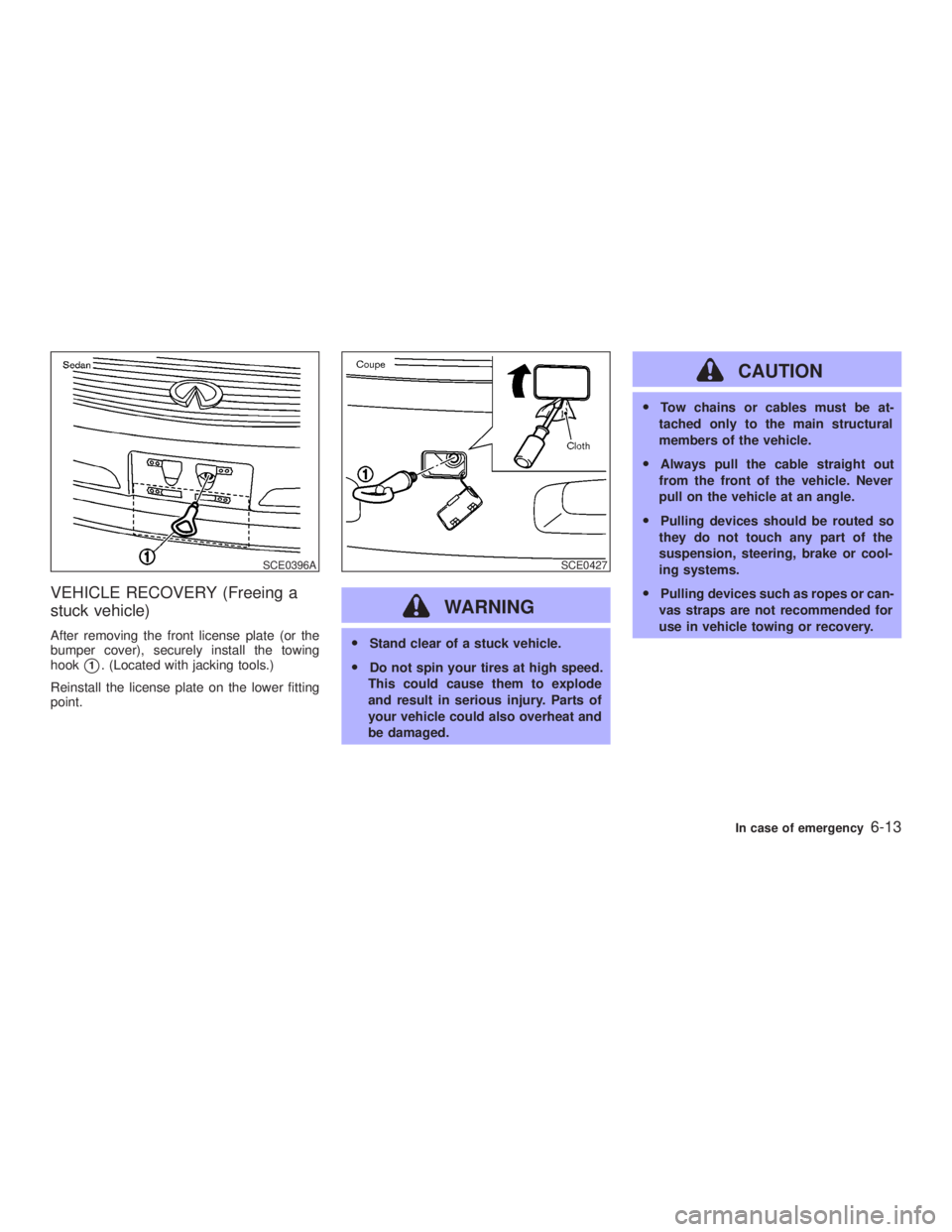
VEHICLE RECOVERY (Freeing a
stuck vehicle) After removing the front license plate (or the
bumper cover), securely install the towing
hook
j 1
. (Located with jacking tools.)
Reinstall the license plate on the lower fitting
point.
WARNING O Stand clear of a stuck vehicle.
O Do not spin your tires at high speed.
This could cause them to explode
and result in serious injury. Parts of
your vehicle could also overheat and
be damaged. CAUTION O Tow chains or cables must be at-
tached only to the main structural
members of the vehicle.
O Always pull the cable straight out
from the front of the vehicle. Never
pull on the vehicle at an angle.
O Pulling devices should be routed so
they do not touch any part of the
suspension, steering, brake or cool-
ing systems.
O Pulling devices such as ropes or can-
vas straps are not recommended for
use in vehicle towing or recovery.SCE0396A SCE0427
In case of emergency
6-13
Z 02.7.29/V35-D/V5.0
X
Page 177 of 256
MOST COMMON FACTORS
CONTRIBUTING TO VEHICLE
CORROSION: O The accumulation of moisture-retaining dirt
and debris in body panel sections, cavities,
and other areas.
O Damage to paint and other protective coat-
ings caused by gravel and stone chips or
minor traffic accidents.
ENVIRONMENTAL FACTORS
INFLUENCE THE RATE OF
CORROSION:
Moisture Accumulation of sand, dirt and water on the
vehicle body underside can accelerate corro-
sion. Wet floor coverings will not dry com-
pletely inside the vehicle, and should be re-
moved for drying to avoid floor panel
corrosion.
Relative humidity Corrosion will be accelerated in areas of high
relative humidity, especially those areas where
the temperatures stay above freezing and
where atmospheric pollution exists and road
salt is used. Temperature A temperature increase will accelerate the rate
of corrosion to those parts which are not well
ventilated.
Air pollution Industrial pollution, the presence of salt in the
air in coastal areas, or heavy road salt use will
accelerate the corrosion process. Road salt
will also accelerate the disintegration of paint
surfaces.
TO PROTECT YOUR VEHICLE
FROM CORROSION: O Wash and wax your vehicle often to keep
the vehicle clean.
O Always check for minor damage to the paint
and repair it as soon as possible.
O Keep drain holes at the bottom of the doors
open to avoid water accumulation.
O Check the underbody for accumulation of
sand, dirt or salt. If present, wash with water
as soon as possible. CAUTION O NEVER remove dirt, sand or other
debris from the passenger compart-
ment by washing it out with a hose.
Remove dirt with a vacuum cleaner or
broom.
O Never allow water or other liquids to
come in contact with electronic com-
ponents inside the vehicle as this
may damage them.
Chemicals used for road surface de-icing are
extremely corrosive. They accelerate corro-
sion and deterioration of underbody compo-
nents such as the exhaust system, fuel and
brake lines, brake cables, floor pan and fend-
ers.
In winter, the underbody must be cleaned
periodically.
For additional protection against rust and cor-
rosion, which may be required in some areas,
consult your local INFINITI retailer.CORROSION PROTECTION
Appearance and care
7-5
Z 02.7.29/V35-D/V5.0
X
Page 179 of 256

8 Do-it-yourself Maintenance precautions .......................................... 8-2
Engine compartment check locations ....................... 8-4
Engine cooling system .............................................. 8-5
Checking engine coolant level ............................. 8-5
Changing engine coolant ..................................... 8-6
Engine oil .................................................................. 8-7
Checking engine oil level ..................................... 8-7
Changing engine oil and filter .............................. 8-8
Automatic transmission fluid ................................... 8-10
Power steering fluid ................................................ 8-10
Brake and clutch fluid ............................................. 8-11
Brake fluid .......................................................... 8-11
Clutch fluid.......................................................... 8-11
Window washer fluid ............................................... 8-12
Battery ..................................................................... 8-13
Jump starting ...................................................... 8-14
Drive belts ............................................................... 8-14
Spark plugs ............................................................. 8-15
Replacing spark plugs ........................................ 8-15
Air cleaner ............................................................... 8-16
Windshield wiper blades ......................................... 8-16
Cleaning ............................................................. 8-16
Replacing............................................................ 8-17 Parking brake and brake pedal ............................... 8-18
Checking parking brake ..................................... 8-18
Checking brake pedal ........................................ 8-18
Brake booster ..................................................... 8-19
Fuses....................................................................... 8-20
Engine compartment .......................................... 8-20
Passenger compartment .................................... 8-21
Keyfob battery replacement .................................... 8-21
Lights ....................................................................... 8-23
Headlights........................................................... 8-25
Exterior and interior lights .................................. 8-26
Wheels and tires ..................................................... 8-30
Tire pressure ...................................................... 8-30
Types of tires...................................................... 8-30
Tire chains .......................................................... 8-31
Changing wheels and tires ................................. 8-32
Z 02.7.29/V35-D/V5.0
X
Page 180 of 256
When performing any inspection or mainte-
nance work on your vehicle, always take care
to prevent serious accidental injury to yourself
or damage to the vehicle. The following are
general precautions which should be closely
observed.
WARNINGO Park the vehicle on a level surface,
apply the parking brake securely and
block the wheels to prevent the ve-
hicle from moving. For a manual
transmission, move the shift lever to
N (Neutral) position. For an automatic
transmission, move the selector lever
to P (Park) position.
O Be sure the ignition key is OFF or
LOCK when performing any parts re-
placement or repairs.
O If you must work with the engine
running, keep your hands, clothing,
hair and tools away from moving
fans, belts and any other moving
parts.
O It is advised to secure or remove any loose clothing and any jewelry, such
as rings, watches, etc. before work-
ing on your vehicle.
O Always wear eye protection when-
ever you work on your vehicle.
O If you must run the engine in an
enclosed space such as a garage, be
sure there is proper ventilation for
exhaust gases to escape.
O Never get under the vehicle while it is
supported only by a jack. If it is nec-
essary to work under the vehicle,
support it with safety stands.
O Keep smoking materials, flame and
sparks away from fuel and the bat-
tery.
O On gasoline engine models with the
Multiport Fuel Injection (MFI) System,
the fuel filter or fuel lines should be
serviced by an INFINITI retailer be-
cause the fuel lines are under high
pressure even when the engine is off. CAUTION O Do not work under the hood while the
engine is hot. Turn off the engine and
wait until it cools down.
O Never connect or disconnect either
the battery or any transistorized com-
ponent connector while the ignition
key is on.
O Never leave any engine or automatic
transmission related component har-
ness connector disconnected while
the ignition key is on.
O Avoid direct contact with used engine
oil and coolant. Improperly disposed
engine oil, engine coolant and/or
other vehicle fluids can hurt the envi-
ronment. Always conform to local
regulations for disposal of vehicle
fluid.
This ª8. Do-it-yourselfº section gives instruc-
tions regarding only those items which are
relatively easy for an owner to perform.
A genuine INFINITI Service Manual is alsoMAINTENANCE PRECAUTIONS
8-2 Do-it-yourself
Z 02.7.29/V35-D/V5.0
X
Page 182 of 256

1. Fuse/fusible link holder
2. Battery
3. Engine oil filler cap
4. Brake fluid reservoir
5. Clutch fluid reservoir
6. Power steering fluid reservoir
7. Engine coolant reservoir
8. Windshield washer fluid reservoir
9. Radiator filler cap
10. Engine oil dipstick
11. Air cleaner
SDI1485ENGINE COMPARTMENT CHECK
LOCATIONS
8-4 Do-it-yourself
Z 02.7.29/V35-D/V5.0
X