2003 INFINITI G35 change time
[x] Cancel search: change timePage 226 of 256

after using oxygenate-blend fuels, immediately
change to a non-oxygenate fuel or a fuel with
a low blend of MTBE.
Take care not to spill gasoline during refu-
eling. Gasoline containing oxygenates can
cause paint damage.
Aftermarket fuel additives INFINITI does not recommend the use of any
fuel additives (i.e. fuel injector cleaner, octane
booster, intake valve deposit removers, etc.)
which are sold commercially. Many of these
additives intended for gum, varnish or deposit
removal may contain active solvent or similar
ingredients that can be harmful to the fuel
system and engine.
Octane rating tips In most parts of North America, you should use
unleaded gasoline with an octane rating of at
least 87 or 91 AKI (Anti-Knock Index) number.
However, you may use unleaded gasoline with
an octane rating as low as 85 AKI number in
these high altitude areas [over 4,000 ft (1,219
m)] such as: Colorado, Montana, New Mexico,
Utah, Wyoming, northeastern Nevada, south-
ern Idaho, western South Dakota, western
Nebraska, and that part of Texas which is
directly south of New Mexico. Using unleaded gasoline with an octane
rating lower than stated above can cause
persistent, heavy spark knock. (Spark
knock is a metallic rapping noise.) If se-
vere, this can lead to engine damage. If you
detect a persistent heavy spark knock even
when using gasoline of the stated octane
rating, or if you hear steady spark knock
while holding a steady speed on level
roads, have your dealer correct the condi-
tion. Failure to correct the condition is
misuse of the vehicle, for which INFINITI is
not responsible.
Incorrect ignition timing will result in knocking,
after-run or overheating. This in turn may
cause excessive fuel consumption or damage
to the engine. If any of the above symptoms
are encountered, have your vehicle checked at
an INFINITI retailer or other competent service
facility.
However, now and then you may notice
light spark knock for a short time while
accelerating or driving up hills. This is no
cause for concern, because you get the
greatest fuel benefit when there is light
spark knock for a short time under heavy
engine load.
10-4 Technical and consumer information
Z 02.7.29/V35-D/V5.0
X
Page 241 of 256
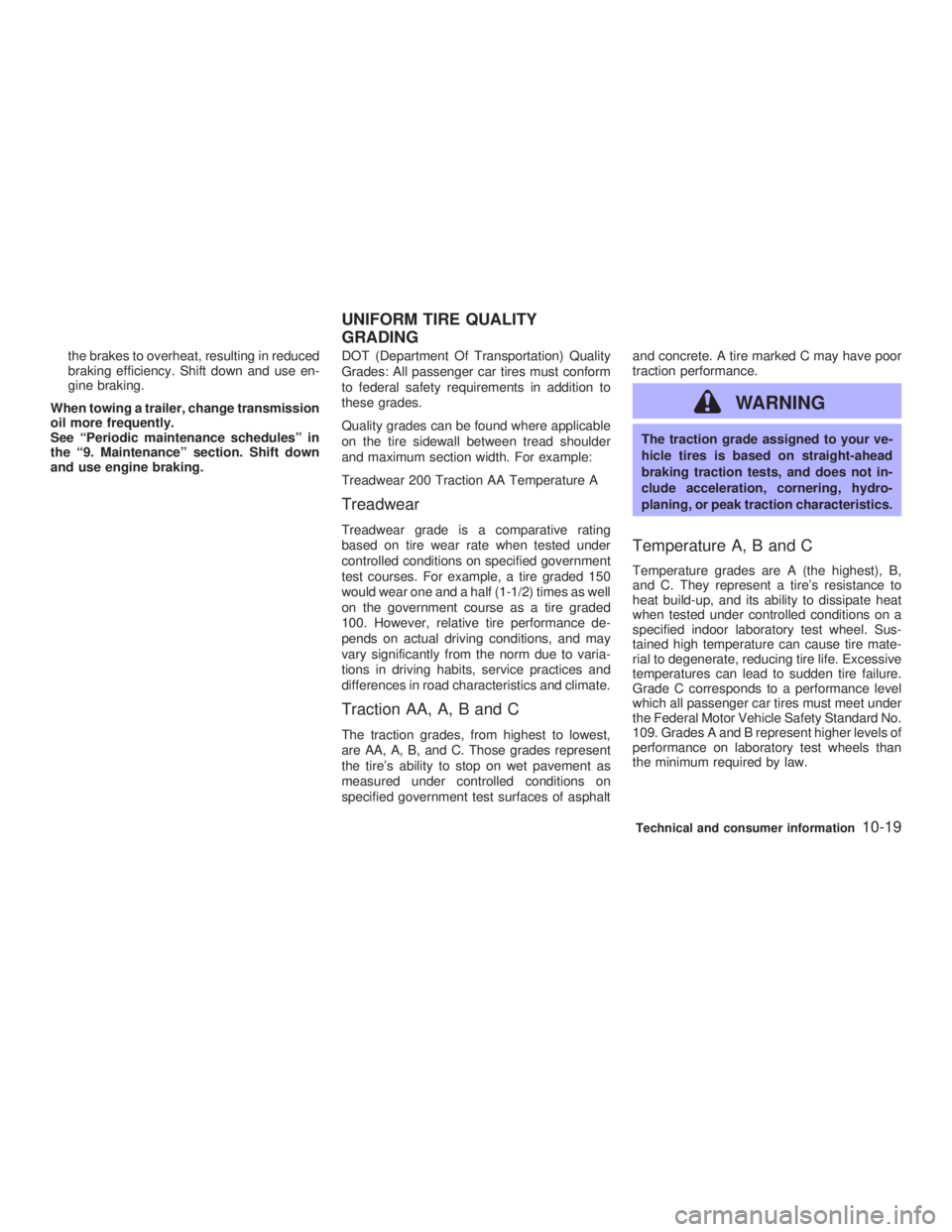
the brakes to overheat, resulting in reduced
braking efficiency. Shift down and use en-
gine braking.
When towing a trailer, change transmission
oil more frequently.
See ªPeriodic maintenance schedulesº in
the ª9. Maintenanceº section. Shift down
and use engine braking. DOT (Department Of Transportation) Quality
Grades: All passenger car tires must conform
to federal safety requirements in addition to
these grades.
Quality grades can be found where applicable
on the tire sidewall between tread shoulder
and maximum section width. For example:
Treadwear 200 Traction AA Temperature A
Treadwear Treadwear grade is a comparative rating
based on tire wear rate when tested under
controlled conditions on specified government
test courses. For example, a tire graded 150
would wear one and a half (1-1/2) times as well
on the government course as a tire graded
100. However, relative tire performance de-
pends on actual driving conditions, and may
vary significantly from the norm due to varia-
tions in driving habits, service practices and
differences in road characteristics and climate.
Traction AA, A, B and C The traction grades, from highest to lowest,
are AA, A, B, and C. Those grades represent
the tire's ability to stop on wet pavement as
measured under controlled conditions on
specified government test surfaces of asphalt and concrete. A tire marked C may have poor
traction performance.
WARNING The traction grade assigned to your ve-
hicle tires is based on straight-ahead
braking traction tests, and does not in-
clude acceleration, cornering, hydro-
planing, or peak traction characteristics.
Temperature A, B and C Temperature grades are A (the highest), B,
and C. They represent a tire's resistance to
heat build-up, and its ability to dissipate heat
when tested under controlled conditions on a
specified indoor laboratory test wheel. Sus-
tained high temperature can cause tire mate-
rial to degenerate, reducing tire life. Excessive
temperatures can lead to sudden tire failure.
Grade C corresponds to a performance level
which all passenger car tires must meet under
the Federal Motor Vehicle Safety Standard No.
109. Grades A and B represent higher levels of
performance on laboratory test wheels than
the minimum required by law.UNIFORM TIRE QUALITY
GRADING
Technical and consumer information
10-19
Z 02.7.29/V35-D/V5.0
X
Page 248 of 256

Installation on rear seat outboard or center
positions .................................................... 1-35
Precautions on child restraints .................. 1-33
Top tether strap anchor point locations .... 1-42
With top tether strap.................................. 1-41
Child safety ..................................................... 1-27
Child safety rear door lock................................ 3-5
Chimes, Audible reminders............................. 2-13
Cigarette lighter and ashtray .......................... 2-24
Circuit breaker, Fusible link ............................ 8-20
Cleaning exterior and interior .................... 7-2, 7-3
Clock ............................................................... 2-23
Clutch fluid ...................................................... 8-11
Coat fook (Coupe) .......................................... 2-30
Cold weather driving ....................................... 5-23
Compact Disc (CD) changer operation .......... 4-15
Compact spare tire ......................................... 8-34
Compass display .............................................. 2-6
Console box .................................................... 2-28
Controls
Heater and air conditioner controls
(automatic)................................................... 4-3
Steering audio control ............................... 4-17
Coolant
Capacities and recommended fuel/lubricants/
fluids .......................................................... 10-2
Changing engine coolant ............................ 8-6
Checking engine coolant level .................... 8-5
Corrosion protection ......................................... 7-5
Cruise control.................................................. 5-15
Cup holder ...................................................... 2-26 D
Daytime running light system ......................... 2-19
Defroster switch, Rear window and outside mirror
defroster switch ............................................. 2-16
Dehumidified defrosting or defogging ............... 4-4
Dimensions and weights ................................. 10-8
Door open warning light ................................. 2-10
Drive belts ....................................................... 8-14
Drive positioner, Automatic ............................. 3-19
Driving
Cold weather driving ................................. 5-23
Driving with automatic transmission .... 5-4, 5-8
Driving with manual transmission ...... 5-5, 5-12
Precautions when starting and driving ........ 5-2
E
Economy, Fuel ................................................ 5-17
Emission control information label ................ 10-11
Emission control system warranty ................ 10-20
Engine
Before starting the engine ........................... 5-7
Capacities and recommended fuel/lubricants/
fluids .......................................................... 10-2
Changing engine coolant ............................ 8-6
Changing engine oil and filter ..................... 8-8
Checking engine coolant level .................... 8-5
Checking engine oil level ............................ 8-7
Coolant temperature gauge ........................ 2-5
Engine block heater .................................. 5-24
Engine compartment check locations ......... 8-4
Engine cooling system ................................ 8-5 Engine oil..................................................... 8-7
Engine oil and oil filter recommendation... 10-5
Engine oil viscosity .................................... 10-5
Engine serial number .............................. 10-10
Engine specifications................................. 10-7
If your vehicle overheats ........................... 6-10
Starting the engine ...................................... 5-7
Exhaust gas (Carbon monoxide) ...................... 5-2
F
F.M.V.S.S. certification label......................... 10-10
Filter, Air cleaner housing filter ....................... 8-16
Flashers (See hazard warning flasher
switch) ............................................................. 2-20
Flat tire .............................................................. 6-2
Floor mat cleaning ............................................ 7-4
Fluid
Automatic transmission fluid (ATF) ............. 8-9
Brake and clutch fluid................................ 8-11
Brake fluid ................................................. 8-11
Capacities and recommended fuel/lubricants/
fluids .......................................................... 10-2
Engine coolant............................................. 8-5
Engine oil..................................................... 8-7
Power steering fluid................................... 8-10
Window washer fluid ................................. 8-12
FM-AM-satellite radio with cassette player and
Compact Disc (CD) changer........................... 4-11
Fog light switch ............................................... 2-20
Front air bag system (See supplemental restraint
system) ........................................................... 1-17
Front manual seat adjustment .......................... 1-2
Front power seat adjustment ............................ 1-4
11-2
Z 02.7.29/V35-D/V5.0
X