2003 INFINITI G35 ECO mode
[x] Cancel search: ECO modePage 144 of 256

manual shift mode. Shift range can be se-
lected manually.
In the manual shift mode, the shift range is
displayed on the position indicator in the
meter. When shifting the selector lever to the
manual shift gate, the position indicator first
displays 4 M
(4th).
Shift ranges up or down one by one as follows: 1 M
!
à 2 M
!
à 3 M
!
à 4 M
!
à 5 M
5 M
(5th):
Use this position for all normal forward driving.
4 M
(4th):
For driving up or down long slopes where
engine braking would be advantageous.
3 M
(3rd) and 2 M
(2nd):
Use for hill climbing or engine braking on
downhill grades.
1 M
(1st):
Use this position when climbing steep hills
slowly or driving slowly through deep snow,
sand or mud, or for maximum engine braking
on steep downhill grades.
O Remember not to drive at high speeds for
extended periods of time in lower than 4 M
range. This reduces the fuel economy. O When shifting up, move the selector lever to
the + (up) side. (Shifts to higher range.)
O When shifting down, move the selector
lever to the þ (down) side. (Shifts to lower
range.)
O The transmission will automatically shift the
gears between the 1st and the selected
range. (For example, if you select the 3rd
range, the transmission will shift up or down
between 1st, 2nd and 3rd gears.
O Moving the selector lever rapidly to the
same side twice will shift the ranges in
succession.
O When canceling the manual shift mode,
return the selector lever to the D position.
The transmission returns to the normal
driving mode.
O In the manual shift mode, the transmis-
sion may not shift to the selected gear.
This helps maintain driving performance
and reduces the chance of vehicle dam-
age or loss of control.
O In the manual shift mode, the transmis-
sion may shift up automatically over the
selected range, if the engine is revved
up to the hazardous speed. When the
vehicle speed decreases, the transmis-
sion automatically shifts down and shifts to 1st gear before the vehicle
comes to a stop.
Manual shift mode (Coupe) When the selector lever is shifted from D to the
manual shift gate with the vehicle stopped or
while driving, the transmission enters the
manual shift mode. Shift range can be se-
lected manually.
In the manual shift mode, the shift range is
displayed on the position indicator in the
meter.
Shift ranges up or down one by one as follows: M
1 !
à M
2 !
à M
3 !
à M
4 !
à M
5M
5 (5th):
Use this position for all normal forward driving. M
4 (4th):
For driving up or down long slopes where
engine braking would be advantageous. M
3 (3rd) and M
2 (2nd):
Use for hill climbing or engine braking on
downhill grades. M
1 (1st):
Use this position when climbing steep hills
slowly or driving slowly through deep snow,
5-10 Starting and driving
Z 02.7.29/V35-D/V5.0
X
Page 145 of 256

sand or mud, or for maximum engine braking
on steep downhill grades.
O Remember not to drive at high speeds for
extended periods of time in lower than M
4
range. This reduces the fuel economy.
O When shifting up, move the selector lever to
the + (up) side. (Shifts to higher range.)
O When shifting down, move the selector
lever to the þ (down) side. (Shifts to lower
range.)
O Moving the selector lever to the same side
twice will shift the ranges in succession.
However, if this motion is rapidly done, the
second shifting may not be completed prop-
erly.
O In the manual shift mode, the transmis-
sion automatically shifts down to 1st
gear before the vehicle comes to a stop.
When accelerating again, it is necessary
to shift up to the desired range.
O When canceling the manual shift mode,
return the selector lever to the D position.
The transmission returns to the normal
driving mode.
O In the manual shift mode, the transmis-
sion may not shift to the selected gear.
This helps maintain driving performance and reduces the chance of vehicle dam-
age or loss of control.
Accelerator downshift
Ð In D position Ð For passing or hill climbing, fully depress the
accelerator pedal to the floor. This shifts the
transmission down into the lower gear, de-
pending on the vehicle speed.
Fail-safe When the fail-safe operation occurs, the next
time the key is turned to the ON position, the
light will blink for approximately 8 sec-
onds after coming on for 2 seconds. While the
vehicle can be driven under these circum-
stances please note that the gears in the
automatic transmission will be locked in 4th
gear.
If the vehicle is driven under extreme con-
ditions, such as excessive wheel spinning
and subsequent hard braking, the fail-safe
system may be activated. This will occur
even if all electrical circuits are functioning
properly. In this case, turn the ignition key
OFF and wait for 3 seconds. Then turn the
key back to the ON position. The vehicle
should return to its normal operating con-
dition. If it does not return to its normal
operating condition, have your INFINITI re- tailer check the transmission and repair if
necessary.
Starting and driving
5-11
Z 02.7.29/V35-D/V5.0
X
Page 149 of 256
WARNINGDo not use the cruise control when driv-
ing under the following conditions:
O it is not possible to keep the vehicle
at a set speed.
O in heavy traffic or in traffic that varies
in speed.
O on winding or hilly roads.
O on slippery roads (rain, snow, ice,
etc.).
O in very windy areas.
Doing so could cause a loss of vehicle
control and result in an accident.
CAUTIONOn manual transmission models, do not
shift into N (Neutral) without depressing
the clutch pedal when the cruise control
is set. Should this occur, depress the
clutch pedal and turn the main switch off
immediately. Failure to do so may cause engine damage.
PRECAUTIONS ON CRUISE
CONTROL O If the cruise control system malfunctions, it
cancels automatically. The SET indicator
light on the meter panel then blinks to warn
the driver.
O If the engine coolant temperature becomes
excessively high, the cruise control system
will be canceled automatically.
O If the SET indicator light blinks, turn the
cruise control main switch off and have the
system checked by your INFINITI retailer.
O The SET indicator light may blink when the
cruise control main switch is turned on
while pushing the RES/ACCEL, COAST/
SET, or CANCEL switch (located on the
steering wheel). To properly set the cruise
control system, perform the preceding
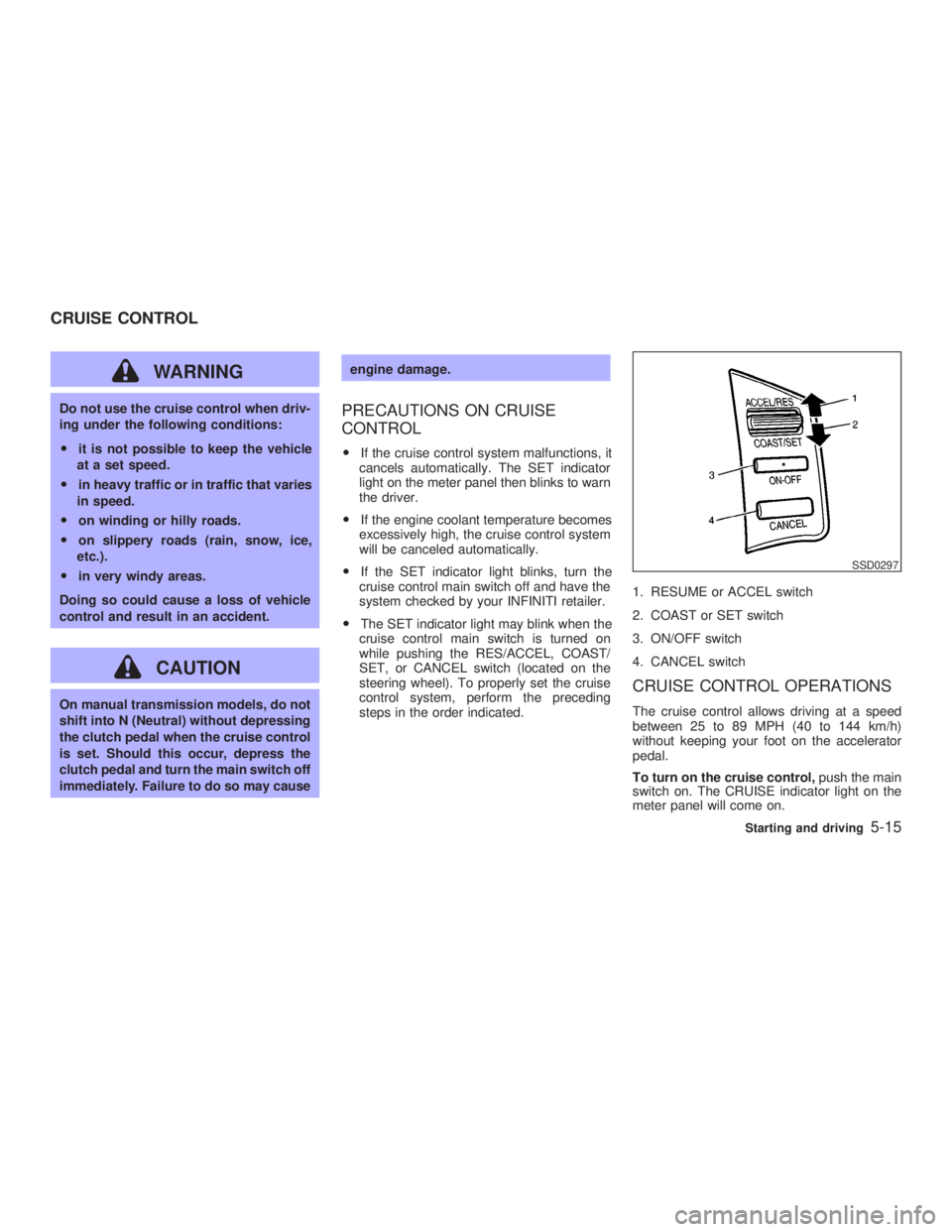
steps in the order indicated. 1. RESUME or ACCEL switch
2. COAST or SET switch
3. ON/OFF switch
4. CANCEL switch
CRUISE CONTROL OPERATIONS The cruise control allows driving at a speed
between 25 to 89 MPH (40 to 144 km/h)
without keeping your foot on the accelerator
pedal.
To turn on the cruise control, push the main
switch on. The CRUISE indicator light on the
meter panel will come on. SSD0297
CRUISE CONTROL
Starting and driving
5-15
Z 02.7.29/V35-D/V5.0
X
Page 151 of 256

During the first 1,200 miles (2,000 km), follow
these recommendations to obtain maximum
engine performance and ensure the future
reliability and economy of your new vehicle.
Failure to follow these recommendations may
result in shortened engine life and reduced
engine performance.
O Avoid driving for long periods at constant
speed, either fast or slow. Do not run the
engine over 4,000 rpm.
O Do not accelerate at full throttle in any gear.
O Avoid quick starts.
O Avoid hard braking as much as possible.
O Do not tow a trailer for the first 500 miles
(800 km). O Accelerate slowly and smoothly. Maintain
cruising speeds with a constant accelerator
position.
O Drive at moderate speeds on the highway.
Driving at high speed will lower fuel
economy.
O Avoid unnecessary stopping and braking.
Maintain a safe distance behind other ve-
hicles.
O Use a proper gear range which suits road
conditions. On level roads, shift into high
gear as soon as possible.
O Avoid unnecessary engine idling. O Keep your engine tuned up.
O Follow the recommended periodic mainte-
nance schedule.
O Keep the tires inflated at the correct pres-
sure. Low pressure will increase tire wear
and waste fuel.
O Keep the front wheels in correct alignment.
Improper alignment will cause not only tire
wear but also lower fuel economy.
O Air conditioner operation lowers fuel
economy. Use the air conditioner only when
necessary.
O When cruising at highway speeds, it is
more economical to use the air conditioner
and leave the windows closed to reduce
drag. SD1001M
BREAK-IN SCHEDULE INCREASING FUEL ECONOMY
Starting and driving
5-17
Z 02.7.29/V35-D/V5.0
X
Page 164 of 256
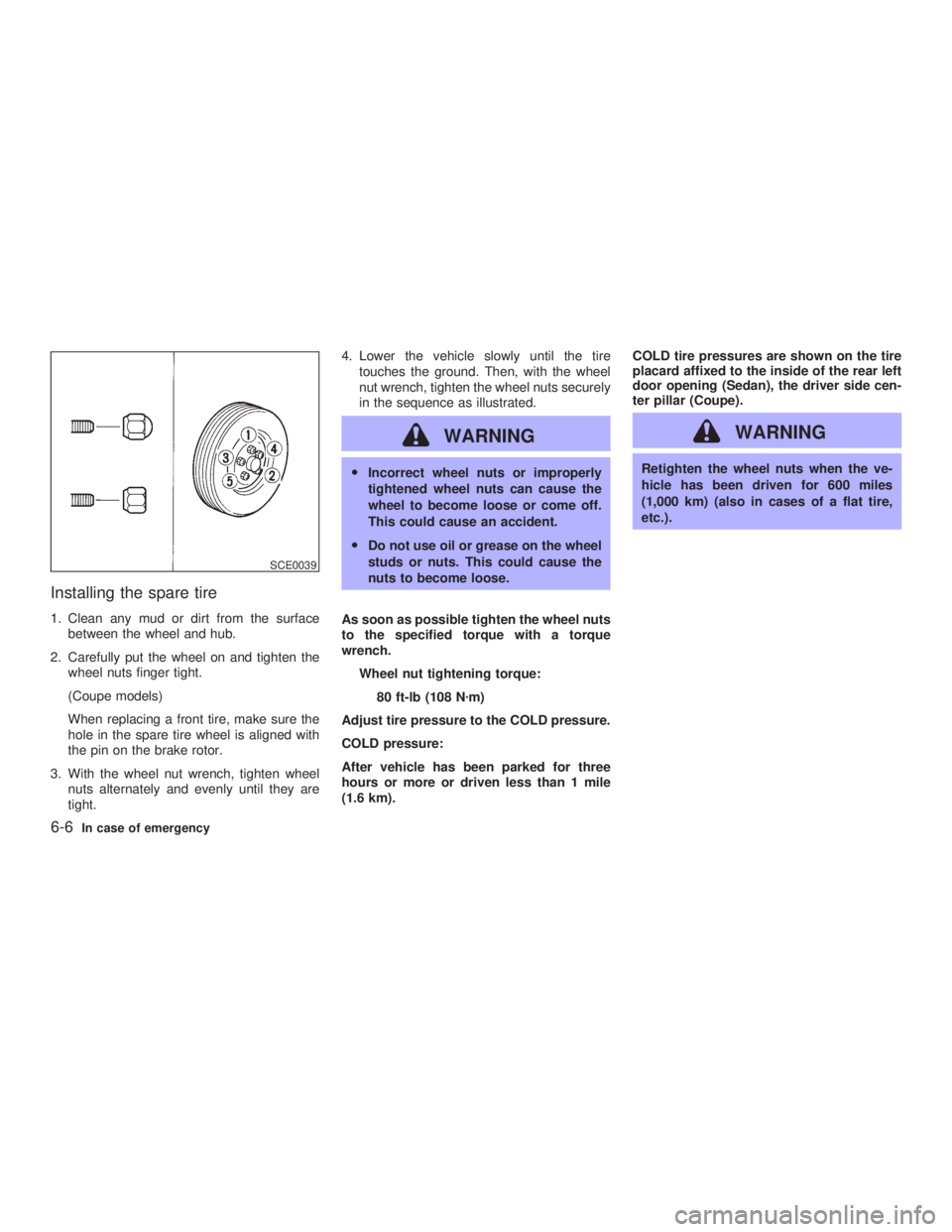
Installing the spare tire 1. Clean any mud or dirt from the surface
between the wheel and hub.
2. Carefully put the wheel on and tighten the
wheel nuts finger tight.
(Coupe models)
When replacing a front tire, make sure the
hole in the spare tire wheel is aligned with
the pin on the brake rotor.
3. With the wheel nut wrench, tighten wheel
nuts alternately and evenly until they are
tight. 4. Lower the vehicle slowly until the tire
touches the ground. Then, with the wheel
nut wrench, tighten the wheel nuts securely
in the sequence as illustrated.
WARNING O Incorrect wheel nuts or improperly
tightened wheel nuts can cause the
wheel to become loose or come off.
This could cause an accident.
O Do not use oil or grease on the wheel
studs or nuts. This could cause the
nuts to become loose.
As soon as possible tighten the wheel nuts
to the specified torque with a torque
wrench.
Wheel nut tightening torque:
80 ft-lb (108 N z m)
Adjust tire pressure to the COLD pressure.
COLD pressure:
After vehicle has been parked for three
hours or more or driven less than 1 mile
(1.6 km). COLD tire pressures are shown on the tire
placard affixed to the inside of the rear left
door opening (Sedan), the driver side cen-
ter pillar (Coupe).
WARNING Retighten the wheel nuts when the ve-
hicle has been driven for 600 miles
(1,000 km) (also in cases of a flat tire,
etc.).SCE0039
6-6 In case of emergency
Z 02.11.6/V35-D/V5.0
X
Page 167 of 256
CAUTIONO Always connect positive (+) to posi-
tive (+) and negative (þ) to body
ground (for example, strut mounting
bolt, etc. Ð not to the battery).
O Make sure that cables do not touch
moving parts in the engine compart-
ment and that clamps do not contact
any other metal.
5. Start the engine of the other vehicle and let
it run for a few minutes.
6. Keep the engine speed of the other vehicle
at about 2,000 rpm, and start your engine in
the normal manner.
CAUTIONDo not keep starter motor engaged for
more than 10 seconds. If the engine
does not start right away, turn the key
off and wait 3 to 4 seconds before trying
again. 7. After starting your engine, carefully discon-
nect the negative cable and then the posi-
tive cable.
8. Replace the vent caps (if so equipped). Be
sure to dispose of the cloth used to cover
the vent holes as it may be contaminated
with corrosive acid. Do not attempt to start the engine by pushing.
CAUTION O Automatic transmission models can-
not be push started. Attempting to do
so may cause transmission damage.
O Three way catalyst equipped models
should not be started by pushing
since the three way catalyst may be
damaged.
O Never try to start the vehicle by tow-
ing it; when the engine starts, the
forward surge could cause the ve-
hicle to collide with the tow vehicle.
If needed Roadside Assistance is available.
Please see your Warranty Information Booklet
or Roadside Assistance I.D. Card for the toll-
free number to call (U.S.) or Warranty & Road-
side assistance information booklet (Canada).PUSH STARTING
In case of emergency
6-9
Z 02.7.29/V35-D/V5.0
X
Page 176 of 256
FLOOR MATS The use of Genuine INFINITI floor mats can
extend the life of your vehicle carpet and make
it easier to clean the interior. No matter what
mats are used, be sure they are fitted for
your vehicle and are properly positioned in
the footwell to prevent interference with
pedal operation. Mats should be maintained
with regular cleaning and replaced if they
become excessively worn.
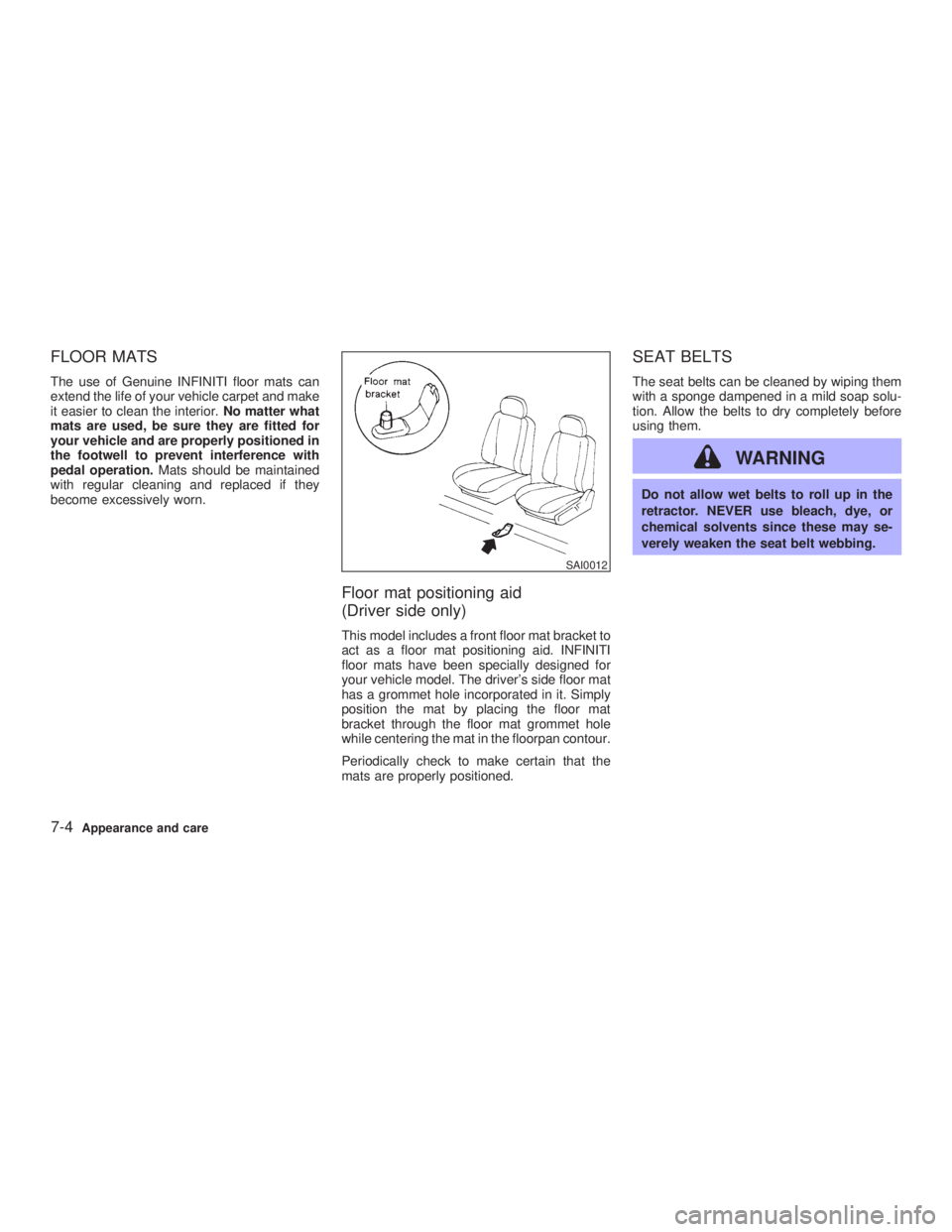
Floor mat positioning aid
(Driver side only) This model includes a front floor mat bracket to
act as a floor mat positioning aid. INFINITI
floor mats have been specially designed for
your vehicle model. The driver's side floor mat
has a grommet hole incorporated in it. Simply
position the mat by placing the floor mat
bracket through the floor mat grommet hole
while centering the mat in the floorpan contour.
Periodically check to make certain that the
mats are properly positioned. SEAT BELTS The seat belts can be cleaned by wiping them
with a sponge dampened in a mild soap solu-
tion. Allow the belts to dry completely before
using them.
WARNING Do not allow wet belts to roll up in the
retractor. NEVER use bleach, dye, or
chemical solvents since these may se-
verely weaken the seat belt webbing. SAI0012
7-4 Appearance and care
Z 02.7.29/V35-D/V5.0
X
Page 197 of 256

WARNINGSee your INFINITI retailer and have it
checked if the brake pedal height does
not return to normal.
Brake pad wear indicators The disc brake pads on your vehicle have
audible wear indicators. When a brake pad
requires replacement, it will make a high
pitched scraping or screeching sound when
the vehicle is in motion whether or not the
brake pedal is depressed. Have the brakes
checked as soon as possible if the wear indi-
cator sound is heard.
Under some driving or climate conditions, oc-
casional brake squeak, squeal or other noise
may be heard. Occasional brake noise during
light to moderate stops is normal and does not
affect the function or performance of the brake
system.
Proper brake inspection intervals should
be followed. For additional information, see
ªPeriodic maintenance schedulesº in the ª9.
Maintenanceº section for maintenance inter-
vals. High performance sports brake pad occasion-
ally makes squeak, squeal or other braking
noise because of its very high friction coeffi-
cient.
These occasional brake noise is normal, but if
it continues, see your INFINITI retailer.
BRAKE BOOSTER Check the brake booster function as follows:
1. With the engine off, press and release the
brake pedal several times. When brake
pedal movement (distance of travel) re-
mains the same from one pedal application
to the next, continue on to the next step.
2. While depressing the brake pedal, start the
engine. The pedal height should drop a
little.
3. With the brake pedal depressed, stop the
engine. Keeping the pedal depressed for
about 30 seconds, the pedal height should
not change.
4. Run the engine for one minute without
depressing the brake pedal, then turn it off.
Depress the brake pedal several times. The
pedal travel distance will decrease gradu-
ally with each depression as the vacuum is
released from the booster. If the brakes do not operate properly, see your
INFINITI retailer.
Do-it-yourself
8-19
Z 02.7.29/V35-D/V5.0
X