2003 Hyundai Matrix wheel
[x] Cancel search: wheelPage 133 of 312

VEHICLE MAINTENANCE REQUIREMENTS
5- 8 F070L01A-AAT
o Suspension Mounting Bolts Check the suspension connections for loose-
ness or damage. Retighten to the specified torque. F070M01A-AAT
o Steering Gear Box, Linkage & Boots/
Lower arm Ball Joint
With the vehicle stopped and engine off, check for excessive free-play in the steering wheel. Check the linkage for bends or damage. Check the dust boots and ball joints for deterioration, cracks, or damage. Replace any damaged parts. F070N01A-AAT o
Power Steering Pump, Belt and HosesCheck the power steering pump and hoses for leakage and damage. Replace any damaged or leaking parts immediately. Inspect the power steering belt for evidence of cuts, cracks, ex- cessive wear, oiliness and proper tension. Re- place or adjust it if necessary. F070P01A-AAT o Driveshafts and Boots Check the drive shafts, boots and clamps for cracks, deterioration, or damage. Replace any damaged parts and, if necessary, repack the grease. F070Q01A-AAT
o Air Conditioning Refrigerant Check the air conditioning lines and connec- tions for leakage and damage. Check air condi- tioning performance according to the relevant shop manual if necessary.
Page 137 of 312

DO-IT-YOURSELF MAINTENANCE
6-4
G020A01A-AAT
GENERAL CHECKS Engine Compartment
The following should be checked regularly:
o Engine oil level and condition
o Transaxle fluid level and condition
o Brake fluid level
o Clutch fluid level
o Engine coolant level
o Windshield washer fluid level
o Accessory drive belt condition
o Engine coolant hose condition
o Fluid leaks (on or below components)
o Power steering fluid level
o Battery condition
o Air filter condition
G020B01A-AAT
Vehicle Exterior The following should be checked monthly:
o Overall appearance and condition
o Wheel condition and wheel nut torque
o Exhaust system condition
o Light condition and operation
o Windshield glass condition
o Wiper blade condition
o Paint condition and body corrosion
o Fluid leaks
o Door and hood lock condition
o Tire pressure and condition (including spare tire) G020C01A-AAT
Vehicle Interior
The following should be checked each time when the vehicle is driven:
o Lights operation
o Windshield wiper operation
o Horn operation
o Defroster, heating system operation (and air conditioning, if installed)
o Steering operation and condition
o Mirror condition and operation
o Turn signal operation
o Accelerator pedal operation
o Brake operation, including parking brake
o Manual transaxle operation, including clutch operation
o Automatic transaxle operation, including "Park" mechanism operation
o Seat control condition and operation
o Seat belt condition and operation
o Sunvisor operation
If you notice anything that does not operate correctly or appears to be functioning incorrect-ly, inspect it carefully and seek assistance fromyour Hyundai dealer if service is needed. G030A01FC-GAT
CHECKING THE ENGINE OIL Gasoline EngineRecommended Oil
SSA6030B
20W-40 20W-50
10W-30 15W-40 15W-50
10W-40 10W-50
°C °F -25-13 2068 40104
-15
- 5 -10-14 0
32 1050
5W-40
5W-30
5W-20
Engine oil is essential to the performance and service of the engine. It is suggested that youcheck the oil level at least once a week innormal use and more often if you are on a tripor driving in severe conditions. SH, SG or SG/CD (API) multi-grade and fuel efficient oil is recommended. NOTE: SAE 5W-20 is not recommended for sus- tained high speed vehicle operation.
Page 150 of 312

DO-IT-YOURSELF MAINTENANCE 6-17
G160A01A-GAT
CHECKING CLUTCH PEDAL FREE-PLAY With the engine off, press lightly on the clutch pedal until you feel a change in resistance. Thisis the clutch pedal freeplay. The freeplay shouldbe within the limits specified in the illustration. Ifit is not, have it inspected by your Hyundaidealer and adjusted or repaired if necessary.
G160A01E
6 ~ 13 mm (0.24 ~ 0.51 in.)
G150A01A-GAT
CHECKING STEERING WHEEL FREEPLAY
To check the steering wheel freeplay, stop the
car with the wheels pointed straight ahead and gently move the steering wheel back and forth.Use very light finger pressure and be sensitiveto changes in resistance that mark the limits ofthe freeplay. If the freeplay is greater thanspecified, have it inspected by your Hyundaidealer and adjusted or repaired if necessary.
G150A01FC
G140D01S-GAT
Checking the Compressor Drive Belt
When the air conditioning is being used regular-
ly, the compressor drive belt tension should be checked at least once a month.
To check the drive belt tension, press down on
the belt halfway between the engine crankshaftand compressor pulleys. Pressing with yourfinger, you should not be able to deflect this beltanymore than 8.0 mm. If you have the instru-ments to check it with a force of 98N (22 lb.),the deflection should be approx. 8.0 mm (0.315in.). If the belt is too loose, have it adjusted byyour Hyundai dealer.
G140D01A
A/C
CRANK PULLEY
TENSION PULLEY
30 mm (1.18 in.)
8mm(0.315 in.)
Page 165 of 312

CONSUMER INFORMATION
8-2 I050A01S-GAT
TIRE CHAINS
Tire chains, if necessary should be installed on
the front wheels. Be sure that the chains are installed in accordance with the manufacturer'sinstructions.
To minimize tire and chain wear, do not contin-
ue to use tire chains when they are no longerneeded.
WARNING: When driving on roads covered with snow
or ice, drive at less than 30 km/h (20 mph). I060A01FC-GAT
TIRE ROTATION
Tires should be rotated every 10,000 km (6,000 miles). If you notice that tires are wearing un-evenly between rotations, have the car checkedby a Hyundai dealer so the cause may becorrected. After rotating, adjust the tire pressures and be sure to check wheel nut torque. WARNING:
o Do not use the temporary spare tire for tire rotation.
o Do not mix bias-ply and radial-ply tires under any circumstances. This may cause dangerous handling characteristics.
I040A01S-GAT
SNOW TIRES
If you equip your car with snow tires, theyshould be the same size and have the sameload capacity as the original tires. Snow tiresshould be installed on all four wheels; other-wise, poor handling may result. Snow tires should carry 28 kPa (4 psi) more air pressure than the pressure recommended forthe standard tires on the tire label on, or up tothe maximum pressure shown on the tiresidewall whichever is less. Do not drive faster than 120 km/h (75 mph) when your car is equipped with snow tires.
Tire pressures should be checked at leastmonthly. Proper tire inflation pressures shouldbe maintained for these reasons:
o Lower-than-recommended tire pressures
cause uneven tread wear and poor han- dling.
o Higher-than-recommended tire pressures increase the chance of damage from im-pacts and cause uneven tread wear.
CAUTION: Always observe the following:
o Check pressures when the tires are cold. That is, after the car has been parked for at least three hours and hasn't been driv-en more than 1.6 km or one mile sincestarting up.
o Check the pressure of your spare tire each time you check the pressure ofother tires.
o Never overload your car. Be especially careful about overloading if you equipyour car with a luggage rack or car topcarrier.
HA1409Spare tire
Page 166 of 312
CONSUMER INFORMATION 8-3
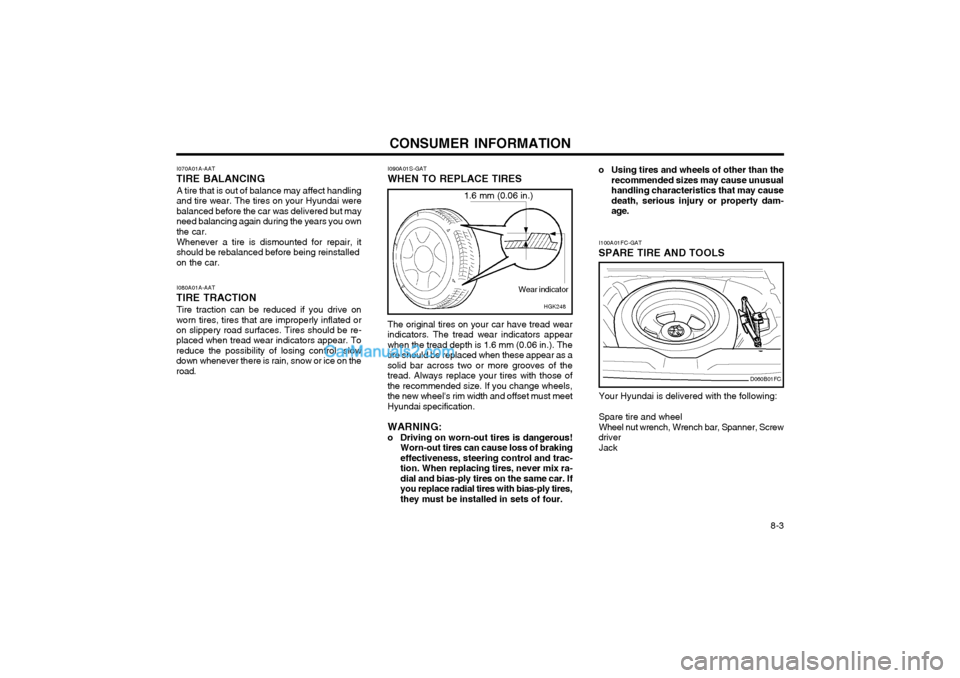
I090A01S-GAT WHEN TO REPLACE TIRES
HGK248
1.6 mm (0.06 in.)
Wear indicator
I070A01A-AAT
TIRE BALANCING
A tire that is out of balance may affect handling and tire wear. The tires on your Hyundai werebalanced before the car was delivered but mayneed balancing again during the years you ownthe car. Whenever a tire is dismounted for repair, it should be rebalanced before being reinstalled on the car. I080A01A-AAT
TIRE TRACTION Tire traction can be reduced if you drive on
worn tires, tires that are improperly inflated or on slippery road surfaces. Tires should be re- placed when tread wear indicators appear. To reduce the possibility of losing control, slowdown whenever there is rain, snow or ice on theroad. The original tires on your car have tread wear
indicators. The tread wear indicators appearwhen the tread depth is 1.6 mm (0.06 in.). Thetire should be replaced when these appear as asolid bar across two or more grooves of thetread. Always replace your tires with those ofthe recommended size. If you change wheels,the new wheel's rim width and offset must meetHyundai specification.
WARNING:
o Driving on worn-out tires is dangerous! Worn-out tires can cause loss of brakingeffectiveness, steering control and trac-tion. When replacing tires, never mix ra-dial and bias-ply tires on the same car. Ifyou replace radial tires with bias-ply tires,they must be installed in sets of four. I100A01FC-GAT
SPARE TIRE AND TOOLS
Your Hyundai is delivered with the following: Spare tire and wheel Wheel nut wrench, Wrench bar, Spanner, Screw
driver Jack
D060B01FC
o Using tires and wheels of other than the recommended sizes may cause unusual handling characteristics that may causedeath, serious injury or property dam-age.
Page 167 of 312

VEHICLE SPECIFICATIONS 9-1
J030A01FC-GAT
TIRE J040A02FC-GAT
ELECTRICAL
ITEM BatteryGenerator
Type Front brake typeRear brake typeParking brake Dual hydraulic with brake boosterVentilated discDrum Cable
J050A01FC-GAT BRAKE
9. VEHICLE SPECIFICATIONS
J010A01FC-GAT
MEASUREMENT
J060A01S-GAT FUEL SYSTEM
J020A01FC-GAT
POWER STEERING Type Wheel free playRack strokeOil pump type Rack and pinion0 ~ 30 mm (0 ~ 1.18 in.)146±1mm (5.7±0.04 in.)Vane type
Front Rear
Fuel tankcapacity Imp.gal
12
US.gal
14.5
Liter
55
Overall lengthOverall widthOverall height (unladen) Wheel base Wheel tread
mm (in.)
4,025(158.4) 1,740(68.5)1,635(64.3)
*1,685(66.3)
2,600(102.3) 1,485 (58.5)1,485 (58.5)
DIESEL
CMF 68 AH 90A (12V)
GASOLINE
MF45AH, MF60AH(12V) 90A (13.5V)
*Installed roof rack
Standard Option
J030B01FC-GAT SPARE TIRE
Temporary Full size
185/65 R14 195/55 R15205/55 R15 (1.8 DOHC only)
StandardOption
9
Page 172 of 312

INDEX10-3
R
Rear Fog Audible Warning Sound
....................................................1-35
Rear Seat Adjustable headrests ..................................................................... 1-11
Adjusting seatback angle .............................................................. 1-11
Adjusting seat forward and rearward ............................................ 1-11
Arm Rest ....................................................................................... 1-43
Fold down ........................................................................... 1-12 ~ 1-13
Rear Window Defroster Switch ......................................................... 1-41
Recommended Shift Poi nts ................................................................ 2-5
Removal of water from the fuel fiter ................................................. 6-22
Replacing Light Bulbs ....................................................................... 6-22
Replacing The Spark Plugs .............................................................. 6-10
Roof R ack ......................................................................................... 1-53
SSeat Belts 2-Point Static Type ............................................................ 1-16 ~ 1-173-Point system ................................................................... 1-15 ~ 1-16
Adjustable height ........................................................................... 1-15
Adjusting your seat belt ................................................................ 1-16
Care of seat belts ......................................................................... 1-14
Precautions ................................................................................... 1-13
Seat Warmer ..................................................................................... 1-13
Spark Plugs ........................................................................... 6-10 ~ 6-11
Spectacle Case ................................................................................. 1-46
Speedometer ..................................................................................... 1-35
Starting Procedures ............................................................................ 2-3Steering Wheel Free play ....................................................................................... 6-17
Tilt lever ........................................................................................ 1-54
Stereo Radio Operation (H210, H220, H260, H280) ............................ 1-64 ~ 1-65, 1-66 ~ 1-67, 1-70 ~ 1-72, 1-77 ~ 1-79
Stereo Sound System ............................................................ 1-62 ~ 1-63
K
Keys .................................................................................................... 1-2
If you lose your keys .................................................................... 3-10
Positions .......................................................................................... 2-2
LLight Bulb Replacement ......................................................... 6-22 ~ 6-23
Lubrication Chart ................................................................................. 9-3
Luggaga Net ..................................................................................... 1-52
M Maintenance Intervals Explanation of scheduled maintenance items ........................ 5-7 ~ 5-8
Maintenance under severe usage conditions ................................. 5-6
Scheduled maintenance ......................................................... 5-3 ~ 5-5
Service requirements ...................................................................... 5-1
Mirros Day-night inside rearview .............................................................. 1-48
Outside rear view .......................................................................... 1-47
Multi Box ........................................................................................... 1-47
O Odometer .......................................................................................... 1-36
Outside Rearview Mirror Heater ....................................................... 1-48
PParking Brake ................................................................................... 1-49
Power Outlet ..................................................................................... 1-50
Power Steering Fluid Level .............................................................. 6-21
Pre-tensioner Seat Belt .......................................................... 1-22 ~ 1-23
Page 202 of 312
1- 21
CONTROLS AND EQUIPMENT
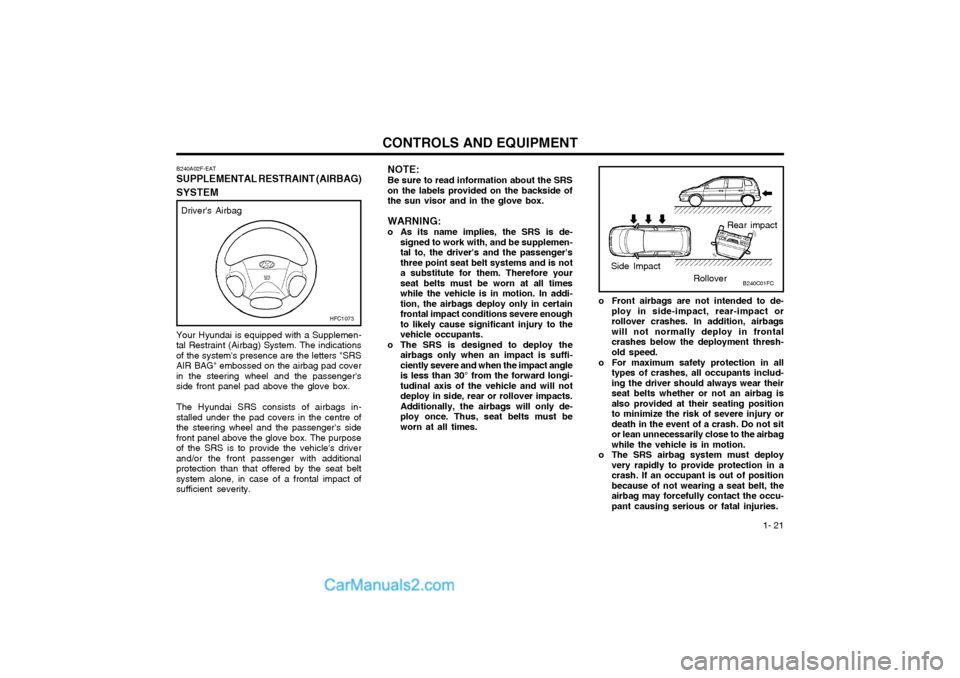
Your Hyundai is equipped with a Supplemen-
tal Restraint (Airbag) System. The indications of the system's presence are the letters "SRSAIR BAG" embossed on the airbag pad coverin the steering wheel and the passenger'sside front panel pad above the glove box.
The Hyundai SRS consists of airbags in-
stalled under the pad covers in the centre ofthe steering wheel and the passenger's sidefront panel above the glove box. The purposeof the SRS is to provide the vehicle's driverand/or the front passenger with additionalprotection than that offered by the seat beltsystem alone, in case of a frontal impact ofsufficient severity. NOTE: Be sure to read information about the SRS on the labels provided on the backside ofthe sun visor and in the glove box. WARNING:
o As its name implies, the SRS is de-
signed to work with, and be supplemen- tal to, the driver's and the passenger'sthree point seat belt systems and is nota substitute for them. Therefore yourseat belts must be worn at all timeswhile the vehicle is in motion. In addi-tion, the airbags deploy only in certainfrontal impact conditions severe enoughto likely cause significant injury to thevehicle occupants.
o The SRS is designed to deploy the airbags only when an impact is suffi-ciently severe and when the impact angleis less than 30° from the forward longi-tudinal axis of the vehicle and will notdeploy in side, rear or rollover impacts.Additionally, the airbags will only de-ploy once. Thus, seat belts must beworn at all times.
Driver's Airbag
B240A02F-EAT
SUPPLEMENTAL RESTRAINT (AIRBAG)
SYSTEM
HFC1073
Rear impact
Side Impact RolloverB240C01FC
o Front airbags are not intended to de-
ploy in side-impact, rear-impact or rollover crashes. In addition, airbagswill not normally deploy in frontalcrashes below the deployment thresh-old speed.
o For maximum safety protection in all types of crashes, all occupants includ-ing the driver should always wear theirseat belts whether or not an airbag isalso provided at their seating positionto minimize the risk of severe injury ordeath in the event of a crash. Do not sitor lean unnecessarily close to the airbagwhile the vehicle is in motion.
o The SRS airbag system must deploy very rapidly to provide protection in acrash. If an occupant is out of positionbecause of not wearing a seat belt, theairbag may forcefully contact the occu-pant causing serious or fatal injuries.