2003 Hyundai Matrix wheel
[x] Cancel search: wheelPage 262 of 312
3-5
IN CASE OF EMERGENCY
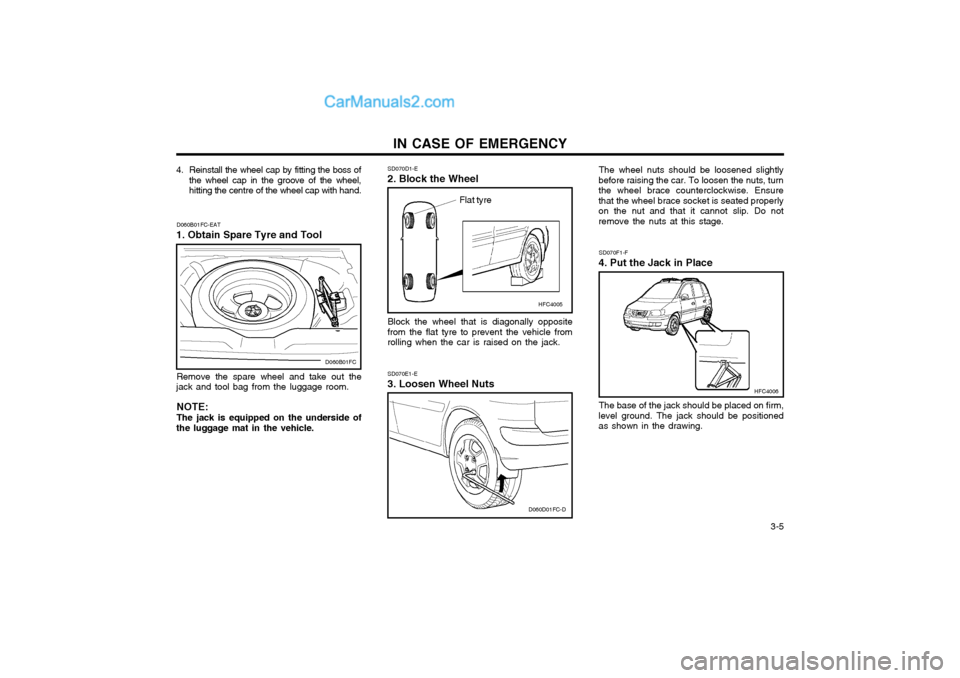
Remove the spare wheel and take out the
jack and tool bag from the luggage room.
NOTE: The jack is equipped on the underside of
the luggage mat in the vehicle. Block the wheel that is diagonally opposite
from the flat tyre to prevent the vehicle from rolling when the car is raised on the jack.
D060B01FC-EAT
1. Obtain Spare Tyre and Tool SD070D1-E
2. Block the Wheel SD070E1-E 3. Loosen Wheel Nuts The wheel nuts should be loosened slightly
before raising the car. To loosen the nuts, turn the wheel brace counterclockwise. Ensurethat the wheel brace socket is seated properlyon the nut and that it cannot slip. Do notremove the nuts at this stage.
SD070F1-F
4. Put the Jack in Place
The base of the jack should be placed on firm,
level ground. The jack should be positionedas shown in the drawing.
4. Reinstall the wheel cap by fitting the boss of
the wheel cap in the groove of the wheel,
hitting the centre of the wheel cap with hand.
Flat tyre
HFC4005
D060D01FC-D
D060B01FC
HFC4006
Page 263 of 312
IN CASE OF EMERGENCY
3-6 WARNING: It is important that the faces of the wheel and hub are clean prior to installing thewheel. The prescence of dirt or other mat-ter in the wheel or hub faces could result inthe wheel nuts becoming loose whilst thevehicle is being driven. SD070I1-E
7. Re-install Wheel Nuts
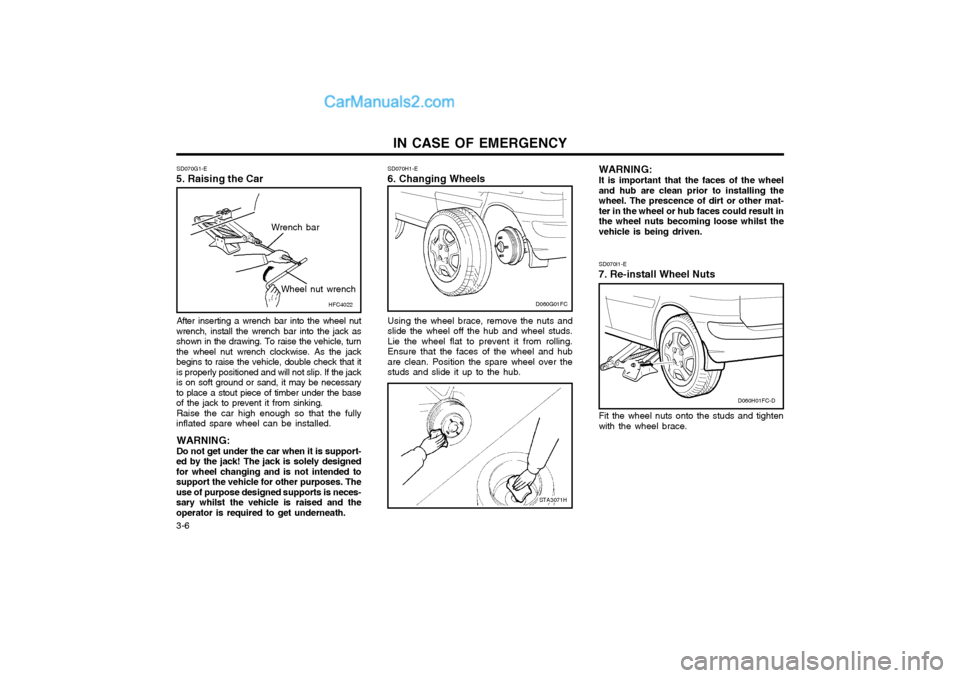
Fit the wheel nuts onto the studs and tighten with the wheel brace.
SD070G1-E
5. Raising the Car SD070H1-E 6. Changing Wheels
After inserting a wrench bar into the wheel nut
wrench, install the wrench bar into the jack as shown in the drawing. To raise the vehicle, turnthe wheel nut wrench clockwise. As the jackbegins to raise the vehicle, double check that itis properly positioned and will not slip. If the jackis on soft ground or sand, it may be necessaryto place a stout piece of timber under the baseof the jack to prevent it from sinking. Raise the car high enough so that the fully
inflated spare wheel can be installed.
WARNING: Do not get under the car when it is support-
ed by the jack! The jack is solely designed for wheel changing and is not intended tosupport the vehicle for other purposes. Theuse of purpose designed supports is neces-sary whilst the vehicle is raised and theoperator is required to get underneath. Using the wheel brace, remove the nuts andslide the wheel off the hub and wheel studs.Lie the wheel flat to prevent it from rolling.Ensure that the faces of the wheel and hubare clean. Position the spare wheel over thestuds and slide it up to the hub.
STA3071H
D060H01FC-D
D060G01FCHFC4022
Wrench bar
Wheel nut wrench
Page 264 of 312
3-7
IN CASE OF EMERGENCY
SD070J1-E
8. Lower Vehicle and Tighten Nuts
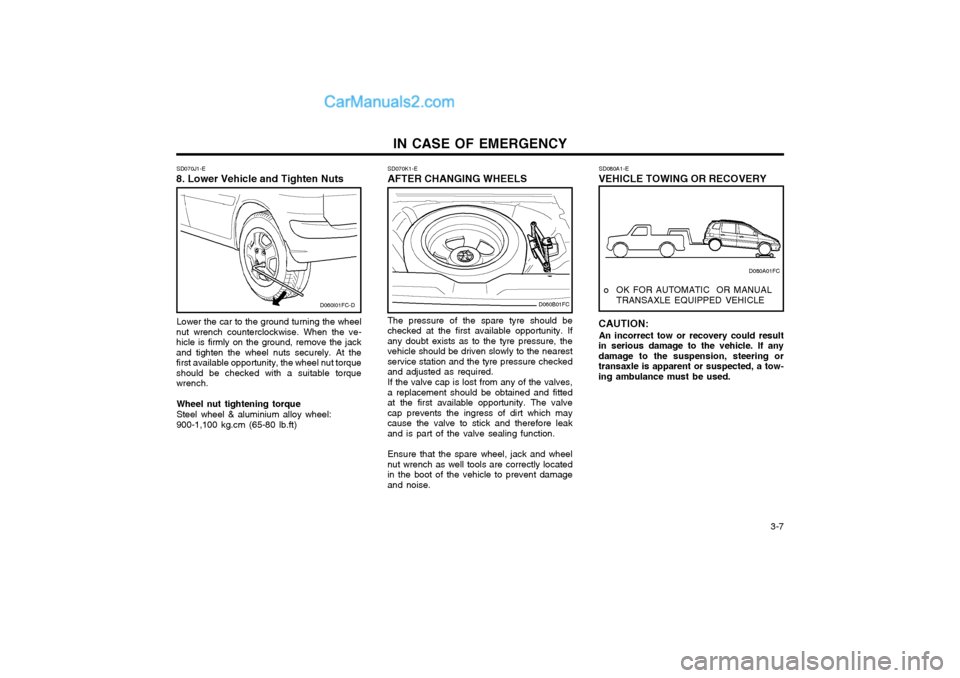
Lower the car to the ground turning the wheel
nut wrench counterclockwise. When the ve- hicle is firmly on the ground, remove the jackand tighten the wheel nuts securely. At thefirst available opportunity, the wheel nut torqueshould be checked with a suitable torquewrench.
Wheel nut tightening torque Steel wheel & aluminium alloy wheel:900-1,100 kg.cm (65-80 lb.ft) SD070K1-E AFTER CHANGING WHEELS
SD080A1-E
VEHICLE TOWING OR RECOVERY
The pressure of the spare tyre should be checked at the first available opportunity. Ifany doubt exists as to the tyre pressure, thevehicle should be driven slowly to the nearestservice station and the tyre pressure checkedand adjusted as required. If the valve cap is lost from any of the valves, a replacement should be obtained and fittedat the first available opportunity. The valvecap prevents the ingress of dirt which maycause the valve to stick and therefore leakand is part of the valve sealing function. Ensure that the spare wheel, jack and wheel nut wrench as well tools are correctly locatedin the boot of the vehicle to prevent damageand noise. CAUTION:
An incorrect tow or recovery could result
in serious damage to the vehicle. If anydamage to the suspension, steering ortransaxle is apparent or suspected, a tow-ing ambulance must be used.
D060I01FC-DD060B01FC
o OK FOR AUTOMATIC OR MANUAL
TRANSAXLE EQUIPPED VEHICLE D080A01FC
Page 265 of 312

IN CASE OF EMERGENCY
3-8 The vehicle may be towed by the conven-
tional method using the towing eye at the front of the vehicle as an attachment point. Inaddition, a suspended tow with or without anambulance may be used with either the frontor the rear wheels being suspended, providedthe above caution is observed. In addition, the following points must be noted:
o If towing by conventional means, the ignition key must be at the "ACC" posi- tion, otherwise the steering lock will beactivated.
o Because the brake system and steering system power assistance is derived fromthe engine, the amount of effort re-quired to stop or steer the vehicle willbe greater than normal. o If a suspended tow is being given to the
rear, the ignition key must be at the"ACC" position since the steering lockis not designed to withstand the forcerequired to hold the front wheels straightduring the tow.
o The vehicle must not be towed with the front wheels on the ground for morethan thirty miles.
o OK FOR AUTOMATIC OR MANUAL
TRANSAXLE EQUIPPED VEHICLE
SD100A2-E
Automatic Transaxle Vehicle
o NOT OK FOR AUTOMATIC TRANSAXLE EQUIPPED VEHICLE
o OK FOR MANUAL TRANSAXLE
The vehicle may be towed by the conven- tional method using the towing eye at the frontof the vehicle as an attachment point. In addition, a suspended tow may be given to the front of the vehicle without an ambulance.In the event of a suspended tow being givento the rear of the vehicle, the use of anambulance is imperative. D120A01A-EAT
IF YOU LOSE YOUR KEYS
Information about the key of immobilizer sys-tem will be found on page 1-2.
CAUTION: The following restriction must be observed in order to avoid serious damage to thetransaxle . The vehicle must never be towed from the rear with the front wheels on the ground. The vehicle must not be towed until transaxle fluid has been added to bringthe level up to the "HOT" marking on thedipstick. (The level will need to be reducedagain after towing). The vehicle must not be towed at speeds faster than 25 mph. or distances greaterthan fifty miles. The general points regard-ing the steering lock etc. described in thepreceding section (Manual transaxle ve-hicle) should be observed.
SD090A1-E
Manual Transaxle Vehicle
o OK FOR AUTOMATIC OR MANUAL TRANSAXLE EQUIPPED VEHICLE WITH NO DAMAGE
D080C01FC
D080B01FC
D080C02FC
Page 266 of 312
APPEARANCE CARE 4-1
retreatment programme must be observed in accordance with the Terms and Conditionsoutlined in the separate Anti Perforation War-ranty Booklet.
NOTE: The underbody should never be steam
cleaned since the underbody coating may be removed by this process.
During the interim period between power
washing the underbody, the more vulnera-ble areas such as wheel arches should behosed off particularly during the winter sea-son to prevent prolonged contact with roadsalts. Ensure that the various drain points located
at the bottom of the door panels and sillsare kept clear to prevent water from becom-ing trapped within the cavities. Whereverpossible, the parking of the vehicle in aconfined, poorly ventilated location (a ga-rage for example) should be avoided whenthe vehicle is wet or is covered with snow orice. Under these conditions, the internalcavities of the vehicle will remain damp forprolonged periods of time which will en-courage corrosion. Parking the vehicle wheregood ventilation exists (outside for example)is preferable. SE040A1-E VALETINGRegular cleaning of the exterior paintwork serves two important functions. Firstly, the removal ofabrasive dirt and contaminants will maintain thelustre of the paintwork and will preventdiscolouration and dulling due to prolonged con-tact.Secondly, the presence of damage through im-pact or abrasion will be apparent allowing earlyrectification to be made thus preventing corro-sion from becoming established and spreadingbeneath the paint film. To avoid "water spotting"the vehicle should not be washed in direct sun-light particularly in the case of vehicles havingdark body colours. The heat from the sun rays isabsorbed by the paint film increasing the surfacetemperature. This action causes water used forwashing to evaporate quickly leaving behind thedeposits from the water and the shampoo used.Use only a shampoo intended for the purposeand ensure that the body work is thoroughlywetted to soften the dirt film prior to attempting toremove this.After removing the dirt film with a soft sponge, thebody work should be thoroughly rinsed and thendried with a good quality chamois leather toprevent streaking or spotting of the paint work.Household detergents, solvents and abrasivecleaning materials should not be used in order toavoid damaging the paint film.
SE030A1-E UNDERBODY COATINGSEvery Hyundai passenger car receives a full
underbody and cavity injection treatment during production. In order that this treatment mayretain maximum effectiveness it is recommend-ed that the underbody receives a power washand a thorough inspection after each winterseason. In so doing any accumulations of mud,which act as moisture traps and combine withroad salts to accelerate corrosion will be re-moved. In order to maintain the Anti PerforationWarranty, the requirements regarding the
SE000A1-E
4. APPEARANCE
CARE
SE020A1-E PROTECTING YOUR HYUNDAI FROM CORROSION By using the most advanced design and con- struction practices, every Hyundai is built toretain the original factory finish for many years.However, long term durability is also greatlydependant upon maintaining the various protec-tion systems and coatings used in manufacturesince constant, exposure to the elements will result in a breakdown and loss of effectiveness. The following suggestions are made to assist inthe maintenance of the vehicle bodywork.
4
Page 267 of 312
APPEARANCE CARE
4-2
Plastic wheel covers should be cleaned using a sponge and water. Cast alloy wheels shouldbe cleaned using a mild soap or neutral deter-gent. Abrasive compounds must not be usedsince in the event of these damaging the lac-quer coating, oxidization of the aluminium wheelwill occur, spoiling the appearance.The use of an a toothbrush will facilitate cleaningbetween the wheel "spokes".
ensure that accidental spillages are immediatelyflushed with water.Do not use abrasive cleaning materials whichmay damage the bumpers.Avoid subjecting the bumpers to high tempera-tures such as may be encountered in high bakepaint ovens.
SE040B1-E STAIN/SPOT REMOVALShould tree sap, dead insects or tar prove to be difficult to remove from the paint film, turpentineor a proprietary paint cutting compound may beused. Ensure that the area to be cleaned is notrubbed intensively to prevent breaking throughthe colour coat and exposing the under coat. SE040C1-E POLISHINGThe exterior paint work should be polished with a proprietary wax polish when water no longercollects in bead form on the paint work. Theinstructions of the product manufacturer shouldbe adhered to. SE040E1-E BUMPER MAINTENANCE The special material from which the bumpers are manufactured warrants special attention to pre-serve the appearance of the bumpers. Avoidcontact with battery electrolyte or brake fluid and SE040F1-E ACCIDENT REPAIRS In the event of the body work sustaining damage, the following points should be noted prior torepairs being undertaken.If body panels are replaced or repaired, anticorrosion treatment must be applied to the repairarea. The product used must be compatible withthose used in manufacture. It is recommendedthat repairs are entrusted to a Hyundai dealer toensure that replacement parts used are of thesame high quality as those used in manufactureof the vehicle and that the correct repair methodsand materials will ensure adequate levels ofcorrosion protection and the continued validity ofthe Anti Perforation Warranty. SE050A1-E INTERIOR During the winter period, it is possible that the passenger compartment flooring may becomewet from damp footwear or quantities of snowadhering to footwear. The carpet should not beallowed to remain in this condition since thecarpet may begin to create musty smells and will
SE050D1-E SEAT BELTSSeat belts should be cleaned only with a mild soap solution. Strong detergents, solvens orbleaches may damage the belt webbing andtherefore reduce the effectiveness of the belt.Belts which display signs of fraying, wear of cutshould be replaced. SE050E1-E WINDOWS A proprietary glass cleaner should be used to clean the inside of the windows. However, therear heated windshield must only be cleanedusing a light horizontal cleaning action. Careshould be exercised to avoid the use of abrasivecleaners or contact with items of jewellery whichmay damage the heating elements.
promote corrosion of the floor pan in addition tothe carpet and under felt beginning to rot. SE050C1-E INTERIOR VALETINGThe soft trim and carpets should be maintained with the regular use of a vacuum cleaner. Heavysoiling should be removed with a dry cleaningagent recommended for this purpose followingthe instructions of the product manufacturer.Paint thinner, solvents or other such cleaningmaterials should not be used since damage tothe upholstery may result.
Page 271 of 312

VEHICLE MAINTENANCE REQUIREMENTS
5- 4 F030C01E-EAT
R : REPLACE I : INSPECT AND, AFTER INSPECTION, CLEAN, ADJUST, REPAIR OR REPLACE IF NECESSARY
GENERAL MAINTENANCE COOLING SYSTEMCOOLANT GASOLINE ENGINEDIESEL ENGINE
ENGINE COOLANT SPECIFIC GRAVITYMANUAL TRANSAXLE OILAUTOMATIC TRANSAXLE FLUIDBRAKE PIPES, HOSES, AND CONNECTIONSBRAKE FLUIDCLUTCH FLUIDREAR BRAKE LININGS AND CYLINDERSBRAKE PADSSUSPENSION AND STEERING SYSTEMFRONT SUSPENSION BALL JOINTSPOLLEN FILTER (IN FRONT OF BLOWER UNIT)REAR WHEEL BEARINGSTYRE CONDITION AND PRESSURE (incl. Spare)LUBRICATE LOCKS AND HINGESCHECK ALL ELECTRICAL SYSTEMSROAD TESTCHECK ALL SYSTEMS WITH HI-SCAN
60 72
50 60
4048
I
R R
I I
R I
R R I I II
R
IIIII I
I I IIII I I I I
R I III I I
I
R IIII
R R I I I I
R I III I I
30 36
2024
I
R
I IIII I I II
R IIIIII
I
R IIII
R R I I I I
R I III I I
10 12
I I IIII I I I I
R I III I I
MILES X 1,000 MONTHS
NO. DESCRIPTION
1 2 3 456789
10111213141516171819
Page 275 of 312

VEHICLE MAINTENANCE REQUIREMENTS
5- 8 6ZF070P1-A
o Driveshafts and boots Check the drive shafts, boots and clamps for cracks, deterioration, or damage. Replaceany damaged parts and, if necessary, repackthe grease. 6ZF070Q1-A
o Air conditioning refrigerant Check the air conditioning lines and connec- tions for leakage and damage. Check airconditioning performance according to therelevant shop manual if necessary.
6ZF070L1-A
o Suspension mounting bolts Check the suspension connections for loose-
ness or damage. Retighten to the specifiedtorque. 6ZF070M1-A
o Steering gear box, linkage & boots/
lower arm ball joint
With the vehicle stopped and engine off, check for excessive freeplay in the steering wheel. Check the linkage for bends or damage. Check the dust boots and ball joints for dete-rioration, cracks, or damage. Replace anydamaged parts. 6ZF070N1-A
o Power steering pump, belt and hoses Check the power steering pump and hoses for leakage and damage. Replace any dam-aged or leaking parts immediately. Inspect thepower steering belt for evidence of cuts,cracks, excessive wear, oiliness and propertension. Replace or adjust it if necessary.