Page 342 of 392
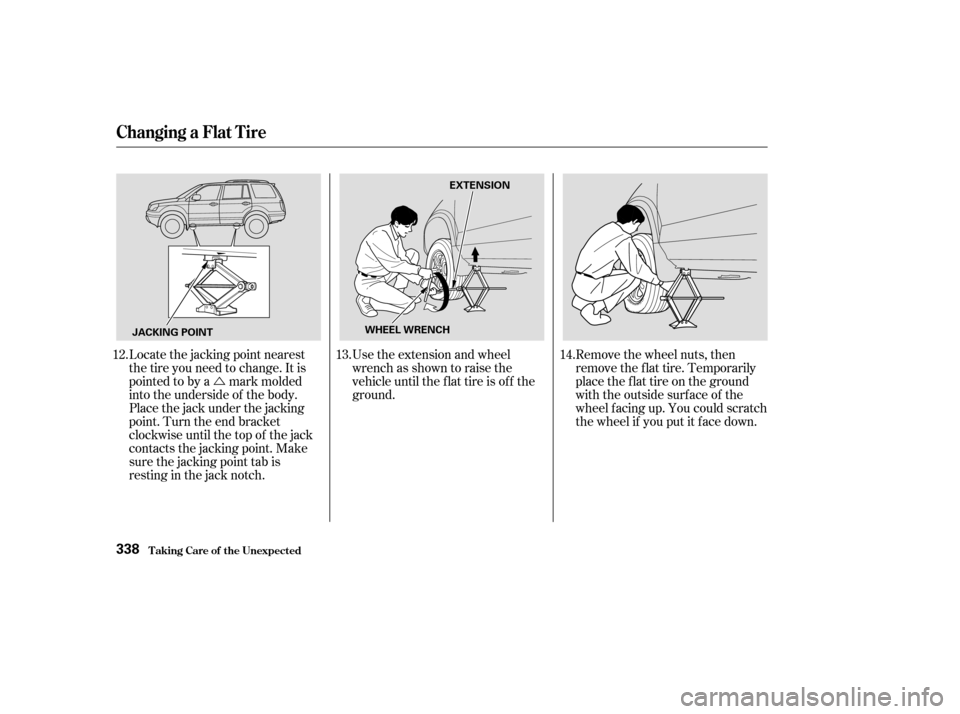
�ÚUse the extension and wheel
wrench as shown to raise the
vehicle until the f lat tire is of f the
ground. Remove the wheel nuts, then
remove the f lat tire. Temporarily
place the f lat tire on the ground
with the outside surface of the
wheel f acing up. You could scratch
the wheel if you put it f ace down.
Locate the jacking point nearest
thetireyouneedtochange.Itis
pointed to by a mark molded
into the underside of the body.
Place the jack under the jacking
point. Turn the end bracket
clockwise until the top of the jack
contacts the jacking point. Make
sure the jacking point tab is
restinginthejacknotch.
12.
13. 14.
Changing a Flat T ire
T aking Care of t he Unexpect ed338
JACKING POINT WHEEL WRENCHEXTENSION
Page 343 of 392
CONT INUED
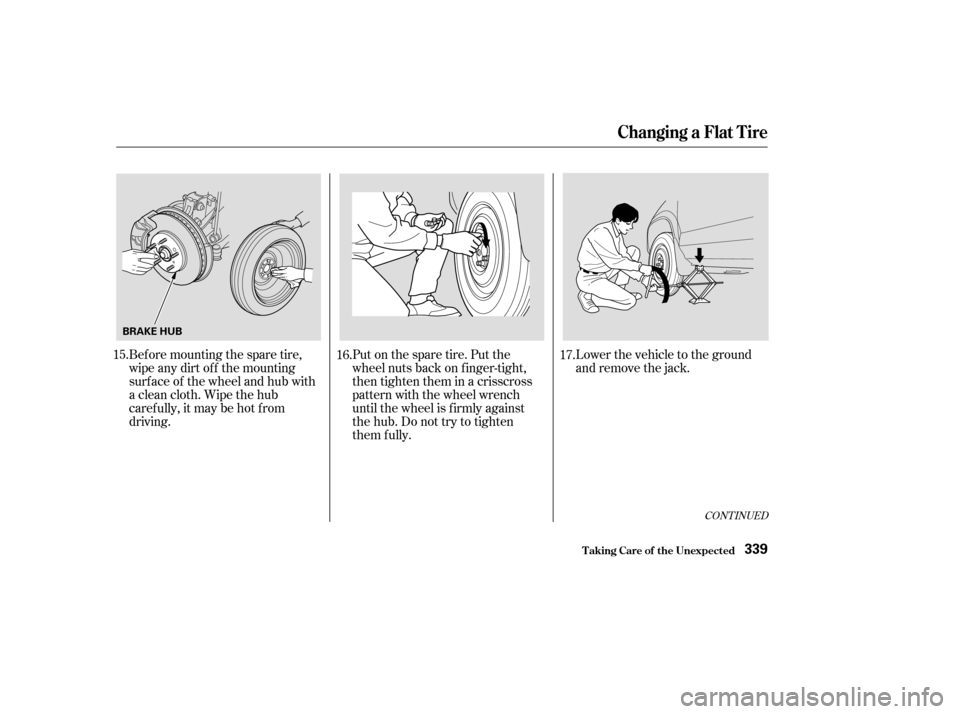
Bef ore mounting the spare tire,
wipeanydirtoff themounting
surface of the wheel and hub with
a clean cloth. Wipe the hub
carefully,itmaybehotfrom
driving.Put on the spare tire. Put the
wheel nuts back on f inger-tight,
then tighten them in a crisscross
pattern with the wheel wrench
until the wheel is f irmly against
the hub. Do not try to tighten
them f ully.Lower the vehicle to the ground
and remove the jack.
15.
16.17.
Changing a Flat T ire
T aking Care of t he Unexpect ed339
BRAKE HUB
Page 344 of 392
Tighten the wheel nuts securely in
the same crisscross pattern. Have
the wheel nut torque checked at
the nearest automotive service
f acility.
Tighten the wheel nuts to:
Remove the center cap from the
flat tire.Place the f lat tire f ace up under
the hoist.
Slowly turn the wheel wrench
clockwisetotakeuptheslackof
the hoist cable. Make sure the
bracketisseatedinthecenter
hole of the spare tire.
Turn the wheel wrench clockwise
until the f lat tire rests against the
underbody of the vehicle and you
hear the hoist click.
Insert the hoist bracket into the
center hole of the f lat tire.
18.
19. 20.
21.
22.
23.
Changing a Flat T ire
T aking Care of t he Unexpect ed340
80 lbf·ft (108 N·m , 11 kgf·m)
Page 345 of 392
Store the jack in its holder. Turn
the jack’s end bracket to lock it in
place. Store the tools, and install
the cover.
24.
Changing a Flat T ire
T aking Care of t he Unexpect ed341
Loose items can fly around the
interior in a crash and could
seriously injure the occupants.
Store the wheel, jack, and tools
securely before driving.
Always raise the spare tire hoist, even
if you are not stowing a tire. If the
hoist is lef t down, it will be damaged
during driving and need to be replaced.
Page 355 of 392
However, if the brake pedal does not
f eel normal, you should take
immediate action. Because of the
brake system’s dual-circuit design, a
problem in one part of the system
will still give you braking at two
wheels. You will f eel the brake pedal
go down much f arther bef ore the
vehicle begins to slow down, and you
will have to press harder on the
pedal. The distance needed to stop
will be much longer. If it comes on at any other time, it
indicates a problem with the vehicle’s
brake system. In most cases, the
problem is a low f luid level in the
brake f luid reservoir. Press lightly on
the brake pedal to see if it f eels
normal. If it does, check the brake
f luid level the next time you stop at a
service station (see page ). If the
f luid level is low, take the vehicle to
your dealer and have the brake
system inspected f or leaks or worn
brake pads.Slow down by shif ting to a lower
gear, and pull to the side of the road
when it is saf e. Because of the
longer distance needed to stop, it is
hazardous to drive the vehicle. You
should have it towed, and repaired as
soon as possible. (See
on page .)
If you must drive the vehicle a short
distance in this condition, drive
slowly and cautiously.
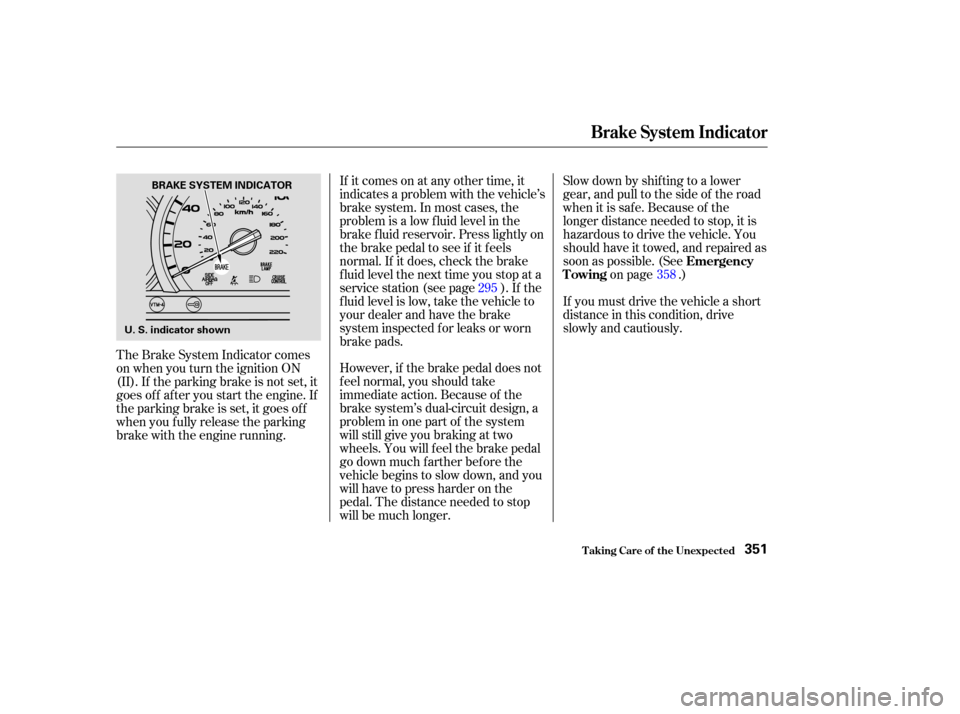
The Brake System Indicator comes
on when you turn the ignition ON
(II). If the parking brake is not set, it
goes of f af ter you start the engine. If
the parking brake is set, it goes of f
when you f ully release the parking
brake with the engine running. 295
358Emergency
Towing
Brake System Indicator
T aking Care of t he Unexpect ed351
BRAKE SYSTEM INDICATOR
U. S. indicator shown
Page 362 of 392

�µ�µ
�µ
If your vehicle needs to be towed,
call a prof essional towing service or,
if youbelongtoone,anorganization
that provides roadside assistance.
Never tow your vehicle behind
another vehicle with just a rope or
chain. It is very dangerous.
There are three popular types of
prof essional towing equipment.
The operator
loads your vehicle on the back of a
truck. Any other
method of towing will damage the
drive system. When you contact the
towing agency, inf orm them that a
f lat-bed is required. The tow
truck uses two pivoting arms that go
under the tires (f ront or rear) and lif t
them of f the ground. The other two
tires remain on the ground. Refer to
on page
for non-emergency towing
inf ormation.
The tow
truck uses metal cables with hooks
on the ends. These hooks go around
parts of the f rame or suspension and
cables lif t that end of the vehicle of f
the ground. Your vehicle’s
suspension and body can be
seriously damaged. 259Flat -bed Equipment
Wheel L if t Equipment
Sling-t ype Equipment
T his is the only way to
transport your vehicle. Never tow your vehicle with
wheel lif t equipment. Towing Your Vehicle
Behind a Motorhome
T his method of
towing your Pilot is unacceptable.
Emergency T owing
T aking Care of t he Unexpect ed358
Towing a Pilot with only two tires on
the ground will damage parts of the
4WD system. It should be transported
on a f lat-bed truck or trailer.
Page 366 of 392

�Î�Î
�Î
�Î
�µ�µ �Î �Î
�Î
�Î
Specif ications
T echnical Inf ormation362
Capacities
Dimensions
Weights
Air Conditioning Fuel tank
Engine
coolant
Engine oil
Automatic
transmission
fluid
Rear
differential
fluid
Windshield
washer
reservoir
1.74 US gal (6.6
, 1.45 Imp gal)
2.25 US gal (8.5, 1.87 Imp gal)
5.1 US qt (4.8
, 4.2 Imp qt)
4.5 US qt (4.3
, 3.8 Imp qt)
5.8 US qt (5.5
, 4.8 Imp qt)
3.2 US qt (3.0, 2.6 Imp qt)
8.2 US qt (7.8, 6.9 Imp qt)
Including the coolant in the reserve tank and that remaining in the
engine.
Reserve tank capacity:
0.16 US gal (0.6
, 0.13 Imp gal)
Excluding the oil remaining in the engine. 19.3 US gal (73
, 16.1 Imp gal)
2.79 US qt (2.64
,2.32Impqt)
188.0 in (4,775 mm)
76.3 in (1,938 mm)
70.6 in (1,793 mm)
4.8 US qt (4.5
, 4.0 Imp qt)
66.3 in (1,685 mm)
66.5 in (1,690 mm)
Length
Width
Height
Wheelbase
Track
Gross vehicle weight rating
Gross combined weight
rating (GCWR)
See the tire information label atta-
ched to the driver’s doorjamb.
9,700 lbs (4,400 kg)
Refrigerant type
Charge quantity
Lubricant type HFC-134a (R-134a)
24.7 26.5 oz (700 750 g) ND-OIL8
106.3 in (2,700 mm)
Approx.
Front
Rear
1:
2:
Equipped with transmission fluid cooler and power steering fluid
cooler. Change
Total
Change
Including
filter
Without
filter
Total
Change
Total
Change
The GCWR must be reduced 2 percent for every 1,000 feet (305
meters) of elevation.
1:
2:
2 1
2
1
Page 369 of 392

�µ
The temperature grades are A (the
highest), B, and C, representing the
tire’s resistance to the generation of
heat and its ability to dissipate heat
when tested under controlled
conditions on a specif ied indoor
laboratory test wheel. Sustained high
temperature can cause the material
of the tire to degenerate and reduce
tire life, and excessive temperature
can lead to sudden tire f ailure. The
grade C corresponds to a level of
perf ormance which all passenger car
tires must meet under the Federal
Motor Vehicle Saf ety Standard No.
109. Grades B and A represent
higher levels of perf ormance on the
laboratory test wheel than the
minimum required by law. Warning: The temperature grade f or
this tire is established f or a tire that
is properly inf lated and not over-
loaded. Excessive speed, underinf la-
tion, or excessive loading, either
separately or in combination, can
cause heat buildup and possible tire
f ailure.
DOT T ire Quality Grading (U.S. Vehicles)
T echnical Inf ormation
Temperature A,B,C
365