Page 265 of 392
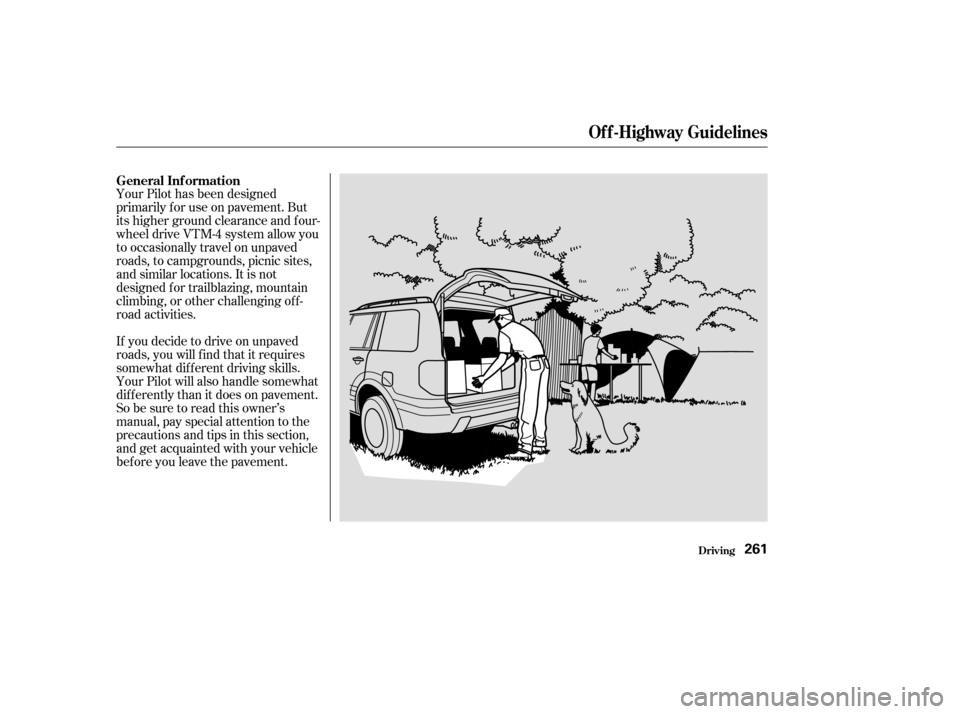
Your Pilot has been designed
primarily f or use on pavement. But
its higher ground clearance and f our-
wheel drive VTM-4 system allow you
to occasionally travel on unpaved
roads, to campgrounds, picnic sites,
and similar locations. It is not
designed f or trailblazing, mountain
climbing, or other challenging of f -
road activities.
If you decide to drive on unpaved
roads, you will f ind that it requires
somewhat dif f erent driving skills.
Your Pilot will also handle somewhat
dif f erently than it does on pavement.
So be sure to read this owner’s
manual, pay special attention to the
precautions and tips in this section,
and get acquainted with your vehicle
before you leave the pavement. General Inf ormation
Off-Highway Guidelines
Driving261
Page 268 of 392

Test your brakes from time to time
to make sure they are operating
properly. This will also give you a
f eel f or how much traction you have
on a given surf ace.
Off-highway, the basic turning
technique is to drive at low speed
and gradually adjust the amount of
steering to suit the surf ace.
You should have no problem making
sharp turns at low speed on level
ground. But never make an abrupt
turn at higher speeds, on or of f
pavement. With a higher center of
gravity, your vehicle can more easily
tip or roll over.Bef ore driving up or down a hill, stop
and assess the situation. If you can’t
clearly see all road conditions (good
traction, no bumps, holes or other
obstacles, a safe way out, etc.) walk
the slope bef ore you drive on it. If
you have any doubt about whether
you can saf ely drive on the slope,
. Find another route.
If you are driving up a hill and f ind
that you cannot continue (because of
the steepness, a large obstacle, etc.), . Your vehicle
could roll over. Slowly back down the
hill, f ollowing the same route you
took up the hill. Bumps, holes, rocks, and other
obstacles can be hazardous. Debris
in the road can damage your
suspension or other components.
Even small rocks can cut your tires.
More important, because your
vehicle has a high center of gravity,
driving over a large obstacle, or
allowing a wheel to drop into a deep
hole, can cause your vehicle to tip or
roll over.
Drive slow enough to observe
obstacles ahead and maneuver
around them. If you can’t avoid a
serious obstacle, turn around and
look f or a better route.
don’t do it
do not try to turn around
T urning
Avoiding Obstacles
Driving on Slopes
Off-Highway Guidelines
Driving264
Page 269 of 392
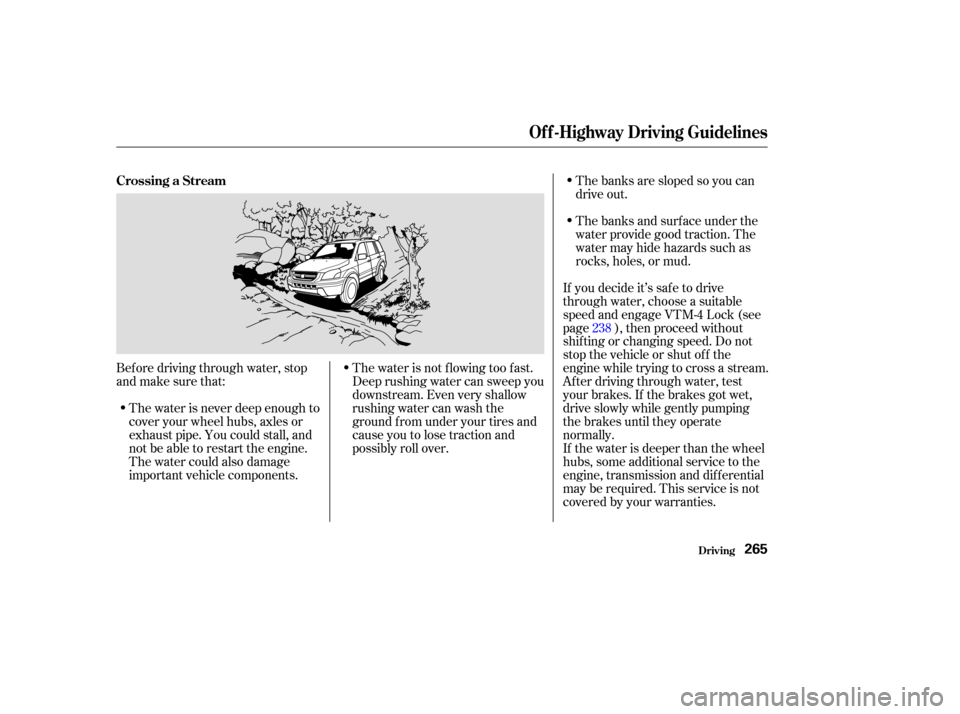
Bef ore driving through water, stop
and make sure that:The water is never deep enough to
cover your wheel hubs, axles or
exhaust pipe. You could stall, and
not be able to restart the engine.
The water could also damage
important vehicle components. The water is not f lowing too f ast.
Deep rushing water can sweep you
downstream. Even very shallow
rushingwatercanwashthe
ground f rom under your tires and
cause you to lose traction and
possibly roll over.The banks are sloped so you can
drive out.
The banks and surf ace under the
water provide good traction. The
water may hide hazards such as
rocks, holes, or mud.
If you decide it’s saf e to drive
through water, choose a suitable
speed and engage VTM-4 Lock (see
page ), then proceed without
shif ting or changing speed. Do not
stop the vehicle or shut of f the
engine while trying to cross a stream.
After driving through water, test
your brakes. If the brakes got wet,
drive slowly while gently pumping
the brakes until they operate
normally.
If the water is deeper than the wheel
hubs, some additional service to the
engine, transmission and dif f erential
mayberequired.Thisserviceisnot
covered by your warranties. 238
Crossing a Stream
Of f -Highway Driving Guidelines
Driving265
Page 273 of 392

This section explains the importance
of keeping your vehicle well
maintained and why you should
f ollow basic maintenance saf ety
precautions.
This section also includes
Maintenance Schedules f or normal
driving and severe driving conditions,
a Maintenance Record, and instruc-
tions f or simple maintenance tasks
you may want to take care of
yourself .
If you have the skills and tools to per-
f orm more complex maintenance
tasks on your Honda, you may want
to purchase the Service Manual. See
page f or inf ormation on how to
obtain a copy, or see your Honda
dealer.......................
Maintenance Saf ety .270
.
Important Safety Precautions . 271
.................
Maintenance Schedule . 272
...
Required Maintenance Record . 279
.......
Owner Maintenance Checks . 281
..............................
Fluid Locations .282
......................................
Engine Oil .283
..................................
Adding Oil .283
....................
Recommended Oil .283
..............................
Synthetic Oil .284
....................................
Additives .284
.....
Changing the Oil and Filter . 285
.............................
Cooling System .287
............
Adding Engine Coolant . 287
.......
Replacing Engine Coolant . 289
....................
Windshield Washers .292
....
Automatic Transmission Fluid . 293
..........................
Dif f erential Fluid .294
....................................
Brake Fluid .295
............................
Brake System .295
..............................
Power Steering .296
.....................
Air Cleaner Element .297
....................................
Hood Latch .298
....................................
Spark Plugs .299
..............................
Replacement .299
............................
Specif ications .301 ...........................................
Battery .302
.................................
Wiper Blades .304
..............
Air Conditioning System . 306
..................
Dust and Pollen Filter . 307
.....................................
Drive Belts .307
....................................
Timing Belt .308
...............................................
Tires .308
......................................
Inf lation .308
..................................
Inspection .310
..............................
Maintenance .311
.............................
Tire Rotation .311
...
Replacing Tires and Wheels . 312
......................
Wheels and Tires .313
..........................
Winter Driving .313
.............................
Snow Tires .314
............................
Tire Chains .314
.............................................
Lights .315
.....................
Headlight Aiming .317
........................
Replacing Bulbs .317
....................
Storing Your Vehicle .324
377
Maintenance
Maint enance269
Page 300 of 392
Always use Honda Power Steering
Fluid. If it is not available, you may
use another power steering f luid as
an emergency replacement.
However, continued use can cause
increased wear and poor steering in
cold weather. Have the power
steering system f lushed and ref illed
with Honda PSF as soon as possible.
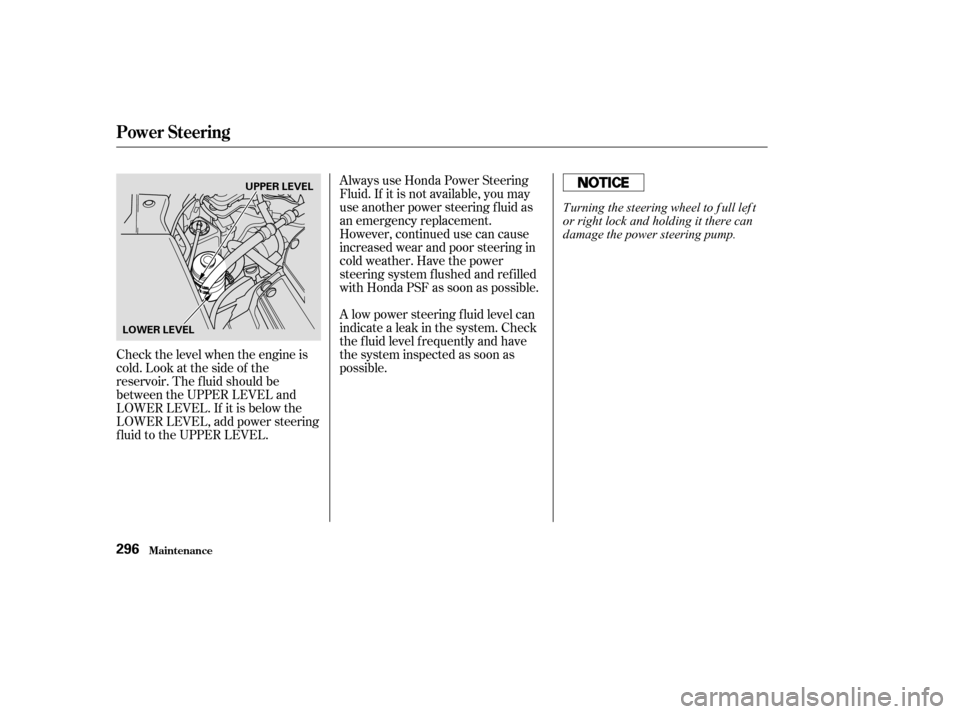
Check the level when the engine is
cold. Look at the side of the
reservoir. The f luid should be
between the UPPER LEVEL and
LOWER LEVEL. If it is below the
LOWER LEVEL, add power steering
f luid to the UPPER LEVEL. A low power steering f luid level can
indicate a leak in the system. Check
the f luid level f requently and have
the system inspected as soon as
possible.
Power Steering
Maint enance296
LOWER LEVELUPPER LEVEL
T urning the steering wheel to f ull lef t
or right lock and holding it there can
damage the power steering pump.
Page 315 of 392

To help increase tire lif e and
distribute wear more evenly, you
should have the tires rotated every
7,500 miles (12,000 km). Move the
tires to the positions shown in the
chart each time they are rotated.
Make sure the installer balances the
wheels when you have new tires
installed. This increases riding
comf ort and tire lif e. Your vehicle’s
original tires were dynamic or ‘‘spin’’
balanced at the f actory. For best
results, have the installer perf orm a
dynamic balance.
In addition to proper inf lation,
correct wheel alignment helps to
decrease tire wear. If you f ind a tire
is worn unevenly, have your dealer
check the wheel alignment.
The tires were properly balanced by
the factory. They may need to be
rebalanced at some time bef ore they
are worn out. Have your dealer
check the tires if you f eel a consis-
tent vibration while driving. A tire
should always be rebalanced if it is
removed f rom the wheel f or repair.
CONT INUED
Tire Rotation
Maintenance
Tires
Maint enance311
Front Front
(For Non-directional
Tires and Wheels) (For Directional
Tires and Wheels)
Improper wheel weights can damage
your vehicle’s aluminum wheels. Use
only genuine Honda wheel weights f or
balancing.
Page 316 of 392

It is best to replace all f our tires at
thesametime.If thatisnotpossible
or necessary, then replace the two
f ront tires or the two rear tires as a
pair. Replacing just one tire can
seriously af f ect your vehicle’s han-
dling.
When shopping f or replacement
tires, you may find that some tires
are ‘‘directional.’’ This means they
are designed to rotate only in one
direction. If you use directional tires,
they should be rotated only front-to-
back.
The tires that came with your
vehicle were selected to match the
perf ormance capabilities of the
vehicle while providing the best
combination of handling, ride
comfort,andlonglife.Youshould
replace them with radial tires of the
same size, load range, speed rating,
and maximum cold tire pressure
rating (as shown on the tire’s
sidewall). Mixing radial and bias-ply
tires on your vehicle can reduce its
braking ability, traction, and steering
accuracy. Replacing T ires and Wheels
Tires
Maint enance312
Installing improper tires on your
vehicle can affect handling and
stability. This can cause a crash
in which you can be seriously
hurt or killed.
Always use the size and type of
tires recommended in this
owner’s manual.
Page 317 of 392

�´
Tires that are marked ‘‘M S’’ or
‘‘All Season’’ on the sidewall have an
all-weather tread design. They
should be suitable f or most winter
driving conditions. Tires without
these markings are designed f or
optimum traction in dry conditions.
They may not provide adequate
perf ormance in winter driving.
For the best perf ormance in snowy
or icy conditions, you should install
snow tires or tire chains. They may
be required by local laws under
certain conditions.
TheABSworksbycomparingthe
speed of the wheels. When replacing
tires, use the same size originally
supplied with the vehicle. Tire size
and construction can affect wheel
speed and may cause the system to
work inconsistently.
Wheel:
Tire:
See page f or inf ormation about
DOT Tire Quality Grading.
If you ever need to replace a wheel,
make sure the wheel’s specif ications
match those of the original wheel
that came on your vehicle. Re-
placement wheels are available at
your Honda dealer. 364
CONT INUED
Winter Driving
Wheels and T ires
Tires
Maint enance313
16x61/2JJ
P235/70R16 104S