Page 339 of 415
Pull the bulb straight out of its
socket.
Push the new bulb straight into
the socket until it bottoms.
Insert the socket back into the
light assembly. Turn it clockwise
to lock it in place.
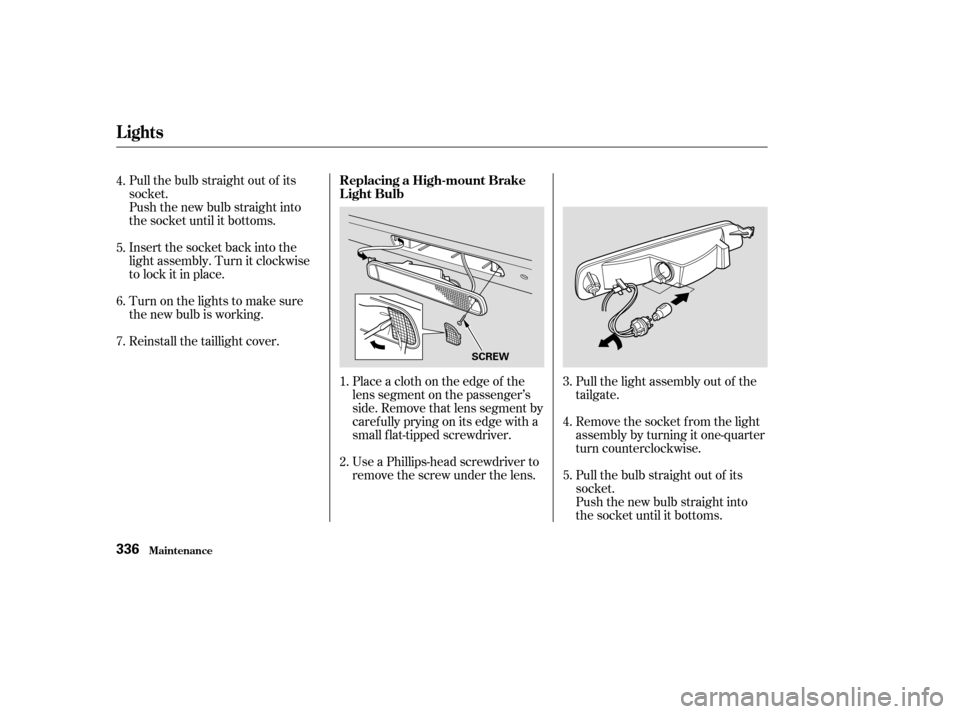
Reinstall the taillight cover.Pull the light assembly out of the
tailgate.
Remove the socket f rom the light
assembly by turning it one-quarter
turn counterclockwise.
Pull the bulb straight out of its
socket.
Push the new bulb straight into
the socket until it bottoms.
Place a cloth on the edge of the
lens segment on the passenger’s
side. Remove that lens segment by
caref ully prying on its edge with a
small f lat-tipped screwdriver.
Use a Phillips-head screwdriver to
remove the screw under the lens.
Turn on the lights to make sure
the new bulb is working.
1.
2. 3.
4.
5.
6.
7.
4.
5.
Lights
Maint enance
Replacing a High-mount Brake
Light Bulb
336
SCREW
Page 344 of 415

If you need to park your vehicle f or
an extended period (more than one
month), there are several things you
should do to prepare it f or storage.
Proper preparation helps prevent
deterioration and makes it easier to
get your vehicle back on the road. If
possible, store your vehicle indoors.Block the rear wheels.
If the vehicle is to be stored f or a
longer period, it should be
supported on jackstands so the
tires are of f the ground.
Leave one window open slightly (if
the vehicle is being stored
indoors).
Fill the f uel tank.
Change the engine oil and f ilter
(see page ).
Wash and dry the exterior
completely.
Cleantheinterior.Makesurethe
carpeting, floor mats, etc. are
completely dry.
Leave the parking brake off. Put
the transmission in Park. Support the f ront and rear wiper
blade arms with a f olded towel or
ragsotheydonottouchthe
windshield. Disconnect the battery.
To minimize sticking, apply a
silicone spray lubricant to all door
and tailgate seals. Also, apply a
vehiclebodywaxtothepainted
surfaces that mate with the door
and tailgate seals.Cover the vehicle with a
‘‘breathable’’ cover, one made
f rom a porous material such as
cotton. Nonporous materials, such
as plastic sheeting, trap moisture,
which can damage the paint.
If possible, run the engine f or a
while periodically (pref erably once
amonth).
If you store your vehicle f or 12
months or longer, have your Honda
dealer perf orm the inspections called
f or in the 24 months/30,000 miles
(48,000 km) maintenance schedule
(Normal Conditions) as soon as you
take it out of storage (see page ).
The replacements called f or in the
maintenance schedule are not
needed unless the vehicle has
actually reached that time or mileage.
299
288
St oring Your Vehicle
Maint enance341
Page 354 of 415

This section covers the more-
common problems that motorists
experience with their vehicles. It
gives you inf ormation about how to
safely evaluate the problem and what
to do to correct it. If the problem has
stranded you on the side of the road,
you may be able to get going again.
If not, you will also f ind instructions
on getting your vehicle towed.......................
Compact Spare Tire .352
....................
Changing a Flat Tire .353
..........
If Your Engine Won’t Start . 362
Nothing Happens or the Starter Motor Operates ........................
Very Slowly .362
The Starter Operates ................................
Normally .363
................................
Jump Starting .364
............
If Your Engine Overheats . 366
.........
Low Oil Pressure Indicator . 369
..........
Charging System Indicator . 370
.......
Malf unction Indicator Lamp . 371
.......................
Readiness Codes .372
...............
Brake System Indicator . 373
..............................................
Fuses .374
..........
Checking and Replacing . 375
......................
Emergency Towing .380
Taking Care of the Unexpected
T aking Care of t he Unexpect ed351
Page 356 of 415
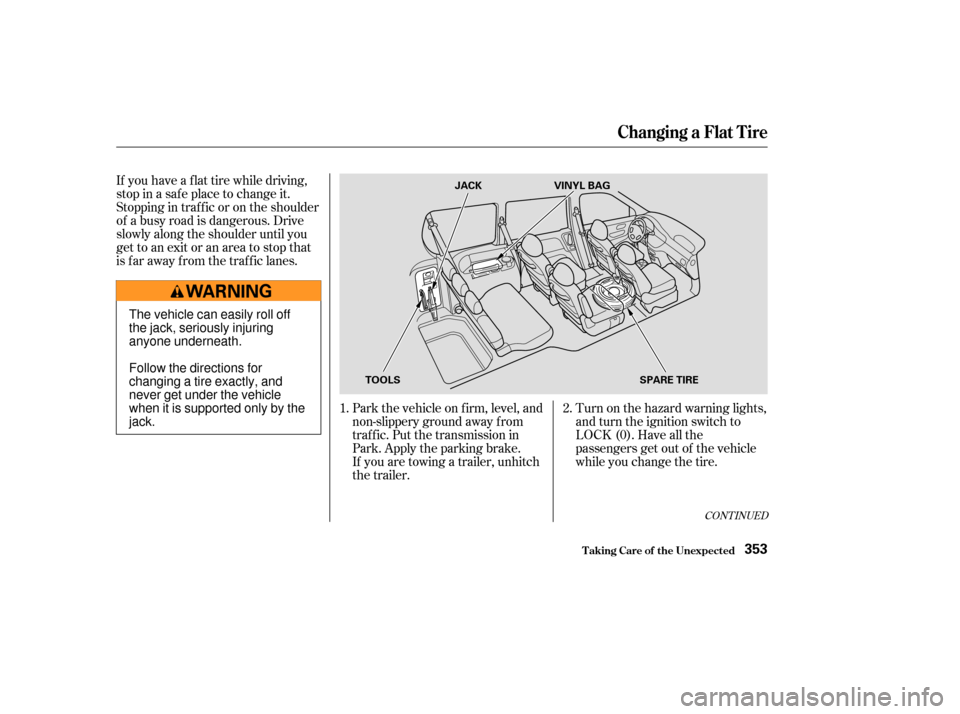
If you have a f lat tire while driving,
stop in a saf e place to change it.
Stopping in traf f ic or on the shoulder
of a busy road is dangerous. Drive
slowly along the shoulder until you
gettoanexitoranareatostopthat
is far away from the traffic lanes.Park the vehicle on f irm, level, and
non-slippery ground away f rom
traffic. Put the transmission in
Park. Apply the parking brake.
If you are towing a trailer, unhitch
the trailer.Turn on the hazard warning lights,
and turn the ignition switch to
LOCK (0). Have all the
passengers get out of the vehicle
while you change the tire.
2.
1.
CONT INUED
Changing a Flat T ire
T aking Care of t he Unexpect ed353
JACK VINYL BAG
SPARE TIRE
TOOLS
The vehicle can easily roll off
the jack, seriously injuring
anyone underneath.
Follow the directions for
changing a tire exactly, and
never get under the vehicle
when it is supported only by the
jack.
Page 367 of 415
�´�´
If your vehicle’s battery has run
down,youmaybeabletostartthe
engine by using a booster battery.
Although this seems like a simple
procedure, you should take several
precautions.
You cannot start a Honda by pushing
or pulling it. To jump start your vehicle, f ollow
these directions closely:
Open the hood and check the
physical condition of the battery
(see page ). In very cold
weather, check the condition of
the electrolyte. If it seems slushy
or like ice, do not try jump starting
until it thaws.
Turn of f all the electrical acces-
sories: heater, A/C, climate
control, stereo system, lights, etc.
Put the transmission in Neutral or
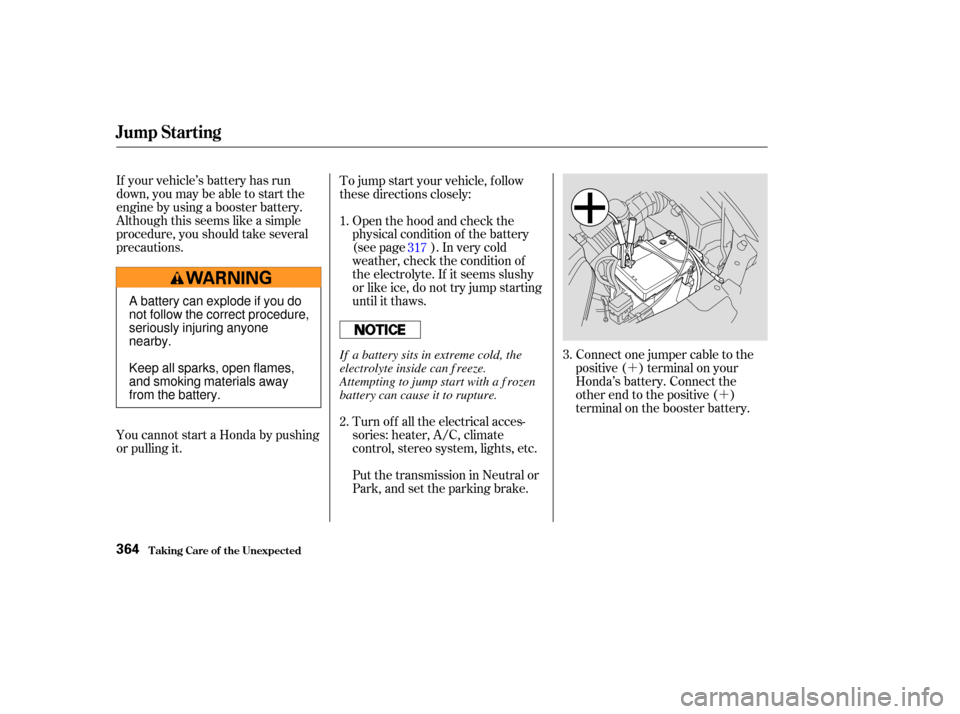
Park, and set the parking brake. Connect one jumper cable to the
positive ( ) terminal on your
Honda’s battery. Connect the
other end to the positive ( )
terminal on the booster battery.
1.
2.
3.
317
T aking Care of t he Unexpect ed
Jump Starting
364
A battery can explode if you do
not follow the correct procedure,
seriously injuring anyone
nearby.
Keep all sparks, open flames,
and smoking materials away
from the battery.
If a battery sits in extreme cold, the
electrolyte inside can f reeze.
Attempting to jump start with a f rozen
battery can cause it to rupture.
Page 369 of 415
Your vehicle can overheat for several
reasons, such as lack of coolant or a
mechanical problem. The only
indication may be the temperature
gauge climbing to or above the red
mark. Or you may see steam or
spray coming f rom under the hood.
In either case, you should take
immediate action.Saf ely pull to the side of the road.
Put the transmission in Neutral or
Park and set the parking brake.
Turn of f the heating and cooling/
climate control system and all
otheraccessories.Turnonthe
hazard warning indicators.
If you see steam and/or spray
coming f rom under the hood, turn
of f the engine.
The pointer of your vehicle’s
temperature gauge should stay in
the midrange under most conditions.
Itmaygohigherif youaredrivingup
a long steep hill on a very hot day. If
it climbs to the red mark, you should
determine the reason.
1.
2.
If Your Engine Overheats
T aking Care of t he Unexpect ed366
Steam and spray from an
overheated engine can
seriously scald you.
Do not open the hood if steam
is coming out.
Driving with the temperature gauge
pointer at the red mark can cause
serious damage to your engine.
Page 376 of 415
�Î
�Î
However, if the brake pedal does not
f eel normal, you should take
immediate action. Because of the
brake system’s dual-circuit design, a
problem in one part of the system
will still give you braking at two
wheels. You will f eel the brake pedal
go down much f arther bef ore the
vehicle begins to slow down, and you
will have to press harder on the
pedal. The distance needed to stop
will be much longer. If it comes on at any other time, it
indicates a problem with the vehicle’s
brake system. In most cases, the
problem is a low f luid level in the
brake f luid reservoir. Press lightly on
the brake pedal to see if it f eels
normal. If it does, check the brake
f luid level the next time you stop at a
service station (see page ). If the
f luid level is low, take the vehicle to
your dealer and have the brake
system inspected f or leaks or worn
brake pads. Slow down by shif ting to a lower
gear, and pull to the side of the road
when it is saf e. Because of the
longer distance needed to stop, it is
hazardous to drive the vehicle. You
should have it towed, and repaired as
soon as possible. (See
on page .)
If you must drive the vehicle a short
distance in this condition, drive
slowly and cautiously.
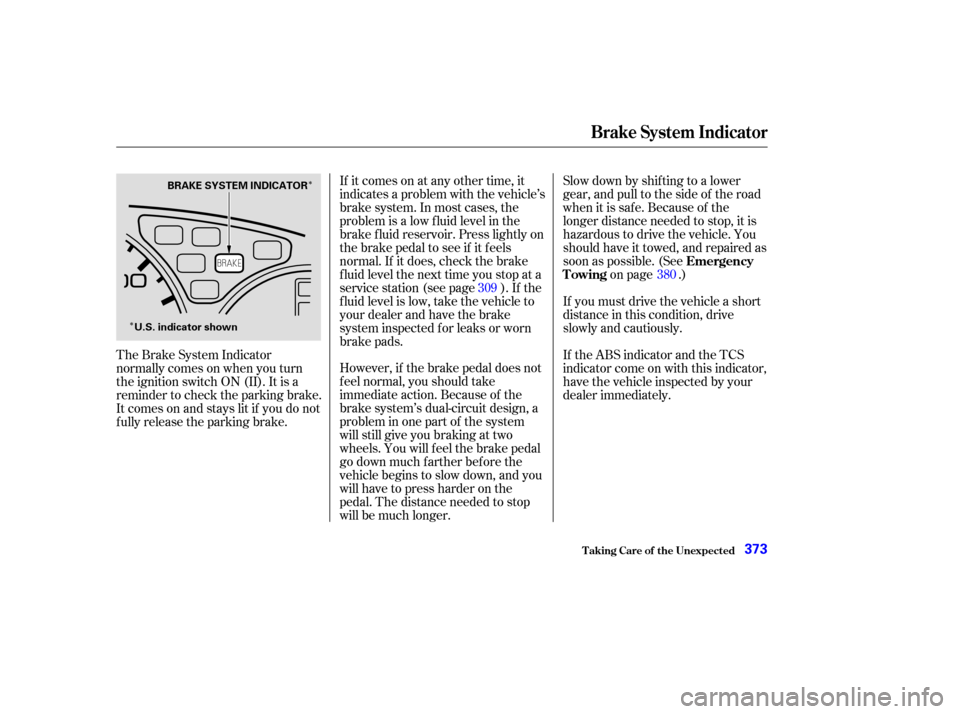
The Brake System Indicator
normallycomesonwhenyouturn
the ignition switch ON (II). It is a
reminder to check the parking brake.
It comes on and stays lit if you do not
f ully release the parking brake. If the ABS indicator and the TCS
indicator come on with this indicator,
have the vehicle inspected by your
dealer immediately.
309
380Emergency
Towing
Brake System Indicator
T aking Care of t he Unexpect ed373
BRAKE SYSTEM INDICATOR
U.S. indicator shown
Page 383 of 415

�µ
�µ �µ
If your vehicle needs to be towed,
call a prof essional towing service or,
if youbelongtoone,anorganization
that provides roadside assistance.
Never tow your vehicle behind
another vehicle with just a rope or
chain. It is very dangerous.
The tow
truck uses metal cables with hooks
on the ends. These hooks go around
parts of the f rame or suspension and
the cables lif t that end of the vehicle
of f the ground. Your vehicle’s sus-
pension and body can be seriously
damaged.
If your Honda cannot be transported
by f lat-bed, it should be towed by
wheel-lif t equipment with the f ront
wheels of f the ground. If , due to
damage, your vehicle must be towed
with the f ront wheels on the ground,
do the f ollowing. With the f ront wheels on the ground,
it is best to tow the vehicle no farther
than 50 miles (80 km), and keep the
speedbelow35mph(55km/h).
There are three popular types of
prof essional towing equipment.
The operator
loads your vehicle on the back of a
truck.
The tow
truck uses two pivoting arms that go
under the tires (f ront or rear) and lif t
them of f the ground. The other two
tires remain on the ground. Release the parking brake.
Start the engine.
ShifttoD,thentoN.
Turn of f the engine.Sling-t ype Equipment
Flat -bed Equipment Wheel-lif t Equipment
T his method of towing
is unacceptable.
This is the best way to trans-
port your Honda.
T his is
an acceptable way to tow your
Honda.
Emergency T owing
T aking Care of t he Unexpect ed380
Improper towing preparation will
damage the transmission. Follow the
above procedure exactly. If you cannot
shif t the transmission or start the
engine, your vehicle must be trans-
ported with the f ront wheels of f the
ground.