Page 367 of 415
�´�´
If your vehicle’s battery has run
down,youmaybeabletostartthe
engine by using a booster battery.
Although this seems like a simple
procedure, you should take several
precautions.
You cannot start a Honda by pushing
or pulling it. To jump start your vehicle, f ollow
these directions closely:
Open the hood and check the
physical condition of the battery
(see page ). In very cold
weather, check the condition of
the electrolyte. If it seems slushy
or like ice, do not try jump starting
until it thaws.
Turn of f all the electrical acces-
sories: heater, A/C, climate
control, stereo system, lights, etc.
Put the transmission in Neutral or
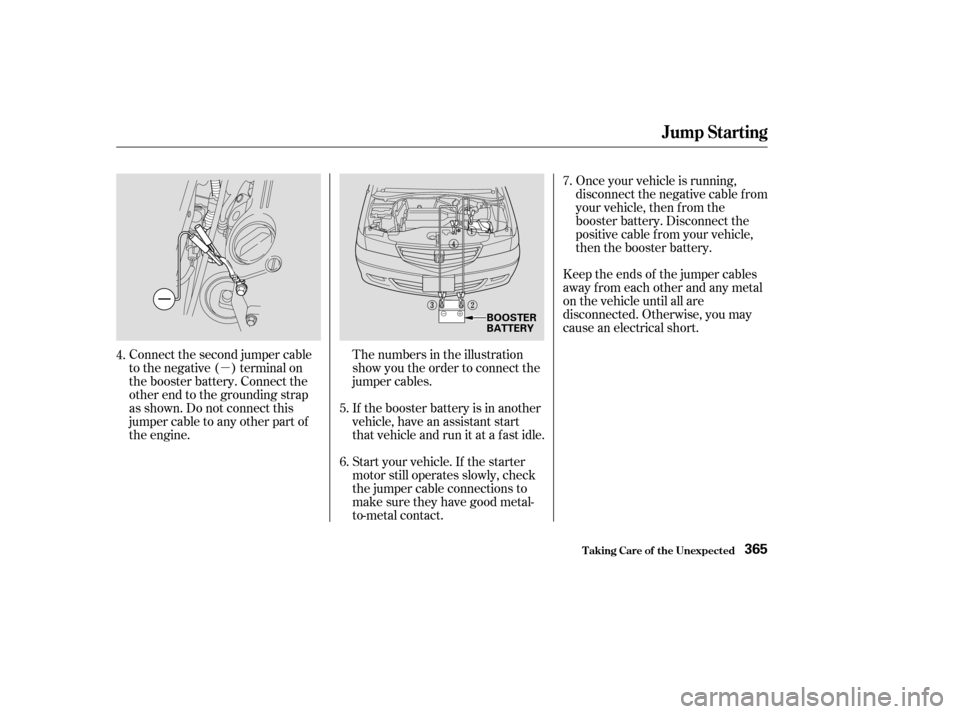
Park, and set the parking brake. Connect one jumper cable to the
positive ( ) terminal on your
Honda’s battery. Connect the
other end to the positive ( )
terminal on the booster battery.
1.
2.
3.
317
T aking Care of t he Unexpect ed
Jump Starting
364
A battery can explode if you do
not follow the correct procedure,
seriously injuring anyone
nearby.
Keep all sparks, open flames,
and smoking materials away
from the battery.
If a battery sits in extreme cold, the
electrolyte inside can f reeze.
Attempting to jump start with a f rozen
battery can cause it to rupture.
Page 368 of 415
�µ
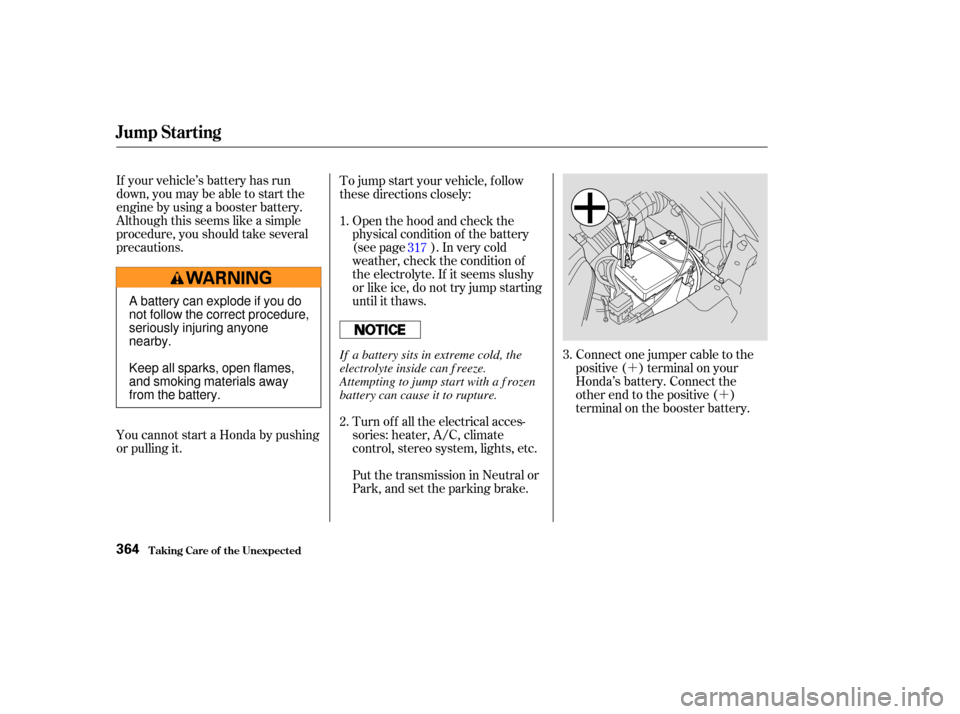
Connect the second jumper cable
to the negative ( ) terminal on
the booster battery. Connect the
other end to the grounding strap
as shown. Do not connect this
jumper cable to any other part of
the engine.Once your vehicle is running,
disconnect the negative cable f rom
your vehicle, then f rom the
booster battery. Disconnect the
positive cable f rom your vehicle,
then the booster battery.
Keep the ends of the jumper cables
away from each other and any metal
on the vehicle until all are
disconnected. Otherwise, you may
cause an electrical short.
Start your vehicle. If the starter
motor still operates slowly, check
the jumper cable connections to
make sure they have good metal-
to-metal contact. If the booster battery is in another
vehicle, have an assistant start
that vehicle and run it at a fast idle. The numbers in the illustration
show you the order to connect the
jumper cables.
4.
6.7.
5.
Jump Starting
T aking Care of t he Unexpect ed365
BOOSTER
BATTERY
Page 370 of 415
If you do not see steam or spray,
leave the engine running and
watch the temperature gauge. If
the high heat is due to overloading
(climbing a long, steep hill on a
hot day with the A/C running, f or
example), the engine should start
to cool down almost immediately.
If it does, wait until the tempera-
ture gauge comes down to the mid-
point then continue driving.
If the temperature gauge stays at
the red mark, turn of f the engine.
Wait until you see no more signs
of steam or spray, then open the
hood.Look f or any obvious coolant leaks,
such as a split radiator hose.
Everything is still extremely hot,
so use caution. If you f ind a leak, it
must be repaired bef ore you
continue driving (see
on page ).
If you don’t f ind an obvious leak,
check the coolant level in the
radiator reserve tank (see page ). If the level is below the
MIN mark, add coolant to halfway
between the MIN and MAX marks. If there was no coolant in the
reserve tank, you may also have to
add coolant to the radiator. Let the
engine cool down until the pointer
reaches the middle of the tempera-
ture gauge, or lower, bef ore check-
ing the radiator.
3.
7. 6.
5. 4. 380
249 8.
CONT INUED
Emergency
Towing
If Your Engine Overheats
T aking Care of t he Unexpect ed367
Removing the radiator cap
while the engine is hot can
cause the coolant to spray out,
seriously scalding you.
Always let the engine and
radiator cool down before
removing the radiator cap.
Page 371 of 415

Using gloves or a large heavy
cloth, turn the radiator cap
counterclockwise, without pushing
down, to the f irst stop. This
releases any remaining pressure in
the cooling system. After the
pressure releases, push down on
the cap and turn it until it comes
off.
Start the engine and set the
temperature control dial to
maximum (climate control to
FULL AUTO at 90°F/32°C). Add
coolant to the radiator up to the
base of the f iller neck. If you do
not have the proper coolant
mixture available, you can add
plain water. Remember to have
the cooling system drained and
ref illed with the proper mixture as
soon as you can.Put the radiator cap back on
tightly. Run the engine and watch
the temperature gauge. If it goes
back to the red mark, the engine
needs repair. (See
on page .)
If the temperature stays normal,
check the coolant level in the
radiator reserve tank. If it has
gone down, add coolant to the
MAX mark. Put the cap back on
tightly.
9.
10. 11.
12.
380
If Your Engine Overheats
T aking Care of t he Unexpect ed
Emergency
Towing
368
Page 372 of 415
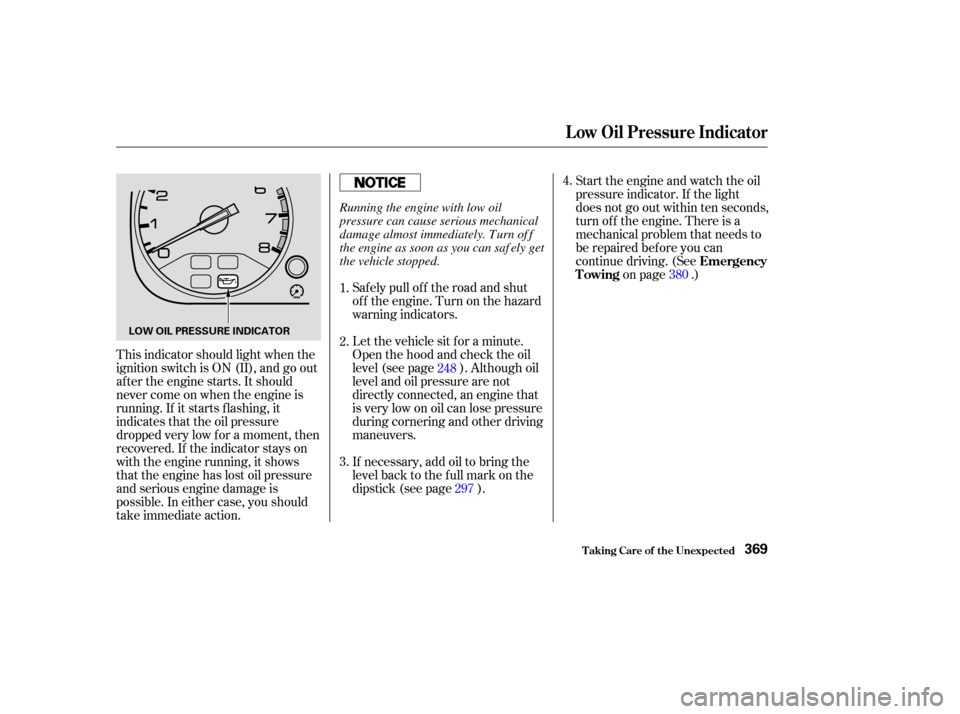
This indicator should light when the
ignition switch is ON (II), and go out
af ter the engine starts. It should
never come on when the engine is
running. If it starts f lashing, it
indicates that the oil pressure
dropped very low f or a moment, then
recovered. If the indicator stays on
with the engine running, it shows
that the engine has lost oil pressure
and serious engine damage is
possible. In either case, you should
take immediate action.Saf ely pull of f the road and shut
of f the engine. Turn on the hazard
warning indicators.
If necessary, add oil to bring the
level back to the full mark on the
dipstick (see page ). Let the vehicle sit f or a minute.
Open the hood and check the oil
level (see page ). Although oil
levelandoilpressurearenot
directly connected, an engine that
is very low on oil can lose pressure
during cornering and other driving
maneuvers.Start the engine and watch the oil
pressure indicator. If the light
does not go out within ten seconds,
turn of f the engine. There is a
mechanical problem that needs to
be repaired bef ore you can
continue driving. (See
on page .)
1.
2.
3. 4.
248 297 380
Emergency
Towing
L ow Oil Pressure Indicator
T aking Care of t he Unexpect ed369
LOW OIL PRESSURE INDICATOR
Running the engine with low oil
pressure can cause serious mechanical
damage almost immediately. Turn of f
the engine as soon as you can saf ely get
the vehicle stopped.
Page 374 of 415
If the indicator remains on past three
driving trips, or the f uel cap was not
loose or missing, have the vehicle
checked by the dealer as soon as
possible. Drive moderately until the
dealer has inspected the problem.
Avoid full-throttle acceleration and
driving at high speed.
Youshouldalsohavethedealer
inspect your vehicle if this indicator
comes on repeatedly, even though it
may turn of f as you continue driving.
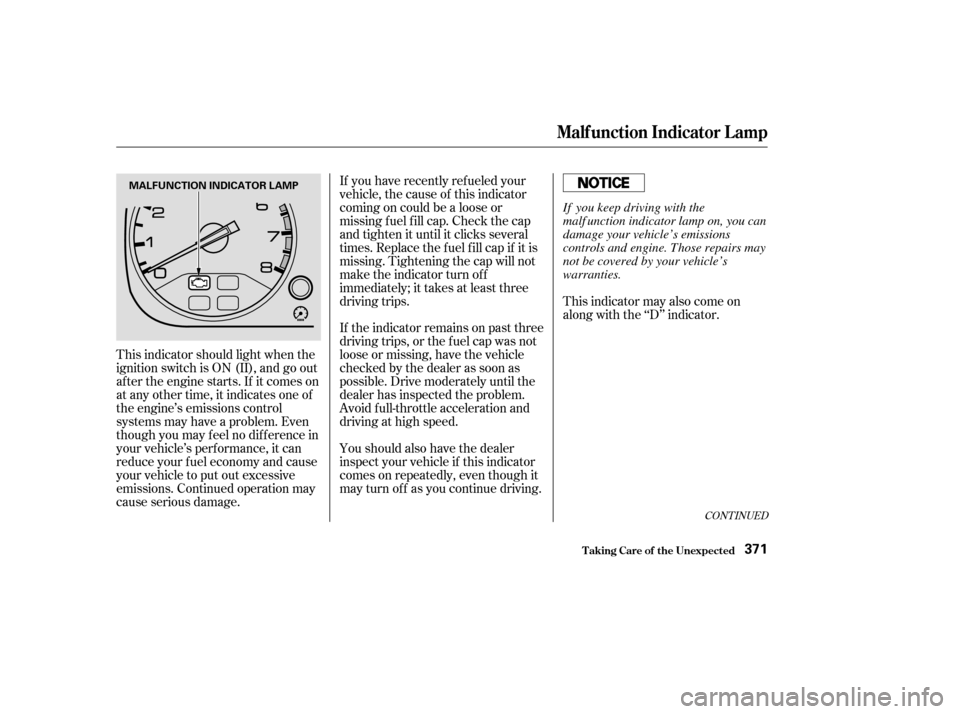
This indicator should light when the
ignition switch is ON (II), and go out
af ter the engine starts. If it comes on
at any other time, it indicates one of
the engine’s emissions control
systems may have a problem. Even
though you may f eel no dif f erence in
your vehicle’s perf ormance, it can
reduce your f uel economy and cause
your vehicle to put out excessive
emissions. Continued operation may
cause serious damage. If you have recently ref ueled your
vehicle, the cause of this indicator
coming on could be a loose or
missing f uel f ill cap. Check the cap
and tighten it until it clicks several
times. Replace the f uel f ill cap if it is
missing. Tightening the cap will not
make the indicator turn of f
immediately; it takes at least three
driving trips.
This indicator may also come on
along with the ‘‘D’’ indicator.
CONT INUED
Malf unction Indicator L amp
T aking Care of t he Unexpect ed371
MALFUNCTION INDICATOR LAMP
If you keep driving with the
malf unction indicator lamp on, you can
damage your vehicle’s emissions
controls and engine. Those repairs may
not be covered by your vehicle’s
warranties.
Page 375 of 415
Your vehicle has certain ‘‘readiness
codes’’ that are part of the on-board
diagnostics f or the emissions
systems. In some states, part of the
emissions testing is to make sure
these codes are set. If they are not
set, the test cannot be completed.
If your vehicle’s battery has been
disconnected or gone dead, these
codes are erased. It takes several
days of driving under various
conditions to set the codes again.If possible, do not take your vehicle
f or a state emissions test until the
readiness codes are set. Ref er to
State Emissions Testing f or more
inf ormation. (See page .)
To check if they are set, turn the
ignition ON (II), but do not start the
engine. The Malf unction Indicator
Lamp will come on f or 20 seconds. If
it then goes of f , the readiness codes
are set. If it blinks 5 times, the
readiness codes are not set.
395
Readiness Codes
Malf unction Indicator L amp
T aking Care of t he Unexpect ed372
Page 378 of 415
CONT INUED
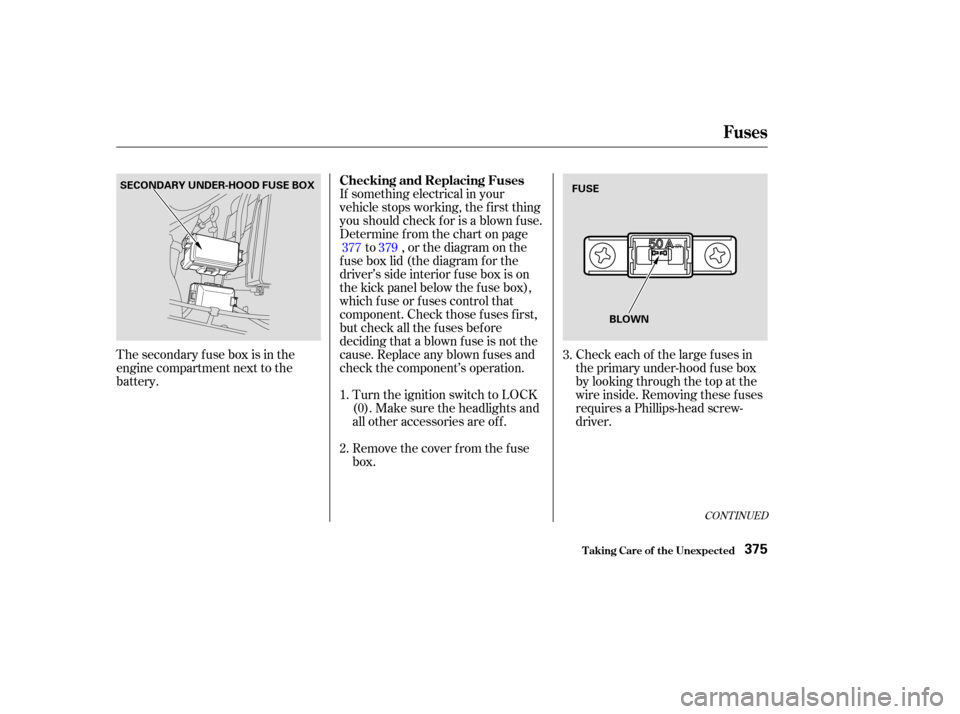
The secondary f use box is in the
engine compartment next to the
battery.If something electrical in your
vehicle stops working, the first thing
youshouldcheckforisablownfuse.
Determine f rom the chart on page
to , or the diagram on the
f use box lid (the diagram f or the
driver’s side interior f use box is on
the kick panel below the f use box),
which f use or f uses control that
component. Check those f uses f irst,
but check all the f uses bef ore
deciding that a blown f use is not the
cause. Replace any blown f uses and
check the component’s operation.
Turn the ignition switch to LOCK
(0). Make sure the headlights and
all other accessories are off.
Remove the cover f rom the f use
box. Check each of the large f uses in
the primary under-hood f use box
by looking through the top at the
wire inside. Removing these f uses
requires a Phillips-head screw-
driver.
1.
2. 379377
3.
Fuses
T aking Care of t he Unexpect ed
Checking and Replacing Fuses
375
FUSE
BLOWN
SECONDARY UNDER-HOOD FUSE BOX