Page 294 of 415

�µ�µ
�Ø
�Ø
�Ø
�Ø
�Ø
�Ø
�Ø
�Ø
�Ø
�Ø
�Ø
�Ø
�Ø
�Ø
�Ø
�Ø
�Ø
�Ø
�Ø
�Ø
�Ø
�Ì
�Ì
�Î
�Î�Ì
�Ì
�Î
�Î
CONT INUED
Maint enance291
A, B, C, D
U.S. Owners
Canadian Owners
A
B
C
D
Service at the indicated distance or time, whichever comes first. Do the items in as required for each distance/time interval.
Refer to page to determine which schedule to use.Use the Maintenance Schedule for Severe Conditions.
3,750 mi/6,000 km
7,500 mi/12,000 km/6 mos
11,250 mi/18,000 km
15,000 mi/24,000 km/1 yr
18,750 mi/30,000 km
22,500 mi/36,000 km
26,250 mi/42,000 km
30,000 mi/48,000 km/2 yrs
33,750 mi/54,000 km
37,500 mi/60,000 km
41,250 mi/66,000 km
3yrs
45,000 mi/72,000 km/3 yrs
48,750 mi/78,000 km
52,500 mi/84,000 km
60,000 mi/96,000 km/4 yrs
63,750 mi/102,000 km Replace engine oil and filter.
Inspect front and rear brakes.
Rotate tires (follow pattern on page
326).
Inspect tie rod ends, steering gearbox and boots.
Inspect suspension components.
Inspect driveshaft boots.
Check parking brake adjustment.
Replace air cleaner element.
Lubricate all hinges, locks and latches with
multipurpose grease.
Inspect brake hoses and lines (including ABS).
Check all fluid levels, condition of fluids, and check
for leaks.
Inspect cooling system hoses and connections.
Inspect exhaust system.
Inspect fuel lines and connections.
Check all lights.
Inspect the underbody.
Replace transmission fluid.
Inspect and adjust drive belts.
Replace dust and pollen filter.
Do item in A.
Do items in A, B.
Do item in A.
DoitemsinA,B,C.
Do item in A.
Do items in A, B.
Do item in A.
DoitemsinA,B,C,D.
Do item in A.
Do items in A, B.
Do item in A.
Replace brake fluid (independent of mileage)
DoitemsinA,B,C.
Do item in A.
Do items in A, B. Replace timing belt.
DoitemsinA,B,C,D.
Do item in A.
290
See information on maintenance and emissions warranty, last
column, page .
Check engine oil and coolant at each fuel stop.
Check and adjust valve clearance, cold engine, only if noisy.
See timing belt on page to determine need for replacement.
See dust and pollen filter on page for replacement information under special driving
conditions.
:
NOTE:
1:
2:
323
322
287
2
1,
Maintenance Schedule for Severe Conditions (listed by distance/time)
Page 298 of 415
�µ�µ �µ
�µ
�µ
�µ �µ
Youshouldcheckthefollowing
items at the specif ied intervals. If
you are unsure of how to perf orm
any check, turn to the page given.
Engine oil level Check every
time you fill the fuel tank. See
page .
Engine coolant level Check the
radiator reserve tank every time
you f ill the f uel tank. See page .Tires Check the tire pressure
monthly. Examine the tread f or
wear and foreign objects. See page
.
Windshield washer f luid Check
the level in the reservoir monthly.
If weather conditions cause you to
use the washers f requently, check
the reservoir each time you stop
f or f uel. See page .
Automatic transmission Check
the f luid level monthly. See page .
Brakes Check the f luid level
monthly. See page . Lights Check the operation of
the headlights, parking lights,
taillights, high-mount brake light,
turn signals, brake lights, and
license plate light monthly. See
page .
248
249
306
307 309 323
330
Owner Maintenance Checks
Maint enance295
Page 299 of 415
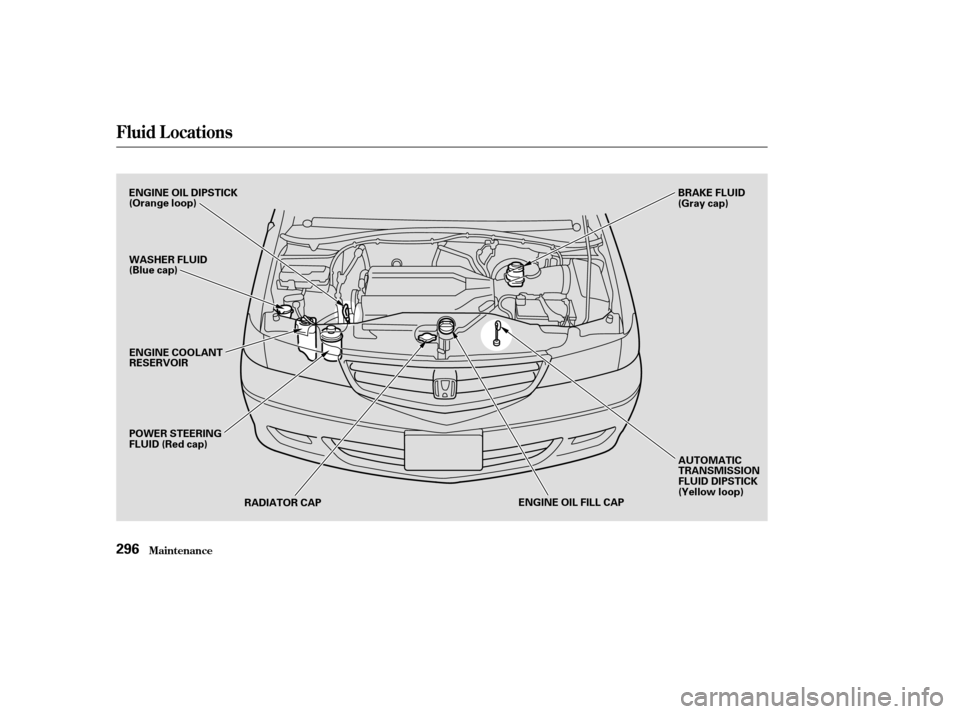
Fluid Locations
Maint enance296
ENGINE OIL DIPSTICK
(Orange loop)
WASHER FLUID
(Blue cap)
POWER STEERING
FLUID (Red cap)RADIATOR CAP ENGINE OIL FILL CAPAUTOMATIC
TRANSMISSION
FLUID DIPSTICK
(Yellow loop)
BRAKE FLUID
(Gray cap)
ENGINE COOLANT
RESERVOIR
Page 302 of 415
Always change the oil and f ilter
accordingtothetimeanddistance
(miles/kilometers) recommenda-
tions in the maintenance schedule.
The oil and f ilter collect contami-
nants that can damage your engine if
they are not removed regularly.
Changing the oil and f ilter requires
special tools and access f rom
underneath the vehicle. The vehicle
should be raised on a service station-
type hydraulic lif t f or this service.
Unless you have the knowledge and
proper equipment, you should have
this maintenance done by a skilled
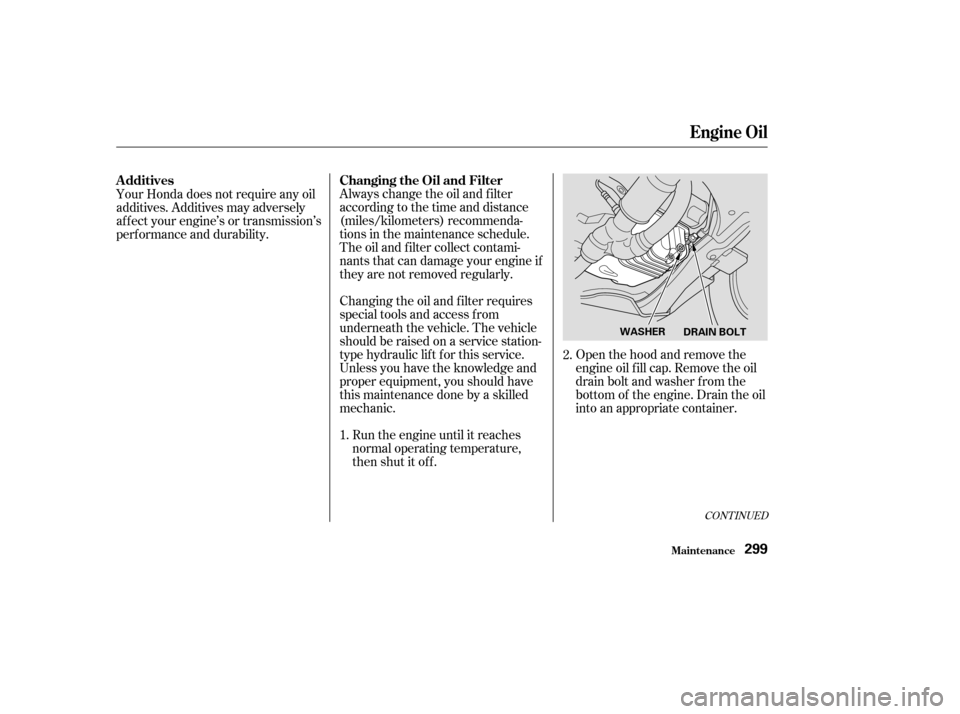
mechanic.Run the engine until it reaches
normal operating temperature,
then shut it off. Open the hood and remove the
engine oil f ill cap. Remove the oil
drain bolt and washer f rom the
bottom of the engine. Drain the oil
into an appropriate container.
Your Honda does not require any oil
additives. Additives may adversely
af f ect your engine’s or transmission’s
perf ormance and durability.
1.2.
CONT INUED
Additives
Changing the Oil and Filter
Engine Oil
Maint enance299
WASHER
DRAIN BOLT
Page 310 of 415
Check the f luid level with the engine
at normal operating temperature.Park the vehicle on level ground.
Shut of f the engine.
Remove the dipstick and check
the f luid level. It should be
between the upper and lower
marks. Insert the dipstick all the way into
the transmission as shown.
Remove the dipstick (yellow loop)
f rom the transmission and wipe it
with a clean cloth.
1.
2.3.
4.
CONT INUED
Maint enance
Automatic Transmission Fluid
307
DIPSTICK DIPSTICK
UPPER MARKLOWER MARK
Page 311 of 415

To thoroughly f lush the transmission,
the technician should drain and ref ill
it with Honda ATF-Z1, then drive the
vehicle a short distance. Do this
three times. Then drain and ref ill the
transmission a f inal time.
If the level is below the lower
mark, remove the f ill plug and add
f luid to bring it to the upper mark.
Pour the f luid slowly and caref ully
so you do not spill. Clean up any
spills immediately. Spilled f luid
could damage components in the
engine compartment.
Insert the dipstick all the way back
into the transmission securely as
shown in the illustration.
The transmission should be drained
and ref illed with new f luid according
to the time and distance recommen-
dations in the maintenance schedule.
If you are not sure how to add f luid,
contact your Honda dealer.
Always use Honda ATF-Z1
(Automatic Transmission Fluid). If
it is not available, you may use a
DEXRON
III automatic
transmission f luid as a temporary
replacement. However, continued
use can affect shift quality. Have
the transmission f lushed and
ref illed with Honda ATF-Z1 as
soon as it is convenient.
5.
6.
Maint enance
Automatic Transmission Fluid
308
Page 344 of 415

If you need to park your vehicle f or
an extended period (more than one
month), there are several things you
should do to prepare it f or storage.
Proper preparation helps prevent
deterioration and makes it easier to
get your vehicle back on the road. If
possible, store your vehicle indoors.Block the rear wheels.
If the vehicle is to be stored f or a
longer period, it should be
supported on jackstands so the
tires are of f the ground.
Leave one window open slightly (if
the vehicle is being stored
indoors).
Fill the f uel tank.
Change the engine oil and f ilter
(see page ).
Wash and dry the exterior
completely.
Cleantheinterior.Makesurethe
carpeting, floor mats, etc. are
completely dry.
Leave the parking brake off. Put
the transmission in Park. Support the f ront and rear wiper
blade arms with a f olded towel or
ragsotheydonottouchthe
windshield. Disconnect the battery.
To minimize sticking, apply a
silicone spray lubricant to all door
and tailgate seals. Also, apply a
vehiclebodywaxtothepainted
surfaces that mate with the door
and tailgate seals.Cover the vehicle with a
‘‘breathable’’ cover, one made
f rom a porous material such as
cotton. Nonporous materials, such
as plastic sheeting, trap moisture,
which can damage the paint.
If possible, run the engine f or a
while periodically (pref erably once
amonth).
If you store your vehicle f or 12
months or longer, have your Honda
dealer perf orm the inspections called
f or in the 24 months/30,000 miles
(48,000 km) maintenance schedule
(Normal Conditions) as soon as you
take it out of storage (see page ).
The replacements called f or in the
maintenance schedule are not
needed unless the vehicle has
actually reached that time or mileage.
299
288
St oring Your Vehicle
Maint enance341
Page 356 of 415
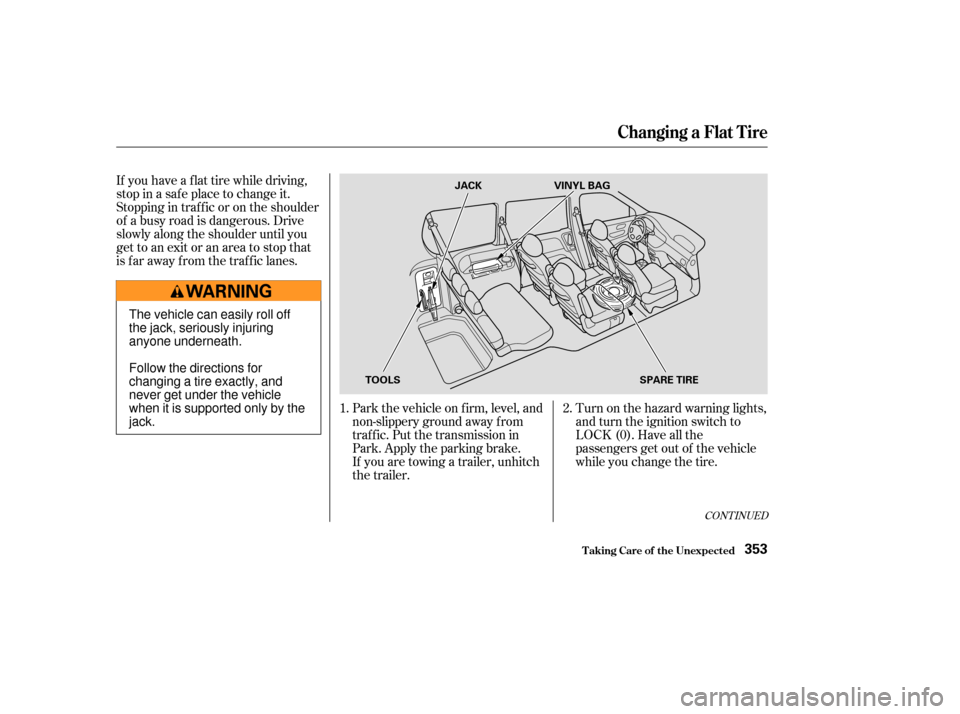
If you have a f lat tire while driving,
stop in a saf e place to change it.
Stopping in traf f ic or on the shoulder
of a busy road is dangerous. Drive
slowly along the shoulder until you
gettoanexitoranareatostopthat
is far away from the traffic lanes.Park the vehicle on f irm, level, and
non-slippery ground away f rom
traffic. Put the transmission in
Park. Apply the parking brake.
If you are towing a trailer, unhitch
the trailer.Turn on the hazard warning lights,
and turn the ignition switch to
LOCK (0). Have all the
passengers get out of the vehicle
while you change the tire.
2.
1.
CONT INUED
Changing a Flat T ire
T aking Care of t he Unexpect ed353
JACK VINYL BAG
SPARE TIRE
TOOLS
The vehicle can easily roll off
the jack, seriously injuring
anyone underneath.
Follow the directions for
changing a tire exactly, and
never get under the vehicle
when it is supported only by the
jack.