Page 313 of 415
Always use Honda Power Steering
Fluid. If it is not available, you may
use another power steering f luid as
an emergency replacement.
However, continued use can cause
increased wear and poor steering in
cold weather. Have the power
steering system f lushed and ref illed
with Honda PSF as soon as possible.
A low power steering f luid level can
indicate a leak in the system. Check
the f luid level f requently and have
the system inspected as soon as
possible.
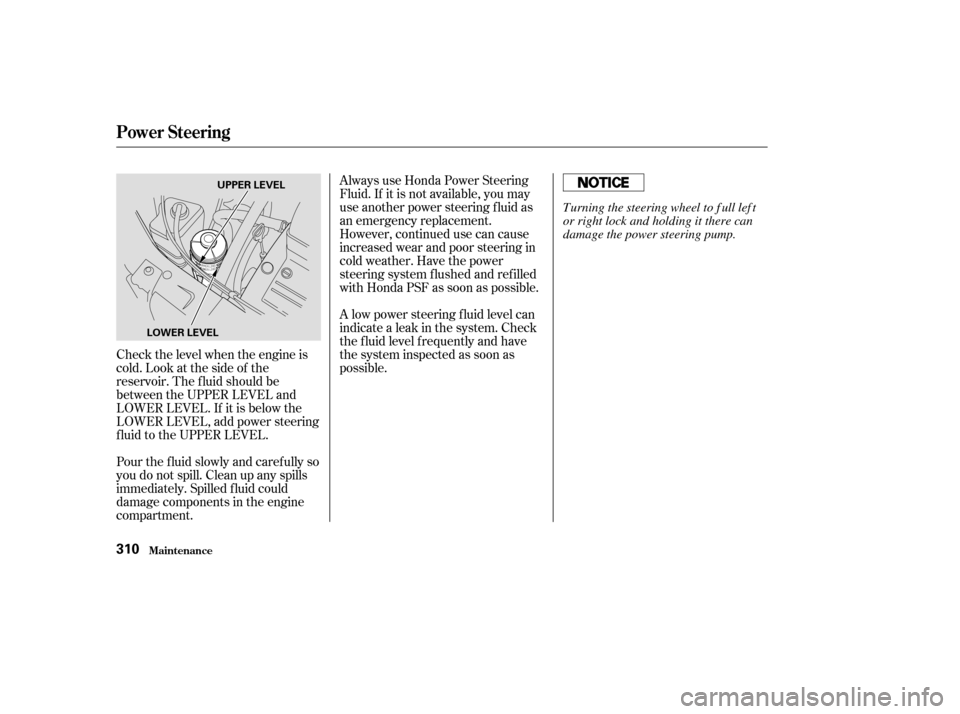
Check the level when the engine is
cold. Look at the side of the
reservoir. The f luid should be
between the UPPER LEVEL and
LOWER LEVEL. If it is below the
LOWER LEVEL, add power steering
f luid to the UPPER LEVEL.
Pour the f luid slowly and caref ully so
you do not spill. Clean up any spills
immediately. Spilled f luid could
damage components in the engine
compartment.
Power Steering
Maint enance310
UPPER LEVEL
LOWER LEVEL
T urning the steering wheel to f ull lef t
or right lock and holding it there can
damage the power steering pump.
Page 317 of 415
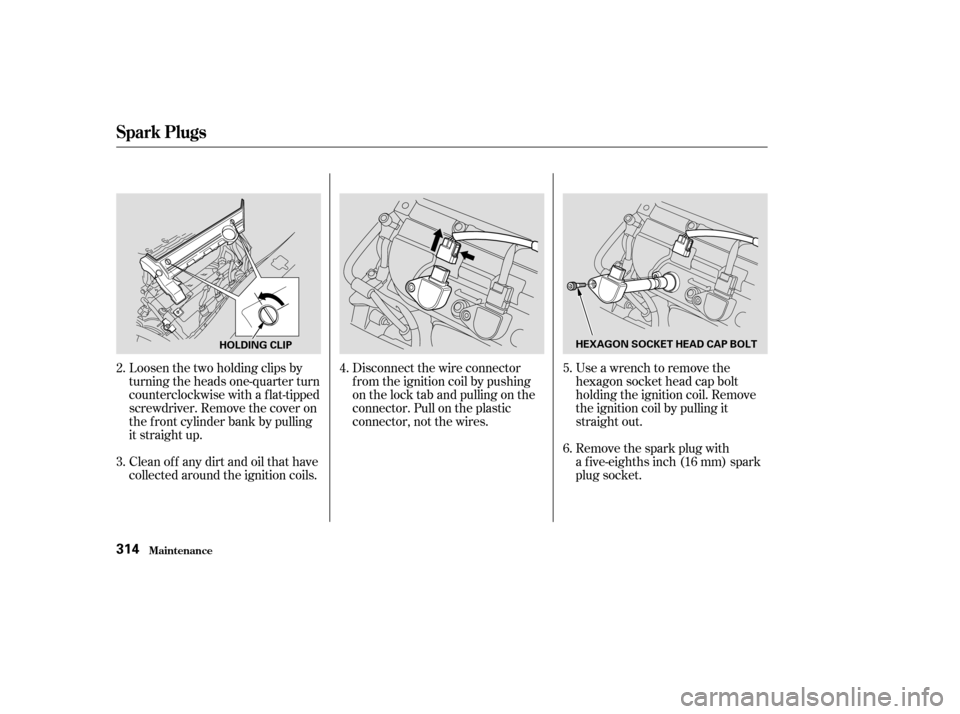
Loosen the two holding clips by
turning the heads one-quarter turn
counterclockwise with a f lat-tipped
screwdriver. Remove the cover on
the f ront cylinder bank by pulling
it straight up.
Clean off any dirt and oil that have
collected around the ignition coils.Disconnect the wire connector
f rom the ignition coil by pushing
on the lock tab and pulling on the
connector. Pull on the plastic
connector, not the wires.
Use a wrench to remove the
hexagonsocketheadcapbolt
holding the ignition coil. Remove
the ignition coil by pulling it
straight out.
Remove the spark plug with
a f ive-eighths inch (16 mm) spark
plug socket.
5.
6.
4.
2.
3.
Maint enance
Spark Plugs
314
HEXAGON SOCKET HEAD CAP BOLT
HOLDING CLIP
Page 319 of 415
�´
�µ
Install the ignition coil. Reinstall
the hexagon socket head cap bolt.
Push the wire connector onto the
ignition coil. Make sure it locks in
place.
Repeat this procedure f or the
other f ive spark plugs.
Reinstall the cover on the front
cylinder bank while putting its
mounting clip in the hole on the
passenger’s side. Secure the cover
by turning the heads of the two
holding clips one-quarter turn
clockwise with a f lat-tipped
screwdriver.Spark Plug Gap:
Reinstall the engine cover and
tighten the f our bolts securely. NGK:
DENSO:
9.
11.
10.
12.
13.
Spark Plugs
Maint enance
Specif ications:
316
PZFR5F-11
PKJ16CR-L11
0.04 in (1.1 mm)
0
0.1 mm
Page 320 of 415
�µ
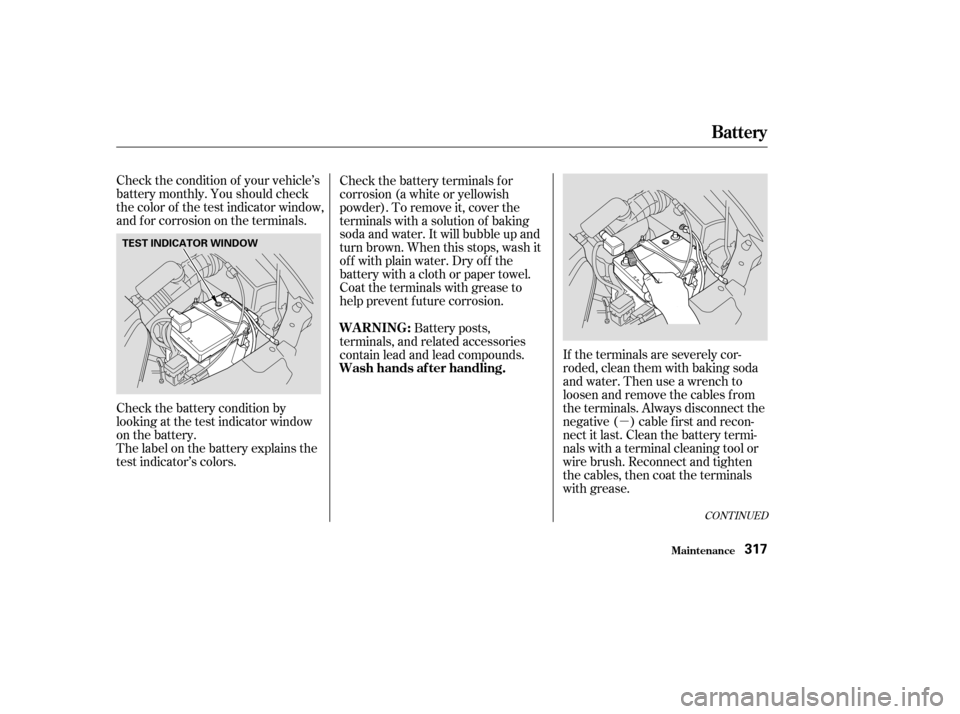
Check the condition of your vehicle’s
battery monthly. You should check
the color of the test indicator window,
and f or corrosion on the terminals.
Check the battery terminals for
corrosion (a white or yellowish
powder). To remove it, cover the
terminals with a solution of baking
soda and water. It will bubble up and
turn brown. When this stops, wash it
of f with plain water. Dry of f the
battery with a cloth or paper towel.
Coat the terminals with grease to
help prevent f uture corrosion.
If the terminals are severely cor-
roded, clean them with baking soda
and water. Then use a wrench to
loosen and remove the cables f rom
the terminals. Always disconnect the
negative ( ) cable f irst and recon-
nect it last. Clean the battery termi-
nals with a terminal cleaning tool or
wire brush. Reconnect and tighten
the cables, then coat the terminals
with grease.
Check the battery condition by
looking at the test indicator window
on the battery.
The label on the battery explains the
test indicator’s colors. Battery posts,
terminals, and related accessories
contain lead and lead compounds.
CONT INUED
Battery
Maint enance
WARNING:
Wash hands af ter handling.
317
TEST INDICATOR WINDOW
Page 321 of 415
If you need to connect the battery to
a charger, disconnect both cables to
prevent damage to the vehicle’s
electrical system.If your vehicle’s battery is
disconnected or goes dead, the
AUTO f eature of the driver’s window
will be disabled. You should reset the
AUTOfeature(seepage ).126
Battery
Maint enance318
The battery gives off explosive
hydrogen gas during normal
operation.
A spark or flame can cause the
battery to explode with enough
force to kill or seriously hurt you.
Wear protective clothing and a
face shield, or have a skilled
mechanic do the battery
maintenance. Charging the battery with the cables
connected can seriously damage your
vehicle’s electronic controls. Detach
the battery cables bef ore connecting
the battery to a charger.
Page 322 of 415
CONT INUED
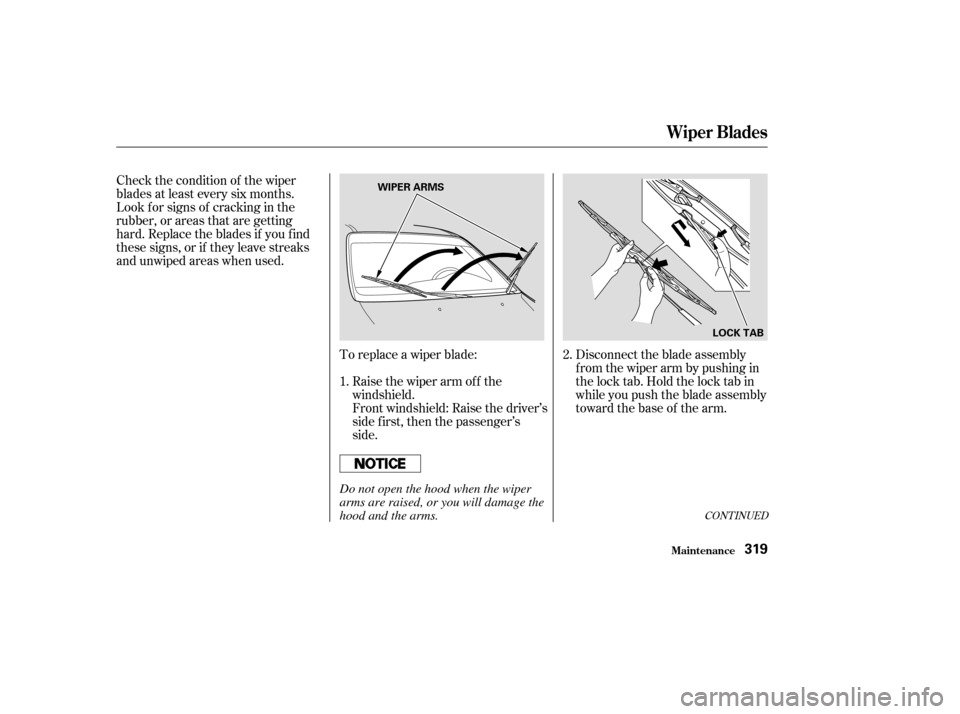
Check the condition of the wiper
blades at least every six months.
Look f or signs of cracking in the
rubber, or areas that are getting
hard. Replace the blades if you f ind
these signs, or if they leave streaks
and unwiped areas when used.Disconnect the blade assembly
fromthewiperarmbypushingin
the lock tab. Hold the lock tab in
while you push the blade assembly
toward the base of the arm.
Raise the wiper arm of f the
windshield.
To replace a wiper blade:
Front windshield: Raise the driver’s
side first, then the passenger’s
side. 2.
1.
Wiper Blades
Maint enance319
WIPER ARMS
LOCK TAB
Do not open the hood when the wiper
arms are raised, or you will damage the
hood and the arms.
Page 324 of 415
Run the air conditioning at least once
a week during the cold weather
months. Run it f or at least ten
minutes while you are driving at a
steady speed with the engine at
normal operating temperature. This
circulates the lubricating oil con-
tained in the ref rigerant.If the air conditioning does not get as
cold as before, have your dealer
check the system. Recharge the
system with Ref rigerant HFC-134a
(R-134a). (See Specif ications on page
.)
Your vehicle’s air conditioning is a
sealed system. Any major mainte-
nance, such as recharging, should be
done by a qualif ied mechanic. You
can do a couple of things to make
sure the air conditioning works
ef f iciently.
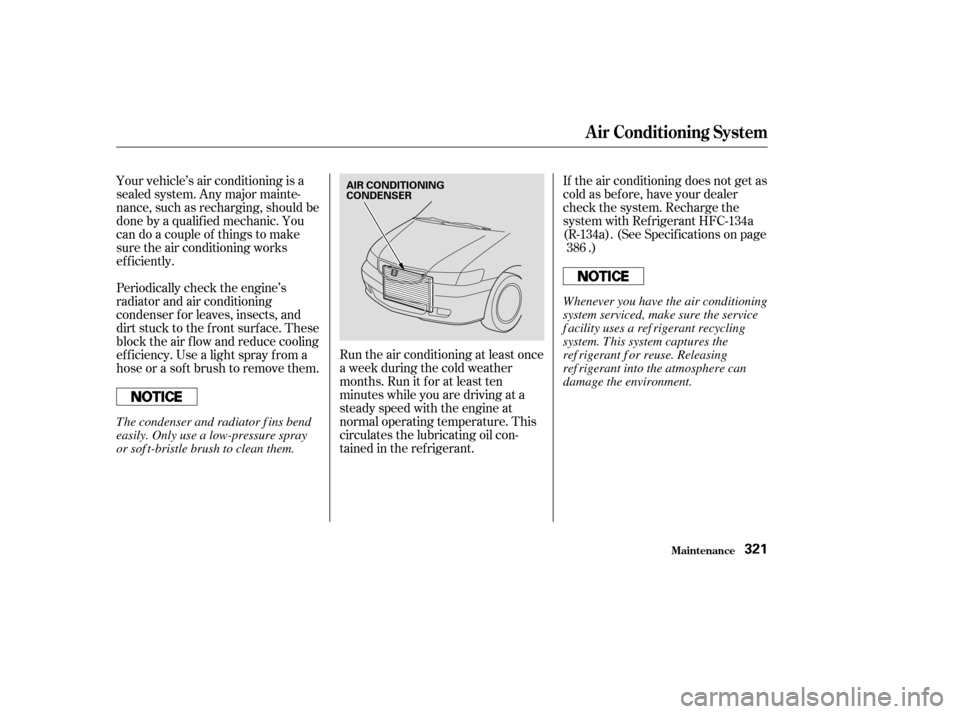
Periodically check the engine’s
radiator and air conditioning
condenser f or leaves, insects, and
dirt stuck to the f ront surf ace. These
block the air f low and reduce cooling
ef f iciency. Use a light spray f rom a
hose or a sof t brush to remove them. 386
Maint enance
A ir Condit ioning Syst em
321
AIR CONDITIONING
CONDENSER
Whenever you have the air conditioning
system serviced, make sure the service
f acility uses a ref rigerant recycling
system. This system captures the
ref rigerant f or reuse. Releasing
ref rigerant into the atmosphere can
damage the environment.
The condenser and radiator f ins bend
easily. Only use a low-pressure spray
or sof t-bristle brush to clean them.
Page 325 of 415
�µ�µ
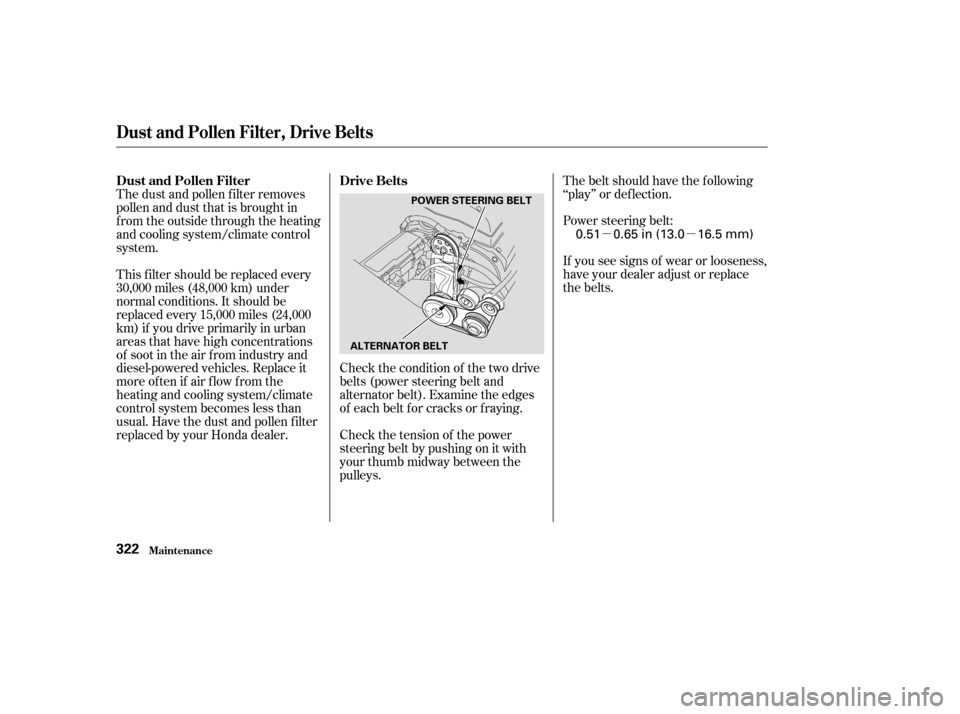
Check the condition of the two drive
belts (power steering belt and
alternator belt). Examine the edges
of each belt f or cracks or f raying. If you see signs of wear or looseness,
have your dealer adjust or replace
the belts. Power steering belt: Thebeltshouldhavethefollowing
‘‘play’’ or def lection.
Check the tension of the power
steering belt by pushing on it with
your thumb midway between the
pulleys.
The dust and pollen f ilter removes
pollen and dust that is brought in
f rom the outside through the heating
and cooling system/climate control
system.
This f ilter should be replaced every
30,000 miles (48,000 km) under
normal conditions. It should be
replaced every 15,000 miles (24,000
km) if you drive primarily in urban
areas that have high concentrations
of soot in the air f rom industry and
diesel-powered vehicles. Replace it
more of ten if air f low f rom the
heating and cooling system/climate
control system becomes less than
usual. Have the dust and pollen f ilter
replaced by your Honda dealer.
Drive Belts
Dust and Pollen Filter
Maint enance
Dust and Pollen Filter, Drive Belts
322
POWER STEERING BELT
ALTERNATOR BELT
0.51 0.65 in (13.0 16.5 mm)