Page 45 of 415

Then pull hard on the loose end of
thebelttoremovetheanyslack(it
may help to put weight on the child
seat while pulling on the belt).
Finally, f ollow instruction number 5
on page to verify that the child
seat is secured.When a child reaches the
recommended weight or height limit
for a forward-facing child seat, the
child should sit in the back seat on a
booster and wear a lap/shoulder belt.
We recommend that the child use a
booster seat until the child is tall
enough to use the seat belt without a
booster.
The f ollowing pages give
instructions on how to check proper
seat belt f it, what kind of booster
seat to use if one is needed, and
important precautions f or a child
who must sit in the f ront seat.
41
Protecting L arger Children
Protecting Children
Driver and Passenger Saf ety42
Allowing a larger child to sit
improperly in the front seat can
result in injury or death if the
passenger’s front airbag inflates.
If a larger child must sit in front,
make sure the child moves the
seat as far back as possible,
uses a booster seat if needed,
and wears the seat belt properly.
Page 47 of 415
The National Highway Traffic Safety
Administration and Transport
Canada recommend that all children
ages 12 and under be properly
restrained in a back seat.
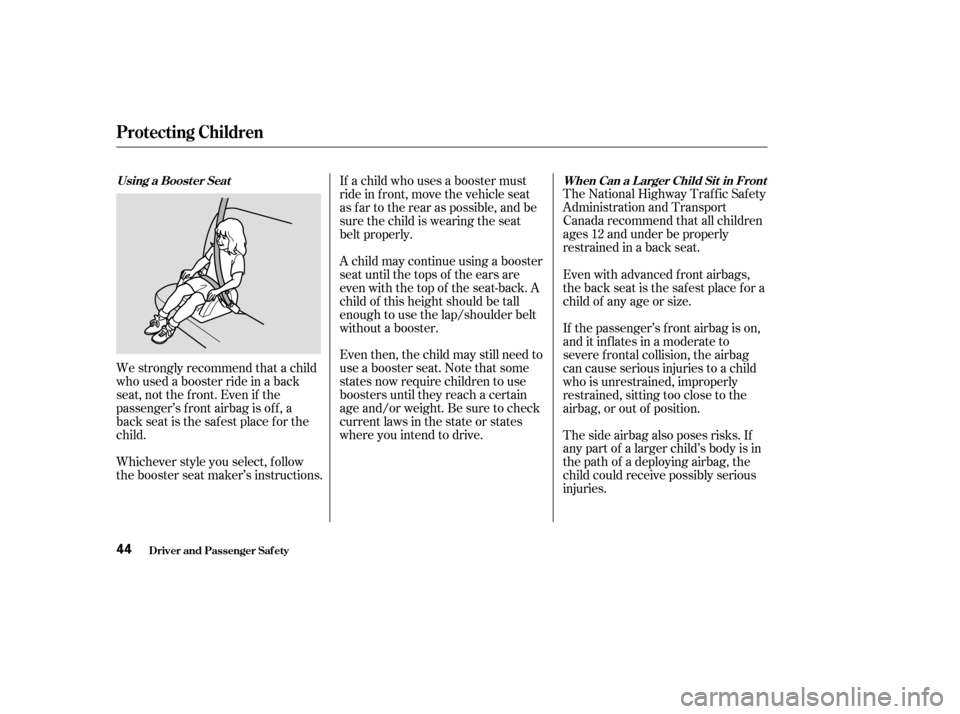
We strongly recommend that a child
whousedaboosterrideinaback
seat,notthefront.Evenif the
passenger’s f ront airbag is of f , a
back seat is the safest place for the
child.
Whichever style you select, f ollow
the booster seat maker’s instructions. If a child who uses a booster must
ride in f ront, move the vehicle seat
as far to the rear as possible, and be
sure the child is wearing the seat
belt properly.
A child may continue using a booster
seat until the tops of the ears are
even with the top of the seat-back. A
child of this height should be tall
enough to use the lap/shoulder belt
without a booster.
Even then, the child may still need to
use a booster seat. Note that some
states now require children to use
boosters until they reach a certain
ageand/orweight.Besuretocheck
current laws in the state or states
where you intend to drive.
If the passenger’s f ront airbag is on,
and it inflates in a moderate to
severe f rontal collision, the airbag
can cause serious injuries to a child
who is unrestrained, improperly
restrained, sitting too close to the
airbag, or out of position.
The side airbag also poses risks. If
any part of a larger child’s body is in
the path of a deploying airbag, the
child could receive possibly serious
injuries. Even with advanced front airbags,
the back seat is the safest place for a
child of any age or size.
When Can a Larger Child Sit in Front
Using a Boost er Seat
Protecting Children
Driver and Passenger Saf ety44
Page 57 of 415
Your Supplemental Restraint System
(SRS) includes:Automatic seat belt tensioners
(see page ). Two f ront airbags. The driver’s
airbag is stored in the center of
the steering wheel; the f ront
passenger’sairbagisstoredinthe
dashboard. Both are marked ‘‘SRS
AIRBAG.’’
Sensors that can detect a
moderate to severe frontal
collision.
A sophisticated electronic system
that continually monitors and
records inf ormation about the
sensors, the control unit, the
airbag activators, and driver and
passenger seat belt use when the
ignition is ON (II). 52
SRS Components
Additional Inf ormation About Your Airbags
Driver and Passenger Saf ety54
(1) Driver’s Airbag
(2) Front Passenger’s Airbag
(3) Control Unit
(4) Seat Belt Tensioners
(5) Side Airbags
(6) Driver’s Seat Position Sensor
(7) Front Passenger’s Weight Sensors
(8) Front Sensor
(9) Passenger Airbag Cutoff Indicator
(5)
(9)
(2)
(8)
(3)
(7)
(4)
(4) (1)
(5)
(6)
(7)
Page 58 of 415

CONT INUED
During a frontal crash, your seat
belts help restrain your lower body
and torso. Your airbag provides a
cushion to help restrain and protect
your head and chest.
Since both airbags use the same
sensors, both airbags normally
inf late at the same time. However, it
is possible f or only one airbag to
inf late.
This can occur when the severity of
a collision is at the margin, or
threshold, that determines whether
or not the airbags will deploy. In
such cases, the seat belt will provide
suf f icient protection, and the
supplemental protection of f ered by
the airbag would be minimal.
If you ever have a moderate to
severe f rontal collision, the sensors
will detect the vehicle’s rapid
deceleration. If the rate of
deceleration is high enough, the
control unit will instantly inf late the
f ront airbags. Your vehicle is equipped with dual-
stage, dual-threshold airbags to help
reduce the chance of airbag-caused
injuries.
A driver’s seat position sensor that
monitors the driver’s seat position
and adjusts the inf lation and
timing of the driver’s airbag (see
page ).
Front passenger’s weight sensors
that monitor the weight on the
seat. These prevent the passenger’s
airbag from inflating if the weight
is less than about 65 lbs (30 kg)
(see page ).
An indicator light on the
instrument panel that alerts you to
a possible problem with the
system (see page ).
Emergency backup power in case
your vehicle’s electrical system is
disconnected in a crash.
56
57 59
Additional Inf ormation About Your Airbags
Driver and Passenger Saf ety
How Your Front A irbags Work
55
Page 60 of 415
If there is a problem in the sensor,
the SRS indicator in the instrument
panel comes on. In this case, the
driver’s airbag will inf late normally
during a crash regardless of the
driver’s seating position.Your vehicle has front passenger’s
weight sensors as a part of the
advanced airbag system. They are
located under both of the f ront
passenger’s seat rails. These sensors
monitor the total weight on the seat.If there is no passenger in the f ront
passenger’s seat, the passenger
airbag cutoff indicator does not
come on, however the system shuts
of f the f ront passenger’s airbag.
If the total weight on the seat is
about65lbs(30kg)orless,the
system shuts of f the f ront passenger’s
airbag and the passenger airbag
cutof f indicator comes on. It reminds
you that the f ront passenger’s airbag
will not inf late during a crash.
CONT INUED
Front Passenger’s Weight Sensors
Additional Inf ormation About Your Airbags
Driver and Passenger Saf ety57
Page 61 of 415
The driver’s and f ront passenger’s
seat sensors may not work properly
if :Be caref ul not to spill any liquids.
Spilled liquids could damage the
sensors under the f ront seats.
If your vehicle sustains a severe
impact, have the driver’s seat
position sensor and the f ront
passenger’s weight sensors
inspected by your Honda dealer.
You do not wear your seat belt
properly.
You do not sit upright and as f ar
back as possible f rom the steering
wheel or the dashboard (see page
).
You do not secure the child seat
properly, and move the f ront seat
as far back as possible. For additional information on how
your airbags work, see the booklet
titled
that came with your
owner’s manual.
For additional information on how
your airbags work, ask your dealer
f or a copy of the booklet titled
20
SRS: What You Need to Know
About Airbags
SRS:
What You Need to Know About Airbags
.
Driver and Passenger Saf ety
Additional Inf ormation About Your Airbags
U.S.Owners
Canadian Owners
58
Page 62 of 415

Your vehicle is equipped with side
airbags f or the driver and a f ront
seat passenger. The airbags are
stored in the outer edges of the f ront
seat-backs, and both are marked
‘‘SIDE AIRBAG.’’If you ever have a moderate to
severe side impact, the sensors will
detect rapid deceleration and signal
the control unit to instantly inf late
either the driver’s or the passenger’s
side airbag.
Only one airbag will deploy during a
side impact. If the impact is on the
passenger’s side, the passenger’s
side airbag will deploy even if there
is no passenger.
To get the best protection f rom the
side airbags, front seat occupants
should wear their seat belts and sit
upright and well back in their seats.
The SRS indicator light
alerts you to a potential
problem with your f ront airbags and
automatic seat belt tensioners.
This light will also alert you to a
potential problem with your side
airbags, passenger’s side airbag
automatic cutoff system (see page ), or the driver’s seat position
sensor and the f ront passenger’s
weight sensors (see pages and ).
When you turn the ignition ON (II),
this indicator will light brief ly then
go out. This tells you that the system
is working properly. 60
57
62
CONT INUED
Driver and Passenger Saf ety
How Your Side A irbags Work How the SRS Indicator L ight
Works
Additional Inf ormation About Your Airbags
59
Page 65 of 415

This light alerts you that the f ront
passenger’s airbag is shut of f .If the light is on, it does not mean
there is a problem with the f ront
passenger’s airbag. If there is a
problem in the weight sensors, the
SRS indicator in the instrument
panel comes on. In this case, the
passenger airbag cutof f indicator
turns of f , and the f ront passenger’s
airbag will inflate during a crash.
To reduce the chance of airbag-
caused injuries, the system shuts of f
the f ront passenger’s airbag when
the total weight on the f ront
passenger’s seat is about 65 lbs
(30 kg) or less. The passenger
airbag cutoff indicator comes on to
remind you the f ront passenger’s
airbag will not inf late during a crash.If there is no passenger in the f ront
passenger’s seat, this indicator does
not come on, however the system
shuts of f the f ront passenger’s
airbag.
If this indicator comes on with no
passenger in the f ront passenger’s
seat,orwithanadultintheseat,
there may be a problem in the
advanced airbag system. Have the
vehicle checked by the dealer as
soon as possible.
This indicator may come on or of f
repeatedly, if some objects are put
on the f ront passenger’s seat, or if
the temperature of the vehicle’s
interior changes suddenly when a
door is opened.
Additional Inf ormation About Your Airbags
Driver and Passenger Saf ety
How the Passenger Airbag Cutof f
Indicator Works
62
PASSENGER AIRBAG CUTOFF
INDICATOR


