Page 989 of 1139
I
Keyless/Power Door Lock System
Door Lock Actuator Test
Driver's door:
1. Remove the driver's door panel (seepage20-4).
2. Disconnect the 2P connector from the actuator.
Check actuator operation by connecting power and
ground according to the table. To prevent damage
to the actuator, apply battery voltage only
momenlanry.
Terminal
ilil;lll
'l2
LOCKee
UNLOCKee
lf the actuator does not operate as specified,
reprace rr.
4.
22-158
Passenger's door:
1. Remove the passenger's door panel (seepage20-
4).
2. Disconnect the 2P connector from the actuator,
Check actuator operation by connecting power and
ground according to the table. To prevent damage
to the actuator, apply battery voltage only
momenlanty.
Terminal
P."I,l.;--\2
LOCKee
UNLOCKeo
lf the actuator does not operate as specified,
reprace [,
Page 990 of 1139
J
Hatch Lock Actuator Test
1. Open the hatch.
2. Remove the hatch lower trim panel lsee page 20-
53).
3. Disconnect the 2P connector from the hatch lock
actualor.
4. Check actuator operation by connecting power and
ground according to the table. To prevent damage
to the actuator, apply battery voltage only
momentaflty.
\TerminalPo.irion\1
LOCK@
UNLOCKo
Terminal side ofmale terminals
22-159
Page 991 of 1139

Keyless/Power Door Lock System
1.
Door Lock Knob Switch Test
Remove the driver's door panel (see page 20-4).
Disconnect the 3P connector from the actuator.
Check for continuity between the No. 1 and No. 2
term ana ls.
. There should be continuity when the door lock
knob switch is in the LOCKED position.
. There should be no continuity when the door lock
knob switch is in the UNLOCKED position.
Check for continuity between the No. 2 and No. 3
termtnals.
. There should be continuity when the door lock
knob switch is in the UNLOCKED position.
. There should be no continuity when the door lock
knob switch is in the LOCKED position.
lf the continuity is not as specified, replace the door
locl( actuator.
5.
22-160
'1.
Door Lock Switch Test
Remove the driver's door panel (see page 20-4).
Remove the two mounting screws and the door
lock switch.
Check for continuity between the terminals.
. There should be continuity between the No. 1
and No. 2 terminals when the door lock switch is
in the LOCKED position.. There should be continuity between the No. 2
and No. 3 terminals when the door lock switch is
in the UNLOCKED position.
lf the continuity is not as specified. replace the door
lock switch.
Tr
NO
I
.ti
I.l
I
(
.1
I
1
Page 1012 of 1139
Seat Belts
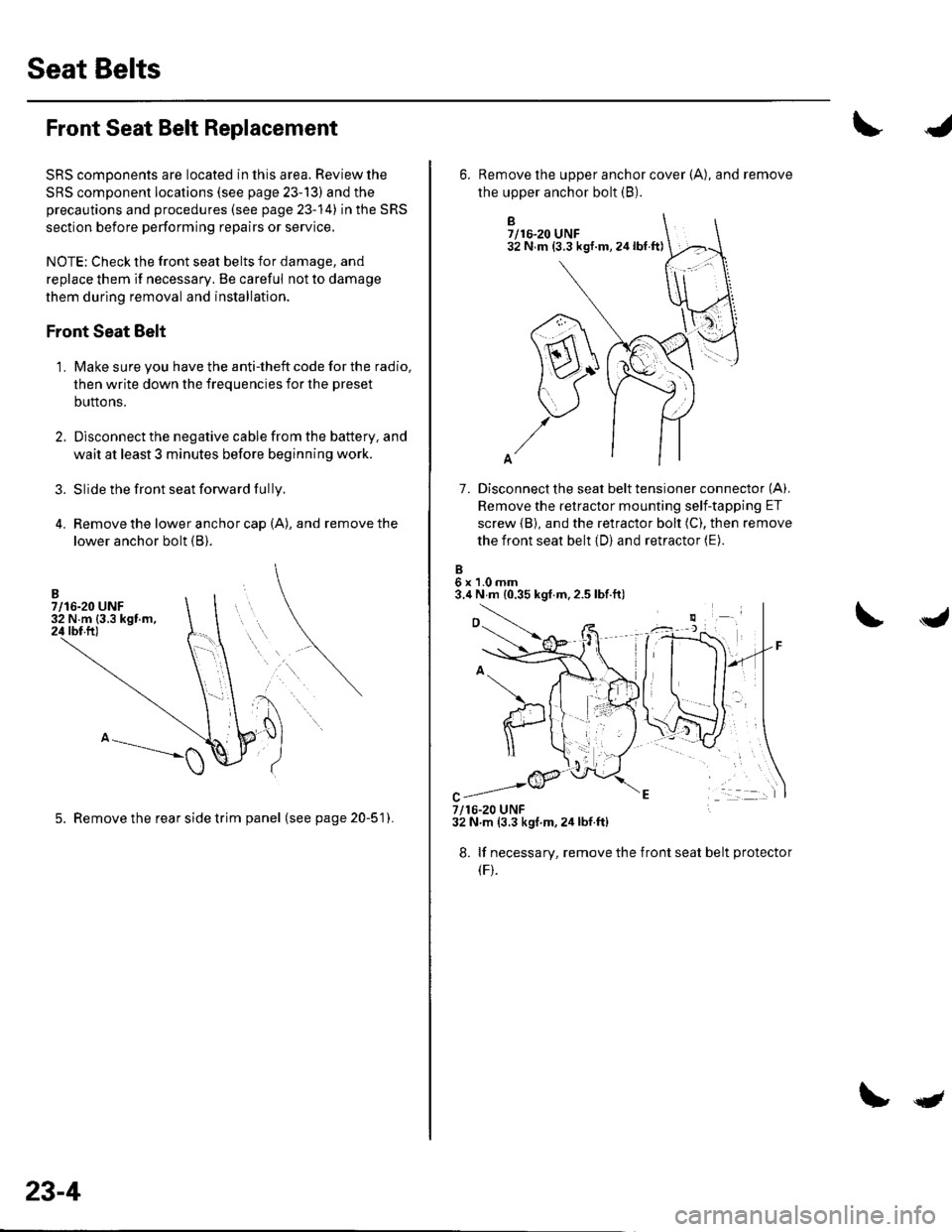
Front Seat Belt Replacement
SRS comDonents are located in this area. Review the
SRS component locations (see page 23-13) and the
precautions and procedures (see page 23-14) in the SRS
section before performing repairs or service,
NOTE: Check the front seat belts for damage, and
replace them if necessary. Be careful not to damage
them during removal and installation.
Front Seat Belt
Make sure you have the anti-theft code for the radio,
then write down the frequencies for the preset
buttons.
Disconnect the negative cable from the battery, and
wait at least 3 minutes before beginning work.
Slide the front seat forward fully.
Remove the lower anchor cap (A), and remove the
lower anchor bolt (B).
3.
1.
5. Remove the rear side trim panel (seepage20-51).
23-4
qt
B7/16-20 UNF32 N m (3.3 kgf.m,24lbt.ft)
7. Disconnect the seat belt tensioner connector (A).
Remove the retractor mounting self-tapping ET
screw {B), and the retractor bolt (C), then remove
the front seat belt (D) and retractor (E).
6x1.0mm3.4 N m {0.35 kgf.m,2.5 lbf.ft)
6. Remove the upper anchor cover {A), and remove
the upper anchor bolt (B).
7/16-20 UNF32 N.m (3.3 kgf m,2ir lbf.ft)
8. lf necessary, remove the
(F).
front seat belt protecto
Page 1015 of 1139
I
I
Rear Seat Belt Replacement
NOTE: Check the rear seat belts for damage, and
replace them if necessary. Be careful not to damage
them during removal and installation.
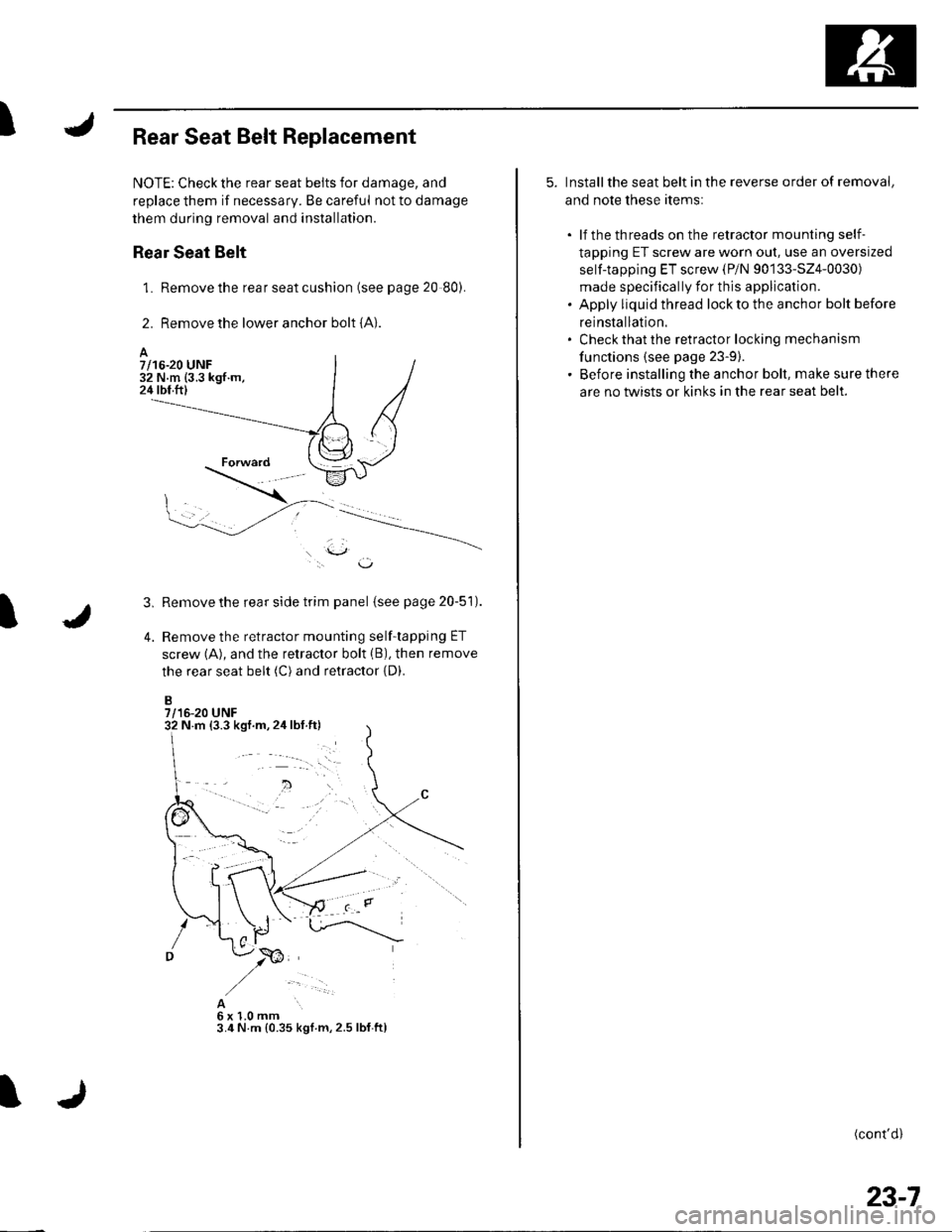
Rear Seat Belt
1. Remove the rear seat cushion (see page 20 80).
2. Remove the lower anchor bolt {A}.
l.\J,
Remove the rear side trim panel (see page 20-51).
Remove the retractor mounting self-tapping ET
screw (A), and the retractor bolt (B), then remove
the rear seat belt (C) and retractor {D).
B7/16-20 UNF
3,
4.
A6x1.0mm3.4 N.m {0.35 kgl m,2.5 lbf.ftl
A7/16-20 UNF32 N.m (3.3 kgf.m,24 tbf.ftl
N m {3.3 kgf.m,2ir lbf.ft)
5. Installthe seat belt in the reverse order of removal,
and note these items:
. lf the threads on the retractor mounting self-
tapping ET screw are worn out, use an oversized
self-tapping ET screw (P/N 90133-524-0030)
made specifically for this application.. Apply liquid thread lock to the anchor bolt before
reinstallation.' Check that the retractor locking mechanism
functions {see page 23-9).. Before installing the anchor bolt, make sure there
are no twists or kinks in the rear seat belt.
(cont'd)
23-7
Page 1019 of 1139
IChild Seat Tether Anchor RemovaUlnstallation
Middle
1. Remove the child seat tether anchor cover (A) in
the rear trim panel (B).
8 x 1.25 mm22 N m {2.2 ksf.m, 16lbf.ft)
,tltl
v\
2.
3.
Remove the anchor bolt (C), then remove the child
seat tether anchor (D). Do not remove the toothed
washer (E) from the tether anchor.
Installthe anchor in the reverse order of removal.
IJ
23-11
Side
1. Remove the rear bulkhead covers from both sides
(see page 20-51).
2. Remove the anchor bolt (A), then remove the child
seat tether anchor (B) from behind the seat-back on
each side ofthe cargo compartment. Do not
remove the toothed washer (C) from the tether
anchor.
AI18 x 1.25 mm22 N.m {2.2 kgt m. 16lbfft)
lnstallthe anchors in the reverse order of removal.
f-..- t".i..].-
Page 1028 of 1139
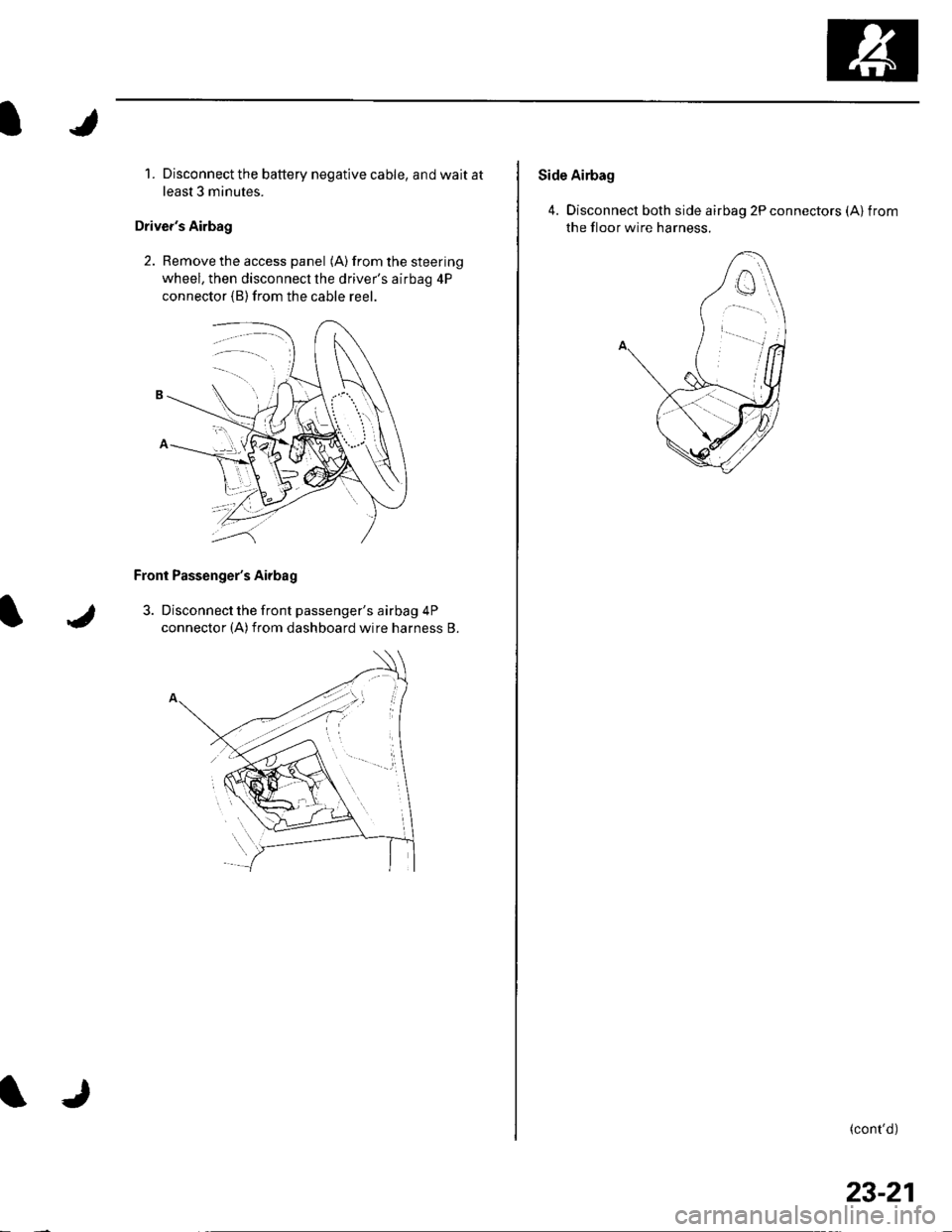
1. Disconnect the battery negative cable, and wait at
least 3 minutes.
Driver's Airbag
2. Remove the access panel (A) from the steering
wheel, then disconnecl the driver's airbag 4P
connector (B)from the cable reer.
Front Passenger's Airbag
3. Disconnect the front passenger's airbag 4P
connector (A)from dashboard wire harness B.
Side Airbag
4. Disconnect both side airbag 2P connectors (Alfrom
the floor wire harness.
(cont'd)
23-21
Page 1038 of 1139
ISystem Description
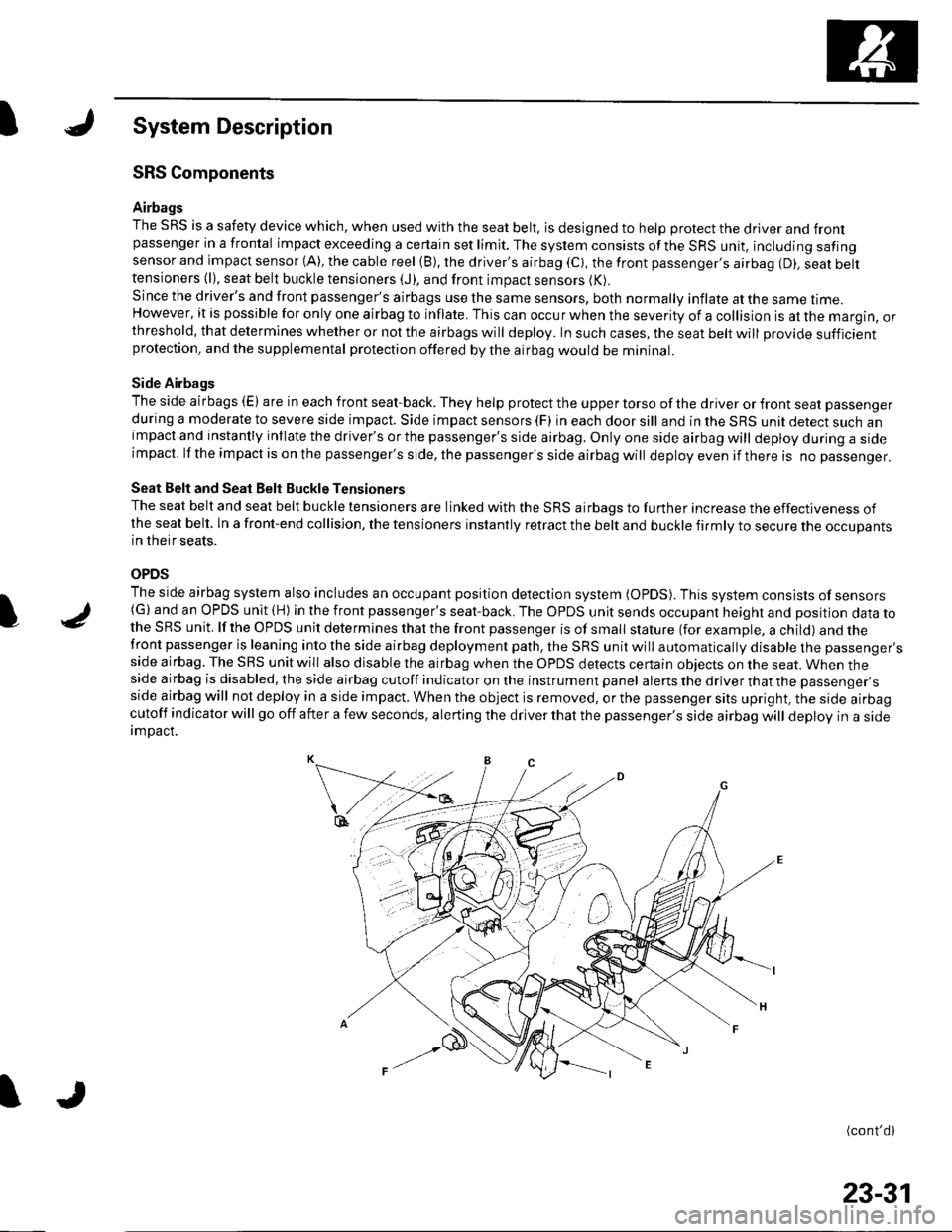
SRS Components
Airbags
The SRS is a safety device which, when used with the seat belt, is designed to help protect the driver and frontpassenger in a frontal impact exceeding a certain set limit. The system consists ofthe SRS unit, including safingsensor and impact sensor (A), the cable reel (B), the driver's airbag (C), the front passenger,s airbag (D). seat belttensioners (l), seat belt buckle tensioners (J), and front impact sensors (K).
Since the driver's and front passenger's airbags use the same sensors, both normally inflate at the same ttme.However, it is possible for only one airbag to inflate. This can occur when the severity of a collision is at the margin, orthreshold, that determines whether or not the airbags will deploy. In such cases, the seat belt will provide sufficientprotection, and the supplemental protection offered by the airbag would be mininal.
Side Airbags
The side airbags (E) are in each front seat-back. They help protect the upper torso of the driver or front seat passenger
during a moderate to severe side impact. Side impact sensors (F) in each door sill and in the SRS unit detect such animpact and instantly inflate the driver's or the passenger's side airbag. Only one side airbag will deploy during a sideimpacl. lf the impact is on the passenger's side, the passenger's side airbag will deploy even if there is no passenger.
Seat Belt and Seat Belt Buckle Tensioners
The seat belt and seat belt buckle tensioners are linked with the SRS airbags to further increase the effectiveness ofthe seat belt. ln a front-end collision, the tensioners instantly retract the belt and buckle firmly to secure the occupantsin their seats.
OPDS
The side airbag system also includes an occupant position detection system (OpDS). This system consists of sensors(G)and an OPDS unit (H) in the front passenger's seat-back. The OPDS unit sends occupant heighl and position data tothe SRS unit. lf the OPDS unit determines that the front passenger is of small stature (for example, a child) and thefront passenger is leaning into the side airbag deployment path, the SRS unit will automatically disable the passenger'sside airbag. The SRS unit will also disable the airbag when the OPDS detects certain obiects on the seat. When theside airbag is disabled, the side airbag cutoff indicator on the instrument panel alerts the driver that the passenger'sside airbag will not deploy in a side impact. When the object is removed, or the passenger sits upright, the side airbagcutoff indicator will go off after a few seconds, alerting the driver that the passenger's side airbag will deploy in a sideimDact.
(cont'd)
I
23-31


 in
the rear trim panel (B).
8 x 1.25 mm22 N m {2.2 ksf.m, 16lbf.ft)
,tltl
v\
2.
3.
Remove the anch")