Page 66 of 317

This light normally comes on when
you turn the ignition ON (II) and
goes of f af ter the engine starts. If it
comes on at any other time, there is
a problem in the Electric Power
Steering system. If this happens,
stop the car in a safe place and turn
of f the engine. Reset the system by
restarting the engine. The indicator
will not turn of f immediately. If it
does not go of f af ter driving a short
distance, or comes back on again
while driving, take the car to your
dealer to have it checked. With the
light on, the EPS may be turned of f ,
making the car harder to steer.This indicator comes on f or a f ew
seconds when you turn the ignition
switch ON (II). It will then go of f if
you have inserted a properly-coded
ignition key. If it is not a properly-
coded key, the indicator will blink
and the engine will not start (see
page ).
This indicator also blinks several
times when you turn the ignition
switch f rom ON (II) to ACCESSORY
(I) or LOCK (0).
This indicator normally comes on f or
a f ew seconds when you turn the
ignition switch ON (II). If it comes
on at any other time, it indicates a
problem in the Integrated Motor
Assist (IMA) system. With the IMA
indicator on, the vehicle may not
accelerate as it normally does. Have
the vehicle checked by the dealer as
soon as possible.
See pages and .
84
172
164
Indicator L ights
Inst rument s and Cont rols
Electric Power Steering
(EPS) Indicator Immobilizer System
IndicatorIMA System Indicator
A uto Idle Stop Indicator
63
Page 75 of 317
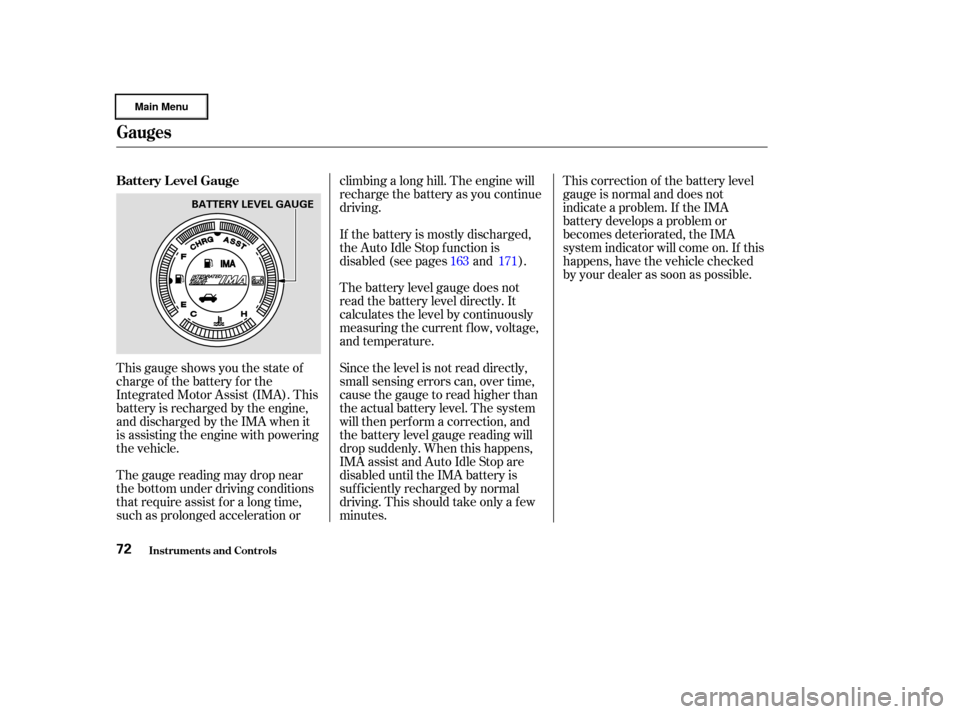
This gauge shows you the state of
charge of the battery for the
Integrated Motor Assist (IMA). This
battery is recharged by the engine,
anddischargedbytheIMAwhenit
is assisting the engine with powering
the vehicle.
The gauge reading may drop near
the bottom under driving conditions
that require assist f or a long time,
such as prolonged acceleration orclimbing a long hill. The engine will
recharge the battery as you continue
driving.
If the battery is mostly discharged,
the Auto Idle Stop f unction is
disabled (see pages and ).
The battery level gauge does not
read the battery level directly. It
calculates the level by continuously
measuring the current f low, voltage,
and temperature.
Since the level is not read directly,
small sensing errors can, over time,
cause the gauge to read higher than
the actual battery level. The system
will then perf orm a correction, and
the battery level gauge reading will
drop suddenly. When this happens,
IMA assist and Auto Idle Stop are
disabled until the IMA battery is
suf f iciently recharged by normal
driving. This should take only a f ew
minutes.This correction of the battery level
gauge is normal and does not
indicate a problem. If the IMA
battery develops a problem or
becomes deteriorated, the IMA
system indicator will come on. If this
happens, have the vehicle checked
by your dealer as soon as possible.
163 171
Battery Level Gauge
Gauges
Inst rument s and Cont rols72
BATTERY LEVEL GAUGE
Page 76 of 317
This gauge shows you the status of
the Integrated Motor Assist (IMA).
When the IMA battery is being
charged, the lef t side of the gauge
illuminates. When the IMA is
assisting the engine, the right side of
the gauge illuminates.If the IMA battery is too hot or too
cold, the IMA system shuts down to
protect the battery. This disables the
IMA assist and Auto Idle Stop, even
though the Battery Level Gauge may
show that the battery is well-charged.
Theref ore, those f unctions may not
operate when you f irst start driving
in very hot or cold weather.
The battery temperature will
normalize af ter a f ew minutes of
driving, and the IMA system will
work normally.
Inst rument s and Cont rols
Gauges
Charge/Assist Gauge
73
IMA CHARGE
GAUGE
IMA ASSIST
GAUGE
Page 139 of 317

If you do not clean the cassette
player regularly, it may eventually
become impossible to remove the
contamination with a normal
cleaning kit.
Use 100-minute or shorter cassettes.
Cassettes longer than that use
thinner tape that may break or jam
the drive.Look at the cassette before you
insert it. If the tape is loose, tighten
it by turning a hub with a pencil or
your f inger.
The cassette player picks up dirt and
oxides f rom the tape. This contami-
nation builds up over time and
causes the sound quality to degrade.
To prevent this, you should clean the
player af ter every 30 hours of use.
Your dealer has a cleaning kit
available.
Never try to insert f oreign objects
into the cassette player. When they are not in use, store
cassettes in their cases to protect
them f rom dust and moisture. Never
place cassettes where they will be
exposed to direct sunlight, high heat,
or high humidity. If a cassette is
exposed to extreme heat or cold, let
it reach a moderate temperature
bef ore inserting it in the player. If the label is peeling of f , remove it
from the cassette or it could cause
the cassette to jam in the player.
Never try to insert a warped or
damaged cassette in the player.If you see the error indication
‘‘ ’’ on the display, press
the EJECT button and remove the
cassette from the unit. Make sure
thetapeisnotdamaged.If the
cassette will not eject or the error
indication stays on after the cassette
ejects, take the car to your Honda
dealer.
Audio System
Comf ort and Convenience Feat ures
Caring f or the Cassette Player
136
Page 186 of 317

Be sure
there is adequate ventilation
whenever you operate the engine.
Let the
engine and exhaust system cool
bef ore touching any parts.
Do
not run the engine unless in-
structed to do so. Read the instructions before you
begin, and make sure you have the
tools and skills required.
Bef ore you begin any maintenance,
make sure your car is parked on
level ground and that the parking
brake is set. Also, be sure the engine
is of f . This will help to eliminate
several potential hazards:
You should wear eye protection and
protective clothing when working
near the battery or when using
compressed air. To reduce the possibility of f ire or
explosion, be caref ul when working
around gasoline or batteries. Use a
commercially available degreaser or
parts cleaner, not gasoline, to clean
parts. Keep cigarettes, sparks, and
flames away from the battery and all
f uel-related parts.
Maintenance Saf ety
Maint enance
Important Saf ety Precautions
Carbon monoxide poisoning
f rom engine exhaust.
Burns f rom hot parts.
Injury f rom moving parts.
183
Page 263 of 317
Lowerthecartothegroundand
remove the jack.
Put on the spare tire. Put the
wheel nuts back on f inger-tight,
then tighten them in a crisscross
pattern with the wheel wrench
until the wheel is f irmly against
the hub. Do not try to tighten
them f ully.
Bef ore mounting the spare tire,
wipeanydirtoff themounting
surface of the wheel and hub with
a clean cloth. Wipe the hub
carefully,itmaybehotfrom
driving.
11.
12.
13.
T aking Care of t he Unexpect ed
Changing a Flat T ire
260
BRAKE HUB
Page 275 of 317

�µ
�µ
This indicator should come on when
the ignition switch is ON (II), and go
out af ter the engine starts. If it
comes on brightly when the engine
is running, it indicates that the
charging system has stopped
charging the battery. Immediately turn of f all electrical
accessories: radio, heater, A/C, rear
def ogger, cruise control, etc. Try not
to use other electrically-operated
controls such as the power windows.
Keep the engine running and take
extra care not to stall it. Starting the
engine will discharge the battery
rapidly.
By eliminating as much of the
electrical load as possible, you can
drive several miles (kilometers)
before the battery is too discharged
to keep the engine running. Drive to
a service station or garage where
you can get technical assistance.
If the Auto Idle Stop is active f or an
extended period, the charging
system indicator may come on. If it
happens, start the engine.
The charging system indicator may
also come on if the Integrated Motor
Assist (IMA) battery charge drops
below a desired level and the engine
starts to recharge the battery.
This indicator may blink af ter you
start the car in the morning when
the temperature is below 20°F
( 30°C). It will stop blinking when
the IMA battery warms up.
T aking Care of t he Unexpect ed
Charging System Indicator
272
CHARGING SYSTEM INDICATOR
Page 288 of 317
Thediagramsinthissectiongive
you the dimensions and capacities of
your Honda, and the locations of the
identif ication numbers. It also
includes inf ormation you should
know about your vehicle’s tires and
emissions control systems.................
Identif ication Numbers . 286
................................
Specif ications .288
DOT Tire Quality Grading .............................
(U.S.Cars) .290
Unif orm Tire Quality ..................................
Grading .290
.................................
Treadwear .290
......................................
Traction .290
.............................
Temperature .291
.........................
Oxygenated Fuels .292
......
Driving in Foreign Countries . 293.......................
Emissions Controls .294
.....................
The Clean Air Act .294
Crankcase Emissions Control ....................................
System .294
Evaporative Emissions Control ....................................
System .294
Onboard Ref ueling Vapor ................................
Recovery .294
...
Exhaust Emissions Controls . 295
....................
PGM-FI System .295
Ignition Timing Control ................................
System .295
Exhaust Gas Recirculation ...................
(EGR) System . 295
Three Way Catalytic ...........................
Converter .295
....................
Replacement Parts . 295
..
Three Way Catalytic Converter . 296
..............
State Emissions Testing . 297
T echnical Inf ormat ion
T echnical Inf ormation285