Page 216 of 317
CONT INUED
The spark plugs in your car are a
special iridium-tipped design f or
longer lif e. The spark plugs should
be replaced according to the
distance recommendation in the
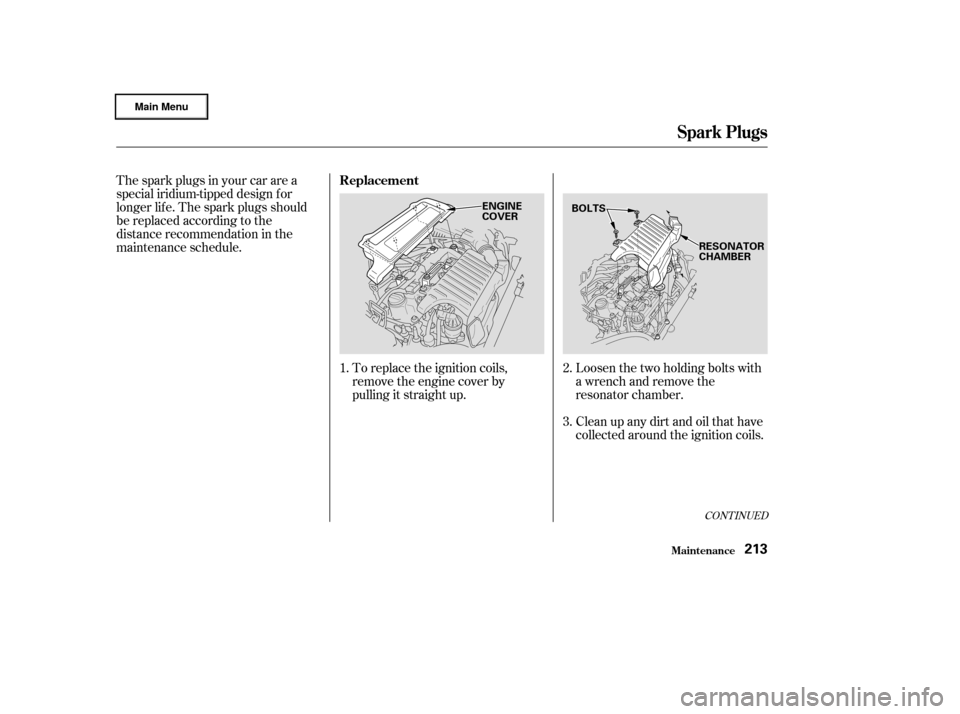
maintenance schedule.Loosen the two holding bolts with
a wrench and remove the
resonator chamber.
Clean up any dirt and oil that have
collected around the ignition coils.
To replace the ignition coils,
remove the engine cover by
pulling it straight up.
1.
2.
3.
Maint enance
Spark Plugs
Replacement
213
ENGINE
COVERBOLTS
RESONATOR
CHAMBER
Page 217 of 317
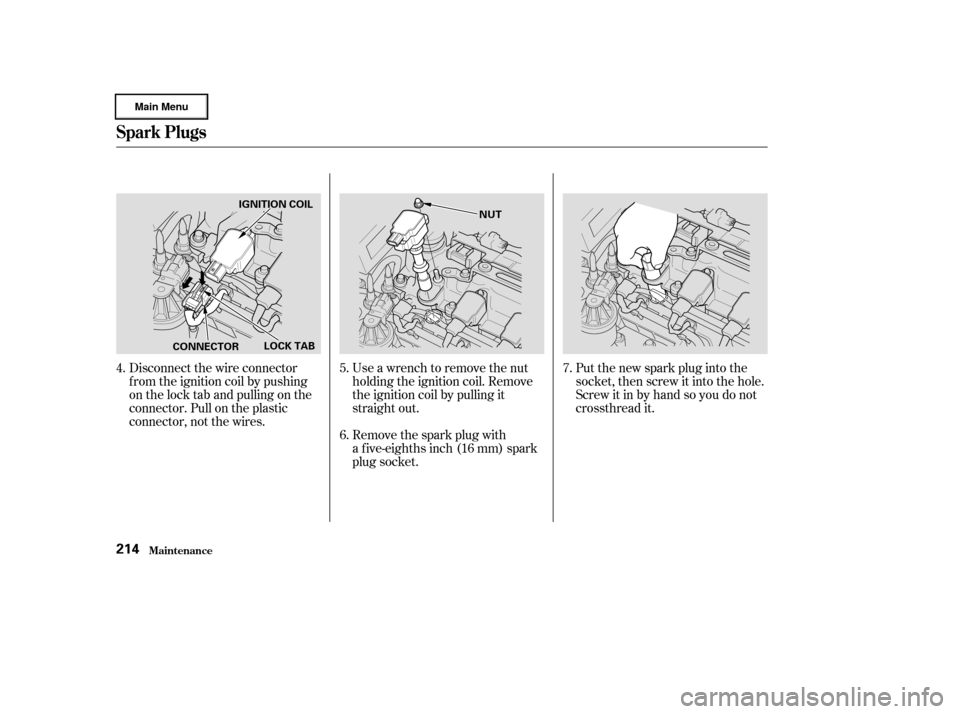
Put the new spark plug into the
socket, then screw it into the hole.
Screw it in by hand so you do not
crossthread it.
Use a wrench to remove the nut
holding the ignition coil. Remove
the ignition coil by pulling it
straight out.
Remove the spark plug with
a f ive-eighths inch (16 mm) spark
plug socket.
Disconnect the wire connector
f rom the ignition coil by pushing
on the lock tab and pulling on the
connector. Pull on the plastic
connector, not the wires.
4.
5.
6.7.
Spark Plugs
Maint enance214
IGNITION COIL
CONNECTOR LOCK TAB NUT
Page 218 of 317
�´
�µSpark Plug Gap:
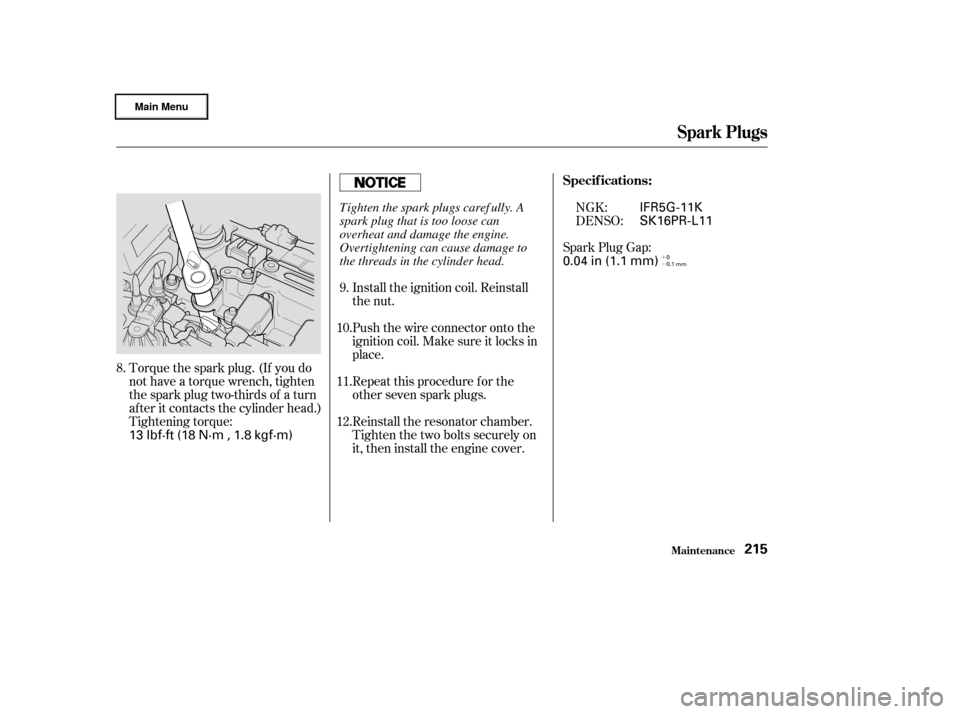
Install the ignition coil. Reinstall
the nut.
Push the wire connector onto the
ignition coil. Make sure it locks in
place.
Repeat this procedure f or the
other seven spark plugs.
Reinstall the resonator chamber.
Tighten the two bolts securely on
it, then install the engine cover.
Torque the spark plug. (If you do
not have a torque wrench, tighten
the spark plug two-thirds of a turn
af ter it contacts the cylinder head.)
Tightening torque: NGK:
DENSO:
9.
10.
11.
12.
8.
Maint enance
Spark Plugs
Specif ications:
215
IFR5G-11K
SK16PR-L11
0.04 in (1.1 mm)
13 lbf·ft (18 N·m , 1.8 kgf·m)
0
0.1 mm
Tighten the spark plugs caref ully. A
spark plug that is too loose can
overheat and damage the engine.
Overtightening can cause damage to
the threads in the cylinder head.
Page 224 of 317
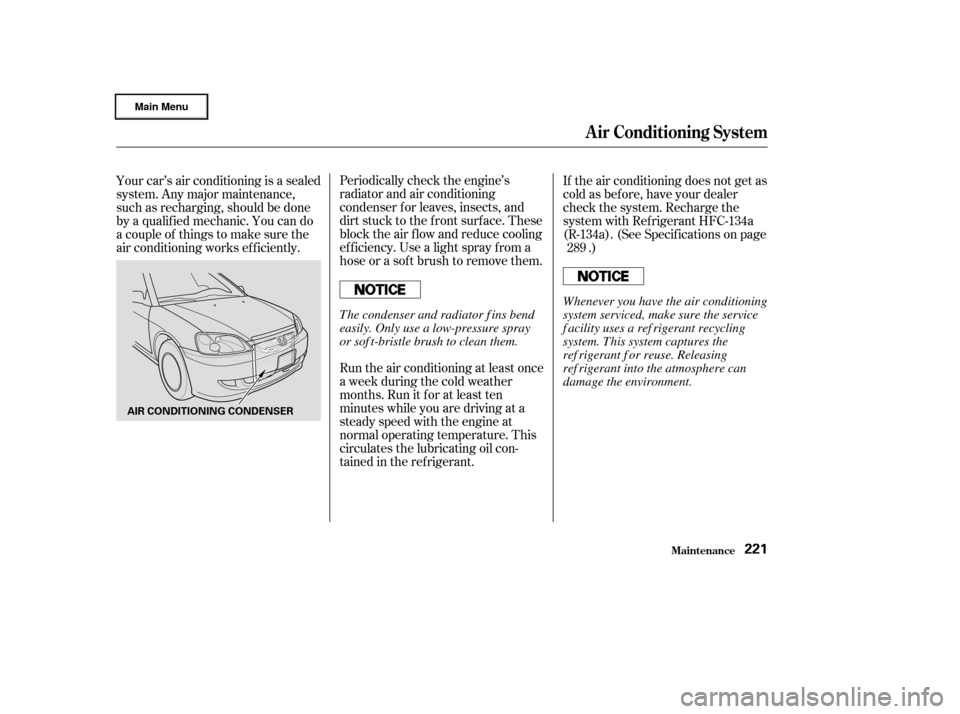
Periodically check the engine’s
radiator and air conditioning
condenser f or leaves, insects, and
dirt stuck to the f ront surf ace. These
block the air f low and reduce cooling
ef f iciency. Use a light spray f rom a
hose or a sof t brush to remove them.If the air conditioning does not get as
cold as before, have your dealer
check the system. Recharge the
system with Ref rigerant HFC-134a
(R-134a). (See Specif ications on page
.)
Run the air conditioning at least once
a week during the cold weather
months. Run it f or at least ten
minutes while you are driving at a
steady speed with the engine at
normal operating temperature. This
circulates the lubricating oil con-
tained in the ref rigerant.
Your car’s air conditioning is a sealed
system. Any major maintenance,
such as recharging, should be done
by a qualif ied mechanic. You can do
a couple of things to make sure the
air conditioning works ef f iciently.
289
A ir Condit ioning Syst em
Maint enance221
AIR CONDITIONING CONDENSER
Whenever you have the air conditioning
system serviced, make sure the service
f acility uses a ref rigerant recycling
system. This system captures the
ref rigerant f or reuse. Releasing
ref rigerant into the atmosphere can
damage the environment.
The condenser and radiator f ins bend
easily. Only use a low-pressure spray
or sof t-bristle brush to clean them.
Page 237 of 317
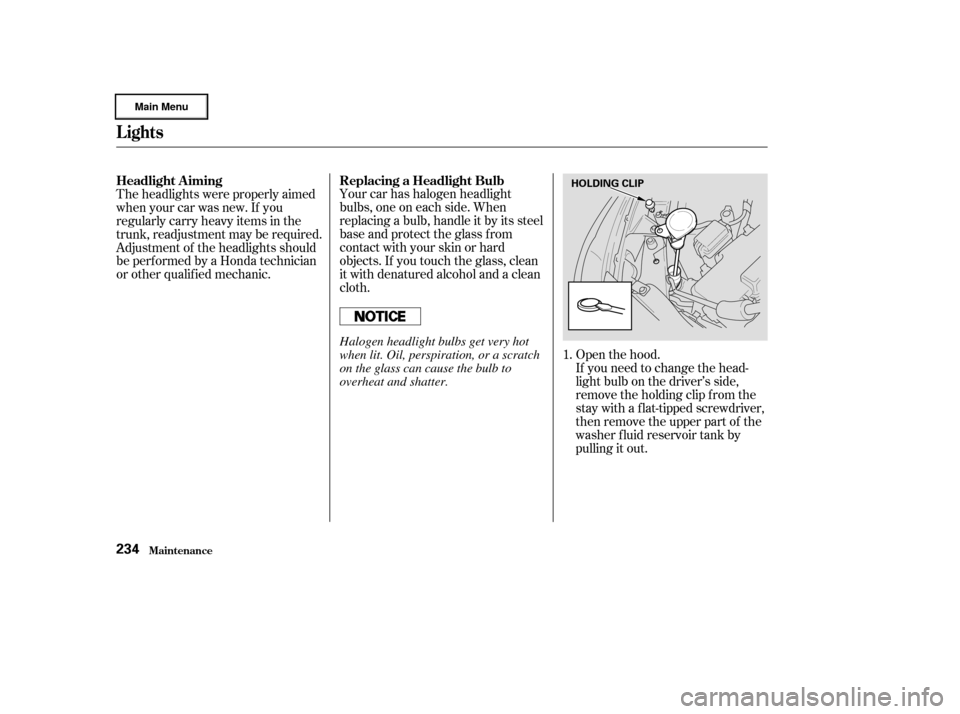
Open the hood.
Your car has halogen headlight
bulbs, one on each side. When
replacing a bulb, handle it by its steel
base and protect the glass from
contactwithyourskinorhard
objects. If you touch the glass, clean
it with denatured alcohol and a clean
cloth.
Theheadlightswereproperlyaimed
when your car was new. If you
regularly carry heavy items in the
trunk, readjustment may be required.
Adjustment of the headlights should
be perf ormed by a Honda technician
or other qualif ied mechanic.
If you need to change the head-
light bulb on the driver’s side,
remove the holding clip f rom the
stay with a flat-tipped screwdriver,
then remove the upper part of the
washer f luid reservoir tank by
pulling it out.
1.
Replacing a Headlight Bulb
Headlight A iming
Lights
Maint enance234
HOLDING CLIP
Halogen headlight bulbs get very hot
when lit. Oil, perspiration, or a scratch
on the glass can cause the bulb to
overheat and shatter.
Page 246 of 317

Block the rear wheels.
Fill the f uel tank.
Change the engine oil and f ilter
(see page ).
Wash and dry the exterior
completely.
Cleantheinterior.Makesurethe
carpeting, floor mats, etc. are
completely dry.
If you need to park your car f or an
extended period (more than one
month), there are several things you
should do to prepare it f or storage.
Proper preparation helps prevent
deterioration and makes it easier to
get your car back on the road. If
possible, store your car indoors.
If the car is to be stored for a
longer period, it should be
supported on jackstands so the
tires are of f the ground.
Leave one window open slightly (if
the car is being stored indoors).
Support the f ront wiper blade
arms with a f olded towel or rag so
they do not touch the windshield.
To minimize sticking, apply a
silicone spray lubricant to all door
and trunk seals. Also, apply a
vehiclebodywaxtothepainted
surfaces that mate with the door
and trunk seals.Coverthecarwitha‘‘breathable’’
cover, one made f rom a porous
material such as cotton.
Nonporous materials, such as
plastic sheeting, trap moisture,
which can damage the paint.
Leave the parking brake off. Put
the transmission in Reverse (5-
speed manual) or Park (CVT). Disconnect the 12 volt battery.
Reconnect the 12 volt battery and
drive your car every month f or
about 30 minutes. This will keep
the IMA battery charged and in
good condition.
If you store your car f or 12 months
or longer, have your Honda dealer
perf orm the inspections called f or in
the 24 months maintenance schedule
(Normal Conditions) as soon as you
take it out of storage (see page ).
The replacements called f or in the
maintenance schedule are not
needed unless the car has actually
reached that time or mileage.
197
186
St oring Your Car
Maint enance243
Page 258 of 317

This section covers the more-
common problems that motorists
experience with their vehicles. It
gives you inf ormation about how to
safely evaluate the problem and what
to do to correct it. If the problem has
stranded you on the side of the road,
you may be able to get going again.
If not, you will also f ind instructions
on getting your car towed.......................
Compact Spare Tire .256
....................
Changing a Flat Tire .257
..........
If Your Engine Won’t Start . 263
Nothing Happens or the Starter Motor Operates Very .....................................
Slowly .263
The Starter Operates ................................
Normally .264
................................
Jump Starting .265
............
If Your Engine Overheats . 268
.........
Low Oil Pressure Indicator . 271
..........
Charging System Indicator . 272
.......
Malf unction Indicator Lamp . 273
.......................
Readiness Codes .274
...............
Brake System Indicator . 275
..............................................
Fuses .276
..........
Checking and Replacing . 277
......................
Emergency Towing .282
Taking Care of the Unexpected
T aking Care of t he Unexpect ed255
Page 274 of 317
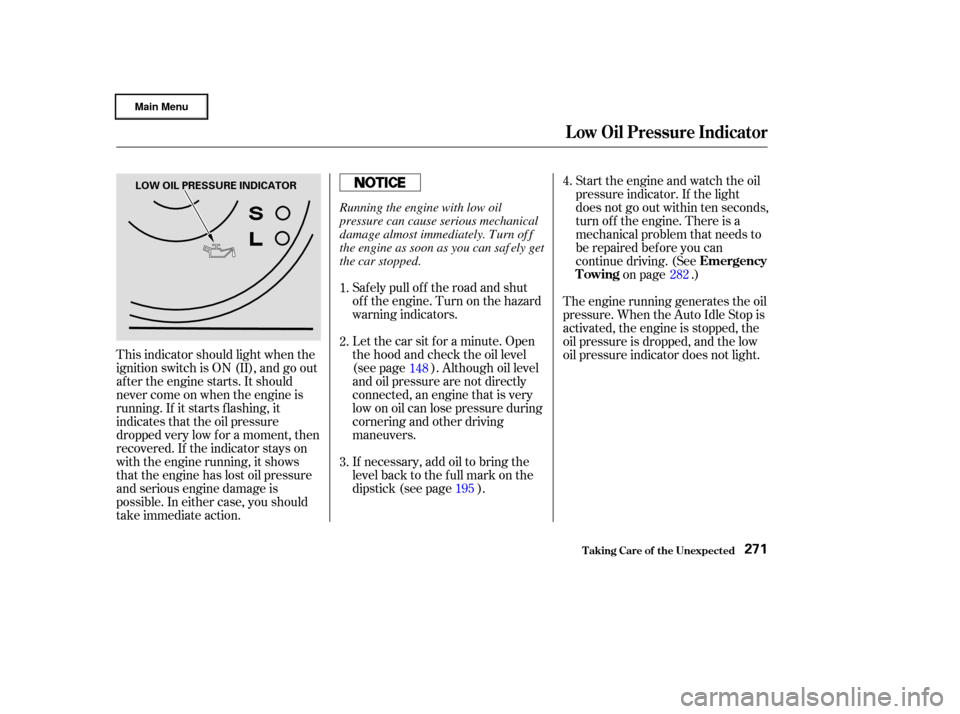
This indicator should light when the
ignition switch is ON (II), and go out
af ter the engine starts. It should
never come on when the engine is
running. If it starts f lashing, it
indicates that the oil pressure
dropped very low f or a moment, then
recovered. If the indicator stays on
with the engine running, it shows
that the engine has lost oil pressure
and serious engine damage is
possible. In either case, you should
take immediate action.Saf ely pull of f the road and shut
of f the engine. Turn on the hazard
warning indicators.
If necessary, add oil to bring the
level back to the full mark on the
dipstick (see page ). Letthecarsitforaminute.Open
the hood and check the oil level
(see page ). Although oil level
and oil pressure are not directly
connected, an engine that is very
low on oil can lose pressure during
cornering and other driving
maneuvers.Start the engine and watch the oil
pressure indicator. If the light
does not go out within ten seconds,
turn of f the engine. There is a
mechanical problem that needs to
be repaired bef ore you can
continue driving. (See
on page .)
The engine running generates the oil
pressure. When the Auto Idle Stop is
activated, the engine is stopped, the
oil pressure is dropped, and the low
oil pressure indicator does not light.
1.
2.
3. 4.
148 195 282
L ow Oil Pressure Indicator
T aking Care of t he Unexpect ed
Emergency
Towing
271
LOW OIL PRESSURE INDICATOR
Running the engine with low oil
pressure can cause serious mechanical
damage almost immediately. Turn of f
the engine as soon as you can saf ely get
the car stopped.