Page 222 of 395

Push the clutch pedal down all the
way. START (III) does not
f unction unless the clutch pedal is
depressed. Apply the parking brake.
In cold weather, turn of f all
electrical accessories to reduce
the drain on the battery.
Make sure the shif t lever is in
Park. Press on the brake pedal.If the engine still does not start,
press the accelerator pedal all the
way down and hold it there while
starting in order to clear f looding.
As bef ore, keep the ignition key in
the START (III) position f or no
more than 15 seconds. Return to
step 5 if the engine does not start.
If it starts, lif t your f oot of f the
accelerator pedal so the engine
does not race.
Without touching the accelerator
pedal, turn the ignition key to the
START (III) position. If the engine
does not start right away, do not
hold the key in START (III) f or
more than 15 seconds at a time.
Pause f or at least 10 seconds
bef ore trying again.
If the engine does not start within
15 seconds, or starts but stalls
right away, repeat step 4 with the
accelerator pedal pressed half-way
down. If the engine starts, release
pressure on the accelerator pedal
so the engine does not race.
1.
2.
3.
4.
5.6.
Automatic Transmission:
Manual Transmission:
Starting the Engine
Driving219
Page 229 of 395
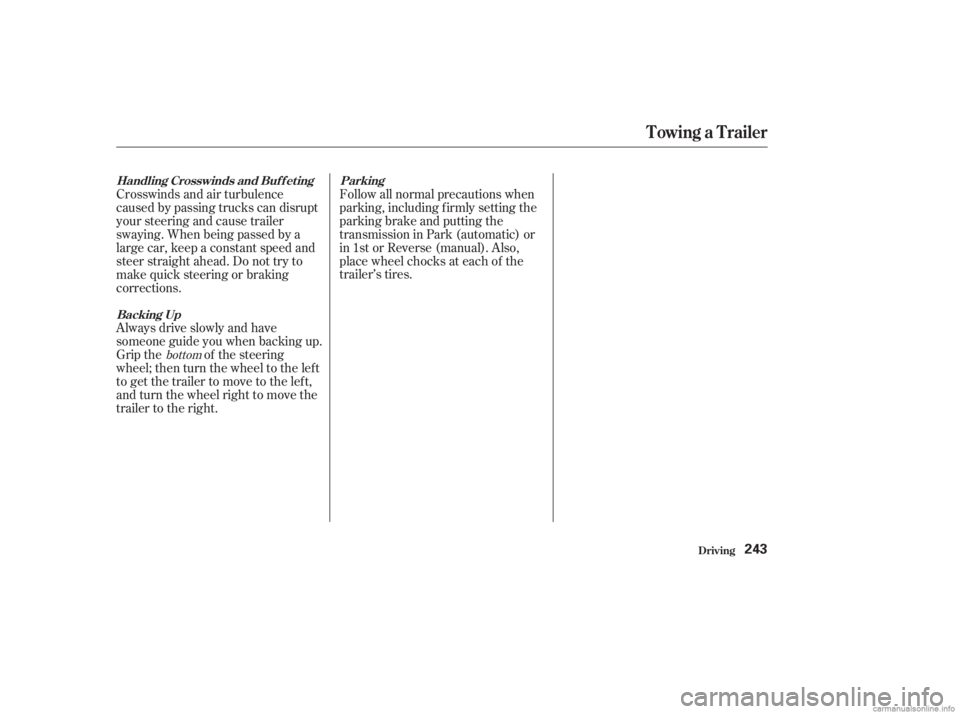
This allows you to move the shif t
lever out of Park if the normal
method of pushing on the brake
pedal and pressing the release
button does not work.Set the Parking brake.
Remove the key from the ignition
switch.
If you exceed the maximum speed
f or the gear you are in, the engine
speed will enter into the tachometer’s
red zone. If this occurs, you may f eel
the engine cut in and out. This is
caused by a limiter in the engine’s
computer controls. The engine will
run normally when you reduce the
RPM below the red zone.
Put a cloth on the edge of the Shif t
Lock Release slot cover next to
the shift lever.
Use a small flat-tipped screwdriver
or finger nail file to remove the
cover. Caref ully pry of f the edge
of the cover.
1.
2.
3.
Automatic Transmission
Driving
Shif t L ock Release
Engine Speed L imiter
226
COVER
Page 231 of 395
�µMake sure the parking brake is f ully
released bef ore driving away.
Driving with the parking brake
partially set can overheat or damage
the rear brakes.
Always use the parking brake when
you park your car. The indicator on
the instrument panel shows that the
parking brake is not f ully released; it
does not indicate that the parking
brakeisfirmlyset.Makesurethe
parking brake is set f irmly or your
car may roll if it is parked on an
incline.
If your car has an automatic
transmission, set the parking brake
bef ore you put the transmission in
Park.Thiskeepsthecarfrom
moving and putting pressure on the
parking mechanism in the
transmission making it easier to
move the shift lever out of Park
when you want to drive away. If the car is f acing uphill, turn the
f ront wheels away f rom the curb. If
you have a manual transmission, put
it in f irst gear.
If the car is f acing downhill, turn the
f ront wheels toward the curb. If you
have a manual transmission, put it in
reverse gear.
Make sure the moonroof (if
equipped) and the windows are
closed.
Lockthedoorswiththekeyorthe
remote transmitter. Place any packages, valuables, etc.,
in the trunk or take them with you. Turn of f the lights.
Never park over dry leaves, tall
grass, or other f lammable
materials. The three way catalytic
converter gets very hot, and could
cause these materials to catch on
fire. Check the indicator on the
instrument panel to verif y that the
security system is set.
On EX, LX-V6, and Canadian LX-G
models
Parking T ips
Driving
Parking
228
Page 234 of 395
such as trying to take a
corner too f ast or making a sudden
lane change. Always drive at a safe,
prudent speed f or the road and
weather conditions.
Always steer moderately
when you are braking hard. Severe
or sharp steering wheel movement
can still cause your car to veer into
oncoming traffic or off the road. it
only helps with steering control
during braking. You should always
maintain a saf e f ollowing distance
f rom other vehicles.
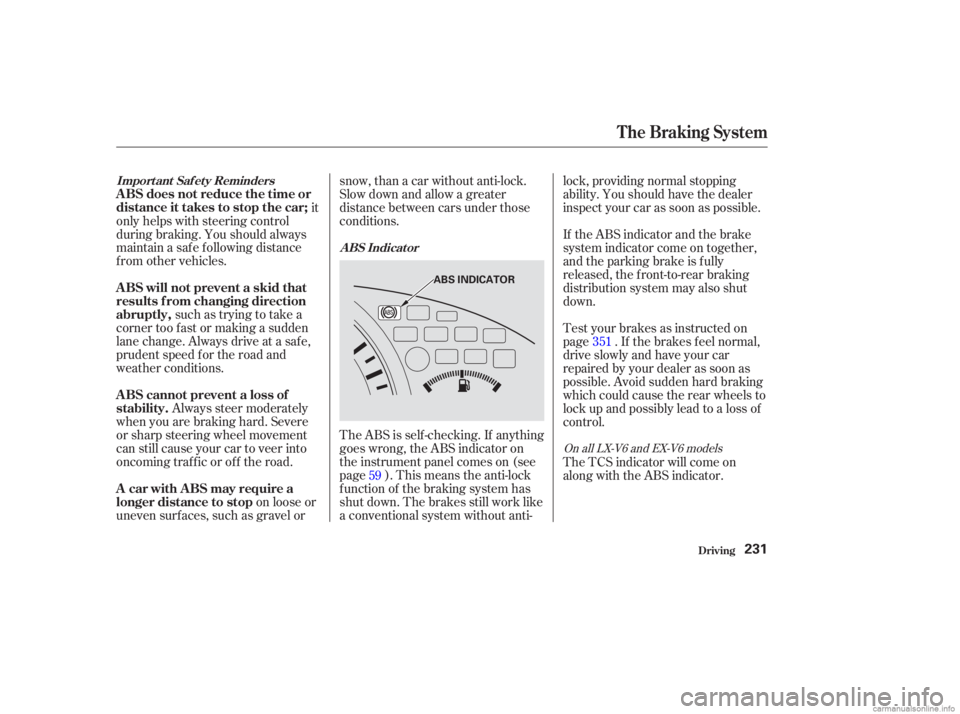
The ABS is self -checking. If anything
goes wrong, the ABS indicator on
the instrument panel comes on (see
page ). This means the anti-lock
f unction of the braking system has
shut down. The brakes still work like
a conventional system without anti-lock, providing normal stopping
ability. You should have the dealer
inspect your car as soon as possible.
on loose or
uneven surf aces, such as gravel or snow, than a car without anti-lock.
Slow down and allow a greater
distance between cars under those
conditions.
If the ABS indicator and the brake
system indicator come on together,
and the parking brake is f ully
released, the front-to-rear braking
distribution system may also shut
down.
Test your brakes as instructed on
page . If the brakes f eel normal,
drive slowly and have your car
repaired by your dealer as soon as
possible. Avoid sudden hard braking
which could cause the rear wheels to
lock up and possibly lead to a loss of
control.
The TCS indicator will come on
alongwiththeABSindicator.
59 351
On all LX-V6 and EX-V6 models
Import ant Saf et y Reminders
A BS Indicat or
A BS will not prevent a skid that
results f rom changing direction
abruptly,
A BS cannot prevent a loss of
stability. A BS does not reduce the time or
distance it takes to stop the car;
A car with ABS may require a
longer distance to stop
The Braking System
Driving231
ABS INDICATOR
Page 245 of 395
When driving down hills, reduce
your speed and shif t down to 2nd
gear. Do not ‘‘ride’’ the brakes, and
remember it will take longer to slow
downandstopwhentowingatrailer.
When climbing hills, closely watch
your temperature gauge. If it nears
the red (Hot) mark, turn the air
conditioning of f , reduce speed and, if
necessary, pull to the side of the
road to let the engine cool.
The added weight, length, and
height of a trailer will af f ect your car’s
handling and perf ormance, so
driving with a trailer requires some
special driving skills and techniques.
Foryoursafetyandthesafetyof
others,taketimetopracticedriving
maneuvers bef ore heading f or the
open road, and f ollow the guidelines
discussed below.
Make turns more slowly and wider
than normal. The trailer tracks a
smaller arc than your car, and it can
hit or run over something the car
misses. Allow more time and
distance f or braking. Do not brake or
turn suddenly as this could cause the
trailer to jackknif e or turn over.
If youmuststopwhenfacinguphill,
use the f oot brake or parking brake.
Do not try to hold the car in place by
pressing on the accelerator, as this
can cause the automatic
transmission to overheat.
Drive slower than normal in all
driving situations, and obey posted
speed limits f or cars with trailers. If
you have an automatic transmission,
use D position when towing a trailer
on level roads. D is the proper shif t
lever position to use when towing a
trailer in hilly terrain. (See ‘‘ ’’ in the next column f or
additional gear information.) If the automatic transmission shif ts
f requently while going up a hill, shif t
to D .
3
3
Driving Saf ely With a T railerMaking T urns and Braking
Driving on Hills
T owing Speeds and Gears
Driving
on Hills
Towing a Trailer
Driving242
Page 246 of 395
Always drive slowly and have
someone guide you when backing up.
Grip the of the steering
wheel; then turn the wheel to the lef t
to get the trailer to move to the lef t,
andturnthewheelrighttomovethe
trailer to the right.Follow all normal precautions when
parking, including f irmly setting the
parking brake and putting the
transmission in Park (automatic) or
in 1st or Reverse (manual). Also,
place wheel chocks at each of the
trailer’s tires.
Crosswinds and air turbulence
caused by passing trucks can disrupt
your steering and cause trailer
swaying. When being passed by a
large car, keep a constant speed and
steer straight ahead. Do not try to
make quick steering or braking
corrections.
bottom
Handling Crosswinds and Buf f et ing
Backing Up Parking
Towing a Trailer
Driving243
Page 250 of 395
Be sure
there is adequate ventilation
whenever you operate the engine.
Let the
engine and exhaust system cool
bef ore touching any parts.
Do
not run the engine unless in-
structed to do so. Read the instructions before you
begin, and make sure you have the
tools and skills required.
Bef ore you begin any maintenance,
make sure your car is parked on
level ground and that the parking
brake is set. Also, be sure the engine
is of f . This will help to eliminate
several potential hazards:
You should wear eye protection and
protective clothing when working
near the battery or when using
compressed air. To reduce the possibility of f ire or
explosion, be caref ul when working
around gasoline or batteries. Use a
commercially available degreaser or
parts cleaner, not gasoline, to clean
parts. Keep cigarettes, sparks, and
flames away from the battery and all
f uel-related parts.
Maintenance Saf ety
Maint enance
Important Saf ety Precautions
Carbon monoxide poisoning
f rom engine exhaust.
Burns f rom hot parts.
Injury f rom moving parts.
247
Page 253 of 395

�µ
�Ì
�Î
�Ì�Ì �Î
Maint enance
4-cylinder Models
250
Visually inspect the following items:
Every 30,000 miles (48,000 km)
Service at the indicated distance
or time whichever comes first.
miles x 1,000
km x 1,000
months
Replace engine oil
Replace engine oil filter
Check engine oil and coolant
Replace air cleaner element
Inspect valve clearance
Replace spark plugs
Inspect drive belt
Inspect idle speed
Replace engine coolant
Replace transmission fluid
Inspect front and rear brakes
Replace brake fluid
Check parking brake adjustment
Replace dust and pollen filter
Rotate tires (Check tire inflation and condition at
least once per month) At 120,000 miles (192,000 km) or 10 years,
then every 60,000 miles (96,000 km) or 5 years
Tie rod ends, steering gear box, and boots
Suspension components
Driveshaft boots
Brake hoses and lines (including ABS)
All fluid levels and condition of fluids
Exhaust system
Fuel lines and connections Every 110,000 miles (176,000 km)
Replace at 120,000 miles (192,000 km) or 6 years, then every 90,000 miles (144,000 km) or 5 years. See information on maintenance and emissions warranty, last column, page . Inspect every 110,000 miles (176,000 km), otherwise adjust only if noisy
Check oil and coolant at each fuel stop
10
16
20
3230
4840
6450
8060
9670
112 80
128 90
144 100
160110
176120
192130
208140
224150
240160
256170
272180
288
Every 30,000 miles (48,000 km) or 2 years Every 10,000 miles (16,000 km) or 1 year
Inspect every 30,000 miles (48,000 km) or 2 years
Rotate tires every 10,000 miles (16,000 km)Every 3 years (independent of mileage) 72
60 84 96 108
12 24 36 48
M/T
A/T
249
:
:
Maintenance Schedule for Normal Conditions