Page 153 of 380
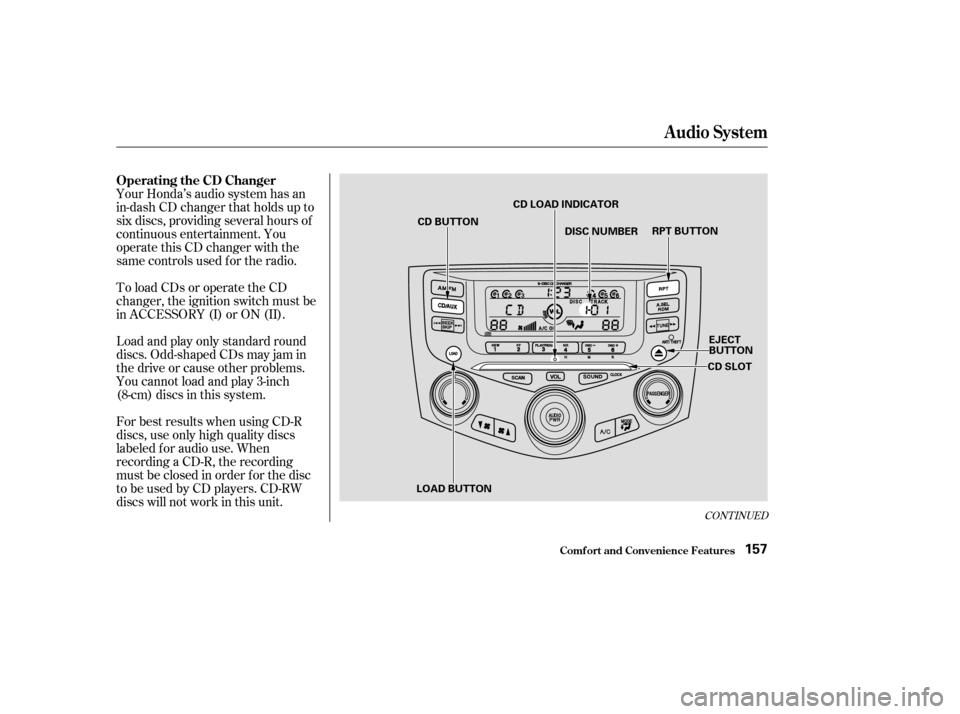
Your Honda’s audio system has an
in-dash CD changer that holds up to
six discs, providing several hours of
continuous entertainment. You
operate this CD changer with the
same controls used f or the radio.
To load CDs or operate the CD
changer, the ignition switch must be
in ACCESSORY (I) or ON (II).
Load and play only standard round
discs. Odd-shaped CDs may jam in
the drive or cause other problems.
You cannot load and play 3-inch
(8-cm)discsinthissystem.
For best results when using CD-R
discs, use only high quality discs
labeled f or audio use. When
recording a CD-R, the recording
must be closed in order f or the disc
to be used by CD players. CD-RW
discs will not work in this unit.
CONT INUED
Operating the CD Changer
Audio System
Comf ort and Convenience Feat ures157
CD BUTTONEJECT
BUTTON
RPT BUTTON
DISC NUMBER
CD SLOT
LOAD BUTTON CD LOAD INDICATOR
�����—�����—�����y������
��������y���
�(�����������y���
�����y
Page 171 of 380
Your Honda’s radio can receive the
complete AM and FM bands.
Those bands cover these f requen-
cies:
AM band:
530 to 1,710 kilohertz
FM band:
87.7 to 107.9 megahertz
Radio stations on the AM band are
assigned f requencies at least ten
kilohertz apart (530, 540, 550).
Stations on the FM band are
assigned f requencies at least 0.2
megahertz apart (87.9, 88.1, 88.3).
Stations must use these exact
f requencies. It is f airly common f or
stations to round-of f the f requency in
their advertising, so your radio could
display a f requency of 100.9 even
though the announcer may identif y
the station as ‘‘FM101.’’How well your Honda’s radio
receives stations is dependent on
many f actors, such as the distance
from the station’s transmitter,
nearby large objects, and atmos-
pheric conditions.
A radio station’s signal gets weaker
as you get f arther away f rom its
transmitter. If you are listening to an
AM station, you will notice the sound
volume becoming weaker, and the
stationdriftinginandout.If youare
listening to an FM station, you will
see the stereo indicator f lickering of f
and on as the signal weakens.
Eventually, the stereo indicator will
go of f and the sound will f ade
completely as you get out of range of
the station’s signal.
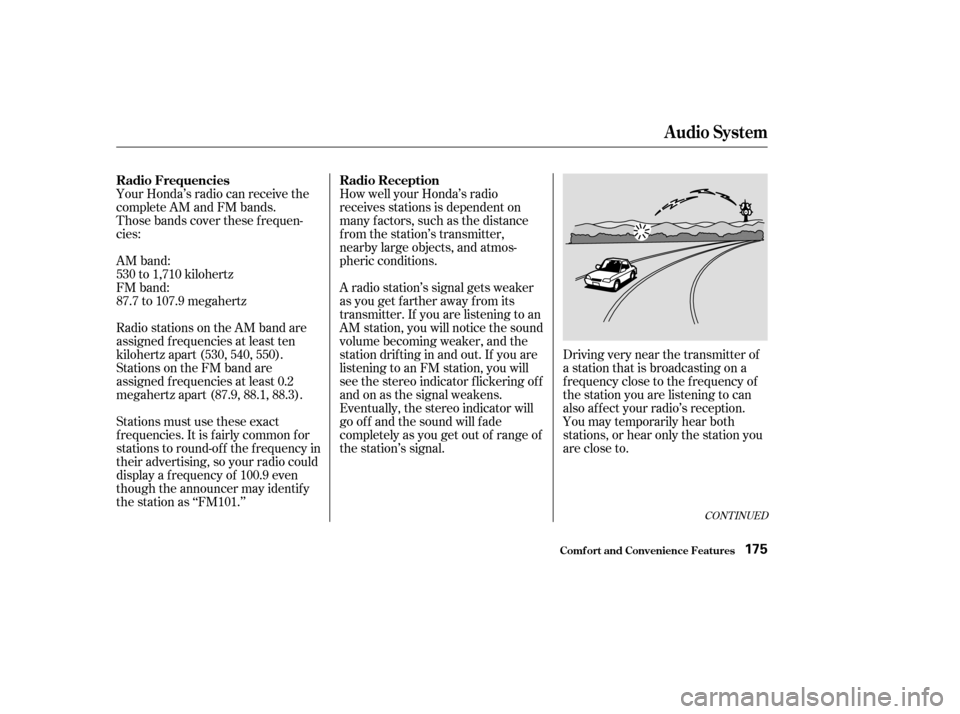
Driving very near the transmitter of
a station that is broadcasting on a
f requency close to the f requency of
the station you are listening to can
also af f ect your radio’s reception.
You may temporarily hear both
stations,orhearonlythestationyou
are close to.
CONT INUED
Radio Frequencies Radio Reception
Audio System
Comf ort and Convenience Feat ures175
�����—�����—�����y������
��������y���
�(�����������y���
�����y
Page 173 of 380
Your Honda’s audio system has an
in-dash CD changer that holds up to
six discs, providing several hours of
continuous entertainment. You
operate this CD changer with the
same controls used f or the radio.
To load CDs or operate the CD
changer, the ignition switch must be
in ACCESSORY (I) or ON (II).
Load and play only standard round
discs. Odd-shaped CDs may jam in
the drive or cause other problems.
You cannot load and play 3-inch
(8-cm)discsinthissystem.
For best results when using CD-R
discs, use only high quality discs
labeled f or audio use. When
recording a CD-R, the recording
must be closed in order f or the disc
to be used by CD players. CD-RW
discs will not work in this unit.
CONT INUED
Operating the CD Changer
Audio System
Comf ort and Convenience Feat ures177
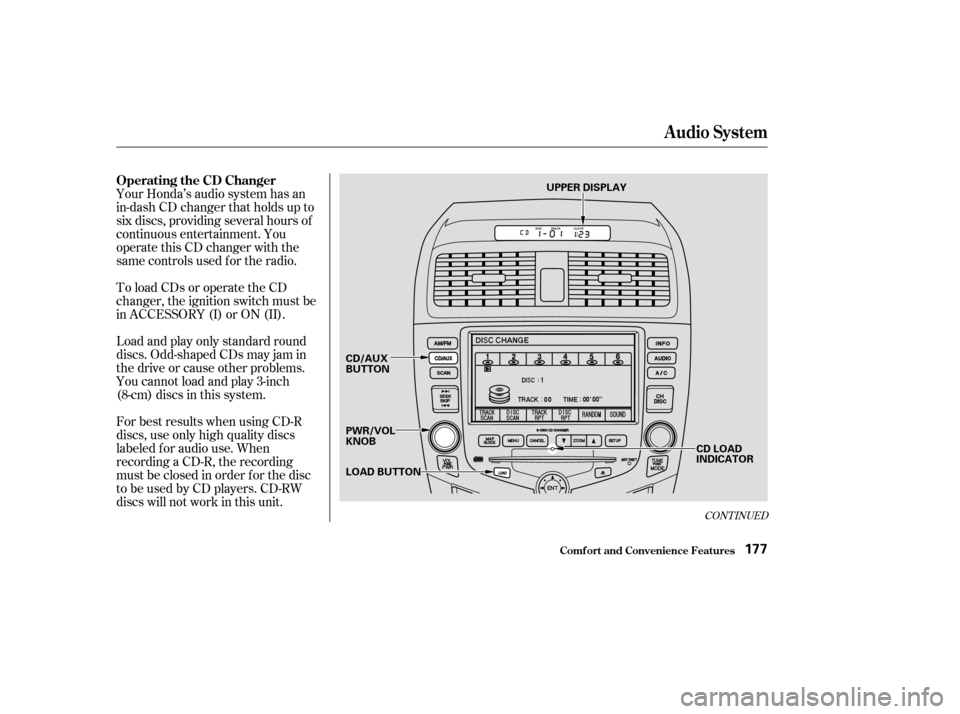
LOAD BUTTON
CD/AUX
BUTTON
PWR/VOL KNOB
CD LOAD
INDICATOR
UPPER DISPLAY
�����—�����—�����y���������������y���
�(�����������y���
�����y
Page 191 of 380
Accelerate to the desired cruising
speedabove25mph(40km/h).
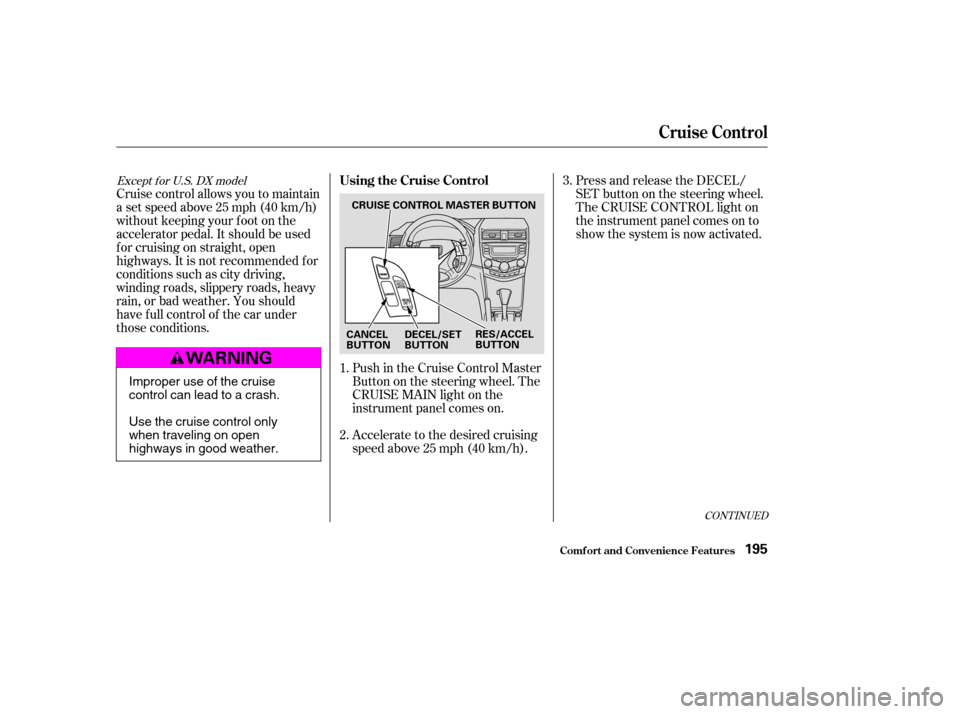
Push in the Cruise Control Master
Buttononthesteeringwheel.The
CRUISE MAIN light on the
instrument panel comes on. Press and release the DECEL/
SET button on the steering wheel.
The CRUISE CONTROL light on
the instrument panel comes on to
show the system is now activated.
Cruise control allows you to maintain
asetspeedabove25mph(40km/h)
without keeping your f oot on the
accelerator pedal. It should be used
f or cruising on straight, open
highways. It is not recommended f or
conditions such as city driving,
winding roads, slippery roads, heavy
rain, or bad weather. You should
have f ull control of the car under
those conditions.
1. 2.3.
CONT INUED
Except f or U.S. DX modelUsing the Cruise Control
Cruise Control
Comf ort and Convenience Feat ures195
CRUISE CONTROL MASTER BUTTON
CANCEL
BUTTON RES/ACCEL
BUTTON
DECEL/SET
BUTTON
Improper use of the cruise
control can lead to a crash.
Use the cruise control only
when traveling on open
highways in good weather.
�����—�����—�����y������
��������y���
�(�����������y���
�����y
Page 219 of 380

�µ�µ
�µ To shif t to Second,
pressthereleasebuttonontheside
of the shif t lever. This position locks
thetransmissioninsecondgear.It
does not downshif t to f irst gear
when you come to a stop. Second
gives you more power when climbing,
and increased engine braking when
going down steep hills. Use second
gear when starting out on a slippery
surf ace or in deep snow. It will help
reduce wheelspin. To shif t f rom Second to
First, press the release button on the
side of the shift lever. With the lever
in this position, the transmission
locks in First gear. By upshif ting and
downshif ting through 1, 2, D , and D,
you can operate this transmission
much like a manual transmission
without a clutch pedal.
ForfasteraccelerationwheninD or
D, you can get the transmission to
automatically downshif t by pushing
the accelerator pedal to the floor.
The transmission will shif t down one
or two gears, depending on your
speed. This position is similar
to D, except only the first three
gears are selected instead of all f ive.
Use D when towing a trailer in hilly
terrain, or to provide engine braking
when going down a steep hill. D can
also keep the transmission f rom
cycling between third and f ourth
gears in stop-and-go driving.
3
3
3
3
Second (2) First (1)
Drive (D )
Automatic Transmission
Driving
3
225
�����—�����—�����y���������������y���
�(�����������y���������y
Page 223 of 380

Your Honda is equipped with f ront
disc brakes. The brakes on the rear
wheels may be disc or drum,
depending on the model. A power
assist helps reduce the ef f ort needed
on the brake pedal.
Put your f oot on the brake pedal only
when you intend to brake. Resting
your f oot on the pedal keeps the
brakes applied lightly, causing them
to build up heat. Heat build-up can
reduce how well your brakes work. It
also keeps your brake lights on all
the time, conf using drivers behind
you.Constant application of the brakes
when going down a long hill builds
up heat and reduces their ef f ective-
ness. Use the engine to assist the
brakes by downshif ting to a lower
gear and taking your f oot of f the
accelerator pedal.
Check your brakes af ter driving
through deep water. Apply the
brakes moderately to see if they f eel
normal. If not, apply them gently and
f requently until they do. Since a
longer distance is needed to stop
with wet brakes, be extra cautious
and alert in your driving. Your brakes may sometimes squeal
or squeak when you apply them
lightly. Do not conf use this with the
brakewearindicators.Theymakea
very audible ‘‘screeching.’’
The f ront disc brakes on all models
have audible brake wear indicators.
They are also on the rear brakes of
cars equipped with rear disc brakes
(EX, EX-V6, and LX-V6 models) as
standard equipment.
When the brake pads need replacing,
you will hear a distinctive metallic
‘‘screeching’’ sound when you apply
the brakes. If you do not have the
brake pads replaced, they will begin
screeching all the time.
Brake Wear Indicators
The Braking System
Driving229
�����—�����—�����y���������������y���
�(�����������y���������y
Page 225 of 380
such as trying to take a
corner too f ast or making a sudden
lane change. Always drive at a safe,
prudent speed f or the road and
weather conditions.
Always steer moderately
when you are braking hard. Severe
or sharp steering wheel movement
can still cause your car to veer into
oncoming traffic or off the road. it
only helps with steering control
during braking. You should always
maintain a saf e f ollowing distance
f rom other vehicles.
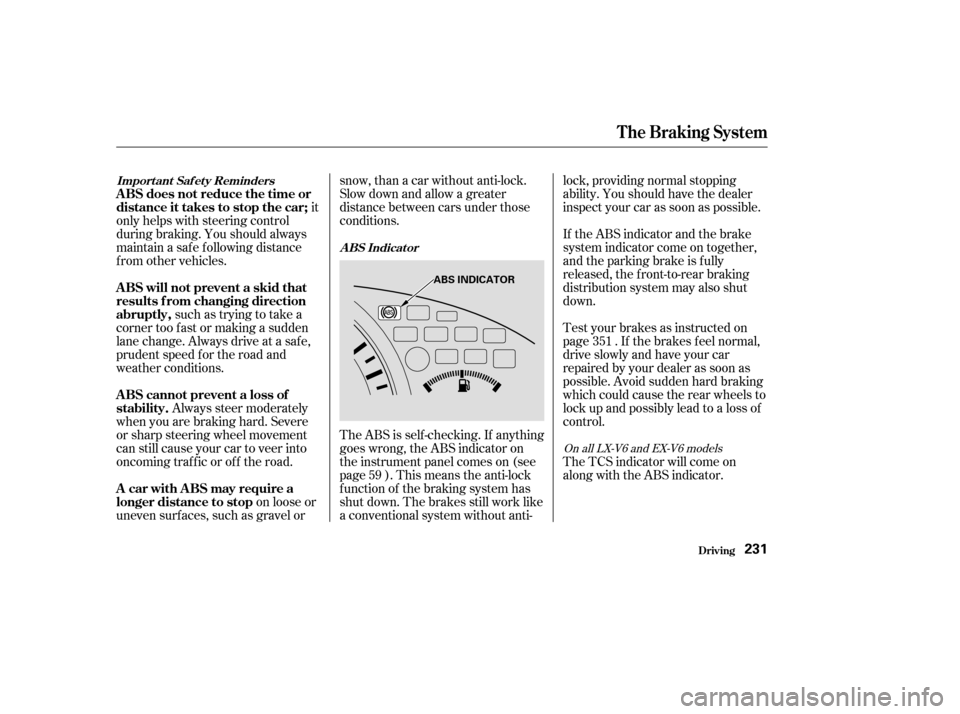
The ABS is self -checking. If anything
goes wrong, the ABS indicator on
the instrument panel comes on (see
page ). This means the anti-lock
f unction of the braking system has
shut down. The brakes still work like
a conventional system without anti-lock, providing normal stopping
ability. You should have the dealer
inspect your car as soon as possible.
on loose or
uneven surf aces, such as gravel or snow, than a car without anti-lock.
Slow down and allow a greater
distance between cars under those
conditions.
If the ABS indicator and the brake
system indicator come on together,
and the parking brake is f ully
released, the front-to-rear braking
distribution system may also shut
down.
Test your brakes as instructed on
page . If the brakes f eel normal,
drive slowly and have your car
repaired by your dealer as soon as
possible. Avoid sudden hard braking
which could cause the rear wheels to
lock up and possibly lead to a loss of
control.
The TCS indicator will come on
alongwiththeABSindicator.
59 351
On all LX-V6 and EX-V6 models
Import ant Saf et y Reminders
A BS Indicat or
A BS will not prevent a skid that
results f rom changing direction
abruptly,
A BS cannot prevent a loss of
stability.
A BS does not reduce the time or
distance it takes to stop the car;
A car with ABS may require a
longer distance to stop
The Braking System
Driving231
ABS INDICATOR
�����—�����—�����y���������������y���
�(�����������y���������y
Page 239 of 380

This section includes instructions f or
simple maintenance tasks, such as
checking and adding oil. Any service
items not detailed in this section
should be perf ormed by a Honda
technician or other qualif ied
mechanic.Some of the most important saf ety
precautions are given here. However,
we cannot warn you of every
conceivable hazard that can arise in
perf orming maintenance. Only you
can decide whether or not you
should perf orm a given task.
Regularly maintaining your car is the
best way to protect your investment.
Proper maintenance is essential to
your saf ety and the saf ety of your
passengers. It will also reward you
with more economical, trouble-f ree
driving and help reduce air pollution.
Maintenance Saf ety
Maint enance246
Failure to properly follow
maintenance instructions and
precautions can cause you to
be seriously hurt or killed.
Always follow the procedures
and precautions in this owner’smanual.
Improperly maintaining this car
or failing to correct a problem
before driving can cause a
crash in which you can be
seriously hurt or killed.
Always follow the inspection
and maintenance
recommendations and
schedules in this owner’smanual.
�����—�����—�����y���������������y���
�(�����������y���������y