2003 FORD WINDSTAR adding oil
[x] Cancel search: adding oilPage 191 of 240

WINDSHIELD WASHER FLUID
Add fluid to fill the reservoir if the
level is low. In very cold weather, do
not fill the reservoir completely.
Only use a washer fluid that meets
Ford specification WSB-M8B16–A2.
Refer toLubricant specifications
in this chapter.
State or local regulations on volatile organic compounds may restrict the
use of methanol, a common windshield washer antifreeze additive.
Washer fluids containing non-methanol antifreeze agents should be used
only if they provide cold weather protection without damaging the
vehicle’s paint finish, wiper blades or washer system.
If you operate your vehicle in temperatures below 4.5°C (40°
F), use washer fluid with antifreeze protection. Failure to use
washer fluid with antifreeze protection in cold weather could result in
impaired windshield vision and increase the risk of injury or accident.
Note:Do not put washer fluid in the engine coolant reservoir. Washer
fluid placed in the cooling system may harm engine and cooling system
components.
Checking and adding washer fluid for the liftgate
Washer fluid for the liftgate is supplied by the same reservoir as the
windshield.
ENGINE OIL
Checking the engine oil
Refer to the scheduled maintenance guide for the appropriate intervals
for checking the engine oil.
Maintenance and Specifications
191
Page 193 of 240
•Oil levels above the MAX mark may cause engine damage. Some oil
must be removed from the engine by a service technician.
7. Put the indicator back in and ensure it is fully seated.
Adding engine oil
1. Check the engine oil. For instructions, refer toChecking the engine
oilin this chapter.
2. If the engine oil level is not within the normal range, add only certified
engine oil of the recommended viscosity. Remove the engine oil filler cap
and use a funnel to pour the engine oil into the opening.
3. Recheck the engine oil level. Make sure the oil level is not above the
MAX mark on the engine oil level indicator (dipstick).
4. Install the indicator and ensure it is fully seated.
5. Fully install the engine oil filler cap by turning the filler cap clockwise
1/4 of a turn until three clicks are heard or until the cap is fully seated.
To avoid possible oil loss, DO NOT operate the vehicle with the
engine oil level indicator and/or the engine oil filler cap removed.
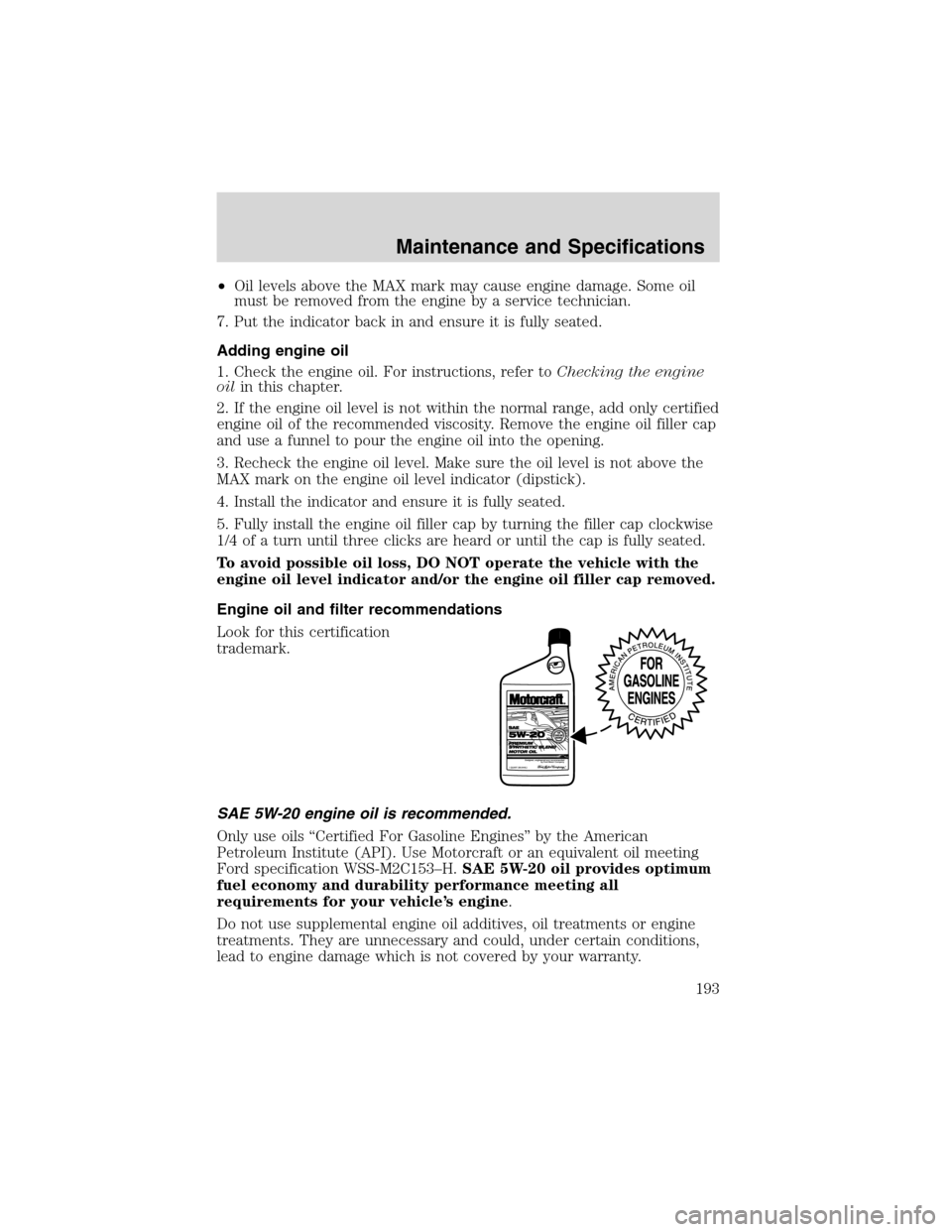
Engine oil and filter recommendations
Look for this certification
trademark.
SAE 5W-20 engine oil is recommended.
Only use oils“Certified For Gasoline Engines”by the American
Petroleum Institute (API). Use Motorcraft or an equivalent oil meeting
Ford specification WSS-M2C153–H.SAE 5W-20 oil provides optimum
fuel economy and durability performance meeting all
requirements for your vehicle’s engine.
Do not use supplemental engine oil additives, oil treatments or engine
treatments. They are unnecessary and could, under certain conditions,
lead to engine damage which is not covered by your warranty.
Maintenance and Specifications
193
Page 197 of 240
•Freeze protection down to -36°C (-34°F).
•Boiling protection up to 129°C (265°F).
•Protection against rust and other forms of corrosion.
•Enables calibrated gauges to work properly.
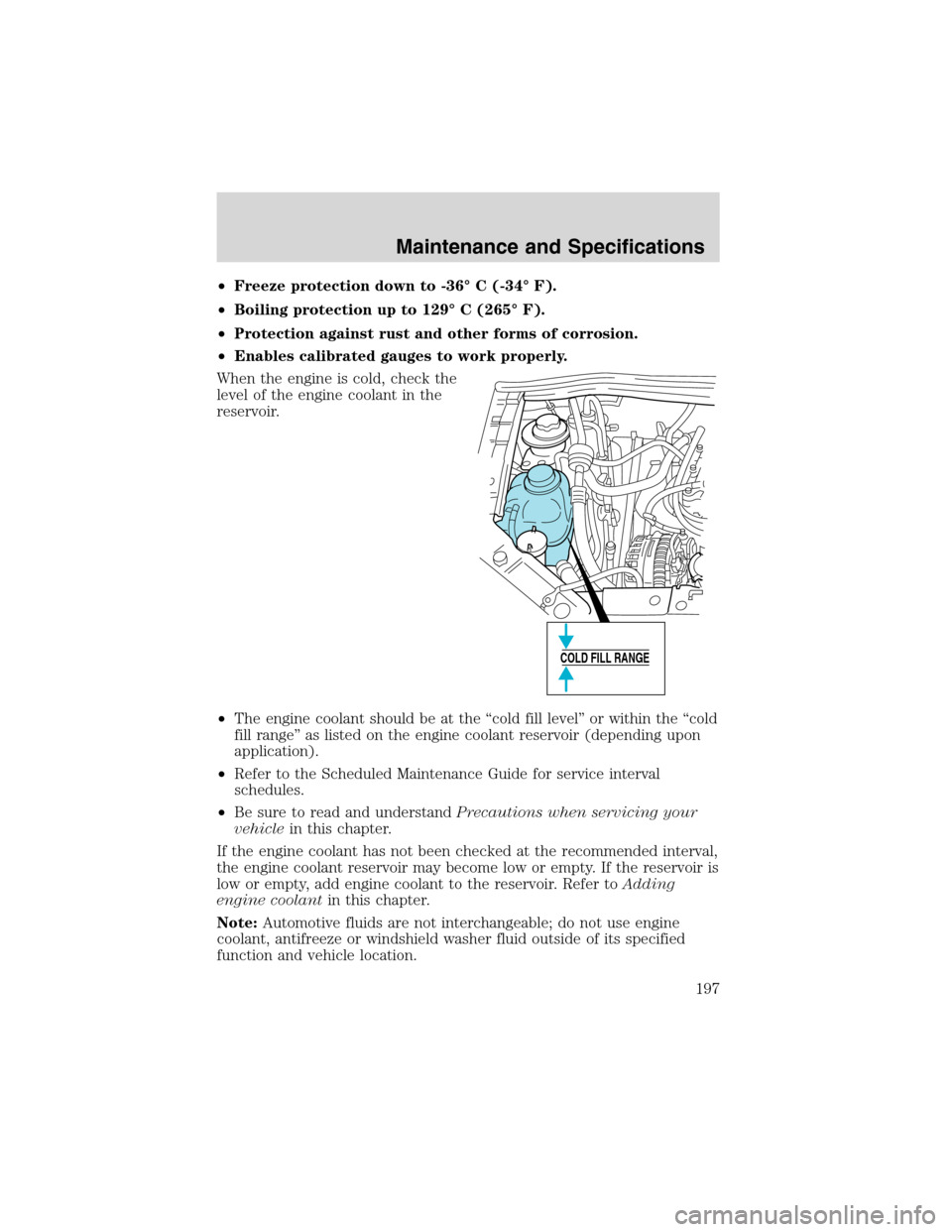
When the engine is cold, check the
level of the engine coolant in the
reservoir.
•The engine coolant should be at the“cold fill level”or within the“cold
fill range”as listed on the engine coolant reservoir (depending upon
application).
•Refer to the Scheduled Maintenance Guide for service interval
schedules.
•Be sure to read and understandPrecautions when servicing your
vehiclein this chapter.
If the engine coolant has not been checked at the recommended interval,
the engine coolant reservoir may become low or empty. If the reservoir is
low or empty, add engine coolant to the reservoir. Refer toAdding
engine coolantin this chapter.
Note:Automotive fluids are not interchangeable; do not use engine
coolant, antifreeze or windshield washer fluid outside of its specified
function and vehicle location.
COLD FILL RANGE
Maintenance and Specifications
197
Page 208 of 240
•Revving the engine before turning it off may reduce fuel economy.
•Using the air conditioner or defroster may reduce fuel economy.
•You may want to turn off the speed control in hilly terrain if
unnecessary shifting between third and fourth gear occurs.
Unnecessary shifting of this type could result in reduced fuel
economy.
•Warming up a vehicle on cold mornings is not required and may
reduce fuel economy.
•Resting your foot on the brake pedal while driving may reduce fuel
economy.
•Combine errands and minimize stop-and-go driving.
Maintenance
•Keep tires properly inflated and use only recommended size.
•Operating a vehicle with the wheels out of alignment will reduce fuel
economy.
•Use recommended engine oil. Refer toLubricant specificationsin
this chapter.
•Perform all regularly scheduled maintenance items. Follow the
recommended maintenance schedule and owner maintenance checks
found in your vehicle scheduled maintenance guide.
Conditions
•Heavily loading a vehicle or towing a trailer may reduce fuel economy
at any speed.
•Carrying unnecessary weight may reduce fuel economy (approximately
0.4 km/L [1 mpg] is lost for every 180 kg [400 lb] of weight carried).
•Adding certain accessories to your vehicle (for example bug
deflectors, rollbars/light bars, running boards, ski/luggage racks) may
reduce fuel economy.
•Using fuel blended with alcohol may lower fuel economy.
•Fuel economy may decrease with lower temperatures during the first
12–16 km (8–10 miles) of driving.
•Driving on flat terrain offers improved fuel economy as compared to
driving on hilly terrain.
•Transmissions give their best fuel economy when operated in the top
cruise gear and with steady pressure on the gas pedal.
Maintenance and Specifications
208
Page 231 of 240
interior .....................................185
interior trim ............................185
plastic parts ............................184
washing ....................................182
waxing .....................................182
wheels ......................................183
wiper blades
............................184
Compass, electronic
..............51, 70
Console
........................................55
overhead
....................................46
Controls
power seat
.................................88
Coolant
checking and adding
..............196
refill capacities
................200, 220
specifications
..................222, 224
Cruise control
(see Speed control)
....................53
Cupholder(s)
...............................91
Customer Assistance
................150
Ford accessories for your
vehicle
.....................................186
Ford Extended
Service Plan
............................175
Getting assistance outside the
U.S. and Canada
.....................179
Getting roadside assistance
...150
Getting the service
you need
.................................173
Ordering additional owner’s
literature
.................................180
The Dispute Settlement
Board
.......................................175
Utilizing the
Mediation/Arbitration
Program
...................................178D
Daytime running lamps
(see Lamps) ................................35
Dipstick
automatic transmission
fluid ..........................................212
engine oil .................................191
Doors
lubricant specifications ..........222
power sliding ............................47
Driving under special
conditions ..................................141
through water .........................144
E
Emergencies, roadside
jump-starting ..........................167
Emission control system ..........209
Engine ........................................224
cleaning ...................................183
coolant .....................................196
idle speed control ...................194
lubrication
specifications ..................222, 224
refill capacities ........................220
service points ..........................190
starting after a collision .........151
Engine block heater .................134
Engine oil ..................................191
change oil soon warning,
message center .......................191
checking and adding ..............191
dipstick ....................................191
filter, specifications ........193, 220
recommendations ...................193
refill capacities ........................220
specifications ..................222, 224
Exhaust fumes ..........................134
Index
231
Page 233 of 240

K
Keyless entry system .................81
autolock .....................................81
Keys
positions of the ignition .........131
L
Lamps
autolamp system .......................35
bulb replacement
specifications chart ..................40
cargo lamps ...............................36
daytime running light ...............35
headlamps .................................35
headlamps, flash to pass ..........36
instrument panel, dimming .....36
interior lamps .....................38–39
replacing bulbs .............40, 42–43
Lane change indicator
(see Turn signal) ........................38
Liftgate ..................................72–73
Lights, warning and indicator ....10
anti-lock brakes (ABS) ..........135
Load limits .................................144
GAWR ......................................144
GVWR ......................................144
trailer towing ..........................144
Locks
autolock .....................................81
childproof ..................................76
Low tire warning .................13, 215
Lubricant specifications ...222, 224
Lumbar support, seats ...............89
M
Message center ...........................62english/metric button ...............63
system check button ................63
warning messages .....................65
Mirrors .........................................46
automatic dimming rearview
mirror ........................................51
fold away ...................................52
heated ........................................52
side view mirrors (power) .......51
Motorcraft parts ................205, 220
O
Octane rating ............................204
Oil (see Engine oil) ..................191
Overdrive ...................................139
P
Parking brake ............................135
Parts (see Motorcraft parts) ....220
Passenger Occupant
Classification Sensor ...................99
Pedals (see Power adjustable
foot pedals) .................................53
Power adjustable foot pedals .....53
Power distribution box
(see Fuses) ...............................157
Power door locks ..................75, 81
Power mirrors .............................51
Power point .................................50
Power steering ..........................138
fluid, checking and adding ....211
fluid, refill capacity ................220
fluid, specifications .........222, 224
Power Windows ...........................50
R
Radio ..........................16, 18, 20, 24
Index
233