Page 105 of 256

hold the brake pedal down, release the parking brake, then trypushing
the parking brake pedal further down. Chock the wheels if required. If
the parking brake cannot hold the weight of the vehicle, the parking
brake mayneed to be serviced.
STEERING
To prevent damage to the power steering system:
•Never hold the steering wheel at its furthest turning points (until it
stops) for more than a few seconds when the engine is running.
•Do not operate the vehicle with a low power steering pump fluid level
(below the MIN mark on the reservoir).
If the power steering system breaks down (or if the engine is turned
off), you can steer the vehicle manually, but it takes more effort.
If the steering wanders or pulls, check for:
•an underinflated tire
•uneven tire wear
•loose or worn suspension components
•loose or worn steering components
•improper steering alignment
TRACTION-LOK AXLE (IF EQUIPPED)
This axle provides added traction on slipperysurfaces, particularlywhen
one wheel is on a poor traction surface. Under normal conditions, the
Traction-Lok axle functions like a standard rear axle.
To reduce the risk of injury, never run the engine with one wheel
off the ground, such as when changing a tire.
PREPARING TO DRIVE YOUR VEHICLE
Utilityvehicles have a significantlyhigher rollover rate than
other types of vehicles.
In a rollover crash, an unbelted person is significantlymore likely
to die than a person wearing a safetybelt.
Your vehicle has larger tires and increased ground clearance, giving the
vehicle a higher center of gravitythan a passenger car.
Driving
105
Page 212 of 256

•Revving the engine before turning it off mayreduce fuel economy.
•Using the air conditioner or defroster mayreduce fuel economy.
•You maywant to turn off the speed control in hillyterrain if
unnecessaryshifting between third and fourth gear occurs.
Unnecessaryshifting of this type could result in reduced fuel
economy.
•Warming up a vehicle on cold mornings is not required and may
reduce fuel economy.
•Resting your foot on the brake pedal while driving may reduce fuel
economy.
•Combine errands and minimize stop-and-go driving.
Maintenance
•Keep tires properlyinflated and use onlyrecommended size.
•Operating a vehicle with the wheels out of alignment will reduce fuel
economy.
•Use recommended engine oil. Refer toLubricant specificationsin
this chapter.
•Perform all regularlyscheduled maintenance items. Follow the
recommended maintenance schedule and owner maintenance checks
found in your vehicle scheduled maintenance guide.
Conditions
•Heavilyloading a vehicle or towing a trailer mayreduce fuel economy
at anyspeed.
•Carrying unnecessaryweight mayreduce fuel economy(approximately
0.4 km/L [1 mpg] is lost for every180 kg [400 lb] of weight carried).
•Adding certain accessories to your vehicle (for example bug
deflectors, rollbars/light bars, running boards, ski/luggage racks) may
reduce fuel economy.
•Using fuel blended with alcohol maylower fuel economy.
•Fuel economymaydecrease with lower temperatures during the first
12–16 km (8–10 miles) of driving.
•Driving on flat terrain offers improved fuel economyas compared to
driving on hillyterrain.
•Transmissions give their best fuel economywhen operated in the top
cruise gear and with steadypressure on the gas pedal.
Maintenance and Specifications
212
Page 224 of 256
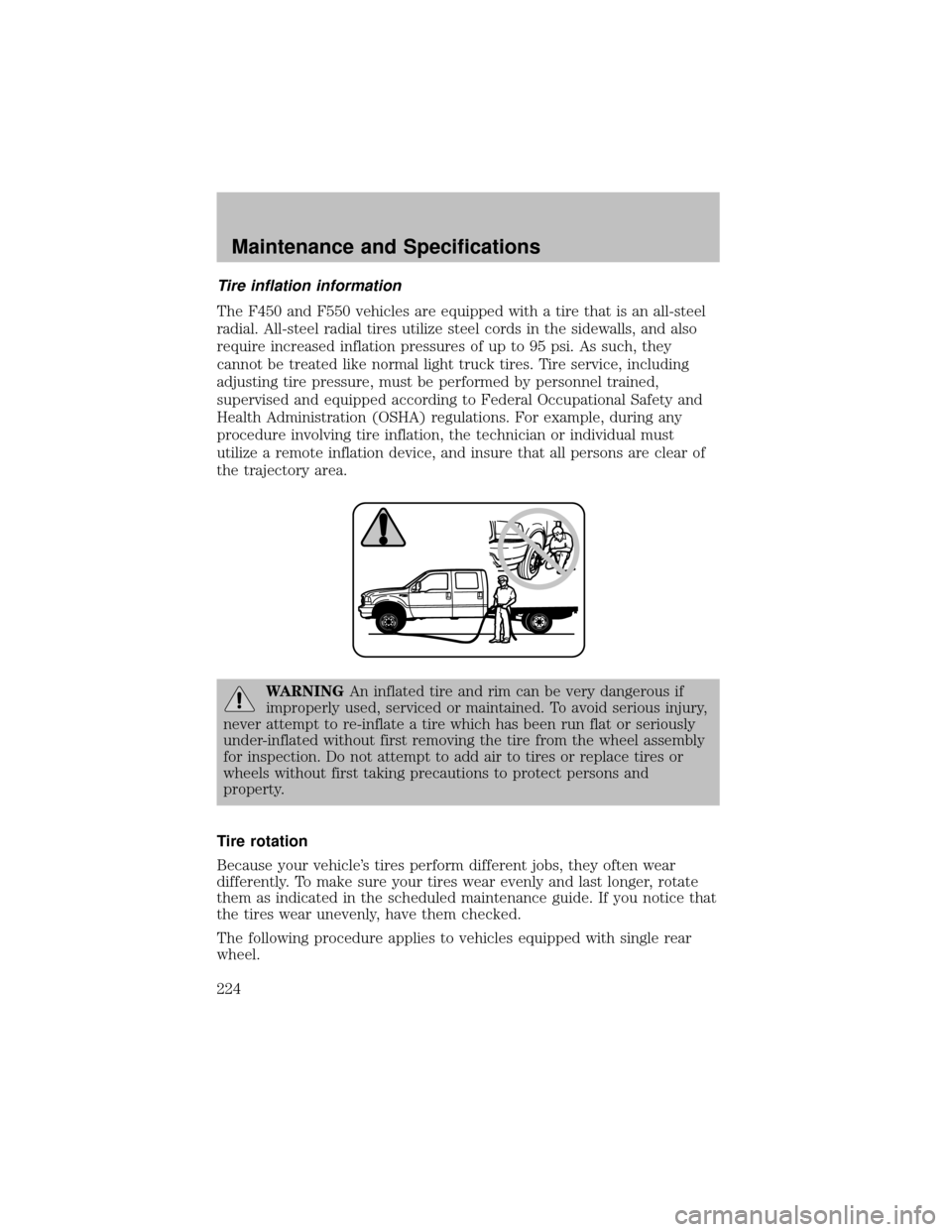
Tire inflation information
The F450 and F550 vehicles are equipped with a tire that is an all-steel
radial. All-steel radial tires utilize steel cords in the sidewalls, and also
require increased inflation pressures of up to 95 psi. As such, they
cannot be treated like normal light truck tires. Tire service, including
adjusting tire pressure, must be performed bypersonnel trained,
supervised and equipped according to Federal Occupational Safetyand
Health Administration (OSHA) regulations. For example, during any
procedure involving tire inflation, the technician or individual must
utilize a remote inflation device, and insure that all persons are clear of
the trajectoryarea.
WARNINGAn inflated tire and rim can be verydangerous if
improperlyused, serviced or maintained. To avoid serious injury,
never attempt to re-inflate a tire which has been run flat or seriously
under-inflated without first removing the tire from the wheel assembly
for inspection. Do not attempt to add air to tires or replace tires or
wheels without first taking precautions to protect persons and
property.
Tire rotation
Because your vehicle’s tires perform different jobs, they often wear
differently. To make sure y our tires wear evenly and last longer, rotate
them as indicated in the scheduled maintenance guide. If you notice that
the tires wear unevenly, have them checked.
The following procedure applies to vehicles equipped with single rear
wheel.
Maintenance and Specifications
224