2003 FORD SUPER DUTY brake light
[x] Cancel search: brake lightPage 161 of 256
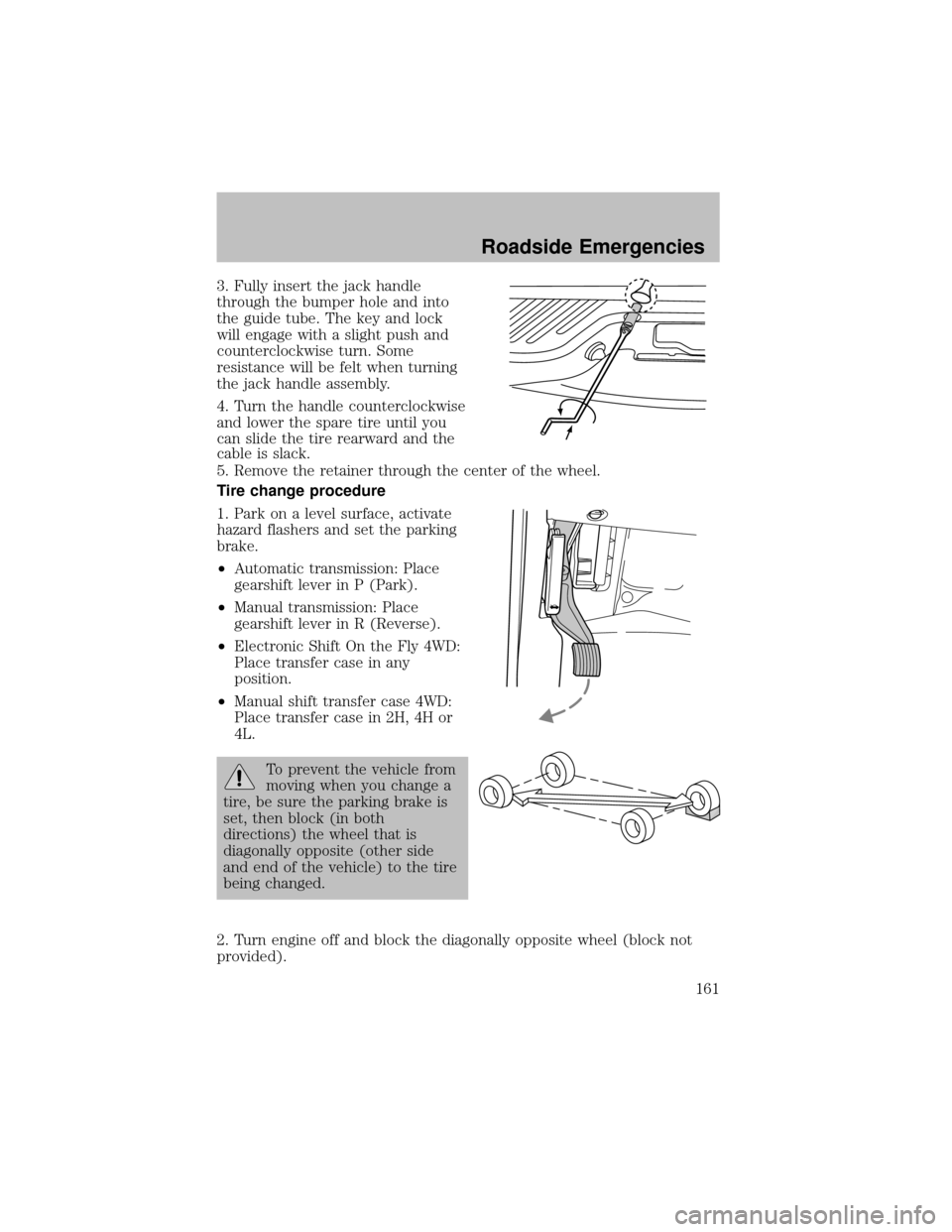
3. Fullyinsert the jack handle
through the bumper hole and into
the guide tube. The keyand lock
will engage with a slight push and
counterclockwise turn. Some
resistance will be felt when turning
the jack handle assembly.
4. Turn the handle counterclockwise
and lower the spare tire until you
can slide the tire rearward and the
cable is slack.
5. Remove the retainer through the center of the wheel.
Tire change procedure
1. Park on a level surface, activate
hazard flashers and set the parking
brake.
•Automatic transmission: Place
gearshift lever in P (Park).
•Manual transmission: Place
gearshift lever in R (Reverse).
•Electronic Shift On the Fly4WD:
Place transfer case in any
position.
•Manual shift transfer case 4WD:
Place transfer case in 2H, 4H or
4L.
To prevent the vehicle from
moving when you change a
tire, be sure the parking brake is
set, then block (in both
directions) the wheel that is
diagonallyopposite (other side
and end of the vehicle) to the tire
being changed.
2. Turn engine off and block the diagonallyopposite wheel (block not
provided).
Roadside Emergencies
161
Page 169 of 256

1.Use only a 12–volt supply to start your vehicle.
2. Do not disconnect the batteryof the disabled vehicle as this could
damage the vehicle’s electrical system.
3. Park the booster vehicle close to the hood of the disabled vehicle
making sure the two vehiclesdo nottouch. Set the parking brake on
both vehicles and stayclear of the engine cooling fan and other moving
parts.
4. Check all batteryterminals and remove anyexcessive corrosion before
you attach the battery cables. Ensure that vent caps are tight and level.
5. Turn the heater fan on in both vehicles to protect anyelectrical
surges. Turn all other accessories off.
Connecting the jumper cables
1. Connect the positive (+) booster cable to the positive (+) terminal of
the discharged battery.
Note:In the illustrations,lightning boltsare used to designate the
assisting (boosting) battery.
+–+–
+–+–
Roadside Emergencies
169
Page 185 of 256

PAINT CHIPS
Your dealer has touch-up paint and sprays to match your vehicle’s color.
Take your color code (printed on a sticker in the driver’s door jam) to
your dealer to ensure you get the correct color.
•Remove particles such as bird droppings, tree sap, insect deposits, tar
spots, road salt and industrial fallout before repairing paint chips.
•Always read the instructions before using the products.
ALUMINUM WHEELS AND WHEEL COVERS
Aluminum wheels and wheel covers are coated with a clearcoat paint
finish. In order to maintain their shine:
•Clean weeklywith Motorcraft Wheel and Tire Cleaner (ZC-37–A),
which is available from your dealer. Heavy dirt and brake dust
accumulation mayrequire agitation with a sponge. Rinse thoroughly
with a strong stream of water.
•Never applyanycleaning chemical to hot or warm wheel rims or
covers.
•Some automatic car washes maycause damage to the finish on your
wheel rims or covers. Chemical-strength cleaners, or cleaning
chemicals, in combination with brush agitation to remove brake dust
and dirt, could wear awaythe clearcoat finish over time.
•Do not use hydrofluoric acid-based or high caustic-based wheel
cleaners, steel wool, fuels or strong household detergent.
•To remove tar and grease, use Ford Extra Strength Tar and Road Oil
Removal (B7A-19520–AA), available from your dealer.
ENGINE
Engines are more efficient when theyare clean because grease and dirt
buildup keep the engine warmer than normal. When washing:
•Take care when using a power washer to clean the engine. The
high-pressure fluid could penetrate the sealed parts and cause
damage.
•Do not spraya hot engine with cold water to avoid cracking the
engine block or other engine components.
•SprayMotorcraft Engine Shampoo and Degreaser (ZC-20) on all parts
that require cleaning and pressure rinse clean.
•Cover the highlighted areas to prevent water damage when cleaning
the engine.
Cleaning
185
Page 191 of 256
SERVICE RECOMMENDATIONS
To help you service your vehicle:
•We highlight do-it-yourself items in the engine compartment for easy
location.
•We provide a scheduled maintenance guide which makes tracking
routine service easy.
If your vehicle requires professional service, your dealership can provide
the necessaryparts and service. Check yourWarranty Guide/Owner
Information Guideto find out which parts and services are covered.
Use onlyrecommended fuels, lubricants, fluids and service parts
conforming to specifications. Motorcraft parts are designed and built to
provide the best performance in your vehicle.
PRECAUTIONS WHEN SERVICING YOUR VEHICLE
•Do not work on a hot engine.
•Make sure that nothing gets caught in moving parts.
•Do not work on a vehicle with the engine running in an enclosed
space, unless you are sure you have enough ventilation.
•Keep all open flames and other burning (cigarettes) material away
from the batteryand all fuel related parts.
Working with the engine off
•Automatic transmission:
1. Set the parking brake and shift to P (Park).
2. Turn off the engine and remove the key.
3. Block the wheels.
•Manual transmission:
1. Set the parking brake, depress the clutch and place the gearshift in 1
(First).
2. Turn off the engine and remove the key.
3. Block the wheels.
Working with the engine on
•Automatic transmission:
1. Set the parking brake and shift to P (Park).
2. Block the wheels.
Maintenance and Specifications
191
Page 212 of 256
•Revving the engine before turning it off mayreduce fuel economy.
•Using the air conditioner or defroster mayreduce fuel economy.
•You maywant to turn off the speed control in hillyterrain if
unnecessaryshifting between third and fourth gear occurs.
Unnecessaryshifting of this type could result in reduced fuel
economy.
•Warming up a vehicle on cold mornings is not required and may
reduce fuel economy.
•Resting your foot on the brake pedal while driving may reduce fuel
economy.
•Combine errands and minimize stop-and-go driving.
Maintenance
•Keep tires properlyinflated and use onlyrecommended size.
•Operating a vehicle with the wheels out of alignment will reduce fuel
economy.
•Use recommended engine oil. Refer toLubricant specificationsin
this chapter.
•Perform all regularlyscheduled maintenance items. Follow the
recommended maintenance schedule and owner maintenance checks
found in your vehicle scheduled maintenance guide.
Conditions
•Heavilyloading a vehicle or towing a trailer mayreduce fuel economy
at anyspeed.
•Carrying unnecessaryweight mayreduce fuel economy(approximately
0.4 km/L [1 mpg] is lost for every180 kg [400 lb] of weight carried).
•Adding certain accessories to your vehicle (for example bug
deflectors, rollbars/light bars, running boards, ski/luggage racks) may
reduce fuel economy.
•Using fuel blended with alcohol maylower fuel economy.
•Fuel economymaydecrease with lower temperatures during the first
12–16 km (8–10 miles) of driving.
•Driving on flat terrain offers improved fuel economyas compared to
driving on hillyterrain.
•Transmissions give their best fuel economywhen operated in the top
cruise gear and with steadypressure on the gas pedal.
Maintenance and Specifications
212
Page 216 of 256
CLUTCH FLUID (IF EQUIPPED)
Check the clutch fluid level. Refer to the scheduled maintenance guide
for the service interval schedules.
Use onlya DOT 3 brake fluid designed to meet Ford specification
ESA-M6C25–A. Refer toLubricant Specificationsin this chapter.
Brake fluid is toxic. If brake fluid contacts the eyes, flush eyes
with running water for 15 minutes. Seek medical if irritation
persists. If taken internally, drink water and induce vomiting. Seek
medical attention immediately.
During normal operation, the fluid level in the clutch reservoir should
remain constant or rise slightly. If the fluid level drops, refill the fluid
level to the step in the reservoir.
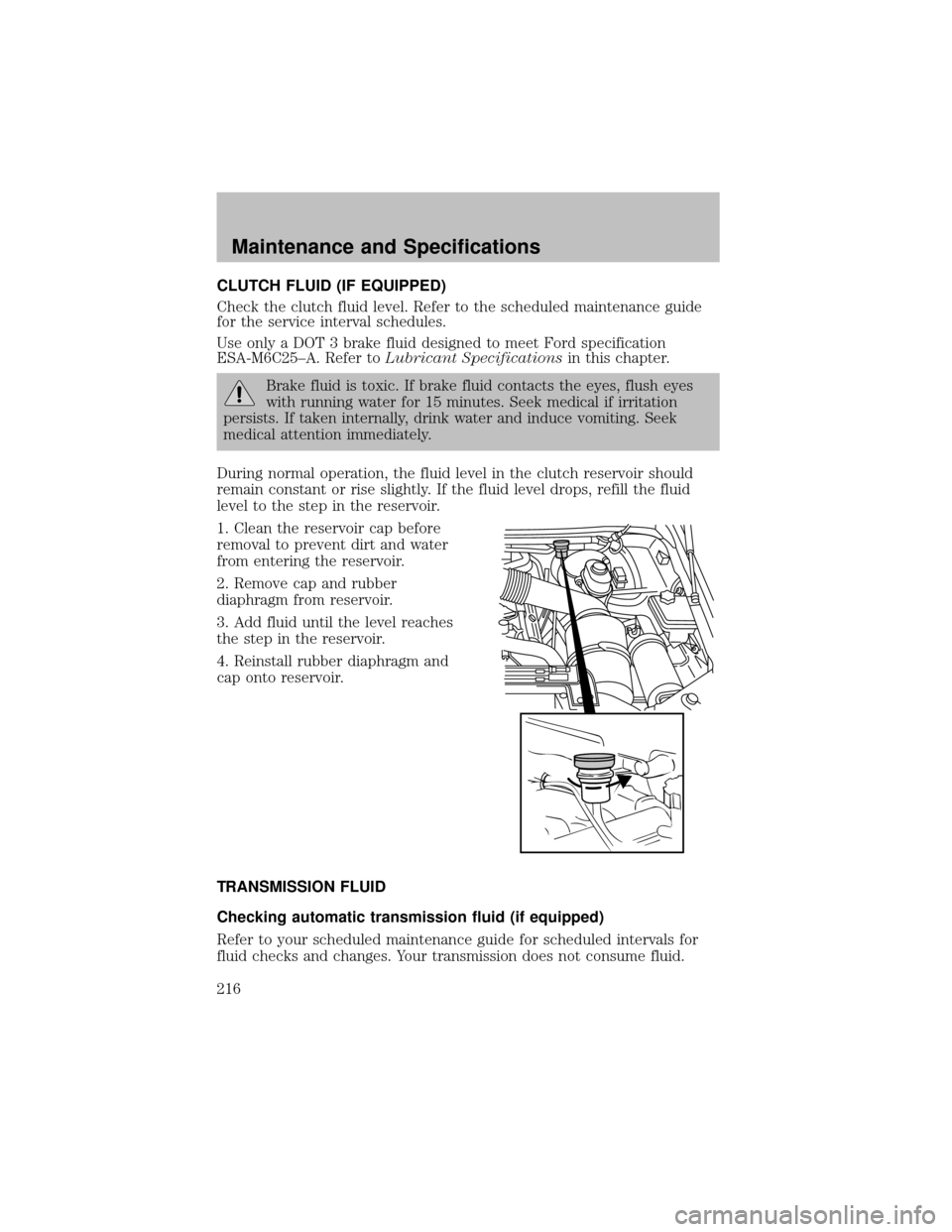
1. Clean the reservoir cap before
removal to prevent dirt and water
from entering the reservoir.
2. Remove cap and rubber
diaphragm from reservoir.
3. Add fluid until the level reaches
the step in the reservoir.
4. Reinstall rubber diaphragm and
cap onto reservoir.
TRANSMISSION FLUID
Checking automatic transmission fluid (if equipped)
Refer to your scheduled maintenance guide for scheduled intervals for
fluid checks and changes. Your transmission does not consume fluid.
Maintenance and Specifications
216
Page 249 of 256

A
Accessorydelay ..........................47
Air bag supplemental restraint
system ..........................................79
and child safetyseats ..............80
description ................................79
disposal ......................................83
driver air bag ............................81
indicator light ...........................82
operation ...................................81
passenger air bag .....................81
passenger deactivation
switch ........................................83
Air cleaner filter .......220–221, 228
Ambulance packages ....................6
Antifreeze
(see Engine coolant) ................199
Anti-lock brake system
(see Brakes) ......................103–104
Audio system
(see Radio) ................17–18, 21, 25
Automatic transmission ............106
driving an automatic
overdrive .................................107
fluid, adding ............................216
fluid, checking ........................216
fluid, refill capacities ..............228
fluid, specification ..................235
Auxiliarypower point .................46
Axle
lubricant specifications ..232, 235
refill capacities ........................228
traction lok ..............................105
B
Battery.......................................197
acid, treating emergencies .....197jumping a disabled battery....168
maintenance-free ....................197
replacement, specifications ...228
servicing ..................................197
BeltMinder ...................................74
Brakes ........................................102
anti-lock ...........................102–104
anti-lock brake system (ABS)
warning light ...........................103
fluid, checking and adding ....215
fluid, refill capacities ..............228
fluid, specifications .........232, 235
lubricant specifications ..232, 235
parking ....................................104
shift interlock ..........................106
Break-in period .............................5
Bulbs ............................................38
C
Calculating load ........................127
Capacities for refilling fluids ....228
Cassette tape player ...................25
CD changer .................................28
CD-single premium .........17–18, 21
Certification Label ....................243
Child safetyrestraints ................88
child safetybelts ......................88
Child safetyseats ........................90
attaching with tether straps ....94
in front seat ..............................92
in rear seat ................................92
Cleaning your vehicle
engine compartment ..............185
instrument panel ....................187
interior .....................................187
interior trim ............................187
plastic parts ............................186
Index
249
Page 252 of 256

Instrument panel
cleaning ...................................187
cluster ........................................10
lighting up panel and
interior .......................................37
J
Jump-starting your vehicle ......168
K
Keyless entry system
autolock .....................................61
Keys
positions of the ignition ...........98
L
Lamps
autolamp system .......................35
bulb replacement
specifications chart ..................38
cargo lamps ...............................37
daytime running light ...............36
fog lamps ...................................36
headlamps .................................35
headlamps, flash to pass ..........37
instrument panel, dimming .....37
interior lamps ...........................38
replacing bulbs ...................38–43
Lane change indicator
(see Turn signal) ........................37
Lights, warning and indicator ....10
anti-lock brakes (ABS) ..........103
speed control ............................51
Load limits .................................125
GAWR ......................................125
GVWR ......................................125
trailer towing ..........................125
Loading instructions .................127Locks
autolock .....................................61
childproof ..................................57
Lubricant specifications ...232, 235
Lumbar support, seats ...............67
M
Manual transmission .................109
fluid capacities ........................228
lubricant specifications ..........235
reverse .....................................110
Message center ...........................51
english/metric button ...............52
menu button .............................52
Mirrors .........................................45
fold away...................................48
side view mirrors (power) .......47
Motorcraft parts ................209, 228
O
Octane rating ............................208
Oil (see Engine oil) ..................194
P
Parking brake ............................104
Parts (see Motorcraft parts) ....228
Pedals (see Power adjustable
foot pedals) .................................48
Power adjustable foot pedals .....48
Power distribution box
(see Fuses) ...............................155
Power door locks ..................56, 61
Power point .................................46
Power steering ..........................105
fluid, checking and adding ....215
Index
252