Page 168 of 256
2. Slide the wheel partiallyunder the vehicle and install the retainer
through the wheel center. Pull on the cable to align the components at
the end of the cable.
3. Turn the jack handle clockwise until the tire is raised to its stowed
position underneath the vehicle. The effort to turn the jack handle
increases significantlyand the spare tire carrier ratchets or slips when
the tire is raised to the maximum tightness. Tighten to the best of your
ability, to the point where the ratchet/slip occurs, if possible. The spare
tire carrier will not allow you to overtighten. If the spare tire carrier
ratchets or slips with little effort, take the vehicle to your dealer for
assistance at your earliest convenience.
4. Check that the tire lies flat against the frame and is properly
tightened. Tryto push or pull, then turn the tire to be sure it will not
move. Loosen and retighten, if necessary. Failure to properly stow the
spare tire mayresult in failure of the winch cable and loss of the tire.
5. Repeat this tightness check procedure when servicing the spare tire
pressure (everysix months, per scheduled maintenance guide), or at any
time that the spare tire is disturbed through service of other
components.
6. If removed, install the spare tire lock (if equipped) into the bumper
drive tube with the spare tire lock key(if equipped) and jack handle.
JUMP STARTING YOUR VEHICLE
The gases around the batterycan explode if exposed to flames,
sparks, or lit cigarettes. An explosion could result in injuryor
vehicle damage.
Batteries contain sulfuric acid which can burn skin, eyes and
clothing, if contacted.
Do not attempt to push-start your vehicle. Automatic
transmissions do not have push-start capability; also, the
catalytic converter may become damaged.
Preparing your vehicle
When the batteryis disconnected or a new batteryis installed, the
transmission must relearn its shift strategy. As a result, the transmission
mayhave firm and/or soft shifts. This operation is considered normal and
will not affect function or durabilityof the transmission. Over time, the
adaptive learning process will fullyupdate transmission operation.
Roadside Emergencies
168
Page 222 of 256
•Treadwear 200 Traction AA Temperature A
These Tire QualityGrades are determined bystandards that the United
States Department of Transportation has set.
Tire QualityGrades applyto new pneumatic tires for use on passenger
cars. Theydo not applyto deep tread, winter-type snow tires,
space-saver or temporaryuse spare tires, tires with nominal rim
diameters of 10 to 12 inches or limited production tires as defined in
Title 49 Code of Federal Regulations Part 575.104(c)(2).
U.S. Department of Transportation-Tire quality grades:The U.S.
Department of Transportation requires Ford to give you the following
information about tire grades exactlyas the government has written it.
Treadwear
The treadwear grade is a comparative rating based on the wear rate of
the tire when tested under controlled conditions on a specified
government test course. For example, a tire graded 150 would wear one
and one-half (1 1/2) times as well on the government course as a tire
graded 100. The relative performance of tires depends upon the actual
conditions of their use, however, and maydepart significantlyfrom the
norm due to variations in driving habits, service practices, and
differences in road characteristics and climate.
Traction AA A B C
The traction grades, from highest to lowest are AA, A, B, and C. The
grades represent the tire’s abilityto stop on wet pavement as measured
under controlled conditions on specified government test surfaces of
asphalt and concrete. A tire marked C mayhave poor traction
performance.
The traction grade assigned to this tire is based on
straight-ahead braking traction tests, and does not include
acceleration, cornering, hydroplaning or peak traction characteristics.
Temperature A B C
The temperature grades are A (the highest), B and C, representing the
tire’s resistance to the generation of heat and its abilityto dissipate heat
when tested under controlled conditions on a specified indoor laboratory
test wheel. Sustained high temperature can cause the material of the tire
to degenerate and reduce tire life, and excessive temperature can lead to
sudden tire failure. The grade C corresponds to a level of performance
Maintenance and Specifications
222
Page 226 of 256
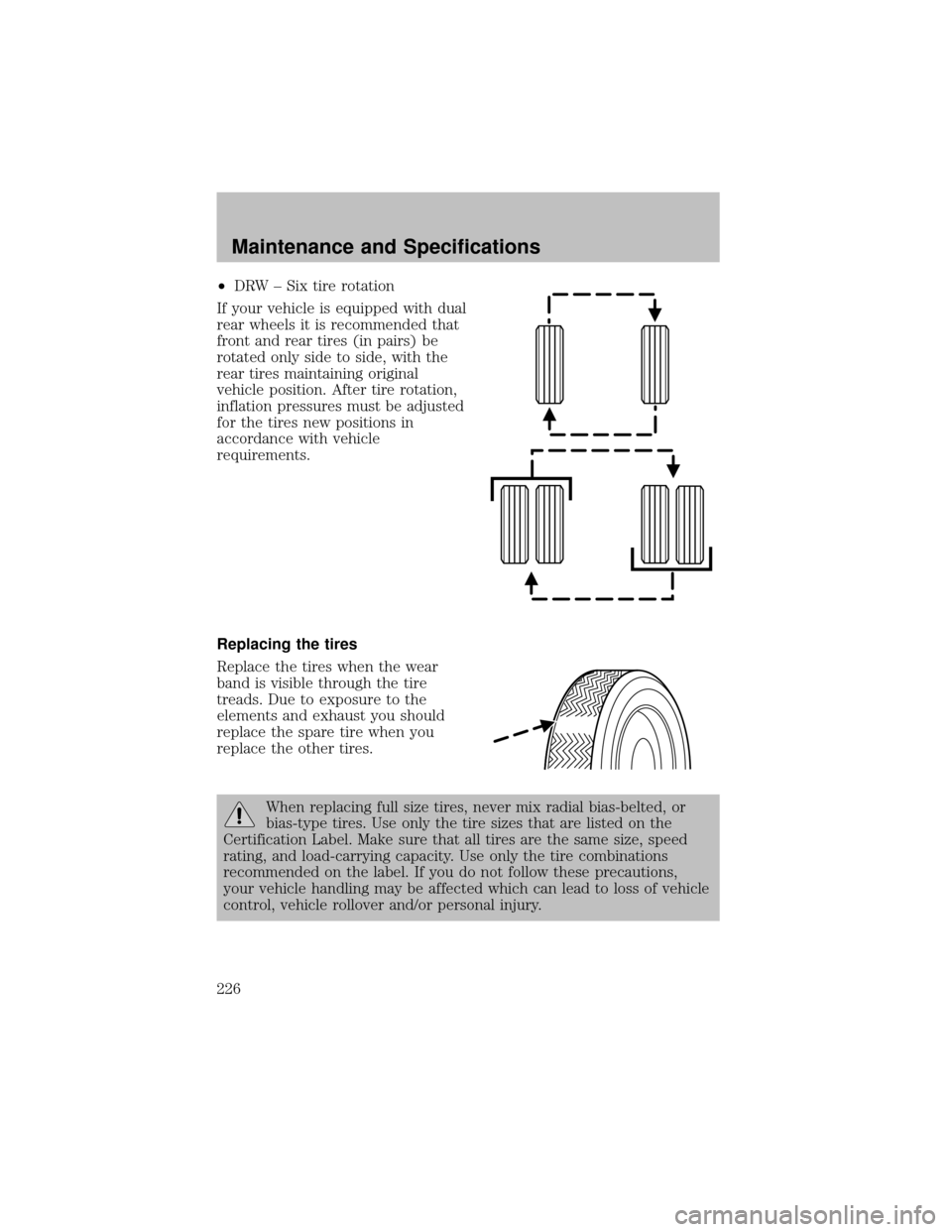
•DRW – Six tire rotation
If your vehicle is equipped with dual
rear wheels it is recommended that
front and rear tires (in pairs) be
rotated onlyside to side, with the
rear tires maintaining original
vehicle position. After tire rotation,
inflation pressures must be adjusted
for the tires new positions in
accordance with vehicle
requirements.
Replacing the tires
Replace the tires when the wear
band is visible through the tire
treads. Due to exposure to the
elements and exhaust you should
replace the spare tire when you
replace the other tires.
When replacing full size tires, never mix radial bias-belted, or
bias-type tires. Use only the tire sizes that are listed on the
Certification Label. Make sure that all tires are the same size, speed
rating, and load-carrying capacity. Use only the tire combinations
recommended on the label. If you do not follow these precautions,
your vehicle handling may be affected which can lead to loss of vehicle
control, vehicle rollover and/or personal injury.
Maintenance and Specifications
226
Page 247 of 256
Bedliners
Carpet floor mats
Cap (hard, color keyed – Leer supplier branded)
Cap (commercial – Leer supplier branded)
Cleaners, waxes and polishes
Diamond plate bed rail caps
Diamond plate front box protection
Diamond plate splash guards
Diamond plate tool box
Door edge guards
Fender flares
Flat splash guards
Front end covers (full)
Hood deflectors
Leather wrap steering wheel
Locking gas cap
Lubricants and oils
Molded splash guards
Rear window deflector
Side window air deflectors
Spare tire lock
Stainless steel grill insert
Step bumpers
Tailgate covers (Diamond plate)
Tonneau cover (soft)
Tonneau cover (hard, color keyed – Leer supplier branded)
Touch-up paint
Truck cover (full vehicle)
Universal floor mats
Wheels
Wheel covers
Accessories
247
Page 253 of 256

fluid, refill capacity................228
fluid, specifications .........232, 235
Power Windows ...........................47
Preparing to drive your
vehicle ........................................105
R
Radio ..........................17–18, 21, 25
Relays ........................................154
Remote entrysystem .................58
illuminated entry......................60
locking/unlocking doors ...........56
Reverse sensing system ...........111
Roadside assistance ..................152
S
Safetybelts (see Safety
restraints) ........................68–71, 73
Safetydefects, reporting ..........183
Safetyrestraints ....................68–73
belt minder ...............................74
cleaning the safetybelts ..........78
extension assembly..................78
for adults .............................69–71
for children .........................87–88
warning light and chime ..........74
Safetyseats for children ............90
Seat belts (see Safety
restraints) ....................................68
Seats ............................................63
child safetyseats ......................90
cleaning ...................................188
Servicing your vehicle ..............191
Snowplowing .................6, 148–150Spare tire
(see Changing the Tire) ...........159
Spark plugs,
specifications .....................228, 235
Special notice ................................7
ambulance conversions ..............6
diesel-powered vehicles .............6
four-wheel drive vehicles .......151
utility-type vehicles ....................6
Specification chart,
lubricants ...........................232, 235
Speed control ..............................48
Starting your vehicle ....98–99, 101
jump starting ..........................168
Steering wheel
tilting .........................................45
T
Tailgate ........................................55
Tires ...................................221–223
changing ..........................159, 161
checking the pressure ............223
replacing ..................................226
rotating ....................................224
snow tires and chains ............227
tire grades ...............................222
treadwear ................................222
Towing .......................................127
trailer towing ..........................127
wrecker ....................................173
Traction-lok rear axle ...............105
Transfer case
fluid checking .........................220
Transmission
automatic operation ...............106
fluid, checking and adding
(automatic) .............................216
Index
253