Page 213 of 256
•Four-wheel-drive operation (if equipped) is less fuel efficient than
two-wheel-drive operation.
•Close windows for high speed driving.
EPA window sticker
Everynew vehicle should have the EPA window sticker. Contact your
dealer if the window sticker is not supplied with your vehicle. The EPA
window sticker should be your guide for the fuel economy comparisons
with other vehicles.
It is important to note the box in the lower left corner of the window
sticker. These numbers represent the Range of L/100 km (MPG)
expected on the vehicle under optimum conditions. Your fuel economy
mayvarydepending upon the method of operation and conditions.
EMISSION CONTROL SYSTEM
Your vehicle is equipped with various emission control components and a
catalytic converter which will enable your vehicle to comply with
applicable exhaust emission standards. To make sure that the catalytic
converter and other emission control components continue to work
properly:
•Use onlythe specified fuel listed.
•Avoid running out of fuel.
•Do not turn off the ignition while your vehicle is moving, especially at
high speeds.
•Have the items listed in your scheduled maintenance guide performed
according to the specified schedule.
The scheduled maintenance items listed in the scheduled maintenance
guide are essential to the life and performance of your vehicle and to its
emissions system.
If other than Ford, Motorcraft or Ford-authorized parts are used for
maintenance replacements or for service of components affecting
emission control, such non-Ford parts should be equivalent to genuine
Ford Motor Companyparts in performance and durability.
Do not park, idle, or drive your vehicle in dry grass or other dry
ground cover. The emission system heats up the engine
compartment and exhaust system, which can start a fire.
Illumination of the “Service Engine Soon” light, charging system warning
light or the temperature warning light, fluid leaks, strange odors, smoke
or loss of engine power, could indicate that the emission control system
is not working properly.
Maintenance and Specifications
213
Page 214 of 256
Exhaust leaks mayresult in entryof harmful and potentially
lethal fumes into the passenger compartment.
Do not make anyunauthorized changes to your vehicle or engine. By
law, vehicle owners and anyone who manufactures, repairs, services,
sells, leases, trades vehicles, or supervises a fleet of vehicles are not
permitted to intentionallyremove an emission control device or prevent
it from working. Information about your vehicle’s emission system is on
the Vehicle Emission Control Information Decal located on or near the
engine. This decal identifies engine displacement and gives some tune up
specifications.
Please consult yourWarranty Guidefor complete emission warranty
information.
Readiness for Inspection/Maintenance (I/M) testing
In some localities, it maybe a legal requirement to pass an I/M test of
the on-board diagnostics system. If your “Check Engine/Service Engine
Soon” light is on, refer to the description in theWarning lights and
chimessection of theInstrument clusterchapter. Your vehicle maynot
pass the I/M test with the “Check Engine/Service Engine Soon” light on.
If the vehicle’s powertrain system or its battery has just been serviced,
the on-board diagnostics system is reset to a “not ready for I/M test”
condition. To readythe on-board diagnostics system for I/M testing, a
minimum of 30 minutes of cityand highwaydriving is necessaryas
described below:
•First, at least 10 minutes of driving on an expresswayor highway.
•Next, at least 20 minutes driving in stop-and-go, city-type traffic with
at least four idle periods.
Allow the vehicle to sit for at least eight hours without starting the
engine. Then, start the engine and complete the above driving cycle. The
engine must warm up to its normal operating temperature. Once started,
do not turn off the engine until the above driving cycle is complete.
Maintenance and Specifications
214
Page 215 of 256
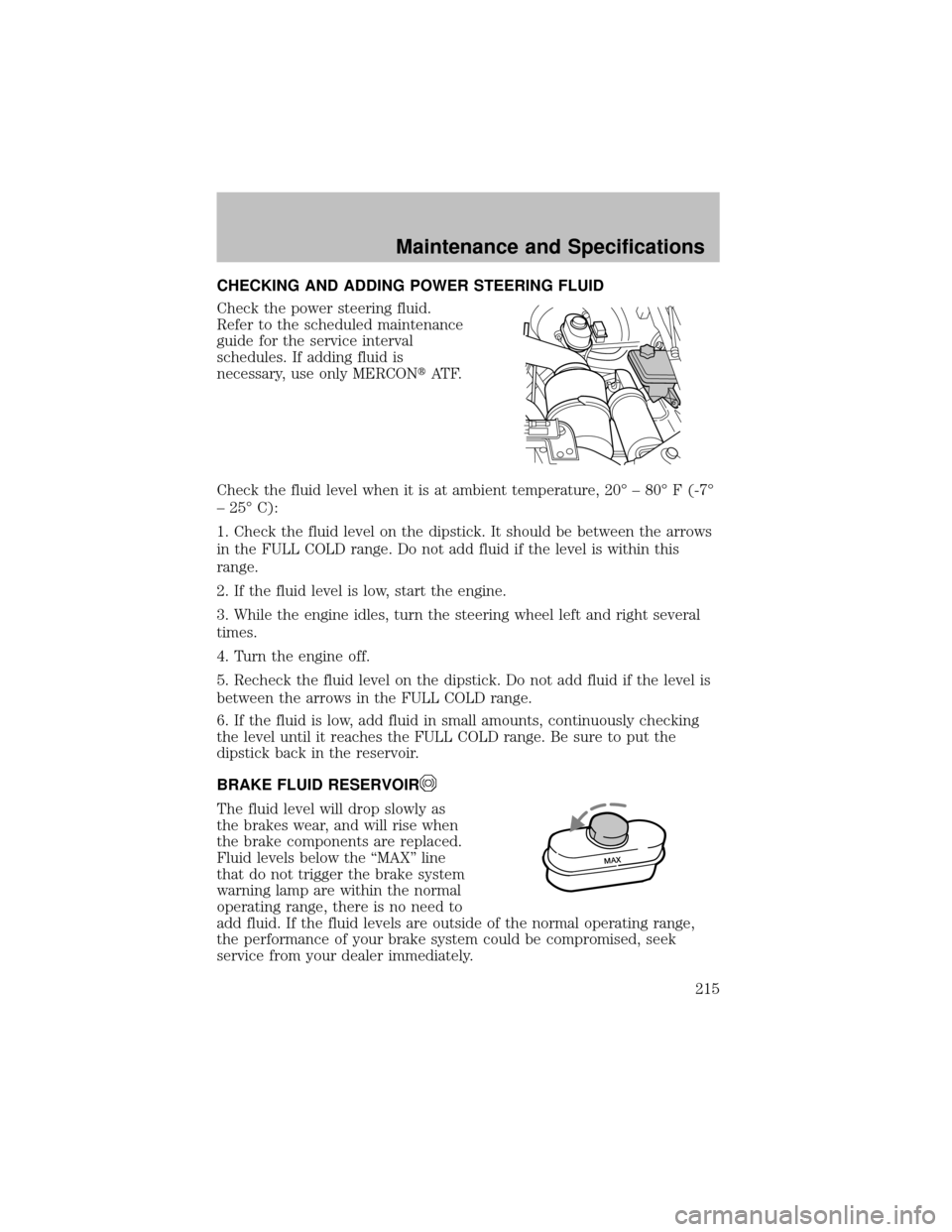
CHECKING AND ADDING POWER STEERING FLUID
Check the power steering fluid.
Refer to the scheduled maintenance
guide for the service interval
schedules. If adding fluid is
necessary, use only MERCON�AT F.
Check the fluid level when it is at ambient temperature, 20° – 80° F (-7°
– 25° C):
1. Check the fluid level on the dipstick. It should be between the arrows
in the FULL COLD range. Do not add fluid if the level is within this
range.
2. If the fluid level is low, start the engine.
3. While the engine idles, turn the steering wheel left and right several
times.
4. Turn the engine off.
5. Recheck the fluid level on the dipstick. Do not add fluid if the level is
between the arrows in the FULL COLD range.
6. If the fluid is low, add fluid in small amounts, continuouslychecking
the level until it reaches the FULL COLD range. Be sure to put the
dipstick back in the reservoir.
BRAKE FLUID RESERVOIR
The fluid level will drop slowlyas
the brakes wear, and will rise when
the brake components are replaced.
Fluid levels below the “MAX” line
that do not trigger the brake system
warning lamp are within the normal
operating range, there is no need to
add fluid. If the fluid levels are outside of the normal operating range,
the performance of your brake system could be compromised, seek
service from your dealer immediately.
M
A
X
Maintenance and Specifications
215
Page 217 of 256
However, the fluid level should be checked if the transmission is not
working properly, i.e., if the transmission slips or shifts slowly or if y ou
notice some sign of fluid leakage.
Automatic transmission fluid expands when warmed. To obtain an
accurate fluid check, drive the vehicle until it is at normal operating
temperature (approximately30 km [20 miles]). If your vehicle has been
operated for an extended period at high speeds, in citytraffic during hot
weather or pulling a trailer, the vehicle should be turned off for about 30
minutes to allow fluid to cool before checking.
1. Drive the vehicle 30 km (20 miles) or until it reaches normal operating
temperature.
2. Park the vehicle on a level surface and engage the parking brake.
3. With the parking brake engaged and your foot on the brake pedal,
start the engine and move the gearshift lever through all of the gear
ranges. Allow sufficient time for each gear to engage.
4. Latch the gearshift lever in P (Park) and leave the engine running.
5. Remove the dipstick, wiping it clean with a clean, drylint free rag. If
necessary, refer toIdentifying components in the engine compartment
in this chapter for the location of the dipstick.
6. Install the dipstick making sure it is fullyseated in the filler tube.
7. Remove the dipstick and inspect the fluid level. The fluid should be in
the designated area for normal operating temperature or ambient
temperature.
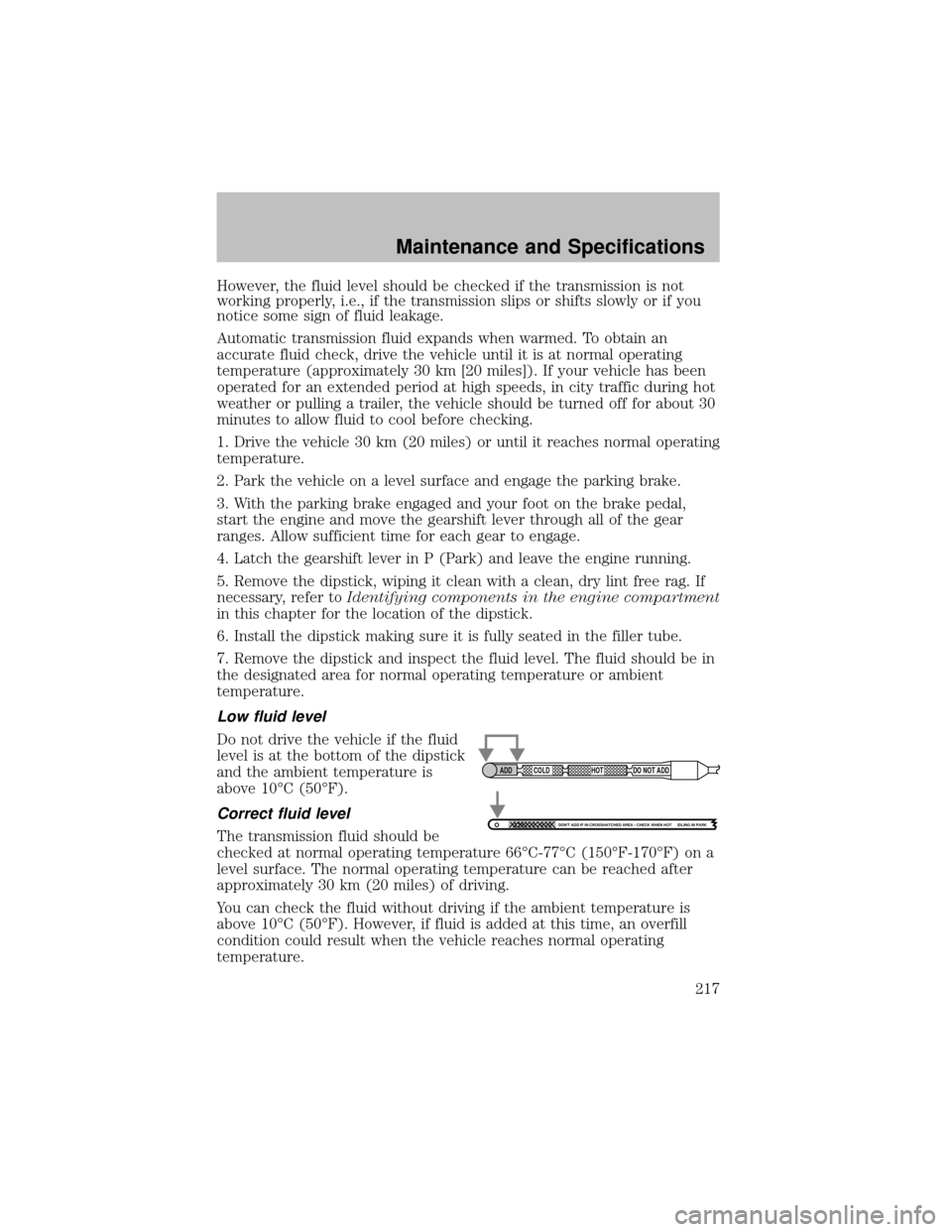
Low fluid level
Do not drive the vehicle if the fluid
level is at the bottom of the dipstick
and the ambient temperature is
above 10°C (50°F).
Correct fluid level
The transmission fluid should be
checked at normal operating temperature 66°C-77°C (150°F-170°F) on a
level surface. The normal operating temperature can be reached after
approximately30 km (20 miles) of driving.
You can check the fluid without driving if the ambient temperature is
above 10°C (50°F). However, if fluid is added at this time, an overfill
condition could result when the vehicle reaches normal operating
temperature.
ADD COLD HOT DO NOT ADD
DON'T ADD IF IN CROSSHATCHED AREA • CHECK WHEN HOT IDLING IN PARK
Maintenance and Specifications
217
Page 221 of 256
Note:Do not start your engine with the air cleaner removed and do not
remove it while the engine is running.
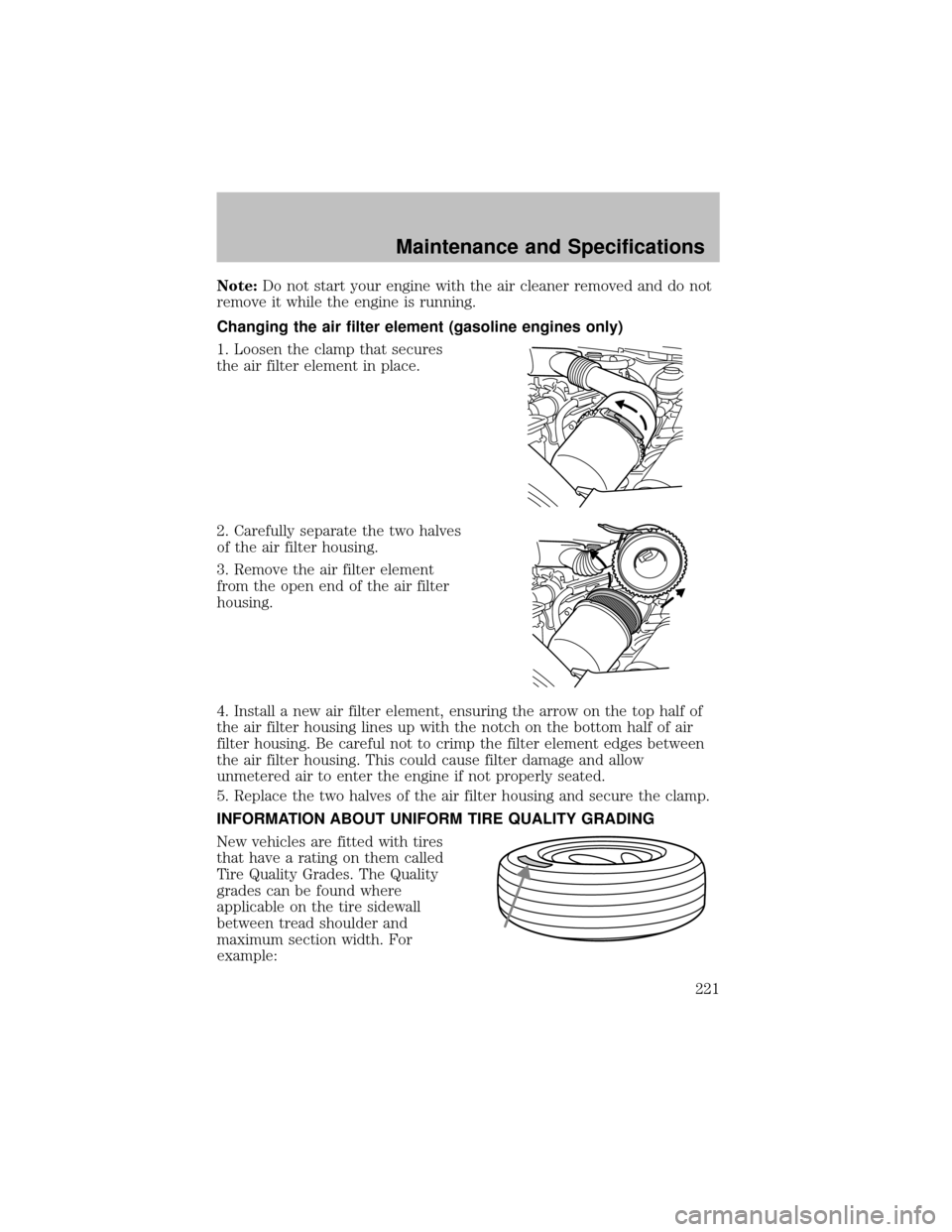
Changing the air filter element (gasoline engines only)
1. Loosen the clamp that secures
the air filter element in place.
2. Carefullyseparate the two halves
of the air filter housing.
3. Remove the air filter element
from the open end of the air filter
housing.
4. Install a new air filter element, ensuring the arrow on the top half of
the air filter housing lines up with the notch on the bottom half of air
filter housing. Be careful not to crimp the filter element edges between
the air filter housing. This could cause filter damage and allow
unmetered air to enter the engine if not properlyseated.
5. Replace the two halves of the air filter housing and secure the clamp.
INFORMATION ABOUT UNIFORM TIRE QUALITY GRADING
New vehicles are fitted with tires
that have a rating on them called
Tire QualityGrades. The Quality
grades can be found where
applicable on the tire sidewall
between tread shoulder and
maximum section width. For
example:
Maintenance and Specifications
221
Page 228 of 256
MOTORCRAFT PART NUMBERS
Component* 5.4L V8 engine 6.8L V10 engine
Air filter element FA-1634 FA-1634
Fuel filter FG-986B FG-986B
Oil filter FL-820-S FL-820-S
PCV valve EV-233 EV-233
Battery(Standard) BXT-65-650 BXT-65-650
Battery(Optional) BXT-65-750 BXT-65-750
Spark plugs-platinum** AGSF-22W AGSF-22W
*Refer to the7.3 Liter Power Stroke Direct Injection Turbo Diesel
Owner’s Guide Supplementfor Motorcraft diesel engine service part
numbers.
**Refer to Vehicle Emissions Control Information (VECI) decal for spark
plug gap information.
REFILL CAPACITIES
FluidFord Part
NameApplication Capacity
Front axle Hypoid Gear Oil
SAE 90F-250/350
(Dana 60 axle)2.7L (5.8 pints)
F-350/450/550
(Dana 60 axle)2.7L (5.8 pints)
Rear axle
1,2Motorcraft SAE
75W-140
Synthetic Rear
Axle LubricantF-250 /350
(10.50 inch
axle)3.3L (6.9 pints)
Motorcraft SAE
75W-90
Synthetic Rear
Axle LubricantF-350/450
(DANA 80)4.0L (8.5 pints)
Motorcraft SAE
80W-90
Premium Rear
Axle LubricantF-550
(Dana 135)11.6L (24.5
pints)
Maintenance and Specifications
228
Page 229 of 256
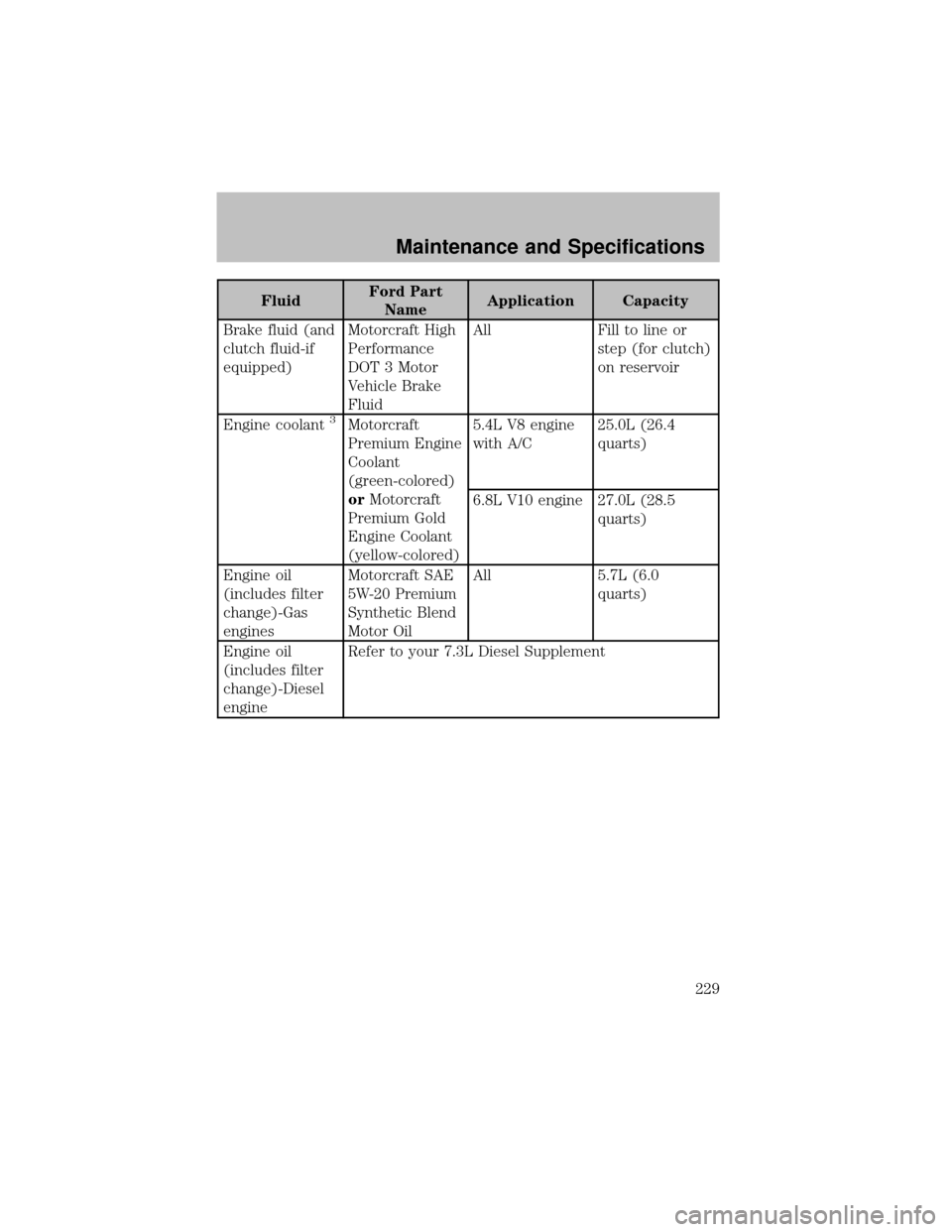
FluidFord Part
NameApplication Capacity
Brake fluid (and
clutch fluid-if
equipped)Motorcraft High
Performance
DOT 3 Motor
Vehicle Brake
FluidAll Fill to line or
step (for clutch)
on reservoir
Engine coolant
3Motorcraft
Premium Engine
Coolant
(green-colored)
orMotorcraft
Premium Gold
Engine Coolant
(yellow-colored)5.4L V8 engine
with A/C25.0L (26.4
quarts)
6.8L V10 engine 27.0L (28.5
quarts)
Engine oil
(includes filter
change)-Gas
enginesMotorcraft SAE
5W-20 Premium
Synthetic Blend
Motor OilAll 5.7L (6.0
quarts)
Engine oil
(includes filter
change)-Diesel
engineRefer to your 7.3L Diesel Supplement
Maintenance and Specifications
229
Page 233 of 256
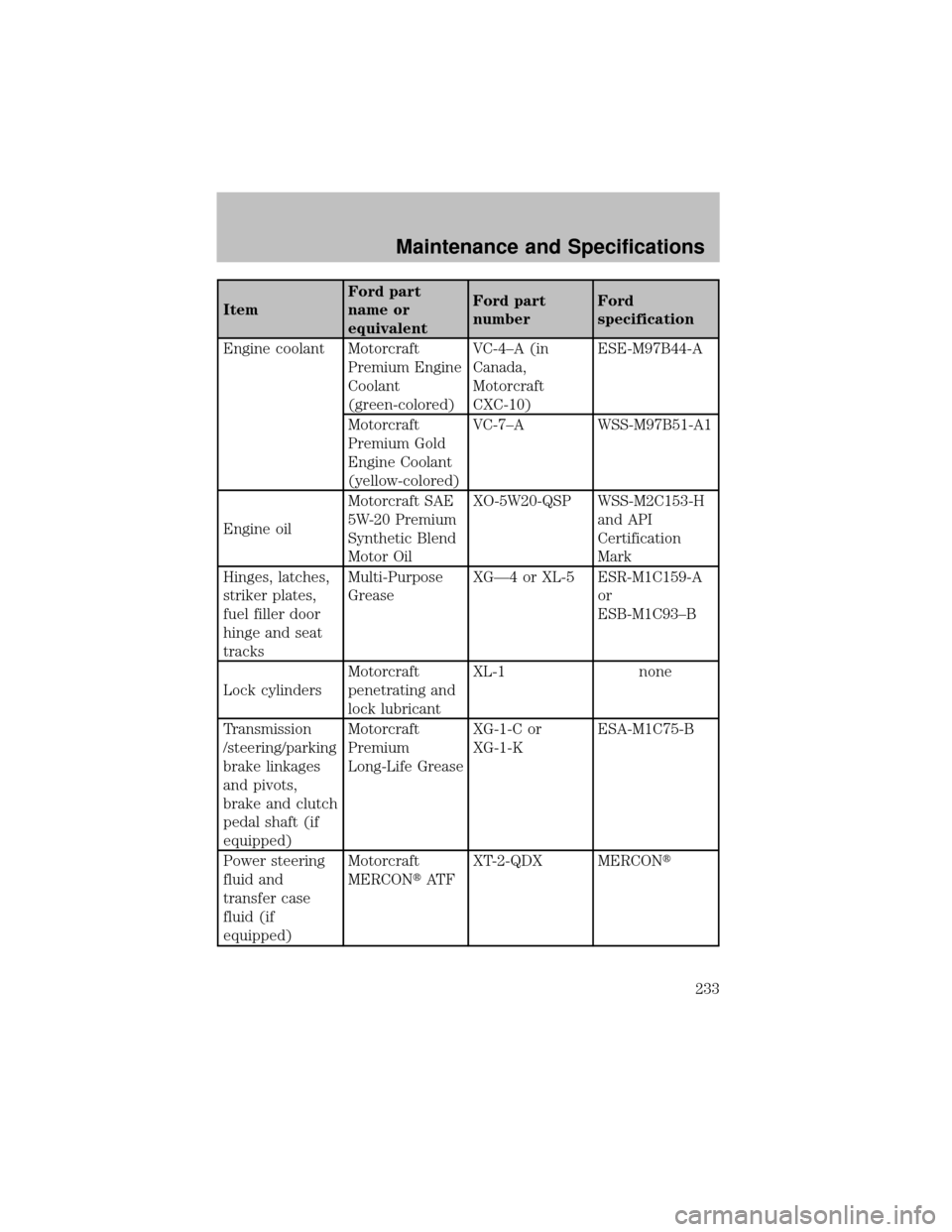
ItemFord part
name or
equivalentFord part
numberFord
specification
Engine coolant Motorcraft
Premium Engine
Coolant
(green-colored)VC-4–A (in
Canada,
Motorcraft
CXC-10)ESE-M97B44-A
Motorcraft
Premium Gold
Engine Coolant
(yellow-colored)VC-7–A WSS-M97B51-A1
Engine oilMotorcraft SAE
5W-20 Premium
Synthetic Blend
Motor OilXO-5W20-QSP WSS-M2C153-H
and API
Certification
Mark
Hinges, latches,
striker plates,
fuel filler door
hinge and seat
tracksMulti-Purpose
GreaseXG—4 or XL-5 ESR-M1C159-A
or
ESB-M1C93–B
Lock cylindersMotorcraft
penetrating and
lock lubricantXL-1 none
Transmission
/steering/parking
brake linkages
and pivots,
brake and clutch
pedal shaft (if
equipped)Motorcraft
Premium
Long-Life GreaseXG-1-C or
XG-1-KESA-M1C75-B
Power steering
fluid and
transfer case
fluid (if
equipped)Motorcraft
MERCON�AT FXT-2-QDX MERCON�
Maintenance and Specifications
233