2003 FORD MUSTANG warning light
[x] Cancel search: warning lightPage 108 of 256
Disconnect the combination lap/shoulder belt and
allow it to retract completely to disengage the
automatic locking mode and activate the vehicle
sensitive (emergency) locking mode.
After any vehicle collision, the front
passenger and rear outboard seat belt
systems must be checked by a qualified technician
to verify that the“automatic locking retractor”
feature for child seats is still functioning properly.
In addition, all seat belts should be checked for
proper function.
BELT AND RETRACTOR ASSEMBLY MUST
BE REPLACED if the seat belt assembly
“automatic locking retractor”feature or any other
seat belt function is not operating properly when
checked according to the procedures in Workshop
Manual.
Failure to replace the Belt and Retractor
assembly could increase the risk of injury in
collisions.
Safety belt warning light and indicator
chime
The seat belt warning light illuminates in the
instrument cluster and a chime sounds to remind
the occupants to fasten their safety belts.
Seating and Safety Restraints
108
Page 109 of 256
Conditions of operation
If... Then...
The driver’s safety belt is
not buckled before the
ignition switch is turned
to the ON position...The safety belt warning light
illuminates1-2 minutes and the
warning chime sounds 4-8
seconds.
The driver’s safety belt is
buckled while the
indicator light is
illuminated and the
warning chime is
sounding...The safety belt warning light
and warning chime turn off.
The driver’s safety belt is
buckled before the
ignition switch is turned
to the ON position...The safety belt warning light
will turn on for 3 seconds and
then turn off. The indicator
chime will remain off.
BeltMinder
The BeltMinder feature is a supplemental warning to
the safety belt warning function. This feature
provides additional reminders to the driver that the
driver’s safety belt is unbuckled by intermittently
sounding a chime and illuminating the safety belt
warning lamp in the instrument cluster.
If... Then...
The driver’s safety belt is
not buckled
approximately 5 seconds
after the safety belt
warning light has turned
off...The BeltMinder feature is
activated - the safety belt
warning light illuminates and
the warning chime sounds for 6
seconds every 30 seconds,
repeating for approximately 5
minutes or until safety belt is
buckled.
The driver’s safety belt is
buckled while the safety
belt indicator light is
illuminated and the safety
belt warning chime is
sounding...The BeltMinder feature will not
activate.
Seating and Safety Restraints
109
Page 112 of 256
•The driver’s safety belt is unbuckled.
•The parklamps/headlamps are in OFF position (If
vehicle is equipped with Autolamps, this will not
affect the procedure).
To reduce the risk of injury, do not
deactivate/activate the Belt Minder feature
while driving the vehicle.
BeltMinder activation and deactivation
procedure
1. Turn the ignition switch to the RUN (or ON)
position. (DO NOT START THE ENGINE.)
2. Wait until the safety belt warning light turns off.
(Approximately 1–2 minutes.)
•Steps 3–5 must be completed within 60 seconds
or the procedure will have to be repeated.
3. Buckle then unbuckle the safety belt three times,
ending with the safety belt unbuckled. This can be
done before or during BeltMinder warning activation.
4. Turn on the parklamps/headlamps, turn off the
parklamps/headlamps.
5. Buckle then unbuckle the safety belt three times,
ending with the safety belt unbuckled.
•After step 5 the safety belt warning light will be
turned on for three seconds.
6. Within seven seconds of the safety belt warning
light turning off, buckle then unbuckle the safety
belt.
•This will disable BeltMinder if it is currently
enabled, or enable BeltMinder if it is currently
disabled.
7. Confirmation of disabling BeltMinder is provided
by the safety belt warning light flashing four times
per second for three seconds.
8. Confirmation of enabling BeltMinder is provided
by:
•The safety belt warning light flashing four times
per second for three seconds.
Seating and Safety Restraints
112
Page 113 of 256
•Followed by three seconds with the safety belt
warning light off.
•Once again, the safety belt warning light will flash
four times per second for three seconds.
9. After receiving confirmation, the
deactivation/activation procedure is complete.
Safety belt extension assembly
If the safety belt is too short when fully extended,
there is a 20 cm (8 inch) safety belt extension
assembly that can be added (part number 611C22).
This assembly can be obtained from your dealer at
no cost.
Use only extensions manufactured by the same
supplier as the safety belt. Manufacturer
identification is located at the end of the webbing on
the label. Also, use the safety belt extension only if
the safety belt is too short for you when fully
extended.
Do not use extensions to change the fit of the
shoulder belt across the torso.
Safety belt maintenance
Inspect the safety belt systems periodically to make
sure they work properly and are not damaged.
Inspect the safety belts to make sure there are no
nicks, tears or cuts. Replace if necessary. All safety
belt assemblies, including retractors, buckles, front
seat belt buckle assemblies, buckle support
assemblies (slide bar-if equipped), shoulder belt
height adjusters (if equipped), shoulder belt guide
on seatback (if equipped), child safety seat tether
bracket assemblies (if equipped), LATCH child seat
tether anchors and lower anchors (if equipped), and
attaching hardware, should be inspected after a
collision. Ford Motor Company recommends that all
safety belt assemblies used in vehicles involved in a
collision be replaced. However, if the collision was
minor and a qualified technician finds that the belts
do not show damage and continue to operate
properly, they do not need to be replaced. Safety
Seating and Safety Restraints
113
Page 118 of 256
amounts of sodium hydroxide may be present which
may irritate the skin and eyes, but none of the
residue is toxic.
While the system is designed to help reduce serious
injuries, contact with a deploying air bag may also
cause abrasions, swelling or temporary hearing loss.
Because air bags must inflate rapidly and with
considerable force, there is the risk of death or
serious injuries such as fractures, facial and eye
injuries or internal injuries, particularly to occupants
who are not properly restrained or are otherwise out
of position at the time of air bag deployment. Thus,
it is extremely important that occupants be properly
restrained as far away from the air bag module as
possible while maintaining vehicle control.
The SRS consists of:
•driver and passenger air bag modules (which
include the inflators and air bags)
•one or more impact and safing sensors
•a readiness light and tone
•a diagnostic module
•and the electrical wiring which connects the
components
The diagnostic module monitors its own internal
circuits and the supplemental air bag electrical
system warning (including the impact sensors), the
system wiring, the air bag system readiness light, the
air bag back up power and the air bag ignitors.
Several air bag system components get hot
after inflation. Do not touch them after
inflation.
If the air bag has deployed,the air bag will
not function again and must be replaced
immediately.If the air bag is not replaced, the
unrepaired area will increase the risk of injury in a
collision.
Seating and Safety Restraints
118
Page 133 of 256
STARTING
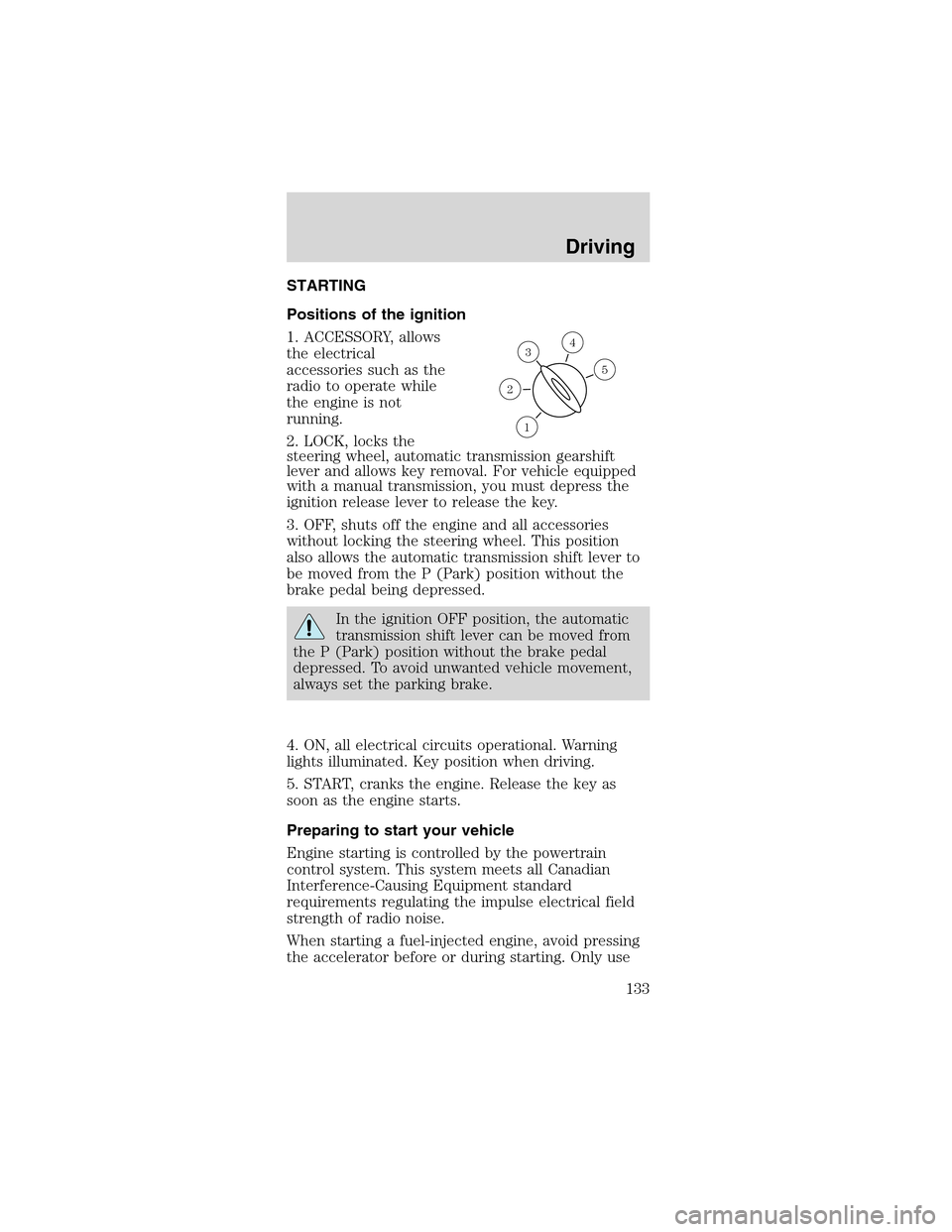
Positions of the ignition
1. ACCESSORY, allows
the electrical
accessories such as the
radio to operate while
the engine is not
running.
2. LOCK, locks the
steering wheel, automatic transmission gearshift
lever and allows key removal. For vehicle equipped
with a manual transmission, you must depress the
ignition release lever to release the key.
3. OFF, shuts off the engine and all accessories
without locking the steering wheel. This position
also allows the automatic transmission shift lever to
be moved from the P (Park) position without the
brake pedal being depressed.
In the ignition OFF position, the automatic
transmission shift lever can be moved from
the P (Park) position without the brake pedal
depressed. To avoid unwanted vehicle movement,
always set the parking brake.
4. ON, all electrical circuits operational. Warning
lights illuminated. Key position when driving.
5. START, cranks the engine. Release the key as
soon as the engine starts.
Preparing to start your vehicle
Engine starting is controlled by the powertrain
control system. This system meets all Canadian
Interference-Causing Equipment standard
requirements regulating the impulse electrical field
strength of radio noise.
When starting a fuel-injected engine, avoid pressing
the accelerator before or during starting. Only use
3
1
2
5
4
Driving
133
Page 140 of 256
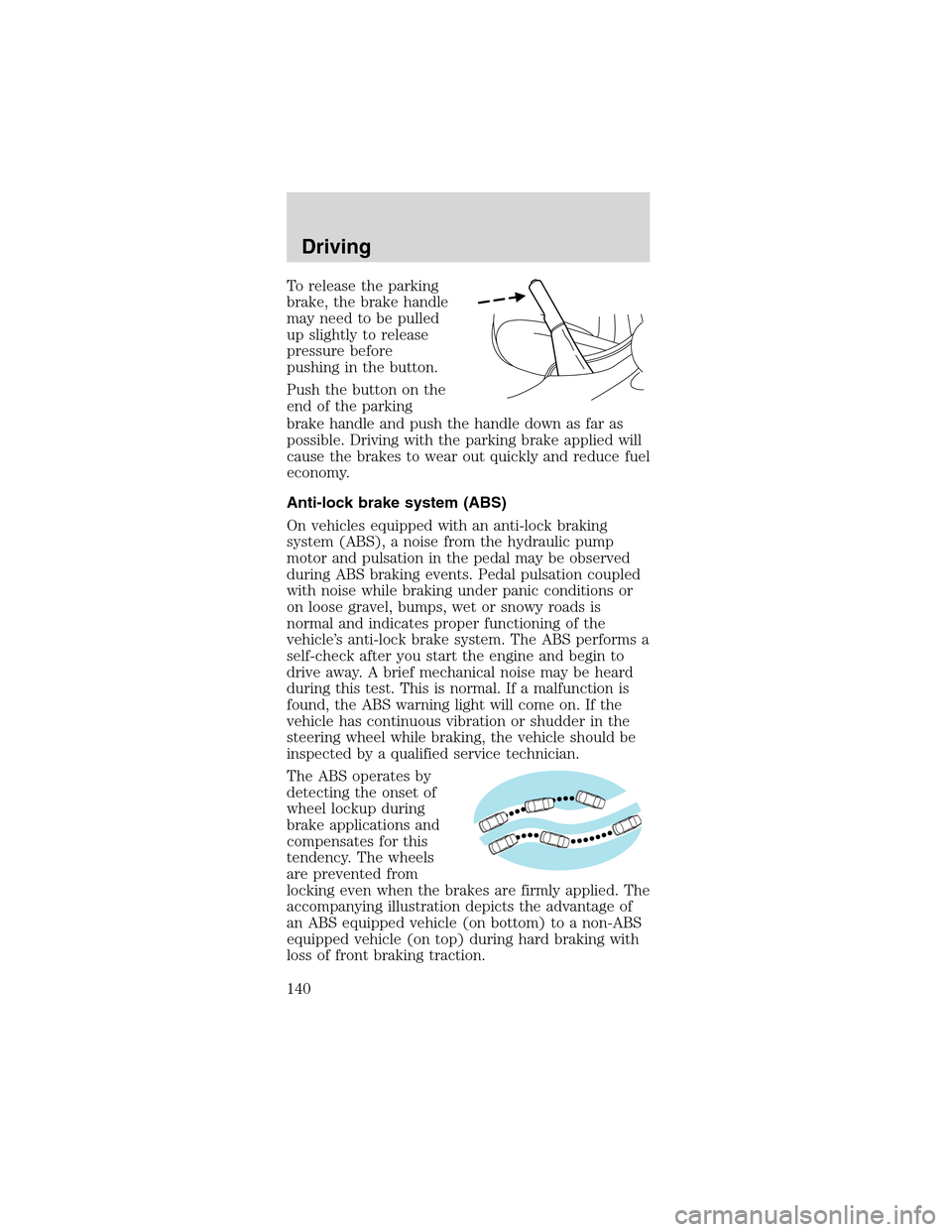
To release the parking
brake, the brake handle
may need to be pulled
up slightly to release
pressure before
pushing in the button.
Push the button on the
end of the parking
brake handle and push the handle down as far as
possible. Driving with the parking brake applied will
cause the brakes to wear out quickly and reduce fuel
economy.
Anti-lock brake system (ABS)
On vehicles equipped with an anti-lock braking
system (ABS), a noise from the hydraulic pump
motor and pulsation in the pedal may be observed
during ABS braking events. Pedal pulsation coupled
with noise while braking under panic conditions or
on loose gravel, bumps, wet or snowy roads is
normal and indicates proper functioning of the
vehicle’s anti-lock brake system. The ABS performs a
self-check after you start the engine and begin to
drive away. A brief mechanical noise may be heard
during this test. This is normal. If a malfunction is
found, the ABS warning light will come on. If the
vehicle has continuous vibration or shudder in the
steering wheel while braking, the vehicle should be
inspected by a qualified service technician.
The ABS operates by
detecting the onset of
wheel lockup during
brake applications and
compensates for this
tendency. The wheels
are prevented from
locking even when the brakes are firmly applied. The
accompanying illustration depicts the advantage of
an ABS equipped vehicle (on bottom) to a non-ABS
equipped vehicle (on top) during hard braking with
loss of front braking traction.
Driving
140
Page 141 of 256
ABSwarning lampABS
TheABSwarning lamp in the instrument cluster
momentarily illuminates when the ignition is turned
to the ON position. If the light does not illuminate
momentarily at start up, remains on or continues to
flash, the ABS needs to be serviced.
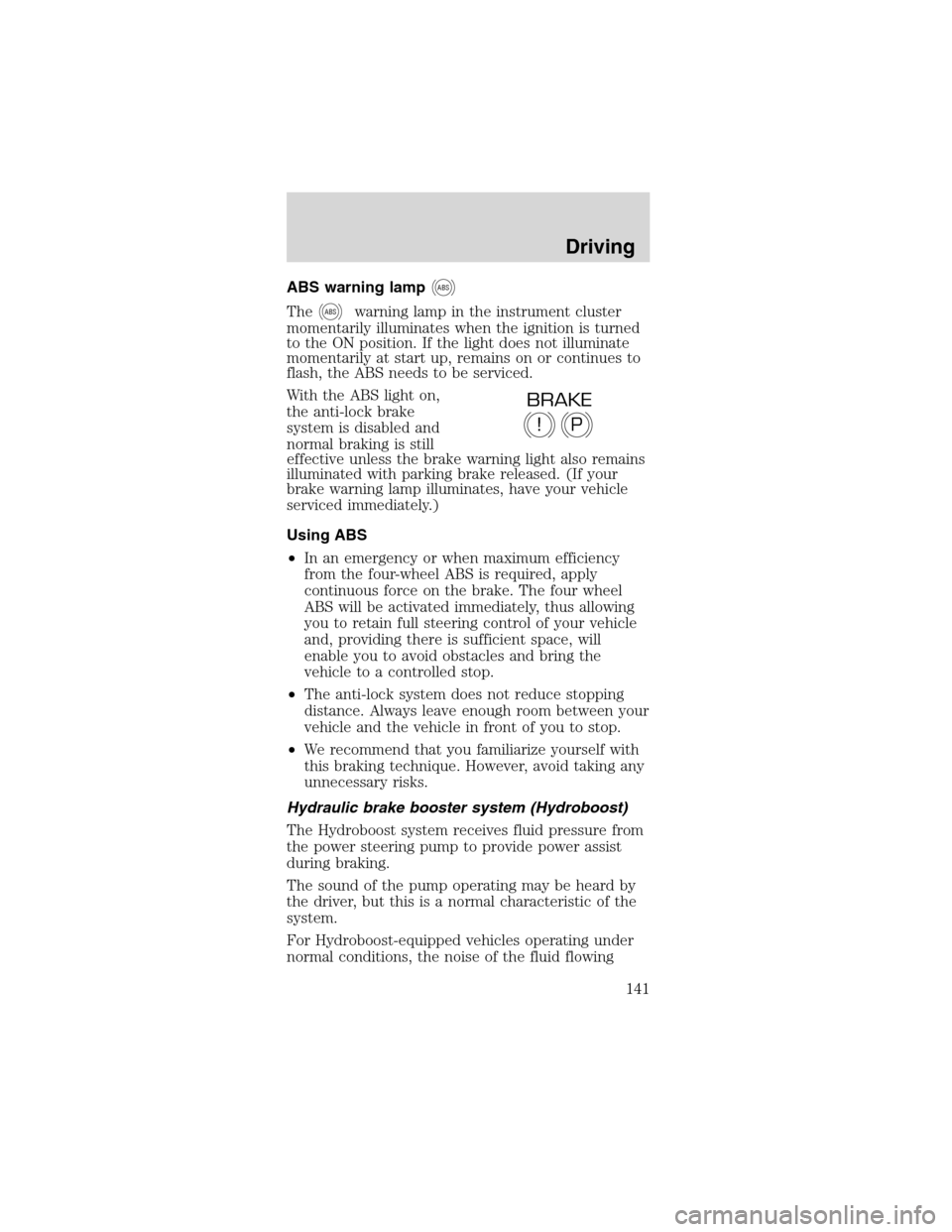
With the ABS light on,
the anti-lock brake
system is disabled and
normal braking is still
effective unless the brake warning light also remains
illuminated with parking brake released. (If your
brake warning lamp illuminates, have your vehicle
serviced immediately.)
Using ABS
•In an emergency or when maximum efficiency
from the four-wheel ABS is required, apply
continuous force on the brake. The four wheel
ABS will be activated immediately, thus allowing
you to retain full steering control of your vehicle
and, providing there is sufficient space, will
enable you to avoid obstacles and bring the
vehicle to a controlled stop.
•The anti-lock system does not reduce stopping
distance. Always leave enough room between your
vehicle and the vehicle in front of you to stop.
•We recommend that you familiarize yourself with
this braking technique. However, avoid taking any
unnecessary risks.
Hydraulic brake booster system (Hydroboost)
The Hydroboost system receives fluid pressure from
the power steering pump to provide power assist
during braking.
The sound of the pump operating may be heard by
the driver, but this is a normal characteristic of the
system.
For Hydroboost-equipped vehicles operating under
normal conditions, the noise of the fluid flowing
P!
BRAKE
Driving
141