2003 FORD EXPEDITION towing capacity
[x] Cancel search: towing capacityPage 219 of 320
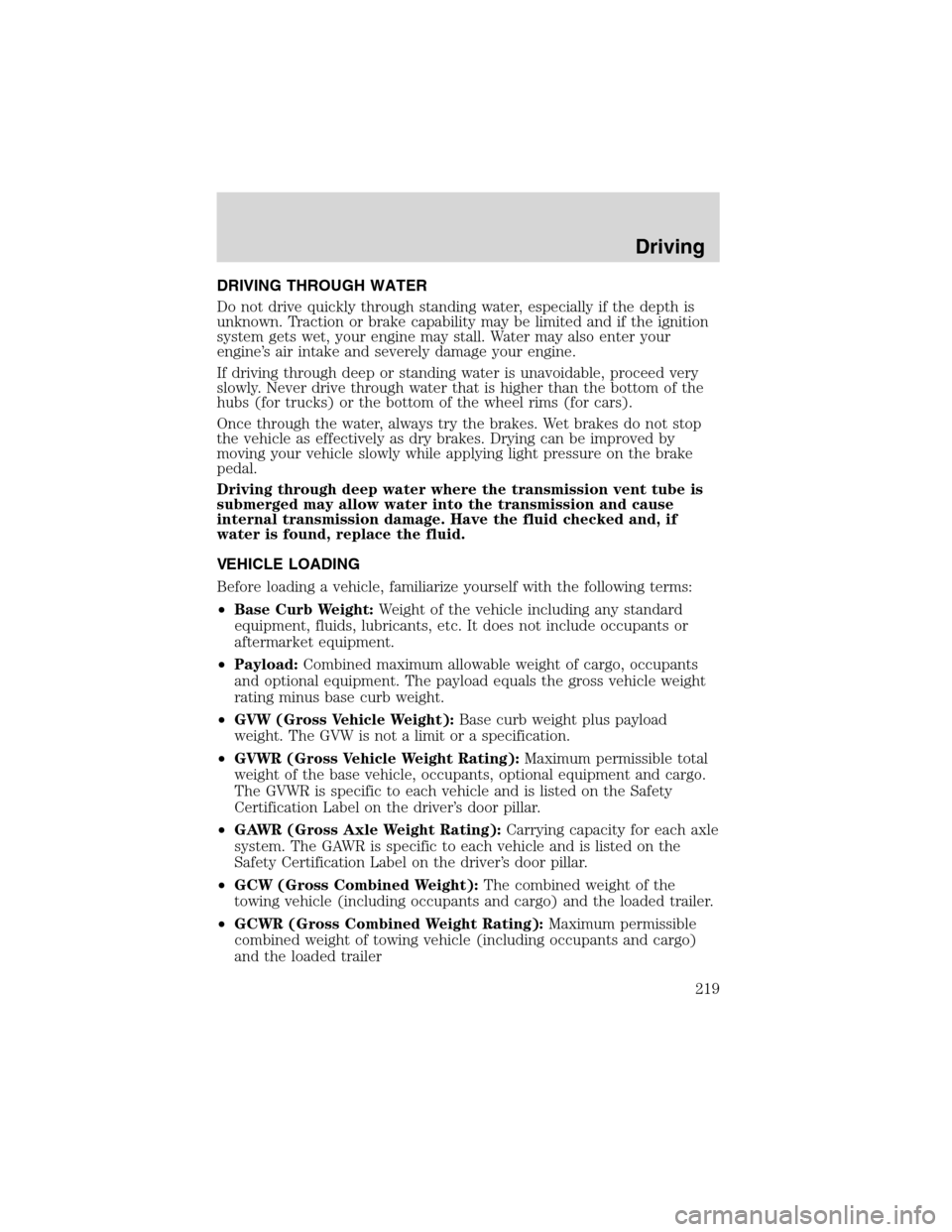
DRIVING THROUGH WATER
Do not drive quickly through standing water, especially if the depth is
unknown. Traction or brake capability may be limited and if the ignition
system gets wet, your engine may stall. Water may also enter your
engine’s air intake and severely damage your engine.
If driving through deep or standing water is unavoidable, proceed very
slowly. Never drive through water that is higher than the bottom of the
hubs (for trucks) or the bottom of the wheel rims (for cars).
Once through the water, always try the brakes. Wet brakes do not stop
the vehicle as effectively as dry brakes. Drying can be improved by
moving your vehicle slowly while applying light pressure on the brake
pedal.
Driving through deep water where the transmission vent tube is
submerged may allow water into the transmission and cause
internal transmission damage. Have the fluid checked and, if
water is found, replace the fluid.
VEHICLE LOADING
Before loading a vehicle, familiarize yourself with the following terms:
•Base Curb Weight:Weight of the vehicle including any standard
equipment, fluids, lubricants, etc. It does not include occupants or
aftermarket equipment.
•Payload:Combined maximum allowable weight of cargo, occupants
and optional equipment. The payload equals the gross vehicle weight
rating minus base curb weight.
•GVW (Gross Vehicle Weight):Base curb weight plus payload
weight. The GVW is not a limit or a specification.
•GVWR (Gross Vehicle Weight Rating):Maximum permissible total
weight of the base vehicle, occupants, optional equipment and cargo.
The GVWR is specific to each vehicle and is listed on the Safety
Certification Label on the driver’s door pillar.
•GAWR (Gross Axle Weight Rating):Carrying capacity for each axle
system. The GAWR is specific to each vehicle and is listed on the
Safety Certification Label on the driver’s door pillar.
•GCW (Gross Combined Weight):The combined weight of the
towing vehicle (including occupants and cargo) and the loaded trailer.
•GCWR (Gross Combined Weight Rating):Maximum permissible
combined weight of towing vehicle (including occupants and cargo)
and the loaded trailer
Driving
219
Page 220 of 320
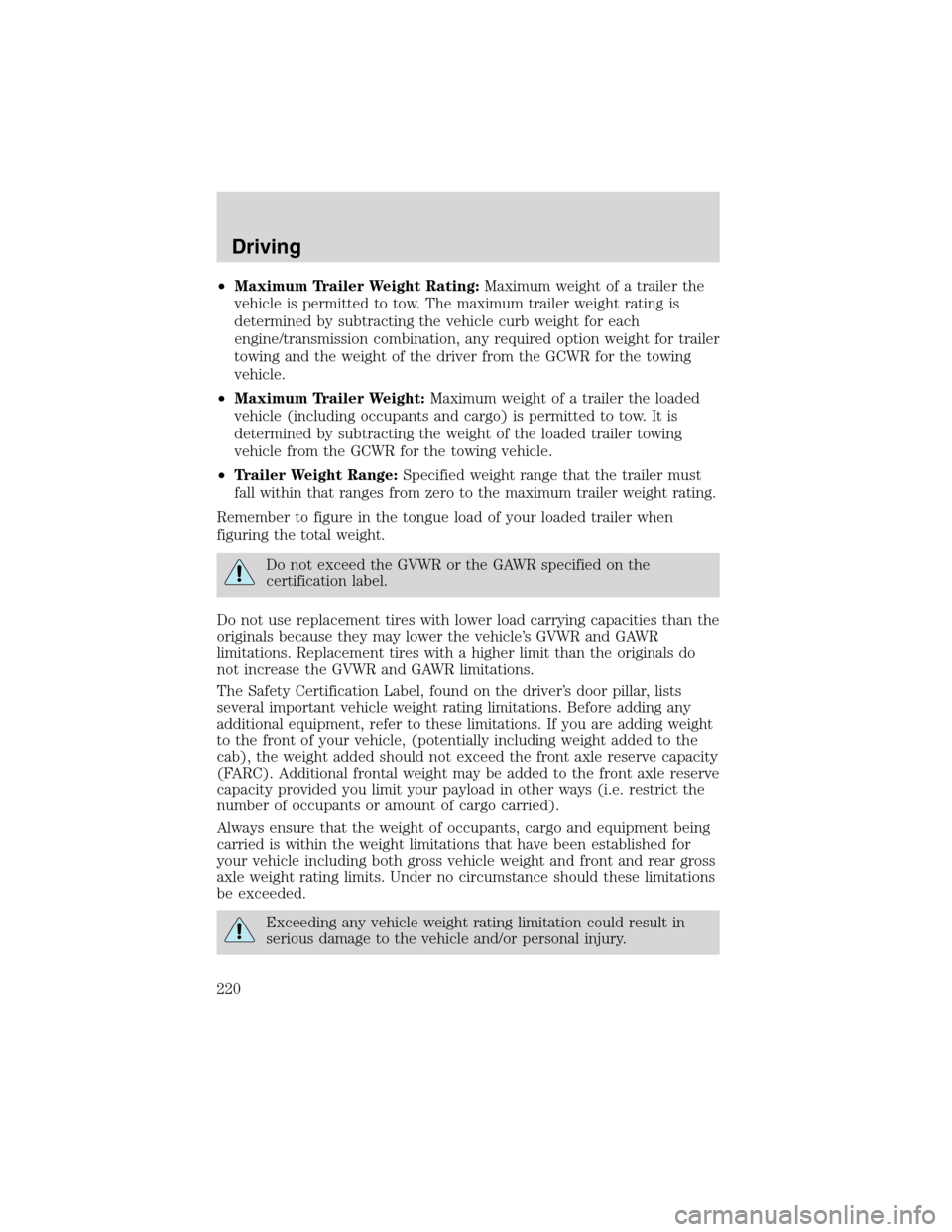
•Maximum Trailer Weight Rating:Maximum weight of a trailer the
vehicle is permitted to tow. The maximum trailer weight rating is
determined by subtracting the vehicle curb weight for each
engine/transmission combination, any required option weight for trailer
towing and the weight of the driver from the GCWR for the towing
vehicle.
•Maximum Trailer Weight:Maximum weight of a trailer the loaded
vehicle (including occupants and cargo) is permitted to tow. It is
determined by subtracting the weight of the loaded trailer towing
vehicle from the GCWR for the towing vehicle.
•Trailer Weight Range:Specified weight range that the trailer must
fall within that ranges from zero to the maximum trailer weight rating.
Remember to figure in the tongue load of your loaded trailer when
figuring the total weight.
Do not exceed the GVWR or the GAWR specified on the
certification label.
Do not use replacement tires with lower load carrying capacities than the
originals because they may lower the vehicle’s GVWR and GAWR
limitations. Replacement tires with a higher limit than the originals do
not increase the GVWR and GAWR limitations.
The Safety Certification Label, found on the driver’s door pillar, lists
several important vehicle weight rating limitations. Before adding any
additional equipment, refer to these limitations. If you are adding weight
to the front of your vehicle, (potentially including weight added to the
cab), the weight added should not exceed the front axle reserve capacity
(FARC). Additional frontal weight may be added to the front axle reserve
capacity provided you limit your payload in other ways (i.e. restrict the
number of occupants or amount of cargo carried).
Always ensure that the weight of occupants, cargo and equipment being
carried is within the weight limitations that have been established for
your vehicle including both gross vehicle weight and front and rear gross
axle weight rating limits. Under no circumstance should these limitations
be exceeded.
Exceeding any vehicle weight rating limitation could result in
serious damage to the vehicle and/or personal injury.
Driving
220
Page 317 of 320
cruise indicator .........................13
door ajar ....................................13
engine oil pressure ...................13
high beam .................................13
low fuel ......................................12
low washer fluid .......................12
overdrive off ..............................14
safety belt .................................12
service engine soon ..................10
speed control ..........................106
turn signal indicator .................13
Limited-slip axle .......................198
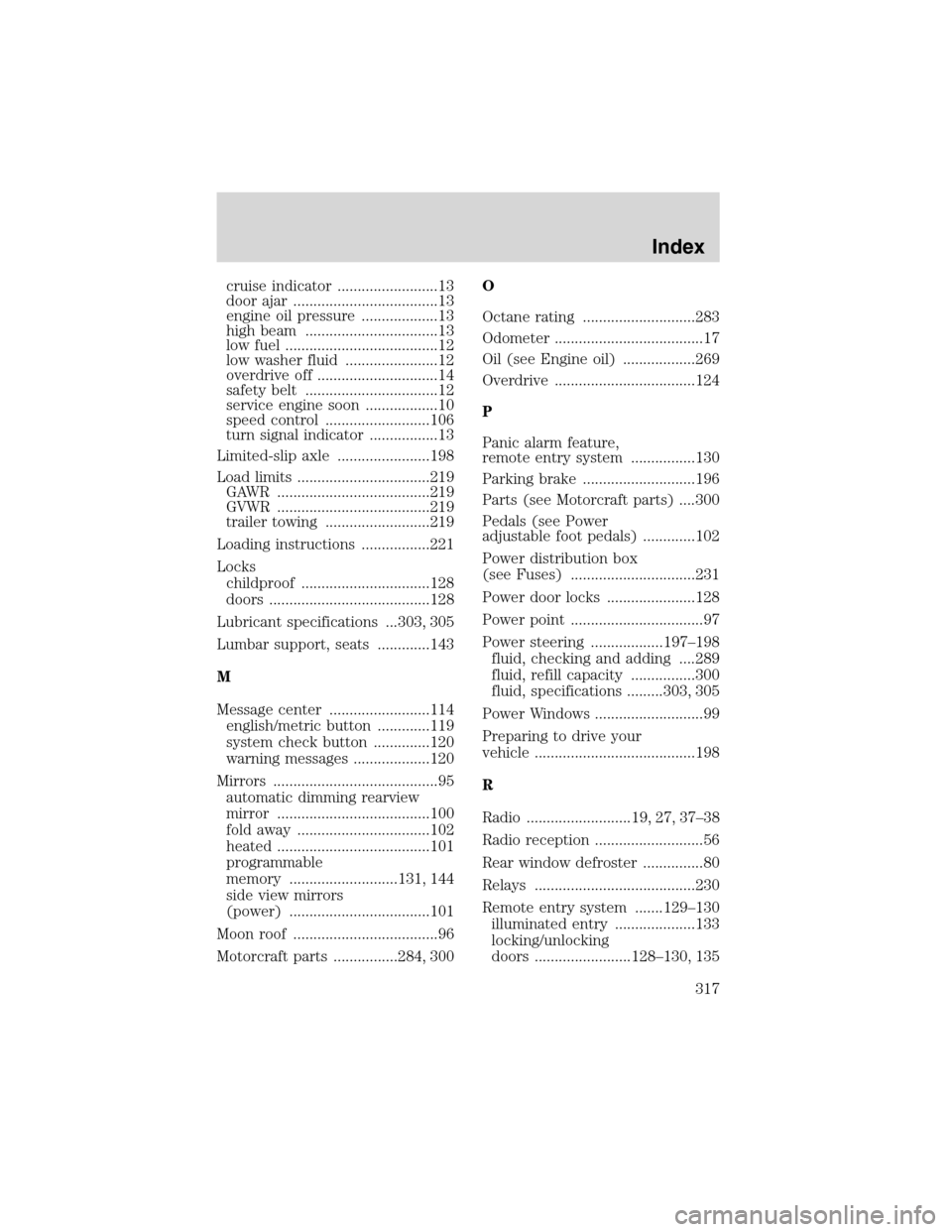
Load limits .................................219
GAWR ......................................219
GVWR ......................................219
trailer towing ..........................219
Loading instructions .................221
Locks
childproof ................................128
doors ........................................128
Lubricant specifications ...303, 305
Lumbar support, seats .............143
M
Message center .........................114
english/metric button .............119
system check button ..............120
warning messages ...................120
Mirrors .........................................95
automatic dimming rearview
mirror ......................................100
fold away .................................102
heated ......................................101
programmable
memory ...........................131, 144
side view mirrors
(power) ...................................101
Moon roof ....................................96
Motorcraft parts ................284, 300O
Octane rating ............................283
Odometer .....................................17
Oil (see Engine oil) ..................269
Overdrive ...................................124
P
Panic alarm feature,
remote entry system ................130
Parking brake ............................196
Parts (see Motorcraft parts) ....300
Pedals (see Power
adjustable foot pedals) .............102
Power distribution box
(see Fuses) ...............................231
Power door locks ......................128
Power point .................................97
Power steering ..................197–198
fluid, checking and adding ....289
fluid, refill capacity ................300
fluid, specifications .........303, 305
Power Windows ...........................99
Preparing to drive your
vehicle ........................................198
R
Radio ..........................19, 27, 37–38
Radio reception ...........................56
Rear window defroster ...............80
Relays ........................................230
Remote entry system .......129–130
illuminated entry ....................133
locking/unlocking
doors ........................128–130, 135
Index
317