Page 235 of 320
Fuse/Relay
LocationFuse Amp
RatingPassenger Compartment Fuse Panel
Description
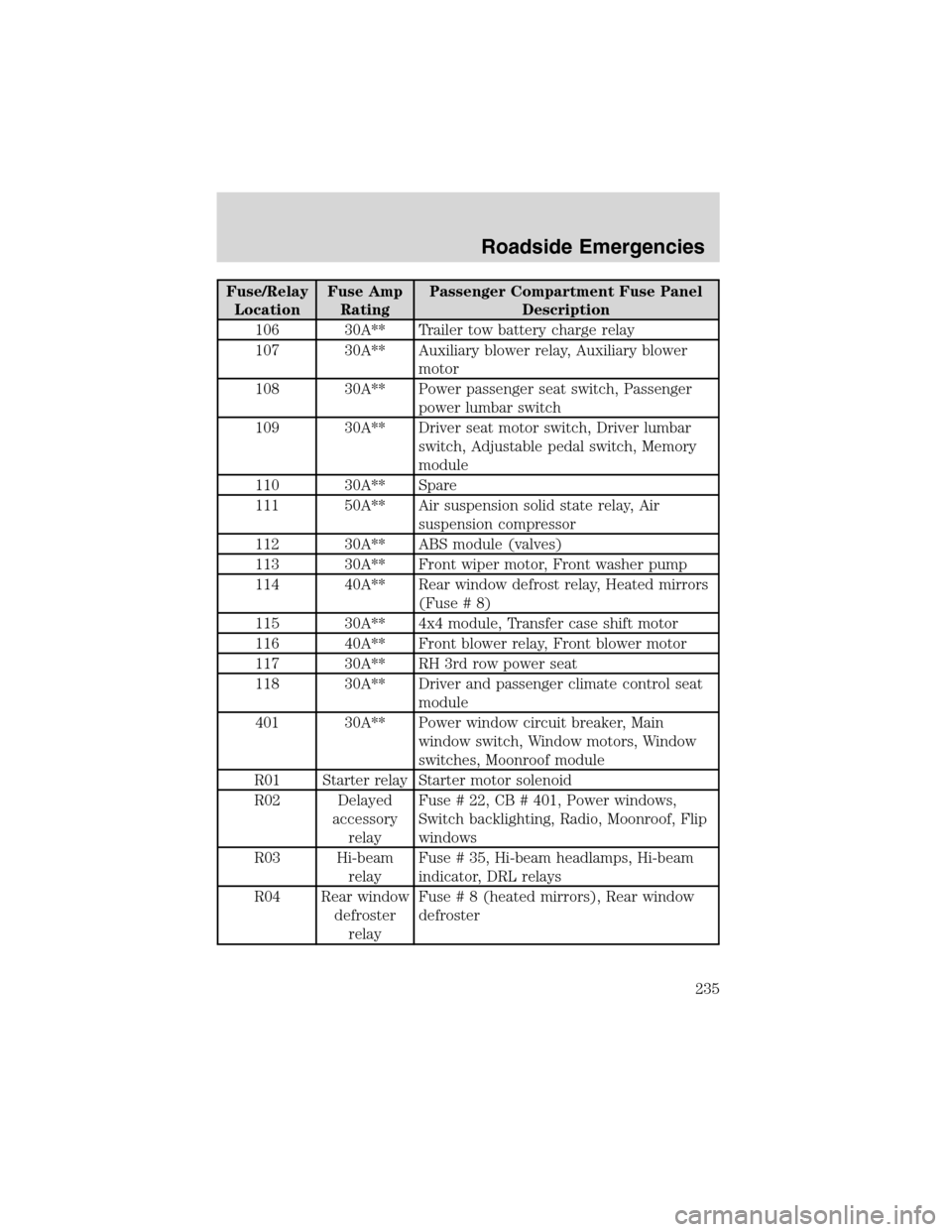
106 30A** Trailer tow battery charge relay
107 30A** Auxiliary blower relay, Auxiliary blower
motor
108 30A** Power passenger seat switch, Passenger
power lumbar switch
109 30A** Driver seat motor switch, Driver lumbar
switch, Adjustable pedal switch, Memory
module
110 30A** Spare
111 50A** Air suspension solid state relay, Air
suspension compressor
112 30A** ABS module (valves)
113 30A** Front wiper motor, Front washer pump
114 40A** Rear window defrost relay, Heated mirrors
(Fuse # 8)
115 30A** 4x4 module, Transfer case shift motor
116 40A** Front blower relay, Front blower motor
117 30A** RH 3rd row power seat
118 30A** Driver and passenger climate control seat
module
401 30A** Power window circuit breaker, Main
window switch, Window motors, Window
switches, Moonroof module
R01 Starter relay Starter motor solenoid
R02 Delayed
accessory
relayFuse # 22, CB # 401, Power windows,
Switch backlighting, Radio, Moonroof, Flip
windows
R03 Hi-beam
relayFuse # 35, Hi-beam headlamps, Hi-beam
indicator, DRL relays
R04 Rear window
defroster
relayFuse # 8 (heated mirrors), Rear window
defroster
Roadside Emergencies
235
Page 236 of 320

Fuse/Relay
LocationFuse Amp
RatingPassenger Compartment Fuse Panel
Description
R05 T/T battery
charge relayTT 7 wire connector, Battery charge
R06 Front blower
relayBlower motor, Blower motor speed control
(EATC)
R201 T/T park
lamp relayTrailer tow park lamps feed
R202 Fog lamp
relayFront fog lamps
R203 PCM relay Fuse # 32, Fuse # 33, Fuse # 34, Fuel
pump relay, PCM solenoids and sensors
R301 T/T back-up
lamp relayBack-up lamps, TT connector (back-up
lamps), Electrochromic mirror
R302 Speed
control relayElectric cooling fan clutch, Speed control
servo
R303 Fuel pump
relayFuel pump shut-off switch, PCM fuel
pump monitor, Fuel pump
R304 Battery
saver relayRail lamps, Vanity mirror lamps, Dome
lamp, Glove box lamp, Instrument cluster
R305 Horn relay Dual note horn
* Mini Fuses ** Maxi Fuses
CHANGING THE TIRES
If you get a flat tire while driving, do not apply the brake heavily.
Instead, gradually decrease your speed. Hold the steering wheel firmly
and slowly move to a safe place on the side of the road.
The use of tire sealants is not recommended and may compromise the
integrity of your tires. The use of tire sealants may also affect your tire
pressure monitoring system (if equipped).
Spare tire information
Your vehicle is equipped with a spare tire that may be used as a spare or
a regular tire. The spare is identical to the other tires on your vehicle,
although the wheel may not match.
Roadside Emergencies
236
Page 237 of 320
Location of the spare tire and tools
The spare tire and tools for your vehicle are stowed in the following
locations:
Item Location
Spare tire Under the vehicle, just forward of
the rear bumper
Jack tools and jacking instructions Under the access panel located in
the floor compartment behind the
rear seat
Removing the jack and tools
1. Open the liftgate, then locate the access panel behind the rear seat.
Unlatch and remove the panel.
2. Remove the jack and tools assembly tray from the compartment by
turning the T-nut counterclockwise to relieve tension against the jack
assembly tray.
3. Unsnap the wheel lug nut wrench, jack extension and handle from the
plastic tray. Remove the jack and instruction sheet from the tray
assembly.
Removing the spare tire
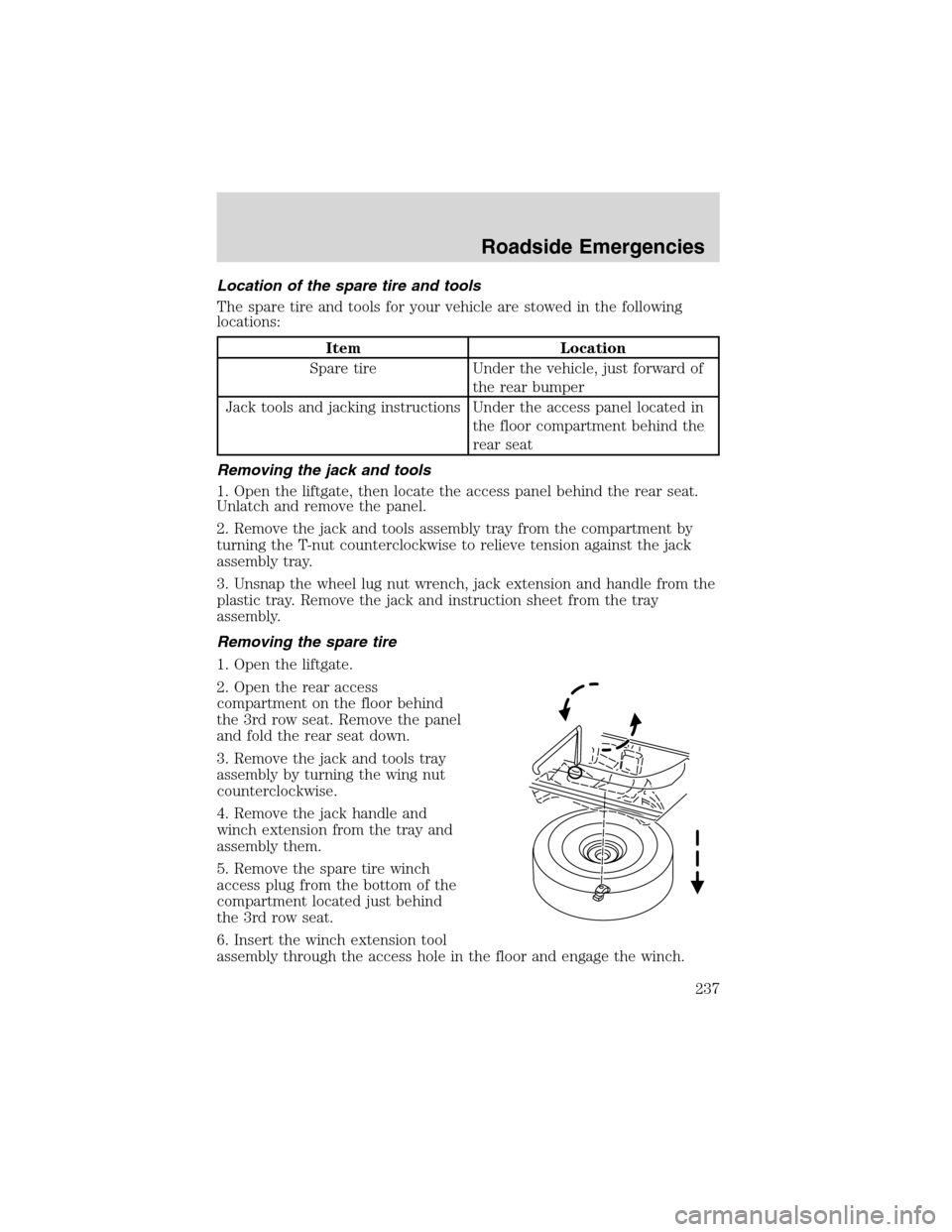
1. Open the liftgate.
2. Open the rear access
compartment on the floor behind
the 3rd row seat. Remove the panel
and fold the rear seat down.
3. Remove the jack and tools tray
assembly by turning the wing nut
counterclockwise.
4. Remove the jack handle and
winch extension from the tray and
assembly them.
5. Remove the spare tire winch
access plug from the bottom of the
compartment located just behind
the 3rd row seat.
6. Insert the winch extension tool
assembly through the access hole in the floor and engage the winch.
Roadside Emergencies
237
Page 238 of 320
7. To remove the spare tire, turn the handle counterclockwise until the
tire is lowered to the ground and the cable is slightly slack.
8. Slide the retainer through the center of the spare tire wheel.
Tire change procedure
To prevent the vehicle from moving when you change a tire, be
sure the parking brake is set, then block (in both directions) the
wheel that is diagonally opposite (other side and end of the vehicle) to
the tire being changed.
If the vehicle slips off the jack, you or someone else could be
seriously injured.
On vehicles equipped with Air Suspension, turn OFF the Air
Suspension switch prior to jacking, hoisting or towing your
vehicle.
Refer to the instruction sheet (located in the rear floor compartment
behind the 3rd row seat with the jack tray tools assembly kit) for
detailed tire change instructions.
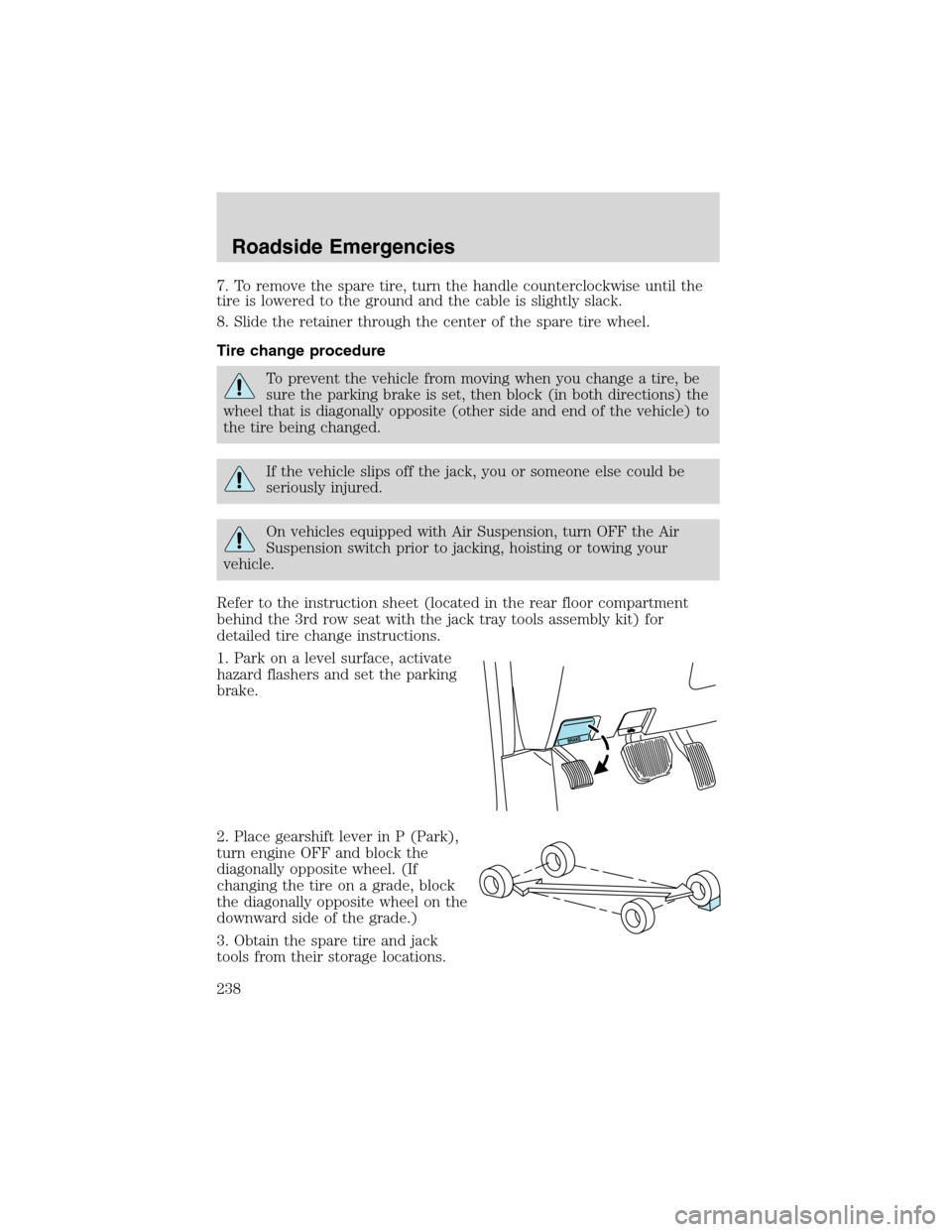
1. Park on a level surface, activate
hazard flashers and set the parking
brake.
2. Place gearshift lever in P (Park),
turn engine OFF and block the
diagonally opposite wheel. (If
changing the tire on a grade, block
the diagonally opposite wheel on the
downward side of the grade.)
3. Obtain the spare tire and jack
tools from their storage locations.
Roadside Emergencies
238
Page 241 of 320
Stowing the spare tire
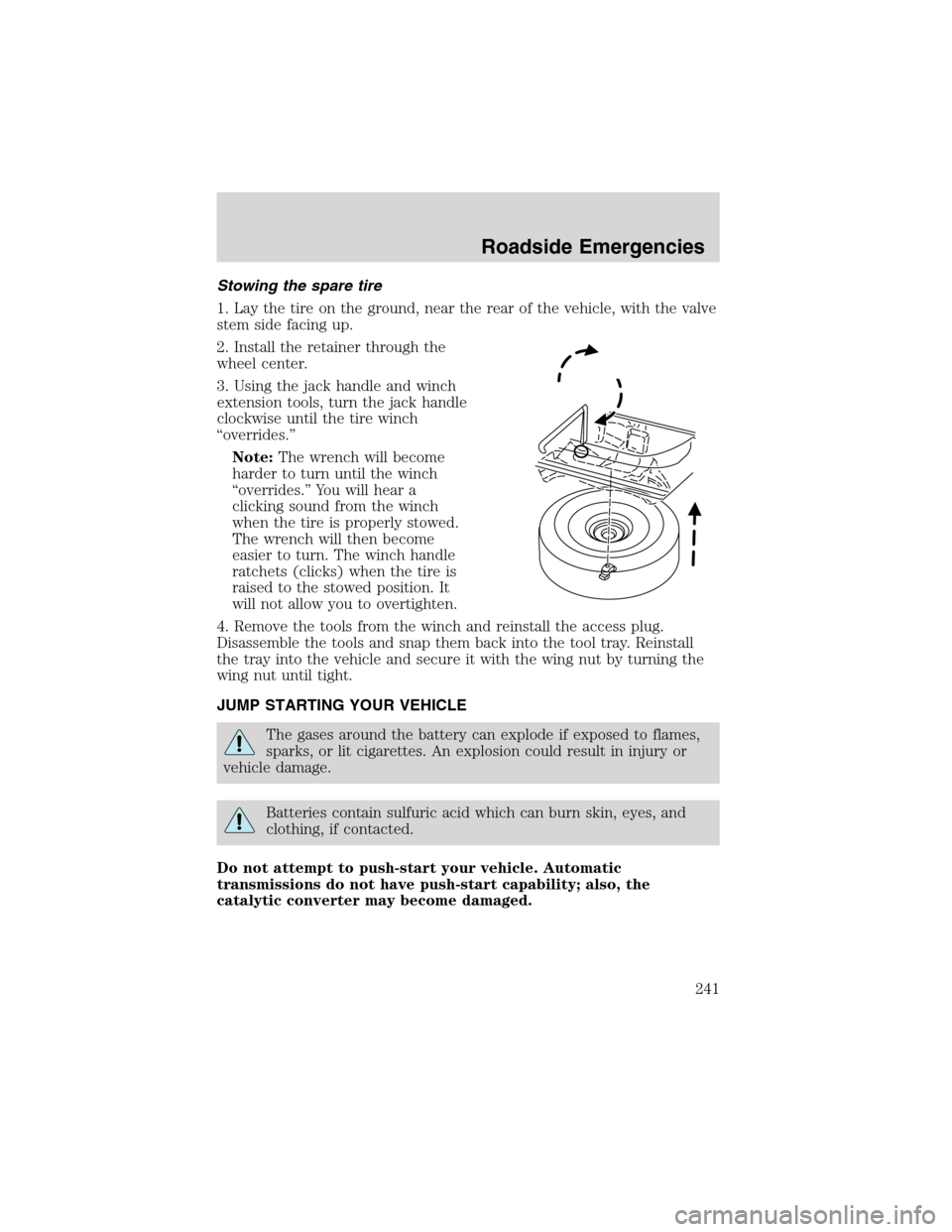
1. Lay the tire on the ground, near the rear of the vehicle, with the valve
stem side facing up.
2. Install the retainer through the
wheel center.
3. Using the jack handle and winch
extension tools, turn the jack handle
clockwise until the tire winch
“overrides.”
Note:The wrench will become
harder to turn until the winch
“overrides.”You will hear a
clicking sound from the winch
when the tire is properly stowed.
The wrench will then become
easier to turn. The winch handle
ratchets (clicks) when the tire is
raised to the stowed position. It
will not allow you to overtighten.
4. Remove the tools from the winch and reinstall the access plug.
Disassemble the tools and snap them back into the tool tray. Reinstall
the tray into the vehicle and secure it with the wing nut by turning the
wing nut until tight.
JUMP STARTING YOUR VEHICLE
The gases around the battery can explode if exposed to flames,
sparks, or lit cigarettes. An explosion could result in injury or
vehicle damage.
Batteries contain sulfuric acid which can burn skin, eyes, and
clothing, if contacted.
Do not attempt to push-start your vehicle. Automatic
transmissions do not have push-start capability; also, the
catalytic converter may become damaged.
Roadside Emergencies
241
Page 247 of 320
WRECKER TOWING
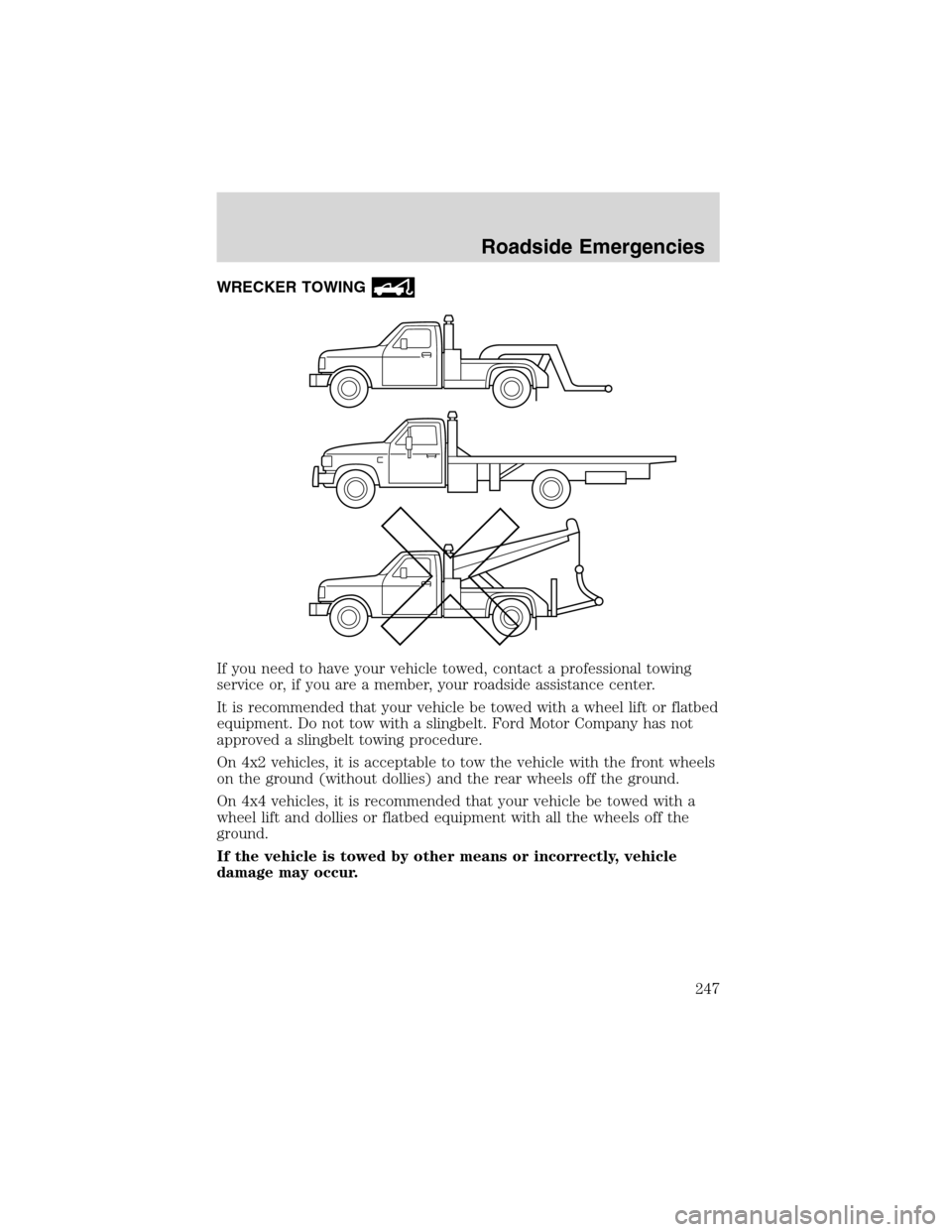
If you need to have your vehicle towed, contact a professional towing
service or, if you are a member, your roadside assistance center.
It is recommended that your vehicle be towed with a wheel lift or flatbed
equipment. Do not tow with a slingbelt. Ford Motor Company has not
approved a slingbelt towing procedure.
On 4x2 vehicles, it is acceptable to tow the vehicle with the front wheels
on the ground (without dollies) and the rear wheels off the ground.
On 4x4 vehicles, it is recommended that your vehicle be towed with a
wheel lift and dollies or flatbed equipment with all the wheels off the
ground.
If the vehicle is towed by other means or incorrectly, vehicle
damage may occur.
Roadside Emergencies
247
Page 248 of 320
Special Conditions:
•Release the parking brake.
•Turn the ignition to the OFF/UNLOCKED position.
•Place the transmission in N (Neutral).
•Do not exceed a distance of 80 km (50 miles).
•Do not exceed 56 km/h (35 mph) vehicle speed.
With a disabled vehicle (without access to wheel dollies, car hauling
trailer or flatbed transport vehicle) your vehicle can be towed (all wheels
on the ground) under the following conditions:
Ford Motor Company produces a towing manual for all authorized tow
truck operators. Have your tow truck operator refer to this manual for
proper hook-up and towing procedures for your vehicle.
Roadside Emergencies
248
Page 251 of 320
In some states (in the U.S.) you must directly notify Ford in writing
before pursuing remedies under your state’s warranty laws. Ford is also
allowed a final repair attempt in some states.
In the United States, a warranty dispute must be submitted to the
Dispute Settlement Board before taking action under the Magnuson-Moss
Warranty Act, or to the extent allowed by state law, before pursuing
replacement or repurchase remedies provided by certain state laws. This
dispute handling procedure is not required prior to enforcing state
created rights or other rights which are independent of the
Magnuson-Moss Warranty Act or state replacement or repurchase laws.
FORD EXTENDED SERVICE PLAN
You can get more protection for your new car or light truck by
purchasing Ford Extended Service Plan (Ford ESP) coverage. Ford ESP
is an optional service contract which is backed by Ford Motor Company
or Ford Motor Service Company (in the U.S.) and Ford of Canada (in
Canada). It provides the following:
•Benefits during the warranty period depending on the plan you
purchase (such as: reimbursement for rentals; coverage for certain
maintenance and wear items).
•Protection against covered repair costs after your Bumper-to-Bumper
Warranty expires.
You may purchase Ford ESP from any participating Ford and Lincoln
Mercury and Ford of Canada dealer. There are several plans available in
various time, distance and deductible combinations which can be tailored
to fit your own driving needs. Ford ESP also offers reimbursement
benefits for towing and rental coverage.
When you buy Ford ESP, you receive Peace-of-Mind protection
throughout the United States and Canada, provided by a network of
more than 5,000 participating Ford or Lincoln Mercury and Ford of
Canada dealers.
If you did not take advantage of the Ford Extended Service Plan at the
time of purchasing your vehicle, you may still be eligible. Please contact
your dealer for further information. Since this information is subject to
change, please ask your dealer for complete details about Ford Extended
Service Plan coverage options, or visit the Ford ESP website at
www.ford-esp.com.
Customer Assistance
251