Page 233 of 320

Fuse/Relay
LocationFuse Amp
RatingPassenger Compartment Fuse Panel
Description
14 15A* Climate control blend door actuator,
Daytime Running Lamps (DRL) relays,
Digital Transmission Range Sensor (DTRS)
back-up lamp
15 5A* AdvanceTrac�switch, Instrument cluster
16 10A* ABS module
17 15A* Foglamps
18 10A* Electrochromic mirror, Auxiliary A/C,
Climate-controlled seats module,
Temperature solenoid, Turn signal flasher,
Sunload sensor, Electronic park brake
relay coil
19 10A* Restraints Control Module (RCM)
20 30A* Air suspension module (air spring
solenoids and height sensors), 4x4 module
21 15A* Instrument cluster (interior lamps),
Interior lamps, Electronic park brake relay,
Tire Pressure Monitoring System (TPMS)
22 10A* Door lock switch illumination, Moonroof
switch illumination, Radio (delayed
accessory signal), Flip window switch
23 10A* RH low beam
24 15A* Battery saver relay, Front map/Dome lamp,
2nd row dome/map lamp, Glove
compartment lamp, Cargo lamp, Rail
lamps, Vanity mirror lamps, Underhood
lamp
25 10A* LH low beam
26 20A* Horn relay, Horns
27 5A* Compass, Reverse sensing system module,
Brake shift interlock (BSI) solenoid,
Overdrive cancel switch, Air suspension
module (Run/Start sense)
Roadside Emergencies
233
Page 234 of 320

Fuse/Relay
LocationFuse Amp
RatingPassenger Compartment Fuse Panel
Description
28 5A* SecuriLock transceiver
29 30A* Trailer tow electric brake controller
30 30A* BSM (door locks), Liftgate glass release
relay, Liftgate glass release motor,
Door/Liftgate locks, Parklamps relay
(BSM), Headlamps relay (BSM), Door
lock/Unlock relay (BSM)
31 25A* Radio
32 15A* CMS, Transmission solenoids
33 20A* Canister vent solenoid, EVR CC, HEGOs,
VMV solenoid, IMTV solenoid, A/C clutch
relay coil
34 20A* PCM, Fuel injectors, Idle air control (IAC)
solenoid, Mass air flow sensor
35 20A* Instrument cluster high beam indicator,
High beam headlamps
36 10A* Trailer tow right turn lamp
37 20A* Cargo area power point
38 25A* Rear wiper motor, Washer pump (rear
window wash)
39 20A* Instrument panel or floor console power
point, Rear console power point
40 20A* Headlamp switch, High beam relay coil, LH
low beam fuse # 25, LH low beam fuse #
23, BSM (autolamps headlamp relay), DRL
41 20A* Cigar lighter, OBD II Connector
42 10A* Trailer tow left turn lamp
101 30A** Starter relay, Starter solenoid
102 30A** Ignition switch, Starter solenoid
103 30A** ABS module (pump motor)
104 30A** LH 3rd row power seat
105 30A** Spare
Roadside Emergencies
234
Page 239 of 320
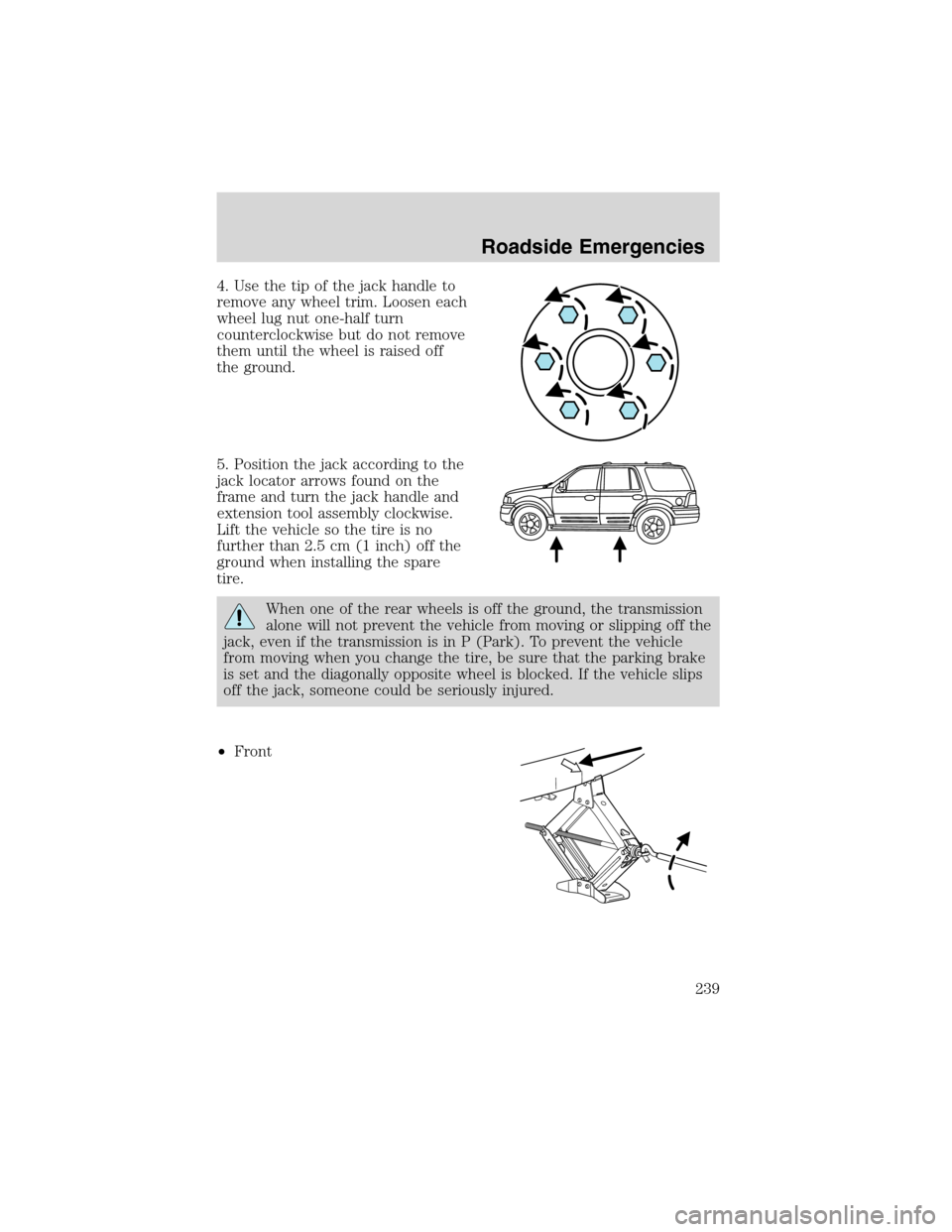
4. Use the tip of the jack handle to
remove any wheel trim. Loosen each
wheel lug nut one-half turn
counterclockwise but do not remove
them until the wheel is raised off
the ground.
5. Position the jack according to the
jack locator arrows found on the
frame and turn the jack handle and
extension tool assembly clockwise.
Lift the vehicle so the tire is no
further than 2.5 cm (1 inch) off the
ground when installing the spare
tire.
When one of the rear wheels is off the ground, the transmission
alone will not prevent the vehicle from moving or slipping off the
jack, even if the transmission is in P (Park). To prevent the vehicle
from moving when you change the tire, be sure that the parking brake
is set and the diagonally opposite wheel is blocked. If the vehicle slips
off the jack, someone could be seriously injured.
•Front
Roadside Emergencies
239
Page 241 of 320
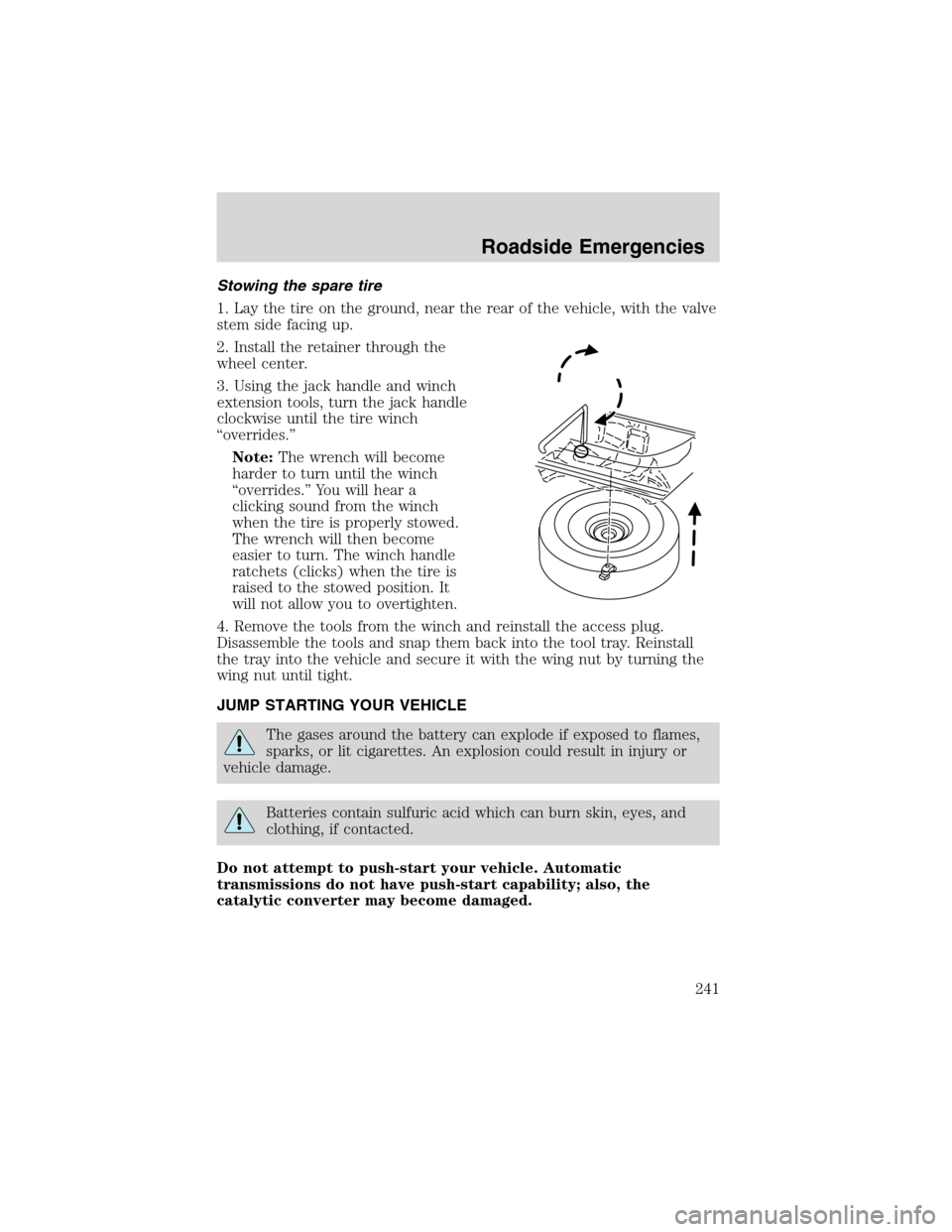
Stowing the spare tire
1. Lay the tire on the ground, near the rear of the vehicle, with the valve
stem side facing up.
2. Install the retainer through the
wheel center.
3. Using the jack handle and winch
extension tools, turn the jack handle
clockwise until the tire winch
“overrides.”
Note:The wrench will become
harder to turn until the winch
“overrides.”You will hear a
clicking sound from the winch
when the tire is properly stowed.
The wrench will then become
easier to turn. The winch handle
ratchets (clicks) when the tire is
raised to the stowed position. It
will not allow you to overtighten.
4. Remove the tools from the winch and reinstall the access plug.
Disassemble the tools and snap them back into the tool tray. Reinstall
the tray into the vehicle and secure it with the wing nut by turning the
wing nut until tight.
JUMP STARTING YOUR VEHICLE
The gases around the battery can explode if exposed to flames,
sparks, or lit cigarettes. An explosion could result in injury or
vehicle damage.
Batteries contain sulfuric acid which can burn skin, eyes, and
clothing, if contacted.
Do not attempt to push-start your vehicle. Automatic
transmissions do not have push-start capability; also, the
catalytic converter may become damaged.
Roadside Emergencies
241
Page 242 of 320
Preparing your vehicle
When the battery is disconnected or a new battery is installed, the
transmission must relearn its shift strategy. As a result, the transmission
may have firm and/or soft shifts. This operation is considered normal and
will not affect function or durability of the transmission. Over time, the
adaptive learning process will fully update transmission operation.
1.Use only a 12–volt supply to start your vehicle.
2. Do not disconnect the battery of the disabled vehicle as this could
damage the vehicle’s electrical system.
3. Park the booster vehicle close to the hood of the disabled vehicle
making sure the two vehiclesdo nottouch. Set the parking brake on
both vehicles and stay clear of the engine cooling fan and other moving
parts.
4. Check all battery terminals and remove any excessive corrosion before
you attach the battery cables. Ensure that vent caps are tight and level.
5. Turn the heater fan on in both vehicles to protect any electrical
surges. Turn all other accessories off.
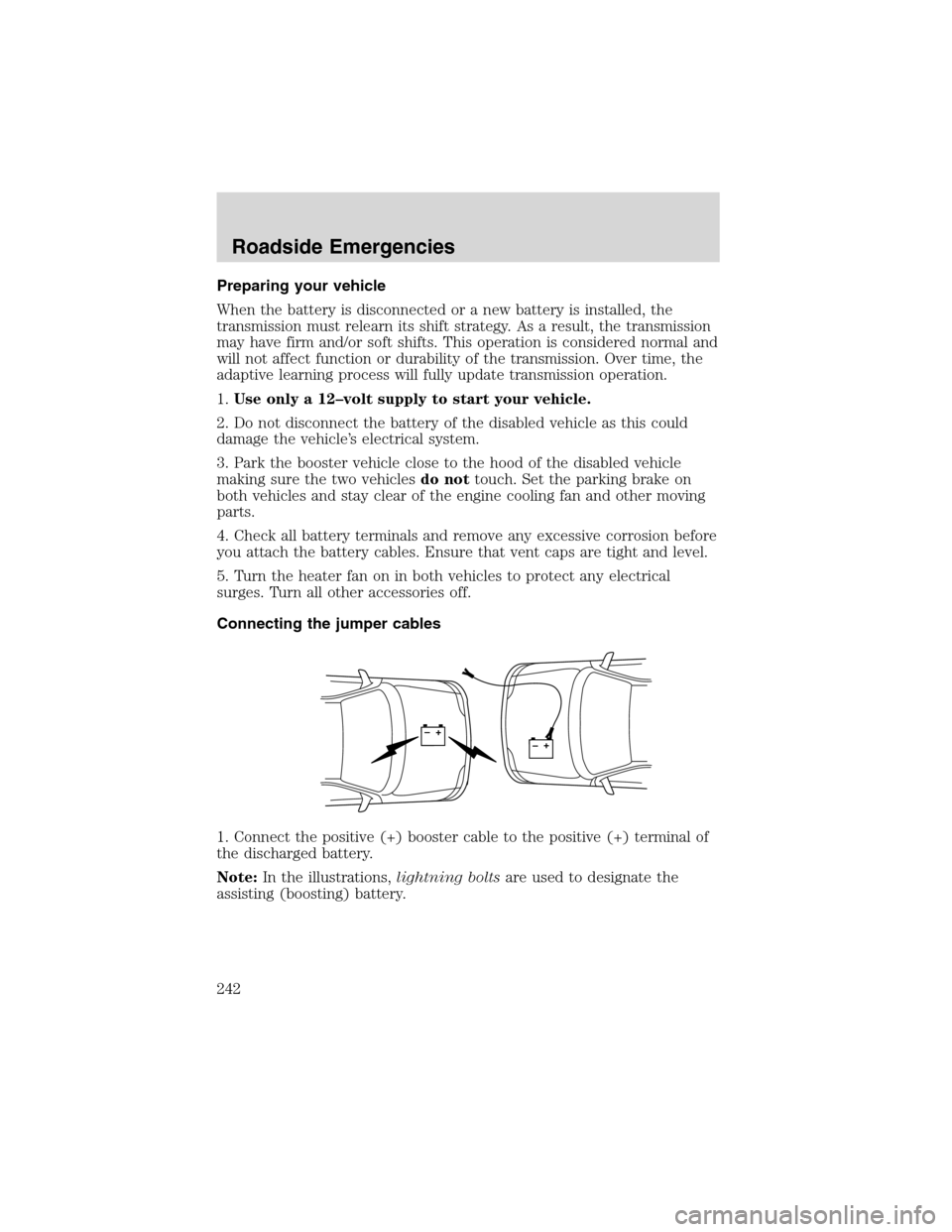
Connecting the jumper cables
1. Connect the positive (+) booster cable to the positive (+) terminal of
the discharged battery.
Note:In the illustrations,lightning boltsare used to designate the
assisting (boosting) battery.
+–+–
Roadside Emergencies
242
Page 248 of 320
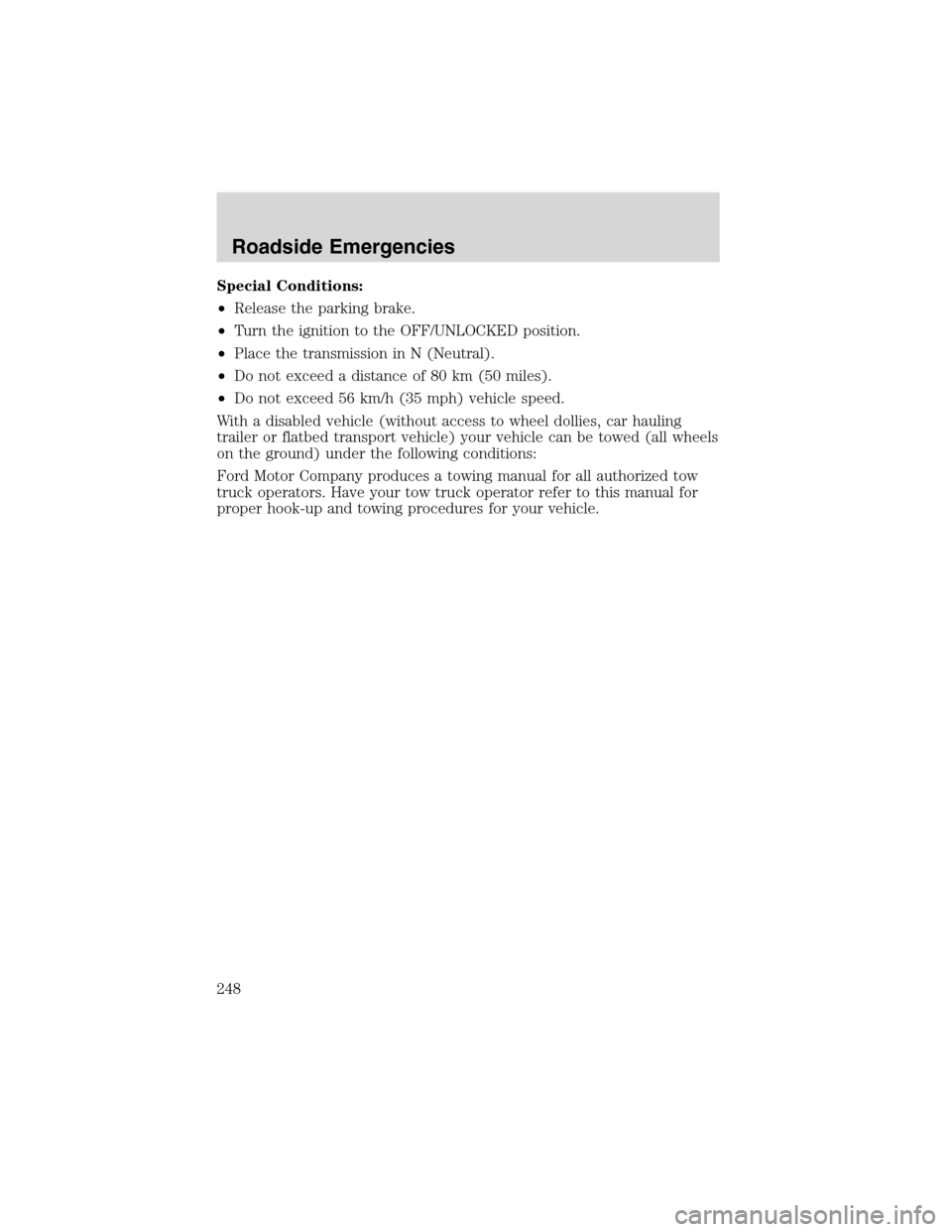
Special Conditions:
•Release the parking brake.
•Turn the ignition to the OFF/UNLOCKED position.
•Place the transmission in N (Neutral).
•Do not exceed a distance of 80 km (50 miles).
•Do not exceed 56 km/h (35 mph) vehicle speed.
With a disabled vehicle (without access to wheel dollies, car hauling
trailer or flatbed transport vehicle) your vehicle can be towed (all wheels
on the ground) under the following conditions:
Ford Motor Company produces a towing manual for all authorized tow
truck operators. Have your tow truck operator refer to this manual for
proper hook-up and towing procedures for your vehicle.
Roadside Emergencies
248
Page 267 of 320
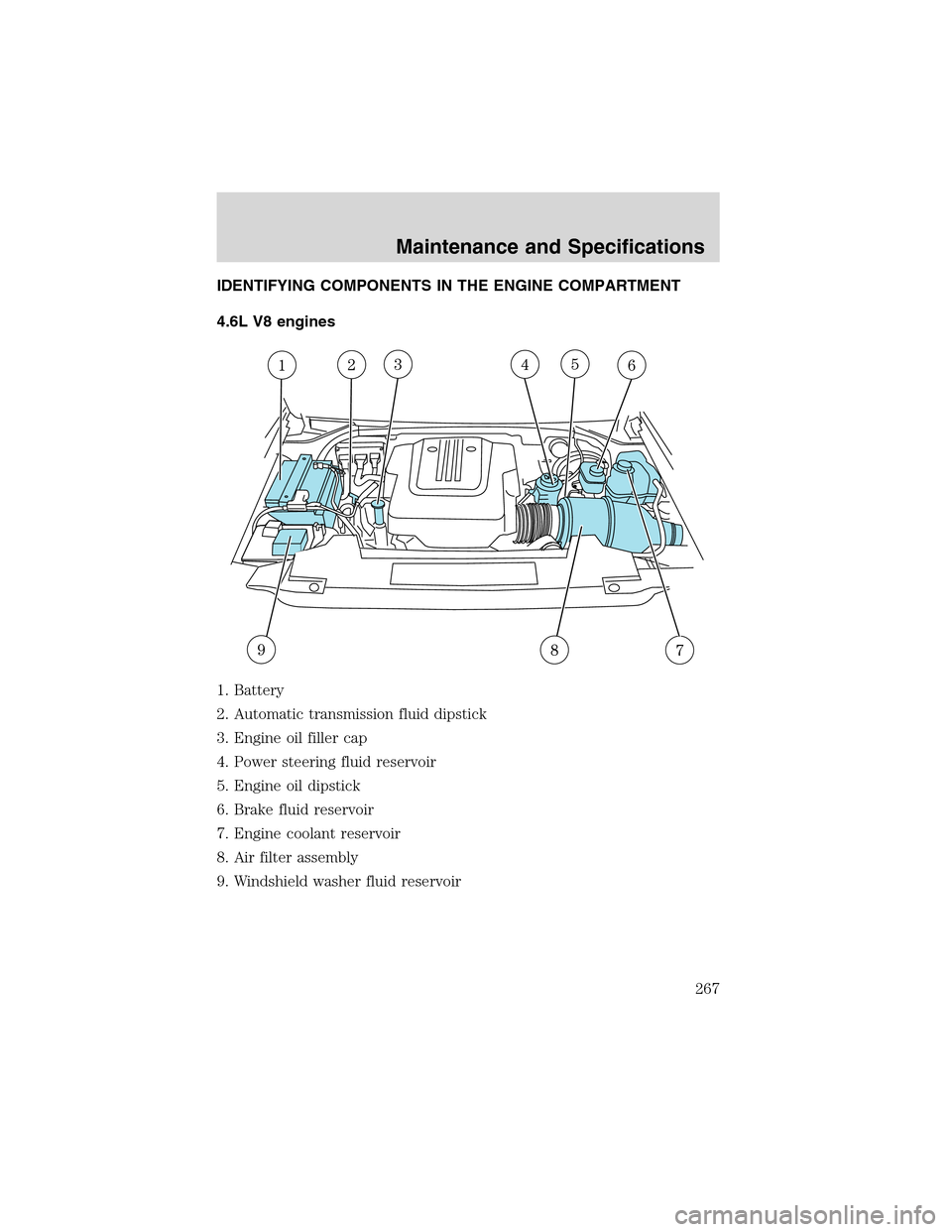
IDENTIFYING COMPONENTS IN THE ENGINE COMPARTMENT
4.6L V8 engines
1. Battery
2. Automatic transmission fluid dipstick
3. Engine oil filler cap
4. Power steering fluid reservoir
5. Engine oil dipstick
6. Brake fluid reservoir
7. Engine coolant reservoir
8. Air filter assembly
9. Windshield washer fluid reservoir
Maintenance and Specifications
267
Page 268 of 320
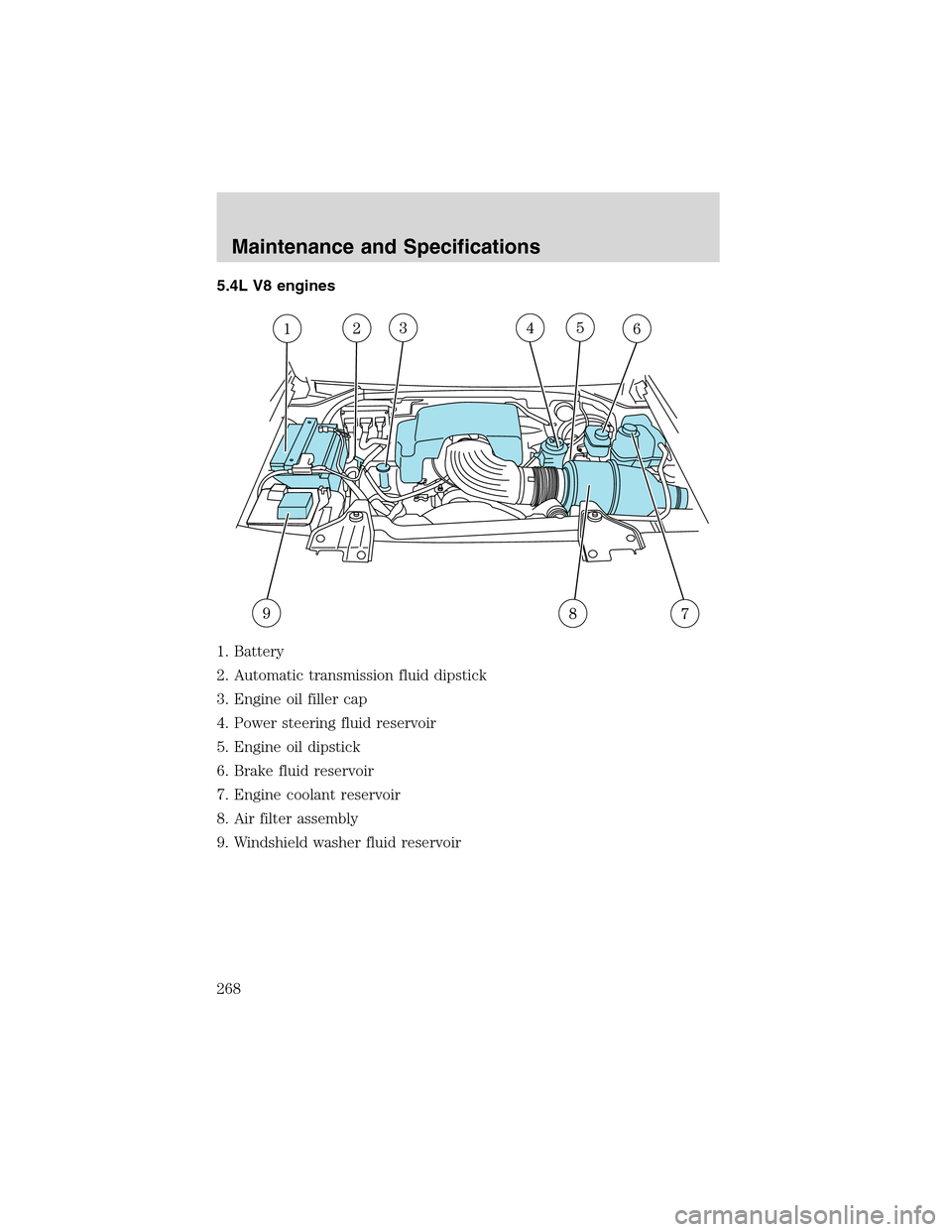
5.4L V8 engines
1. Battery
2. Automatic transmission fluid dipstick
3. Engine oil filler cap
4. Power steering fluid reservoir
5. Engine oil dipstick
6. Brake fluid reservoir
7. Engine coolant reservoir
8. Air filter assembly
9. Windshield washer fluid reservoir
Maintenance and Specifications
268