2003 FORD EXPEDITION light
[x] Cancel search: lightPage 67 of 320
Do not expose the liquid crystal display (LCD) flip-down screen
to direct sunlight or intensive ultraviolet rays for extensive
periods of time. Ultraviolet rays deteriorate the liquid crystal.
Be sure to review User Manuals for video games and video game
equipment when used as auxiliary inputs for your Rear Seat
Entertainment DVD System.
Do not operate video games or video equipment if the power cords
and/or cables are broken, split or damaged. Carefully place cords and/or
cables where they will not be stepped on or interfere with the operation
of seats and/or compartments.
Disconnect video games and video equipment power cords and/or cables
when not in use.
Avoid touching auxiliary input jacks with your fingers. Do not blow on
them or allow them to get wet or dirty.
Do not clean any part of the DVD layer with benzene, paint thinner or
any other solvent.
Federal Communication Commission (FCC) Compliance
Changes or modifications not approved by Ford Motor Company could
void user’s authority to operate the equipment. This equipment has been
tested and found to comply with the limits for a Class B digital device,
pursuant to Part 15 of the FCC Rules. These limits are designed to
provide reasonable protection against harmful interference in a residential
installation. This equipment generates, uses and can radiate radio
frequency energy and, if not installed and used in accordance with the
instructions, may cause harmful interference and radio communications.
However, there is no guarantee that interference will not occur in a
particular installation. If this equipment does cause harmful interference
to radio or television reception, which can be determined by turning the
equipment off and on, the user is encouraged to consult the dealer or an
experienced radio/TV technician for help.
Care and service of the DVD player
Environmental extremes
DVD players that are subjected to harsh environmental conditions may
be damaged or perform at less than maximum capability. To avoid these
outcomes, whenever possible avoid exposing your DVD player to:
•extremely hot or cold temperatures.
•direct sunlight.
Entertainment Systems
67
Page 68 of 320
•high humidity.
•a dusty environment.
•locations where strong magnetic fields are generated.
Temperature extremes
When the vehicle is parked under direct sunlight or in an extremely cold
place for a long period of time, wait until the cabin temperature of the
vehicle is at normal temperature before operating the system.
Humidity and moisture condensation
Moisture in the air will condense in the DVD player under extremely
humid conditions or when moving from a cold place to a warm one. If
moisture condensation occurs, do not insert a CD or DVD into the
player. If one is already in the player, remove it. Turn the DVD player ON
to dry the moisture before inserting a DVD. This could take an hour or
more.
Cleaning the liquid crystal display (LCD) flip-down screen
Clean the display screen by applying a small amount of water or any
ammonia-based household glass cleaner directly to a soft cloth. Rub the
screen gently until the dust, dirt or fingerprints are removed. Do not
spray the screen directly with water or glass cleaning solvents. Overspray
from these fluids could drip down into the internal electronics of the
screen and cause damage. Do not apply excessive pressure while
cleaning the screen.
Foreign substances
Exercise care to prevent dirt and foreign objects from entering the DVD
player compartment. Be especially careful not to spill liquids of any kind
onto the media controls or into the videocassette player. If liquid is
accidentally spilled onto the system, immediately turn the system OFF
and consult a qualified service technician.
Cleaning compact discs
Inspect all discs for contamination before playing. If necessary, clean
discs only with an approved CD cleaner and wipe from the center out to
the edge. Do not use circular motion.
Cleaning the DVD player
Clean the exterior of the DVD player with a damp cloth. Do not use CD
cleaning kits or CDs intended to clean the interior of your DVD player.
Use of these products may damage your system.
Entertainment Systems
68
Page 70 of 320
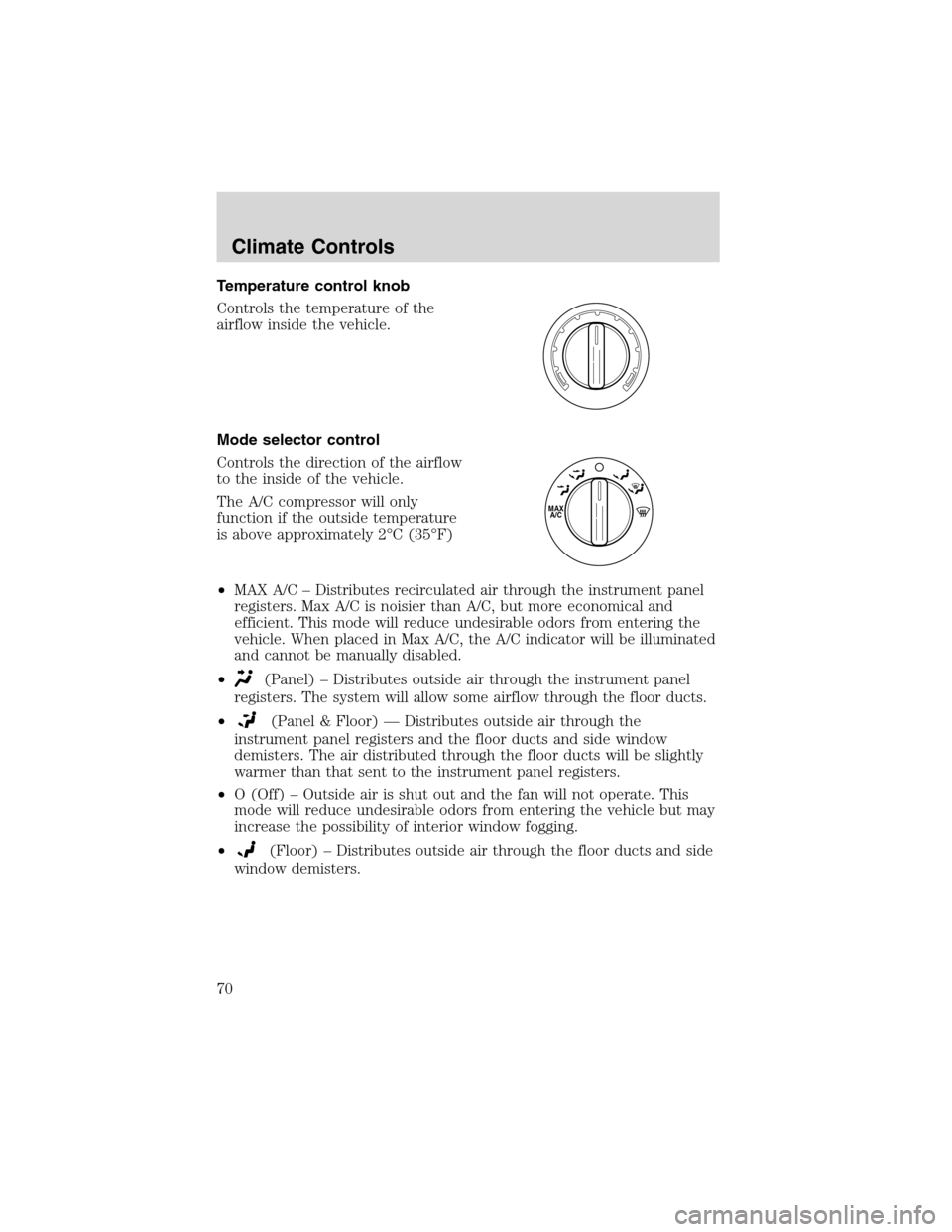
Temperature control knob
Controls the temperature of the
airflow inside the vehicle.
Mode selector control
Controls the direction of the airflow
to the inside of the vehicle.
The A/C compressor will only
function if the outside temperature
is above approximately 2°C (35°F)
•MAX A/C–Distributes recirculated air through the instrument panel
registers. Max A/C is noisier than A/C, but more economical and
efficient. This mode will reduce undesirable odors from entering the
vehicle. When placed in Max A/C, the A/C indicator will be illuminated
and cannot be manually disabled.
•
(Panel)–Distributes outside air through the instrument panel
registers. The system will allow some airflow through the floor ducts.
•
(Panel & Floor)—Distributes outside air through the
instrument panel registers and the floor ducts and side window
demisters. The air distributed through the floor ducts will be slightly
warmer than that sent to the instrument panel registers.
•O (Off)–Outside air is shut out and the fan will not operate. This
mode will reduce undesirable odors from entering the vehicle but may
increase the possibility of interior window fogging.
•
(Floor)–Distributes outside air through the floor ducts and side
window demisters.
MAX
A/C
Climate Controls
70
Page 71 of 320
•(Floor & Defrost)–Distributes outside air through the floor
ducts, windshield defroster ducts and the side window demisters.
However, the A/C indicator will not be lit. The air distributed through
the floor ducts will be slightly warmer than that sent to the windshield
defroster ducts and the side window demisters.
•
(Defrost)–Distributes outside air through the windshield
defroster ducts and the side window demisters. However, the A/C
indicator will not be lit. This mode will clear ice and fog from the
windshield.
Since the air conditioner removes moisture from the air, it is
considered normal operation if water drips on the ground under
the air conditioner drain.
A/C control
A/C
Used to manually enable or disable the operation of the air conditioning
in all modes except Floor & Defrost, Defrost and Max A/C.
When manual A/C is selected (On) the indicator will be lit. When manual
A/C is selected (Off) the indicator will not be lit.
In Floor & Defrost and Defrost, if the outside temperature is above
approximately 2°C (35°F), the air conditioner will automatically
dehumidify the air to reduce fogging. The A/C indicator will not
illuminate.
When placed in Max A/C, the A/C indicator will automatically illuminate
and cannot be manually disabled.
Operating tips
•To reduce fogging in humid weather conditions, unless in Defrost or
Floor and Defrost, press the A/C control before driving as the air
conditioning removes moisture from the air. To reduce humidity
buildup inside the vehicle under warm weather conditions, do not
drive with the climate control system in the Off mode.
•To reduce humidity buildup inside the vehicle under cold weather
conditions, do not drive with the climate control system in Max A/C or
Off mode.
•Under normal weather conditions, do not leave your vehicle in the
Max A/C or Off mode when turning off the vehicle.
•Under snowy or dirty weather conditions, leave your vehicle in the
Max A/C or Off mode when turning off the ignition.
•Remove any snow, ice or leaves from the exterior base of the
windshield.
Climate Controls
71
Page 72 of 320
•To increase the efficiency of the A/C, drive with the windows slightly
open for two to three minutes after start up or until the vehicle has
been“aired out”.
•Do not place objects under the front seat or over the defroster ducts.
They may reduce visibility, fall into the ducts, or degrade the
performance of your climate control system.
Do not place objects on top of the instrument panel, as these
objects may become projectiles in a collision or sudden stop.
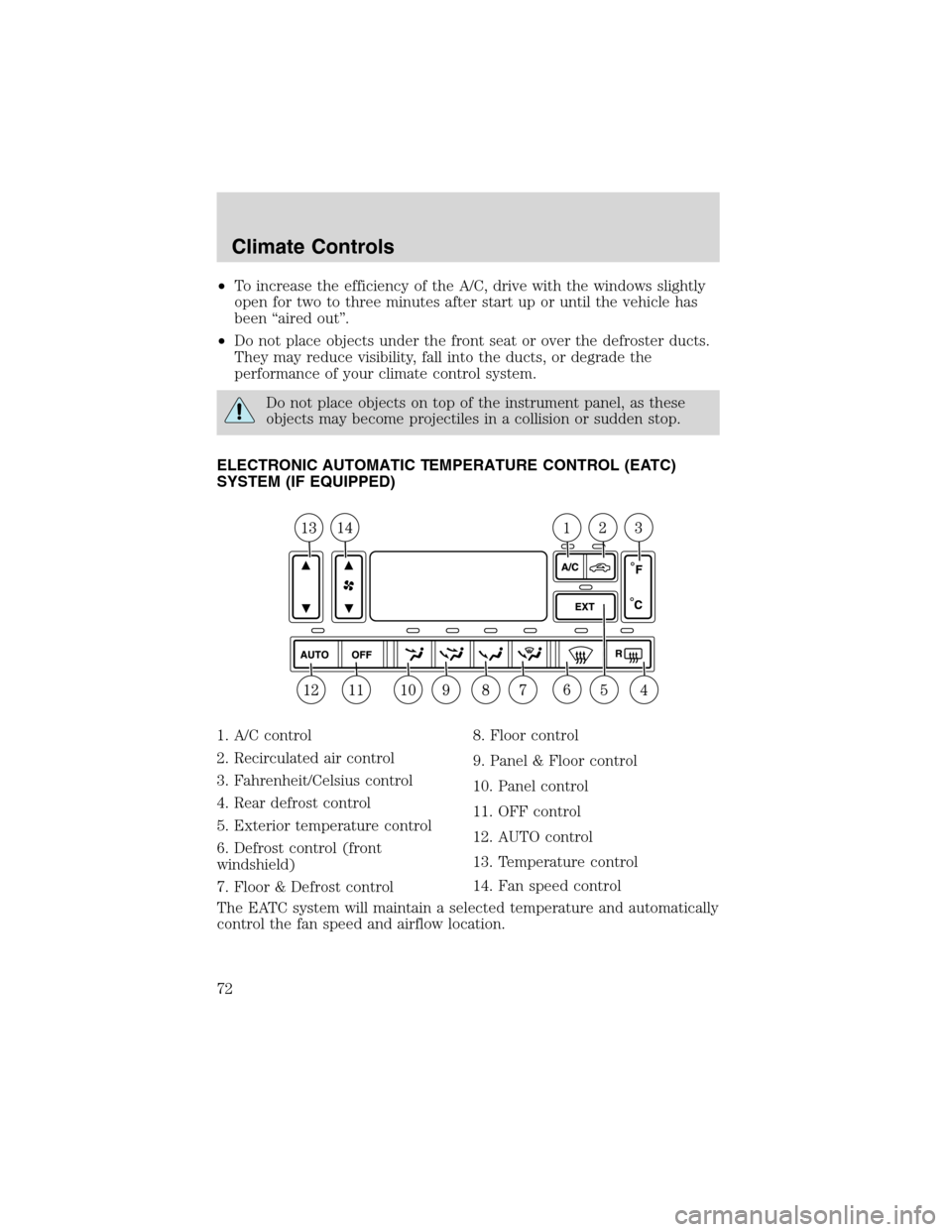
ELECTRONIC AUTOMATIC TEMPERATURE CONTROL (EATC)
SYSTEM (IF EQUIPPED)
1. A/C control
2. Recirculated air control
3. Fahrenheit/Celsius control
4. Rear defrost control
5. Exterior temperature control
6. Defrost control (front
windshield)
7. Floor & Defrost control8. Floor control
9. Panel & Floor control
10. Panel control
11. OFF control
12. AUTO control
13. Temperature control
14. Fan speed control
The EATC system will maintain a selected temperature and automatically
control the fan speed and airflow location.
Climate Controls
72
Page 77 of 320
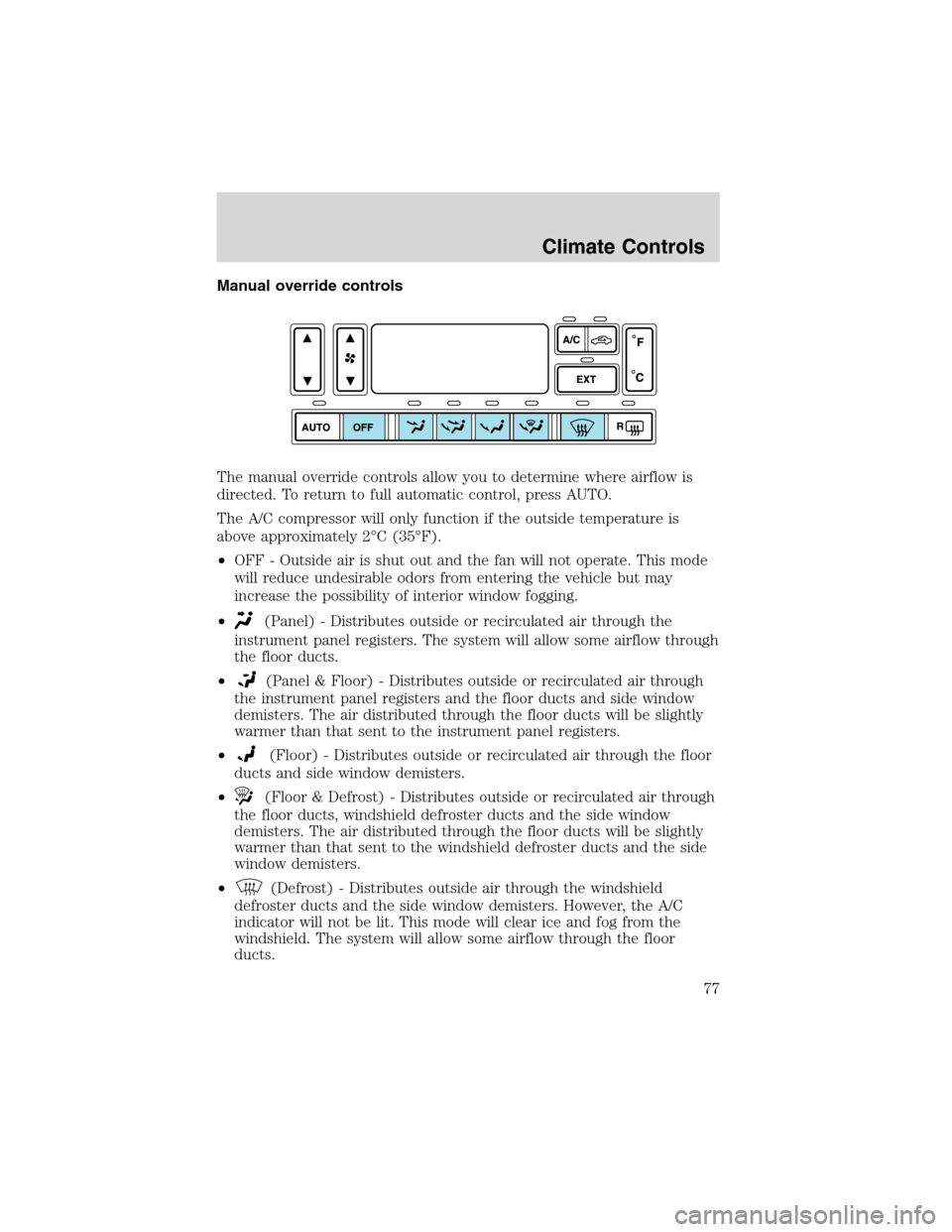
Manual override controls
The manual override controls allow you to determine where airflow is
directed. To return to full automatic control, press AUTO.
The A/C compressor will only function if the outside temperature is
above approximately 2°C (35°F).
•OFF - Outside air is shut out and the fan will not operate. This mode
will reduce undesirable odors from entering the vehicle but may
increase the possibility of interior window fogging.
•
(Panel) - Distributes outside or recirculated air through the
instrument panel registers. The system will allow some airflow through
the floor ducts.
•
(Panel & Floor) - Distributes outside or recirculated air through
the instrument panel registers and the floor ducts and side window
demisters. The air distributed through the floor ducts will be slightly
warmer than that sent to the instrument panel registers.
•
(Floor) - Distributes outside or recirculated air through the floor
ducts and side window demisters.
•
(Floor & Defrost) - Distributes outside or recirculated air through
the floor ducts, windshield defroster ducts and the side window
demisters. The air distributed through the floor ducts will be slightly
warmer than that sent to the windshield defroster ducts and the side
window demisters.
•
(Defrost) - Distributes outside air through the windshield
defroster ducts and the side window demisters. However, the A/C
indicator will not be lit. This mode will clear ice and fog from the
windshield. The system will allow some airflow through the floor
ducts.
Climate Controls
77
Page 78 of 320
Operating tips
•To reduce fogging in humid weather conditions, unless in Defrost and
Floor & Defrost, press the A/C control before driving as the air
conditioning removes moisture form the air.
•To reduce humidity buildup inside the vehicle in warm weather
conditions, don’t drive with the climate control system in the OFF
position.
•To reduce humidity buildup inside the vehicle in cold weather
conditions, don’t drive with the climate control system in the
recirculation mode or OFF mode.
•Remove any snow, ice or leaves from the exterior base of the
windshield.
•To increase the efficiency of the A/C, drive with the windows slightly
open for 2–3 minutes after start up or until the vehicle has been
“aired out.”
•Do not place objects under the front seat or over the defroster ducts.
They may reduce visibility, fall into the ducts, or degrade the
performance of your climate control system.
Do not place objects on top of the instrument panel, as these
objects may become projectiles in a collision or sudden stop.
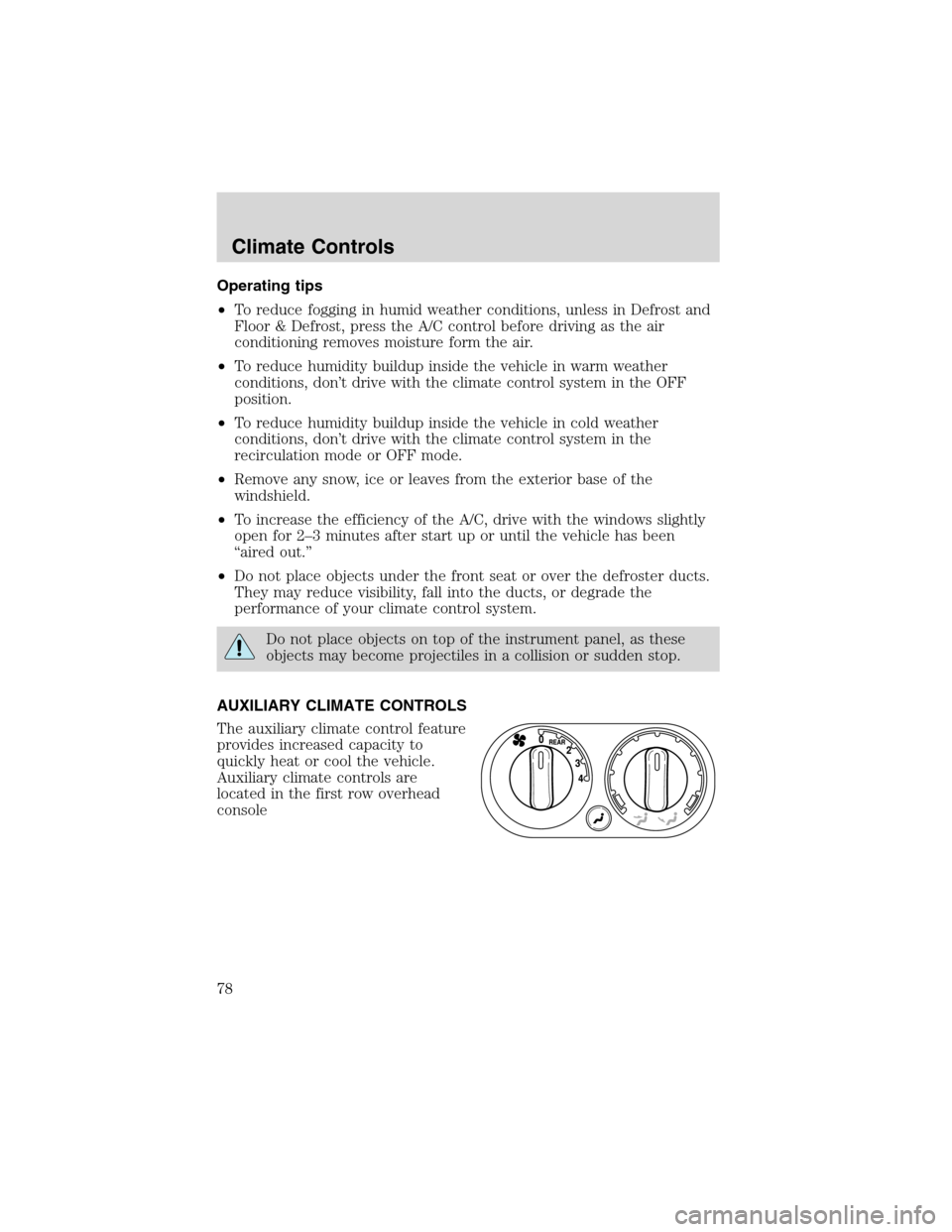
AUXILIARY CLIMATE CONTROLS
The auxiliary climate control feature
provides increased capacity to
quickly heat or cool the vehicle.
Auxiliary climate controls are
located in the first row overhead
console
Climate Controls
78
Page 81 of 320
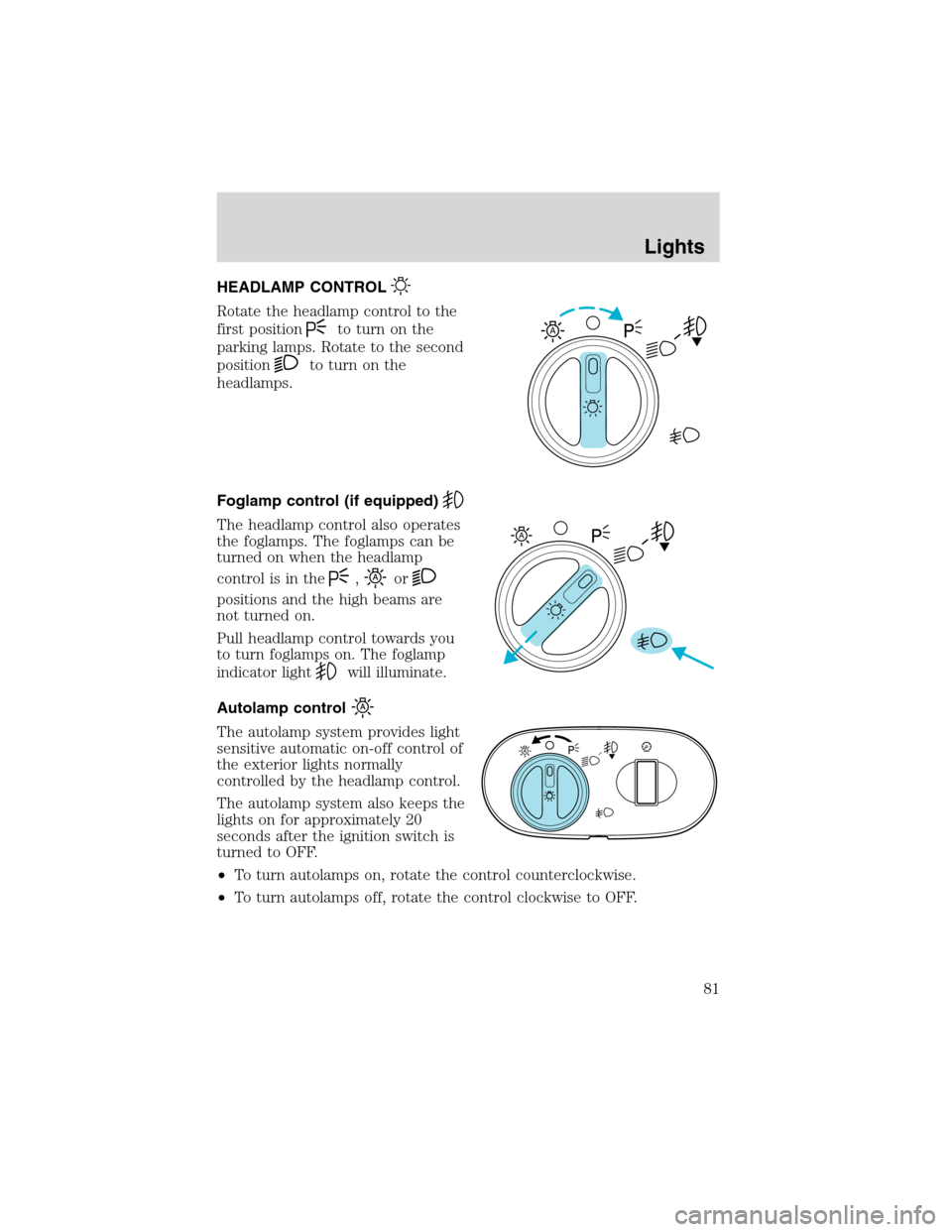
HEADLAMP CONTROL
Rotate the headlamp control to the
first position
to turn on the
parking lamps. Rotate to the second
position
to turn on the
headlamps.
Foglamp control (if equipped)
The headlamp control also operates
the foglamps. The foglamps can be
turned on when the headlamp
control is in the
,or
positions and the high beams are
not turned on.
Pull headlamp control towards you
to turn foglamps on. The foglamp
indicator light
will illuminate.
Autolamp control
The autolamp system provides light
sensitive automatic on-off control of
the exterior lights normally
controlled by the headlamp control.
The autolamp system also keeps the
lights on for approximately 20
seconds after the ignition switch is
turned to OFF.
•To turn autolamps on, rotate the control counterclockwise.
•To turn autolamps off, rotate the control clockwise to OFF.
A
A
Lights
81